Are Cheap Car Seats Safe? What Parents Should Check
Quick Answer
Yes, cheap car seats can be safe, if the seat meets the federal safety standard, fits your child, and installs tight in your car. Cost alone does not decide safety, so check the label, the manual, and the fit against car seat safety standards before you buy.
What makes a cheap seat safe
- Meets the standard: The seat is sold for use in the United States and meets FMVSS 213.
- Right size: Your child is inside the weight and height limits for the mode you will use.
- Tight install: The seat moves less than one inch at the belt path after install.
- Snug harness: The straps sit flat, at the right height, with no slack to pinch.
Walk away if
- The label, manual, or history is missing, or the seat has been in a crash.
- The seat will not install tight in your car, even after a careful second try.
Are cheap car seats safe? I asked that question myself the first time I compared a simple seat with a much higher-cost one in the same store.
In this guide, I explain what cheap really means, what the safety standard covers, where cost changes the seat, and how to check a budget seat before you trust it.
In This Guide
- What Does Cheap Mean for a Car Seat?
- Are Cheap Car Seats Safe?
- What Safety Standard Must Every Car Seat Meet?
- Cheap vs Expensive Car Seats: What Actually Changes?
- How Do You Spot a Cheap Seat That Is Not Safe?
- When Is a Cheap Car Seat a Good Buy?
- How Do You Install and Check a Budget Car Seat Safely?
- Frequently Asked Questions
What Does Cheap Mean for a Car Seat?
A cheap car seat is a low-cost seat that still meets the same federal safety standard as a higher-cost seat. It usually has fewer comfort features, a simpler shell, and a shorter list of modes, but the core job stays the same.
Cheap does not mean used, damaged, or out of date. A new budget seat from a known maker is a different thing from a worn seat with missing parts.
I keep those two ideas apart in my garage, because one is a fair way to save, and the other is a risk I will not take.
Cheap, budget, and value are not the same thing
Cheap can mean a low sticker cost with thin padding and a basic harness adjuster. Budget can mean a fair cost for the stage your child needs now, with no extra modes you will not use.
Value is the third idea, and it asks a simple question. Does this seat fit your child and your car, install tight, and last long enough for the stage you need?
A seat can be cheap and still be good value. It can also cost more and still be poor value if it does not fit your car.
What usually costs less, and what does not
Low-cost seats often use plainer fabric, a simpler recline, and a basic infant insert. They may skip a load leg, a rigid LATCH base, or a no-rethread harness.
Those extras can help, but they are not the safety standard itself. The shell, the harness, and the install still do the main work.
Section takeaway: Cheap means fewer extras and a simpler design, not a lower safety standard, so judge a budget seat by its label, fit, and install.
Are Cheap Car Seats Safe?
Yes, cheap car seats are safe when they meet the federal standard, fit your child, and install correctly. Every seat sold for use in the United States must pass the same baseline crash standard, so a low cost alone does not make a seat unsafe.
Safety comes from the right seat, the right install, and the right harness fit on every ride. A higher-cost seat with a loose install is less safe than a budget seat with a tight install.
Why the answer is yes, with a check
The standard sets a floor, not a ranking. A maker cannot sell a new seat in the United States that fails that floor, whatever the cost.
That floor covers the shell, the harness, and the way the seat holds a child dummy in a crash. It does not cover how soft the fabric feels or how easy the adjuster is to pull.
What parents get wrong about cost and safety
Many parents link cost with safety in a straight line. That link feels natural, but it misses the real causes of risk.
For the myths that drive those mistakes, see common car seat safety myths parents should know before you decide what matters most.
- Myth: cost equals safety: Cost tracks features and comfort more than it tracks the safety floor.
- Myth: heavy means safer: Weight can help a shell feel solid, but a light seat can still meet the standard and install tight.
Pro tip: Check your exact seat and your car against the NHTSA recall lookup and both manuals before you install, and ask a certified child passenger safety technician if the fit still feels wrong.
Section takeaway: A cheap seat can be safe, because the safety floor is the same for all new seats, and fit and install decide the real result.
What Safety Standard Must Every Car Seat Meet?
Every new car seat sold for use in the United States must meet FMVSS 213. That is the federal motor vehicle safety standard for child restraint systems, and it sets the crash performance floor for the shell, the harness, and the way the seat holds a child.
The standard does not rank seats by cost. It asks whether a seat passes the same set of crash checks, whatever the maker charges for it.
What FMVSS 213 covers
FMVSS 213 covers the restraint itself, including the shell, the harness, and the buckle. It sets limits on how far a child dummy moves in a crash, and it requires clear labels for weight, height, and install.
It does not cover every comfort feature. A seat can pass the standard with plain fabric and a simple adjuster, and it can still be safe to use.
- Crash performance: The seat must hold the child dummy within set movement limits.
- Harness and buckle: The straps and buckle must work as the manual directs, in each mode.
- Labels and limits: The seat must show the weight and height limits, and the install rules, on the label.
Check the label for the FMVSS 213 statement, and match it with the manual for your exact model. If the label is missing, do not use the seat.
What the standard does not promise
The standard does not promise that a seat will fit your car. Fit is a separate check, and it is yours to make in your own car.
For recalls and safety checks, use NHTSA before you buy, and register the seat with the maker after you buy it.
Section takeaway: FMVSS 213 is the same floor for every new seat, so a cheap seat that meets it starts from the same safety base as a higher-cost seat.
Cheap vs Expensive Car Seats: What Actually Changes?
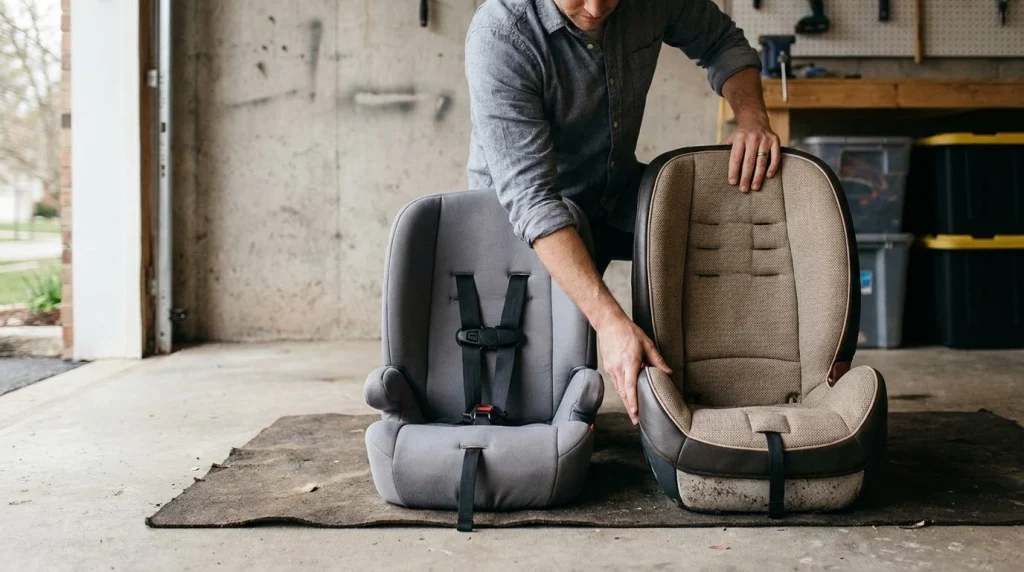
Cheap and expensive seats differ most in comfort, ease of use, and how long one seat lasts. They differ least in the safety floor, because that floor is the same for both.
The table below shows the usual trade-offs, so you can see what your extra spend would buy.
| Feature | Budget seat | Higher-cost seat | What it means |
|---|---|---|---|
| Shell and foam | Simpler shell, basic foam | Deeper shell, extra side layers | Both must meet the standard |
| Harness adjust | Manual rethread on many models | No-rethread harness on many models | Ease, not the safety floor |
| Install aids | Basic LATCH and belt path | Lock-offs, load leg, or rigid LATCH | Help with a tight install |
| Fabric and padding | Plain fabric, thin padding | Soft fabric, thick padding | Comfort on long rides |
| Modes and lifespan | One or two modes, shorter use | All-in-one modes, longer use | Fewer seats to buy later |
| Weight and width | Often light and narrow | Often heavy and wide | Matters for travel and three across |
Where extra spend helps most
Extra spend helps most when it fixes a real problem in your routine. A no-rethread harness helps if you adjust the straps often, and a lock-off helps if the belt install keeps slipping.
Compare the exact models you are weighing on Consumer Reports, and match the scores to the modes and limits in each manual.
Where a budget seat can win
A budget seat can win on weight, width, and simple use. A light, narrow seat is easier to carry, easier to fit beside another seat, and easier to move between cars.
Section takeaway: Cost buys comfort, install aids, and longer use, not a higher safety floor, so spend where it fixes a real fit or use problem.
How Do You Spot a Cheap Seat That Is Not Safe?
A cheap seat is not safe when it is incomplete, out of date, or wrong for your child. Those faults show up on the label, in the box, and in the first install, if you know where to look.
Use the checks below before you pay, and again at home before the first ride.
Check the label and the manual first
Start with the label on the seat shell. It should show the maker, the model, the date of manufacture, the weight and height limits, and the FMVSS 213 statement.
- Missing label: Walk away if the label is torn off or unreadable.
- Missing manual: Do not guess the install, and do not use a manual from another seat.
- Missing parts: Check the infant insert, the harness pads, the buckle, and the tether, if your mode needs them.
- Expiry date passed: Do not use a seat past the expiry date on its label.
Check the history, not just the look
A clean seat can still have a bad history. A seat that has been in a crash, stored in heat, or washed with harsh chemicals may look fine and still be unsafe.
That is why a used seat needs a full history, not just a quick look. For the used-seat rules, read is it safe to use a secondhand car seat before you accept one from a friend or a sale.
Watch the extras that change the fit
Aftermarket extras can change how a harness fits, even when they look soft and safe. Thick inserts, strap covers, and head supports that did not come with the seat can push the straps out of place.
Use only the inserts and pads that came with your exact model, or that the maker lists for it. For the full list, see are aftermarket car seat accessories safe before you add anything to the seat.
If an extra makes the harness hard to tighten, take it out. A snug harness matters more than extra padding.
Section takeaway: A cheap seat is unsafe when the label, manual, parts, or history is missing, or when an extra changes the harness fit.
When Is a Cheap Car Seat a Good Buy?
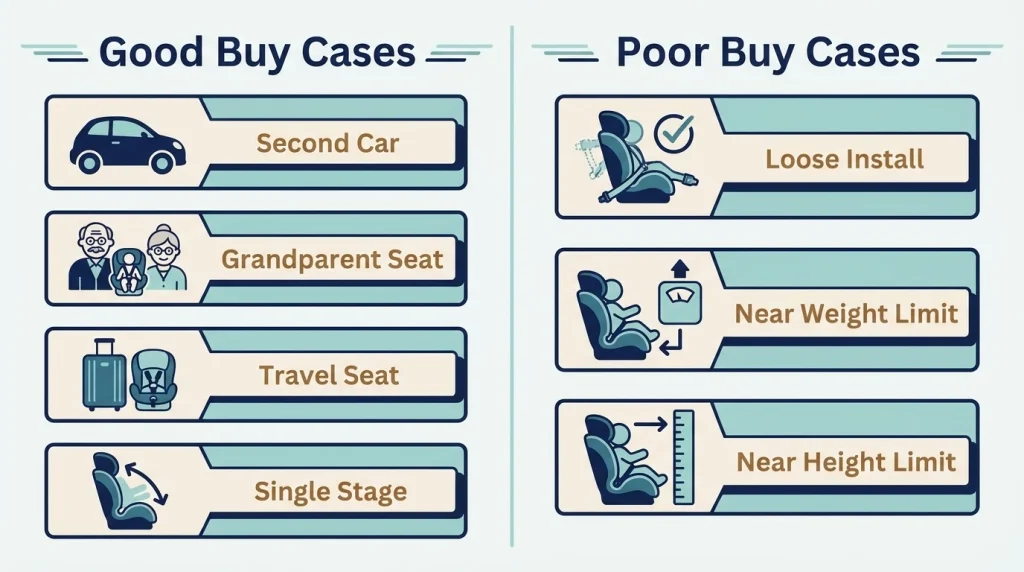
A cheap car seat is a good buy when it fits your child, your car, and your routine, and it leaves no safety check unmet. That is the test, not the cost alone.
It is a poor buy when it forces a loose install, a wrong harness height, or a mode your child has already outgrown.
Good cases for a budget seat
A budget seat works well as a second-car seat, a grandparent seat, or a travel seat. It also works well for one stage, such as a rear-facing infant seat you will replace in a year.
In those cases, you need a tight install and a snug harness, not a long list of modes. A simple seat that installs right every time is the right tool.
Poor cases for a budget seat
A budget seat is a poor buy if it will not install tight in your car, even after a careful second try. It is also a poor buy if your child is near the top of its weight or height limit already.
Check the limits in the manual, and compare them with your child’s current size and growth. For model comparisons, see Edmunds for the exact models you are weighing.
Section takeaway: Buy cheap when the seat fits, installs tight, and covers the stage you need, and skip it when it forces a compromise on fit or limits.
How Do You Install and Check a Budget Car Seat Safely?
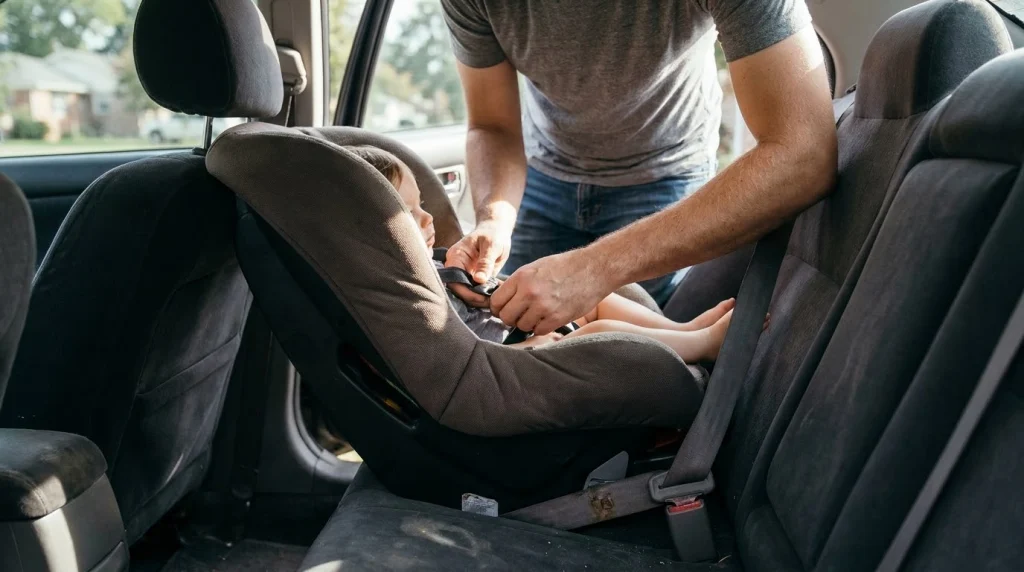
Install a budget seat the same way you would install any seat: read the manual, choose the right mode, and check the fit after every step. A simple seat still needs a careful install.
Install in five steps
Use the method the manual lists for your car and your child’s size. LATCH and seat belt are both safe when used as the manual directs, so do not mix them unless the manual says you can.
- Set the mode: Choose rear-facing or forward-facing, and set the recline as the manual directs.
- Thread the belt: Use the marked belt path for that mode, and remove the slack from the lap section first.
- Lock it down: Lock the belt or tighten the LATCH strap, then check the one-inch movement test at the belt path.
- Add the tether: Use the top tether for every forward-facing install, and check that it is snug.
- Fit the harness: Put your child in, move the straps to the right height, and tighten until you cannot pinch a fold.
For the full install steps, see how car seats are installed and follow the belt path for your exact model.
Run the final checks before every ride
Check the install, the harness, and the recline before you drive. Those three checks take less than a minute, and they catch the errors that creep in on busy days.
Use the essential car seat safety checklist for parents as your routine, and keep it in the car until the steps feel automatic.
- One-inch test: The seat moves less than one inch at the belt path, side to side and front to back.
- Harness pinch test: You cannot pinch a fold in the strap at the shoulder after tightening.
- Strap height: Rear-facing straps sit at or below the shoulders, and forward-facing straps sit at or above them.
- Chest clip: The clip sits at armpit level, not on the belly or near the neck.
- Recline: A newborn’s head does not flop forward, and the recline marker sits in the right range.
Section takeaway: Read the manual, install tight, add the tether forward-facing, and run the one-inch and pinch checks before every ride.
Frequently Asked Questions
Are cheap car seats safe for newborns?
Yes, if the seat meets FMVSS 213, fits a newborn inside its limits, and installs with the right recline. Check the infant insert, the harness height, and the recline marker before the first ride.
Do cheap car seats pass the same crash standard as expensive seats?
Yes, every new seat sold for use in the United States must meet FMVSS 213, whatever the cost. The standard sets the same crash floor for all new seats.
Are cheap car seats safe for a second car?
Yes, a budget seat is often a good second-car seat, if it installs tight in that car and fits your child. Check the fit in the second car, not just in the main car.
Is a used cheap car seat safe?
Only if you know its full history, it has all its parts and manual, it is not expired, and it has no crash history or open recall. If any of those checks fails, do not use it.
What is the cheapest safe way to buy a car seat?
Buy a new seat that meets the standard, fits your child and car, and installs tight, and skip extras you do not need. A simple new seat beats a fancy used seat with an unknown history.
When should you spend more on a car seat?
Spend more when a higher-cost seat fixes a real problem, such as a tight install, a narrow row, or a longer use range. Do not spend more only for softer fabric.
If you are still unsure, start with the fit check above. A cheap seat that installs tight and fits your child well is a safe seat for your family.

Daniel Brooks is an automotive writer and product researcher focused on car accessories, car tech, maintenance, and practical driving guides. At Plug-in Car World, he helps drivers make smarter automotive decisions through honest reviews and research-driven content.