
What Is a Car Seat Tether Strap and How Does It Work?
Quick Answer
A car seat tether strap, also called a top tether, is an adjustable safety strap attached to the upper back of a child car seat. It connects to a designated anchor in the vehicle and helps prevent a forward-facing car seat from rotating too far forward during a crash. The National Highway Traffic Safety Administration recommends using the tether with forward-facing harnessed car seats whenever the car seat and vehicle manufacturers permit it.
Five things to remember
- Primary purpose: Limits forward rotation of the car seat and movement of the child’s head.
- Attachment point: Connects to a manufacturer-approved tether anchor in the vehicle.
- Installation: Works alongside an approved seat belt or lower-anchor installation.
- Proper tension: Remove slack without changing the car seat’s required position.
- Critical warning: Never substitute a cargo hook, headrest post, or other unapproved attachment point.
Safety tip: Always check both manuals before connecting or adjusting a tether strap.
If you’re installing a forward-facing child car seat, the tether strap is one part you should never overlook. It may look like a simple piece of webbing, but it performs an important safety function.
I find it helpful to think of the tether as the connection that controls the top of the child restraint. This guide explains how it works, where to find the anchor, and how to check your installation.
In This Guide
What Is a Car Seat Tether Strap?
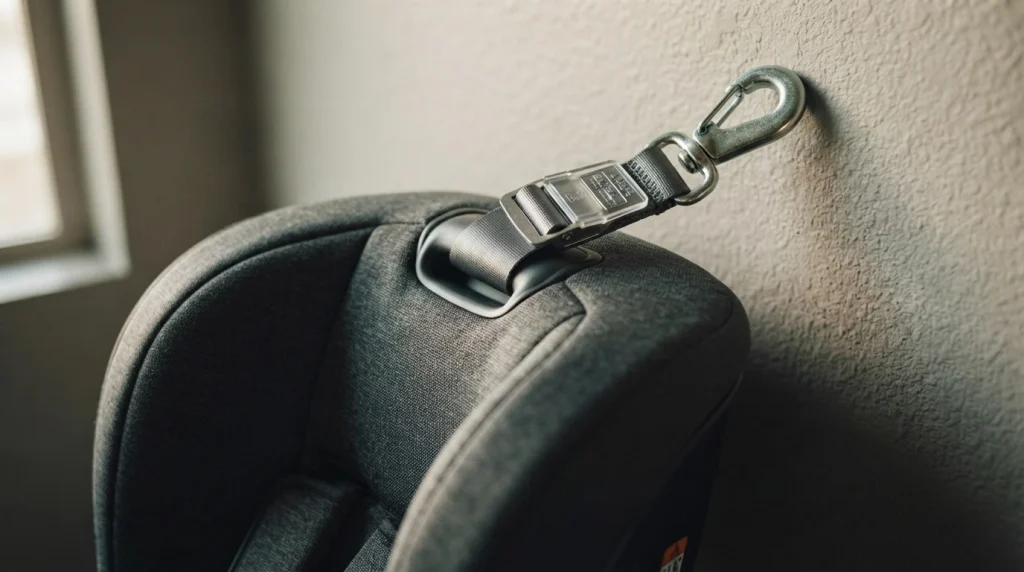
A car seat tether strap is a reinforced fabric strap that connects the top of a child safety seat to an approved vehicle anchor. Its purpose is to limit the upper seat’s forward movement during a collision.
Most forward-facing convertible, combination, and all-in-one child car seats have a top tether. The strap normally sits near the upper rear portion of the child restraint.
What Are the Main Parts of a Top Tether?
A typical top tether system includes several components that work together.
- Tether webbing: The strong fabric strap that connects the car seat to the vehicle.
- Tether hook: The metal connector that attaches to the approved anchor.
- Adjuster: The mechanism used to remove slack from the strap.
- Tether anchor: The designated vehicle attachment point designed to accept the hook.
- Tether routing: The manufacturer-specified path between the child restraint and vehicle anchor.
Each part matters. A correctly routed strap cannot provide its intended protection if the hook connects to the wrong vehicle hardware.
Is the Tether Strap Part of the Child’s Harness?
No. The tether and the five-point harness perform different jobs.
The harness restrains the child’s body inside the car seat. The tether helps control movement of the car seat itself.
Neither component replaces the other. A forward-facing harnessed seat needs the correct harness fit and a secure vehicle installation.
Important distinction: This tether is a child-restraint safety component, not a strap used to secure decorative automotive seat covers.
How Does a Car Seat Tether Strap Work in a Crash?
A top tether helps prevent the upper portion of a forward-facing car seat from rotating excessively toward the front of the vehicle. This limits how far the child’s head can travel forward.
That protection matters because a child’s head and neck can experience significant forces during a crash.
What Happens During a Frontal Collision?
During a frontal crash, a moving vehicle slows rapidly. The child’s body and car seat tend to keep moving forward because of inertia.
The seat belt or lower anchors hold the lower portion of the child restraint in place. However, the upper portion can still rotate forward.
The top tether provides another connection that helps control this rotation.
- The vehicle begins decelerating rapidly during the collision.
- The child restraint experiences forward forces.
- The seat belt or lower anchors secure the lower portion of the restraint.
- The tether becomes tensioned and resists excessive forward rotation.
- The child’s forward head movement is reduced compared with an otherwise similar installation without the tether.
The tether does not eliminate crash forces. Instead, it helps the restraint manage movement in the way its manufacturer intended.
Why Does Reducing Head Movement Matter?
Excessive forward head movement increases the possibility of contacting vehicle structures during a crash. Limiting that movement is a central benefit of the top tether.
Consider a child sitting behind the front passenger seat. Reducing forward movement may help maintain additional clearance between the child’s head and the vehicle interior.
The exact protection depends on the vehicle, car seat, installation, and crash conditions.
Section Takeaway: The top tether controls upper-seat rotation and helps limit forward head movement. It complements the primary installation system rather than replacing it.
Where Is the Car Seat Tether Anchor Located?
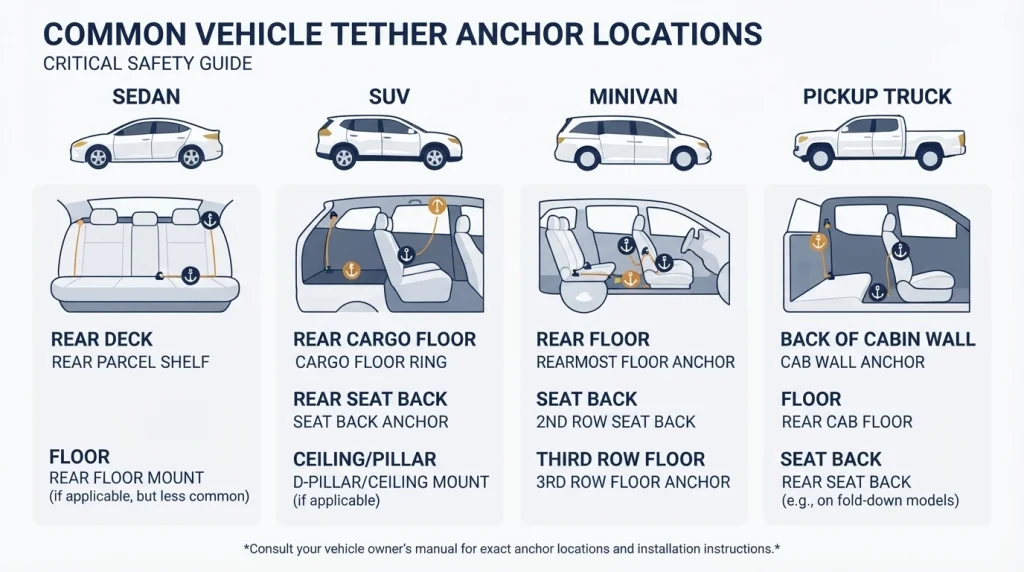
The tether anchor is a designated metal attachment point built into the vehicle. Its location depends on the vehicle’s body style, model year, and seating configuration.
Look for an anchor-shaped symbol or consult the vehicle owner’s manual. Some anchors are hidden behind covers or seat components.
Common Tether Anchor Locations by Vehicle Type
| Vehicle type | Common anchor locations | What to check |
|---|---|---|
| Sedan | Rear package shelf behind the rear seat | Anchor covers and seating-position labels |
| SUV or crossover | Rear seatback, cargo-area floor, or roof area | Approved anchor rather than cargo hardware |
| Minivan | Seatbacks, floor, or designated roof locations | Correct anchor for each seating position |
| Pickup truck | Behind the rear seat or a manufacturer-specific routing system | Special tether routing instructions |
These locations are examples, not universal installation instructions. Always use the anchor assigned to the seating position in your vehicle manual.
How Can You Identify the Correct Anchor?
Start with the child-restraint section of the vehicle manual. Then inspect the relevant seating position for the designated tether anchor.
- Look for the standardized tether-anchor symbol.
- Check behind the rear head restraints and seatbacks.
- Inspect the rear package shelf in sedans.
- Check manufacturer-approved floor or roof locations where applicable.
- Confirm the required tether routing around or through the head restraint.
Safe Kids Worldwide provides additional explanations of top tether anchors and car seat terminology.
Can You Use a Cargo Hook as a Tether Anchor?
No, unless the vehicle manufacturer explicitly identifies that particular point as an approved tether anchor. Cargo hooks and child-restraint tether anchors are not interchangeable.
A cargo tie-down may look strong but have a different design or intended loading direction.
Never attach a child seat tether to a headrest post, ordinary luggage hook, or improvised bracket. If you cannot locate an approved anchor, seek professional installation guidance before using that position.
How Do You Attach a Car Seat Tether Strap Correctly?
Install the forward-facing child restraint with an approved seat belt or lower-anchor method first. Then connect the top tether to the correct vehicle anchor and remove its slack.
The following steps describe the general process. Your specific car seat and vehicle instructions take priority.
Step-by-Step Tether Strap Installation
Read both instruction manuals.Identify the correct forward-facing belt path, approved seating positions, tether routing, and applicable weight limits.
Position the car seat.Place the child restraint in an approved rear seating position and set its required recline angle.
Secure the lower portion.Use either the locked vehicle seat belt or the permitted lower-anchor attachments.
Check the primary installation.Hold the car seat at its belt path and test for movement. It should move no more than 1 inch side-to-side or front-to-back.
Locate the assigned tether anchor.Verify the anchor location using the vehicle manual rather than choosing the nearest metal loop.
Route the tether correctly.Pass the strap over, under, or around the head restraint exactly as the vehicle and car seat manufacturers specify.
Connect the tether hook.Attach it to the designated anchor in the orientation required by the instructions.
Remove the slack.Use the tether adjuster until the strap is snug, without pulling the seat out of its required position.
Perform a final inspection.Check the belt-path movement again, confirm the hook remains connected, and make sure the tether is not twisted.
The official NHTSA forward-facing car seat installation guide includes separate instructions for seat belt and lower-anchor installations.
How Tight Should a Top Tether Be?
The tether should be snug, with slack removed according to the car seat manufacturer’s directions. It should not be tightened in a way that changes the required car seat recline or positioning.
Remember that the 1-inch movement test applies at the seat belt or lower-anchor belt path. It is not a test performed by pulling on the headrest or top of the car seat.
What Should You Check Before Every Trip?
- Confirm the tether hook remains attached.
- Check for visible slack or twisting.
- Verify the primary installation remains secure.
- Make sure the child’s harness is properly adjusted.
- Check that loose items or accessories are not interfering with the strap.
Pro tip: If installation instructions appear inconsistent, consult both manufacturers or a certified Child Passenger Safety Technician before traveling.
Section Takeaway: Secure the car seat using its approved primary installation method, attach the tether to the correct anchor, and verify the complete installation.
What Is the Difference Between a Tether, LATCH, and a Seat Belt?
A top tether, lower anchors, and vehicle seat belts are related but different parts of a child-restraint installation. Understanding their roles helps prevent common setup errors.
LATCH means Lower Anchors and Tethers for Children. In typical forward-facing installations, the tether works with either lower anchors or a seat belt.
Car Seat Installation System Comparison
| Component | Main function | Can it secure the seat alone? |
|---|---|---|
| Top tether | Limits forward rotation of a forward-facing child restraint | No |
| Lower anchors | Attach the lower part of the car seat to vehicle anchor bars | Primary attachment method, subject to limits |
| Vehicle seat belt | Secures the child restraint through its designated belt path | Primary attachment method when correctly installed |
Using lower anchors does not remove the need for a top tether on a forward-facing harnessed seat. The same principle applies when installing with a vehicle seat belt.
Can You Use Both LATCH and a Seat Belt?
Generally, no. Do not use the lower anchors and vehicle seat belt together unless both the child restraint and vehicle manufacturers explicitly permit that combination.
Choose the approved installation method that provides a secure fit. The top tether remains part of the forward-facing installation when permitted.
The American Academy of Pediatrics explains these differences in its car seat installation and LATCH guidance.
Does a Tether Strap Have a Weight Limit?
Tether use can have manufacturer-specific limitations. Always check the child restraint and vehicle manuals before assuming the tether is approved for every child weight.
Lower anchors have a separate weight-limit system. In the United States, the commonly applicable 65-pound combined child-and-seat limit helps determine when lower-anchor use must stop.
For example, if a child restraint weighs 25 pounds, the calculation of 65 minus 25 equals 40 pounds. That does not override a lower limit printed on the car seat label or specified by the manufacturer.
Do not apply the lower-anchor weight limit automatically to the top tether. Their permitted use and limitations must be checked separately.
When lower-anchor use is no longer permitted, a forward-facing harnessed seat can generally be reinstalled using the vehicle seat belt while continuing to use the approved tether.
Do Rear-Facing Car Seats Need a Tether?
Most rear-facing child car seats in the United States do not use a top tether. Some specific models or installation systems have different manufacturer-approved arrangements.
Never assume that a tether intended for forward-facing use should be attached when the seat faces backward.
What About Booster Seats?
Booster-seat requirements depend on the model and its operating mode. Some boosters permit or require specific attachment systems, while others rely on the vehicle seat belt to restrain the child.
When converting a combination seat from harness mode to booster mode, follow the manufacturer’s instructions about tether use.
Section Takeaway: A tether complements the primary car seat installation. Weight limits and attachment rules differ between the lower anchors, tether, and booster configurations.
What Are the Most Common Car Seat Tether Strap Mistakes?
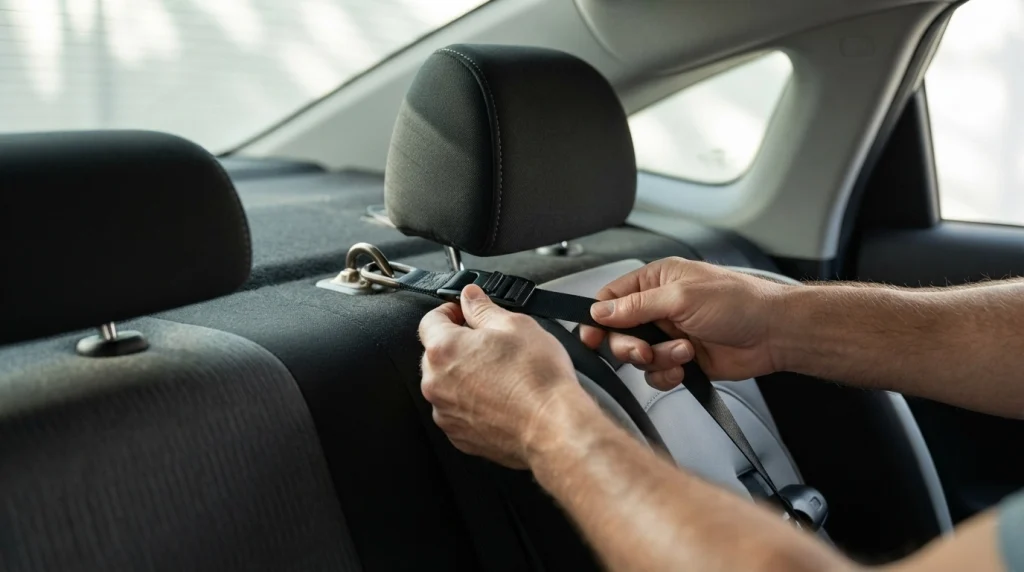
The most serious tether mistakes involve using the wrong anchor, routing the strap incorrectly, or leaving it disconnected. Even a correctly tightened seat belt cannot perform the top tether’s separate function.
Six Mistakes to Avoid
- Leaving the tether unused: A forward-facing car seat loses an important movement-control feature when its required tether is not attached.
- Choosing the wrong anchor: Cargo hooks and other convenient metal fittings are not automatically suitable.
- Incorrect headrest routing: Some vehicles require the strap to pass under or around a head restraint rather than directly over it.
- Leaving excessive slack: An incorrectly adjusted tether may not control movement as intended.
- Using damaged webbing: Cuts, fraying, melted areas, or damaged adjusters require manufacturer guidance before reuse.
- Ignoring installation limits: Vehicle seating positions, child weight, and car seat configuration can affect tether requirements.
Can a Car Seat Cover Interfere With a Tether Strap?
Yes. An automotive seat cover or protector can interfere if it blocks an approved anchor, changes tether routing, or prevents the child restraint from sitting correctly.
A cover placed over the vehicle’s seatback may also conceal anchor labels or openings. Inspect the installation carefully before using accessories near the tether.
There is another important distinction: an aftermarket cover placed on the child safety seat itself may interfere with the harness or original padding.
The American Academy of Pediatrics advises against unapproved accessories that change the fit or protection of a child restraint. Its car seat cover safety guidance explains why extra material beneath a child or harness can be hazardous.
- Use only child-restraint covers and accessories expressly approved by the seat manufacturer.
- Check whether both manufacturers permit a vehicle-seat protector beneath the child restraint.
- Keep the tether hook, strap, and adjuster accessible.
- Never route an approved tether around an obstruction simply to accommodate a decorative cover.
- Recheck installation if you add, remove, or reposition a vehicle seat cover.
What If Your Vehicle Has No Tether Anchor?
Do not improvise a replacement anchor. Check the owner’s manual and contact the vehicle manufacturer or an authorized dealer about approved options.
Some older vehicles may have manufacturer-approved retrofit solutions. Availability depends on the specific vehicle, and not every model can be retrofitted.
If no suitable anchor exists, ask a qualified Child Passenger Safety Technician about safe, manufacturer-approved alternatives.
Can You Repair a Broken Tether Strap Yourself?
Do not sew, knot, splice, or replace a tether with ordinary webbing. The tether is part of a crash-tested child restraint system.
Contact the child car seat manufacturer for the correct replacement procedure or approved parts. After a collision, follow the manufacturer’s crash-replacement instructions before using the seat again.
When Should You Ask for Professional Help?
Get assistance if you cannot identify the proper anchor, the seat fails the movement test, or the tether routing remains unclear.
Other reasons include:
- A damaged or missing tether hook.
- An adjuster that will not hold tension.
- An incompatible seating position.
- Conflicting or unclear instruction manuals.
- Questions about using the car seat after a crash.
A certified Child Passenger Safety Technician can check the complete child-restraint installation and explain how to use it correctly.
Pro tip: For a U.S. vehicle, consult NHTSA’s official car seat resources and the manufacturer’s instructions before making any safety-related changes.
Section Takeaway: Never improvise tether hardware or routing. The correct anchor, intact components, and manufacturer-approved installation are essential.
Frequently Asked Questions About Car Seat Tether Straps
1. Is a top tether necessary for a forward-facing car seat?
Yes, a top tether is an important part of a forward-facing harnessed child car seat installation. Safety organizations recommend using it with either a seat belt or lower anchors whenever the manufacturers permit it. The tether helps limit forward rotation during a crash.
2. Can you install a car seat using only the tether strap?
No. A top tether is not a substitute for the primary installation system. The child car seat must be secured using its approved seat belt or lower-anchor method, with the tether added according to the manufacturer’s instructions.
3. Can you use a tether strap with a seat belt installation?
Yes. A forward-facing harnessed child restraint generally uses a tether whether its primary installation relies on the vehicle seat belt or lower anchors. Follow the manufacturer’s instructions to lock and tighten the seat belt correctly before attaching the tether.
4. How do you know whether the tether strap is tight enough?
Remove visible slack using the tether adjuster without changing the required car seat position. Then check the primary installation at the belt path. The car seat should move no more than 1 inch from side to side or front to back.
5. Can a tether strap attach to a vehicle headrest?
Not unless the vehicle manufacturer specifically identifies that component as an approved tether attachment point. A headrest post is not a substitute for a tether anchor. Some installations route the strap around or beneath a headrest, but the hook must reach the designated anchor.
6. Can a tether strap be used with a booster seat?
Some booster seats allow or require particular attachment methods. Others do not use a top tether in booster mode. Check the booster manufacturer’s instructions and the vehicle owner’s manual before connecting or disconnecting the tether.
7. What happens if a car seat tether strap is damaged?
A damaged tether may not function as designed during a collision. Stop relying on the damaged installation and contact the car seat manufacturer about approved repair or replacement options. Do not repair the strap with knots, household hardware, or ordinary replacement webbing.
Final Thoughts: Why the Top Tether Matters
A car seat tether strap may be small, but it performs an important job. It helps control forward-facing car seat rotation and reduces forward head movement during a crash.
As of 2026, the core safety advice remains clear: use the top tether with a forward-facing harnessed child restraint whenever permitted by both manufacturers.
Before your next trip, inspect the tether anchor, confirm the routing, and verify the installation. If anything seems uncertain, have a certified Child Passenger Safety Technician check the seat.
Your next step: Open your vehicle owner’s manual, find the approved tether anchor for your child’s seating position, and check that the car seat is installed exactly as directed.

Daniel Brooks is an automotive writer and product researcher focused on car accessories, car tech, maintenance, and practical driving guides. At Plug-in Car World, he helps drivers make smarter automotive decisions through honest reviews and research-driven content.
