
What Car Seat Covers Fit My Car? A Fit Guide
Quick Answer
The car seat cover that fits your car matches your exact seat shape, headrest style, and safety openings, not just your make and model. Start with your year, make, model, and trim, then confirm the cover leaves side airbags, seatbelts, and seat controls clear. Once you choose the right fit, this guide to how to install a car seat cover correctly shows the fitting steps in order.
Check these 5 fit points first
- Seat shape: bucket, bench, split bench, or captain chair
- Headrest type: removable, adjustable, fixed, or integrated
- Airbag openings: labelled side-airbag seams on the outer seat back
- Seat controls: power switches, lumbar knobs, and fold levers
- Rear layout: full bench, split fold, or separate captain chairs
Quick fit test
- Sit down, slide back, and stand up twice without pulling the cover straight.
- Check the sides for bunching, loose pockets, and covered buckles.
- Move the seat forward, back, and upright to test every control.
I have wrestled with loose, sliding covers on my old Honda Civic. I have also fitted a snug set to a friend’s Ford F-150 in under an hour.
The brand name mattered far less than the seat shape, headrest style, and airbag openings. This guide walks through those checks in order, so you can order once and fit it right.
In This Guide
- What Is a Car Seat Cover, and What Does Fit Mean?
- How Do I Identify My Seat Type?
- Universal vs Semi-Custom vs Custom-Fit: Which Fits Best?
- How Do I Measure My Seats for a Cover?
- Do Seat Covers Work With Airbags, Heated Seats, and Controls?
- What Car Seat Covers Fit Trucks, SUVs, and Split Seats?
- Frequently Asked Questions
What Is a Car Seat Cover, and What Does Fit Mean?
A car seat cover is a removable fabric or leather layer that protects your seat and changes its look. Fit means the cover follows your seat’s shape, stays tight when you slide in and out, and keeps every safety feature and control usable.
A loose cover can bunch under your legs. A tight cover can pull seams open or block a lever you need.
I judge fit by movement, not by looks alone. If the cover shifts each time I sit down, it does not fit yet.
Why “universal” does not mean “fits everything”
Universal means made for a range of common seats. It does not mean made for every seat on the road.
- Bolster depth varies a lot between plain seats and sport seats.
- Headrest posts differ in width, spacing, and height.
- Seatback pockets, fold levers, and side panels change the shape a cover must follow.
That range works well on plain bucket seats. It struggles on deep sport bolsters and seats with built-in headrests.
Takeaway: Buy for your seat shape first, then for colour and material.
How Do I Identify My Seat Type?
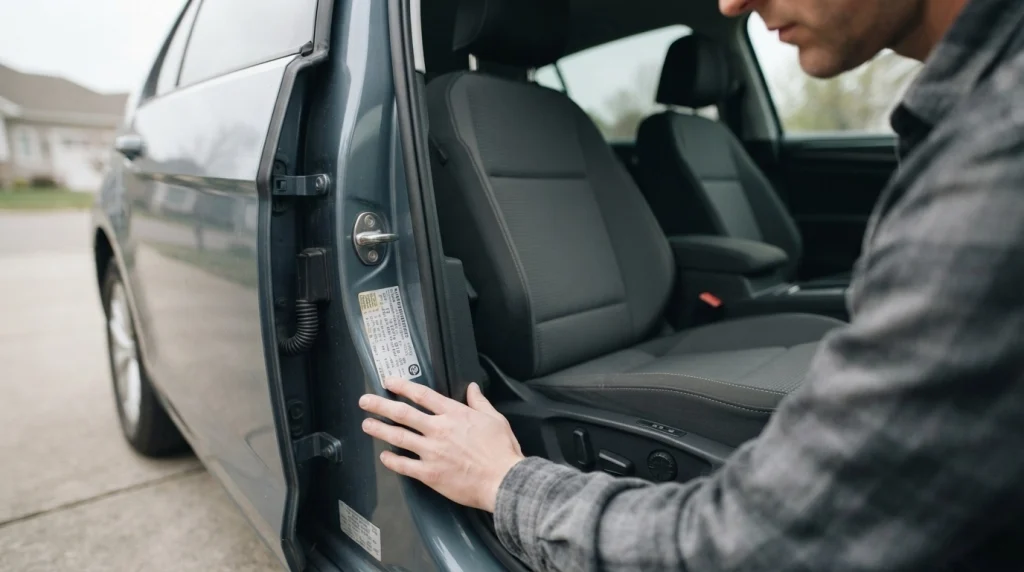
Identify your seat by its shape, headrest, and rear-seat layout. Your year, make, model, and trim narrow the search, but the seat itself settles the fit.
Open the driver’s door and look for the trim badge and door-jamb sticker. Your owner’s manual also lists trim and seat options for your model year.
- Bucket seats: separate front seats with a gap and centre console between them.
- Bench seats: one long front or rear seat with room for three people.
- Split bench seats: a bench that folds or moves in sections, often 60/40 in the rear.
- Captain chairs: separate, armrest-style seats in the second row of many SUVs and vans.
- Sport seats: bucket seats with deep side bolsters that hold you in corners.
- Integrated headrests: headrests built into the seat back, with no posts to remove.
Where to find your exact trim and seat details
Start with the manual and the door-jamb sticker. They beat a guess based on a photo of a similar car.
You can cross-check your model and trim on Edmunds before you compare seat photos. If the chart lists your trim but not your seat style, ask the seller before ordering.
Takeaway: Trim gets you close, but seat shape, headrest type, and rear layout confirm the fit.
Universal vs Semi-Custom vs Custom-Fit: Which Fits Best?
Universal covers stretch to fit many seats, semi-custom covers fit a smaller group of similar seats, and custom covers are cut for one seat pattern. The tighter the pattern, the less shifting you will feel on daily drives.
| Cover type | Best for | Fit | Trade-off |
|---|---|---|---|
| Universal | Plain bucket seats and short-term use | Loose to snug, varies by seat | More shifting and bunching |
| Semi-custom | Most commuters and family cars | Neat on similar seat shapes | May miss unusual bolsters or headrests |
| Custom-fit | Sport seats, trucks, and split benches | Closest to factory upholstery | Longer wait and less room for error in trim choice |
Stretch helps a universal cover go on fast. Stretch also lets it move when you twist to reach the back seat.
Semi-custom covers add shaped panels and stronger straps. They suit most commuters who want a neat look without a custom order.
Which type should most drivers choose?
- Choose universal if your seats are plain, your budget is tight, and you can refit the cover now and then.
- Choose semi-custom if you drive daily and want a tidy fit without waiting for a custom pattern.
- Choose custom-fit if you have deep bolsters, a split bench, integrated headrests, or side airbags that need an exact seam.
I check material claims against broad advice from Consumer Reports before I trust a marketing claim. A thick fabric still fails if its pattern ignores your bolsters.
Takeaway: Pay for pattern accuracy first, because no fabric can fix the wrong shape.
How Do I Measure My Seats for a Cover?
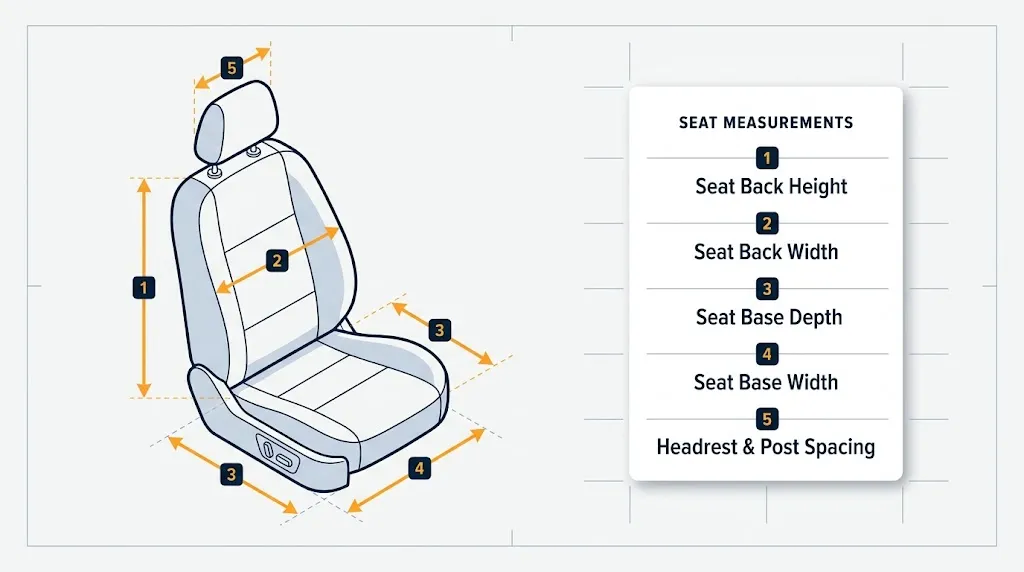
Measure the seat back, seat base, and headrest before you order. A tape measure and five minutes beat a return parcel and a week of waiting.
- Seat back height: from the top of the seat back to the seam where it meets the base.
- Seat back width: across the widest point, including the side bolsters.
- Seat base depth: from the front edge of the cushion to the seat back seam.
- Seat base width: across the widest point of the cushion.
- Headrest width and post spacing: across the headrest, then centre to centre between posts, if fitted.
Measure at the widest point, not the middle of a curve. Keep the tape snug, but do not pull it tight over soft bolsters.
Write down each number in inches or centimetres. Compare the largest number first, because one tight spot can ruin an otherwise good fit.
How to compare your numbers to a size chart
Match your largest back and base numbers to the chart, not the average size. If your number sits between two sizes, check the maker’s guide for stretch, straps, and bolster depth.
- Measuring only the front seats and assuming the rear matches.
- Ignoring bolster depth on sport seats.
- Forgetting headrest posts, fold levers, and armrest hinges.
- Using a photo estimate instead of a tape measure.
Think about cleaning before you buy, too. A cover that is hard to take off will stay dirty longer, so read how to remove a car seat cover for cleaning before you settle on straps and hooks.
Takeaway: Measure widest points, write the numbers down, and let the largest number choose the size.
Do Seat Covers Work With Airbags, Heated Seats, and Controls?
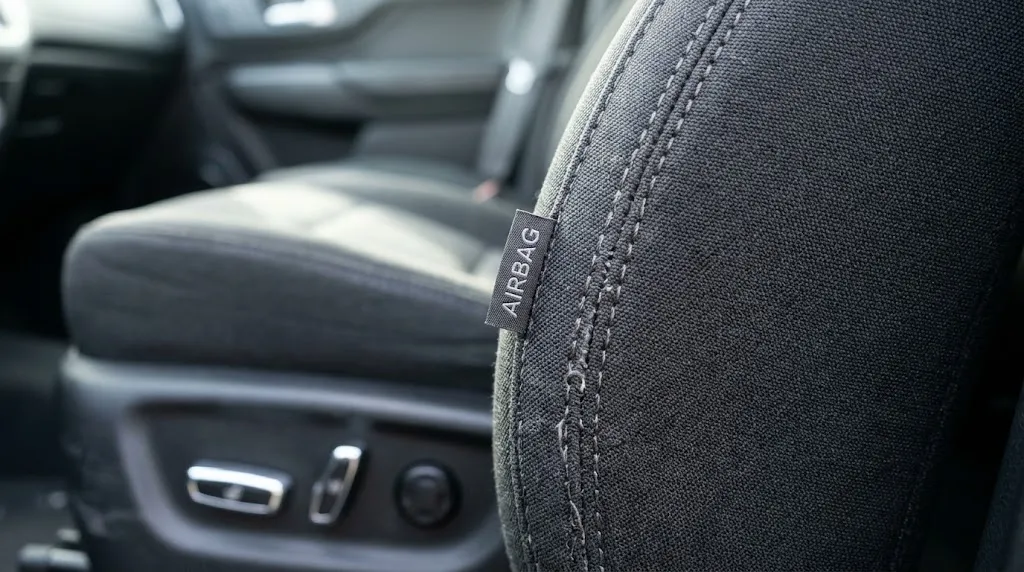
Choose a cover with a labelled side-airbag seam or opening if your seats have side airbags. Never cover an airbag panel, seatbelt buckle, or seat control with solid fabric.
SRS stands for Supplemental Restraint System, the airbag system that works with your seatbelts. Side airbags often deploy from the outer edge of the seat back, so that seam must stay clear.
- Airbag label: a tag or stitch line that marks the deployment seam.
- Seatbelt access: clear slots for belts, buckles, and buckle stalks.
- Child-seat anchors: clear access to ISOFIX or LATCH anchors if you fit a child seat in the rear.
- Headrest posts: openings that match post width and spacing, not a stretched hole.
For a wider safety check, read our guide to understanding car seat safety standards before you cover a seat used by a child or a new driver. It helps you separate a marketing safety claim from a tested standard.
Pro tip: Check your owner’s manual and NHTSA for airbag guidance, and ask a certified mechanic if your seat layout looks unusual.
What about heated and ventilated seats?
A thick cover can slow heat from a heated seat. A tight, non-breathable cover can also trap heat on a ventilated seat.
Look for perforated panels or a maker note that says the cover suits heated seats. If the maker stays silent on heat, test it on a short drive before a long trip.
What about seat controls?
Check power switches, lumbar knobs, fold levers, and armrest hinges. A good cover has openings or stretch panels at each one, not a flap you must lift each time.
Takeaway: A safe fit keeps airbags, belts, heat, and controls working exactly as they did without the cover.
What Car Seat Covers Fit Trucks, SUVs, and Split Seats?
Trucks, SUVs, and cars with split seats need a different fit check from a plain sedan. The rear layout, fold function, and headrest style often matter more than the front-seat size.
Trucks and split benches
A split bench needs separate covers for each section. One long bench cover can block the fold or the centre seatbelt.
Measure each section on its own, and check these details:
- Centre armrest and cup holder openings.
- Fold levers and seatback release handles.
- Under-seat storage lids and seatbelt stalks.
SUVs and captain chairs
Captain chairs look like front buckets, but their armrests and recline levers differ. Check both sides, because driver and passenger controls are rarely mirror images.
For a third row, confirm the cover still lets the seat fold and tumble. A snug second-row fit means little if the third row becomes hard to reach.
Sport bolsters and integrated headrests
Deep bolsters need a cover with shaped side panels. A flat universal panel will bridge the bolster and leave a loose pocket at your hip.
Integrated headrests need a one-piece back or a maker pattern for that seat. Do not cut a headrest hole in a cover that was never made for one.
Heat changes the choice, too. If cooling matters, compare fit first in this cooling car seat cover review, then check its airflow panels against your seat shape.
After the fit test, plan the care routine. Our guide to how to wash a car seat cover without damaging it helps you keep a snug cover snug after cleaning.
Takeaway: For trucks and SUVs, fit the rear layout and fold function first, then judge the front seats.
Frequently Asked Questions
These are the questions I hear most when a driver is stuck between two sizes.
Will universal seat covers fit my car?
Yes, on plain bucket seats with standard headrests and no deep bolsters. Check the size chart first, because a universal cover can still slide on wide seats or bunch on narrow ones.
How do I know if my seats have side airbags?
Look for a side-airbag label on the seat back or in your owner’s manual. Choose only a cover with a labelled airbag seam, and never stitch, tape, or glue over that seam.
Can I use seat covers on heated or cooled seats?
Yes, if the cover is breathable or the maker states it suits heated seats. Test heat on a short drive first, because thick waterproof layers can slow warming and trap sweat on long trips.
Do I need different covers for front and back seats?
Yes, in most cars, because rear benches, splits, and headrests differ from front buckets. Order a front set and a rear set by seat shape, not by one shared size label.
What if my headrests do not come off?
Choose a cover made for fixed or integrated headrests, or one with a stretch headrest sleeve. Do not force a removable-headrest cover over a fixed headrest, because the fit will pull and wrinkle.
Can seat covers fit leather seats without damage?
A clean, well-fitted cover should protect leather from sun, spills, and wear. Remove it for cleaning on a regular schedule, and check for trapped grit that can scuff the surface over time.
Before you buy, run this last check: year, make, model, trim, seat shape, headrest type, airbag opening, and seat controls.
- Year, make, model, and trim confirmed.
- Seat shape and headrest type matched to the listing.
- Airbag seam, belts, and controls left clear.
- Return terms checked in case the fit still fails.
If one answer is still unclear, pause the order. A five-minute check now beats a loose cover for the next year.
Share your seat measurements with the seller when the chart looks close. A seller who can match your numbers is worth more than a seller who promises a universal fit.

Daniel Brooks is an automotive writer and product researcher focused on car accessories, car tech, maintenance, and practical driving guides. At Plug-in Car World, he helps drivers make smarter automotive decisions through honest reviews and research-driven content.
