How Long Can a Baby Be in a Car Seat? The 2-Hour Rule, Age Limits, and Safe Trip Breaks
Quick Answer
How long can a baby be in a car seat? Keep it to two hours at a time, then take your baby out for a break. Newborns need shorter stretches, so read our newborn time-limit guide before a long trip.
The short version
- Two-hour limit: Stop every two hours at most, even if your baby looks asleep.
- Newborns are different: Keep early stretches to about 30 minutes when you can.
- Breaks matter: Take your baby out, stretch them, feed them, and check their breathing.
- Sleep is not rest: A car seat is for travel, not for long naps at home.
- Watch the signs: Slumping, shallow breathing, and fussing mean stop sooner.
Before you drive
- Plan your stops before you leave, not when your baby starts crying.
How long can a baby be in a car seat? I asked myself that question on a three-hour drive with my newborn, and the answer changed how I plan every trip now.
This guide covers the two-hour rule, the age limits that sit behind it, and the break plan that makes long drives work. It goes past newborns too, so you can see how the limit changes as your baby grows.
In This Guide
How Long Can a Baby Be in a Car Seat?
A baby should not stay in a car seat for more than two hours at a time. That two-hour limit is the widely used precaution for babies in their first year.
It applies whether your baby is awake or asleep. The clock keeps running while they sleep, so a nap does not reset it.
A car seat is a travel restraint, not a bed or a chair. It holds your baby in one curved position, and that position gets harder on a small body the longer it lasts.
For a newborn, the limit is tighter in practice. Many health guides suggest about 30 minutes per stretch in the first few weeks, then building toward two hours as your baby gains head control.
I learned this the slow way. On that first long drive, I planned to push through in one go.
My daughter fell asleep after 20 minutes, so I kept driving. Two hours later she woke up hot, stiff, and upset, and I had nowhere good to stop.
Now I plan the stop first and the drive second. The trip takes a little longer, but it feels calmer for both of us.
As of 2026, the two-hour rule is still the standard advice parents hear from pediatric and road-safety sources. It is a precaution, not a law in most places, so treat it as a safety habit.
Pro tip: check your car seat manual and ask your pediatrician about your own baby, especially if your baby was born early or has breathing or heart concerns.
Section Takeaway: Two hours is the ceiling, not the goal. Stop sooner for newborns, and stop sooner still if your baby looks uncomfortable.
Why Is There a Time Limit for Babies in Car Seats?
A baby in a car seat sits semi-reclined with their chin close to their chest. That posture can narrow the airway a little, and it can get worse if the baby slumps.
Newborns have weak neck muscles and soft airways. They cannot lift their head or shift their weight the way an older baby can.
That is why the risk is highest in the first weeks. A baby who slumps forward may breathe more shallowly without crying about it.
Long stretches also press on the same spots for hours. A baby cannot stretch, roll, or change position in a buckled seat.
That stillness can leave a baby stiff and sore. It can also raise their temperature, since the seat padding traps heat around their back.
The two-hour limit is not about the seat being unsafe. It is about giving a small body a break from one fixed position.
Think of it like sitting in one chair for a whole flight. You can do it, but you feel better when you stand up and move.
Your baby cannot tell you they need to move. The time limit does that job for them.
Safety guidance from the National Highway Traffic Safety Administration stresses correct fit and installation first, because a badly fitted seat adds risk on every trip, short or long.
Section Takeaway: The limit protects breathing, posture, and comfort. It exists because babies cannot adjust their own position in a buckled seat.
How Long by Age: Newborn, Infant, and Toddler Limits
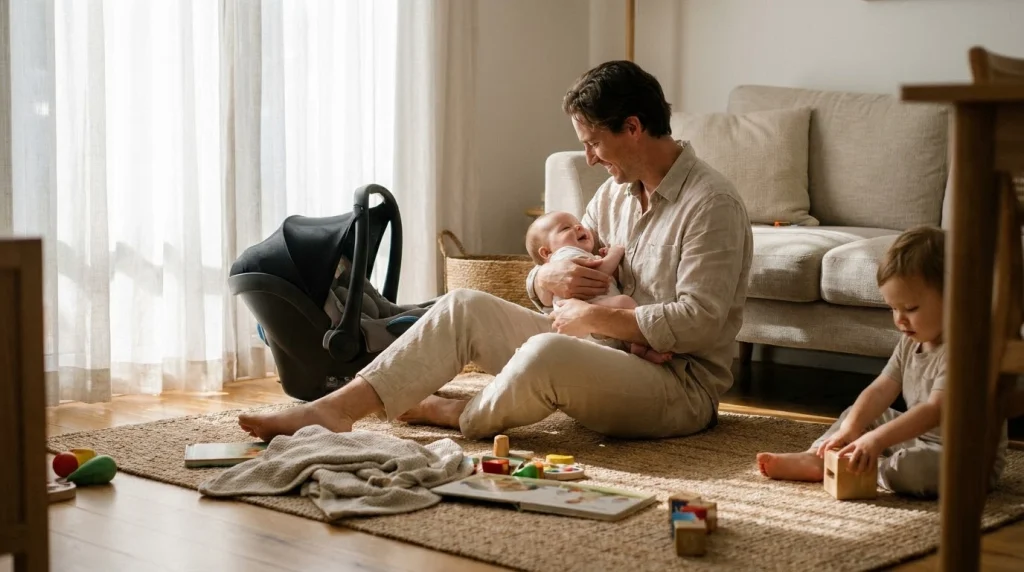
The limit changes as your baby grows. A newborn needs the shortest stretches, while a toddler with good head control handles two hours far better.
Use the table below as a starting point. Then adjust it for your own baby, your seat, and your pediatrician’s advice.
| Age | Suggested stretch | What to do at the break |
|---|---|---|
| 0 to 4 weeks | About 30 minutes | Take baby out, hold upright, feed if due |
| 1 to 3 months | 30 to 60 minutes | Stretch, change nappy, check breathing |
| 3 to 6 months | Up to 90 minutes | Tummy time on a blanket, feed, burp |
| 6 to 12 months | Up to 2 hours | Let baby sit, crawl, or be held upright |
| 12 months and older | Up to 2 hours | Walk, stretch, snack, and drink water |
What about a newborn in the first month?
A newborn should spend as little time as possible in a car seat outside of travel. Short trips are fine, but long stretches are not the place to start.
Keep early drives short when you can. If a trip must run longer, stop every 30 minutes and take your baby out.
Check their chin and chest. Their head should rest back, not flop forward onto their chest.
What changes after three months?
By three months, most babies hold their head up better. Their airway stays more open, and they can shift a little in the seat.
That is why stretches can grow toward 60 to 90 minutes. It is still worth stopping before the two-hour mark.
Watch how your baby settles. A calm baby who sleeps well may handle a longer stretch, while a fussy baby needs a break sooner.
Do toddlers still need the two-hour limit?
Yes, toddlers still benefit from a break every two hours. They can sit longer without the same breathing risk, but they still get stiff and restless.
A toddler who walks, stretches, and drinks at a stop comes back to the seat calmer. That makes the next stretch easier for everyone in the car.
Age and size rules also decide which seat your baby should use. Read our guide to car seat age, height, and weight requirements before you move up a seat size.
Pro tip: premature babies need extra care here. Ask your pediatrician about a car seat test before your first long trip, and follow the time limit they set.
Section Takeaway: Start short with newborns, build toward two hours by six months, and keep the two-hour ceiling for toddlers too.
What Happens If a Baby Stays Too Long? Signs to Watch
A baby who stays too long in a car seat may breathe more shallowly. You may not hear a cry, so you need to look for quiet signs.
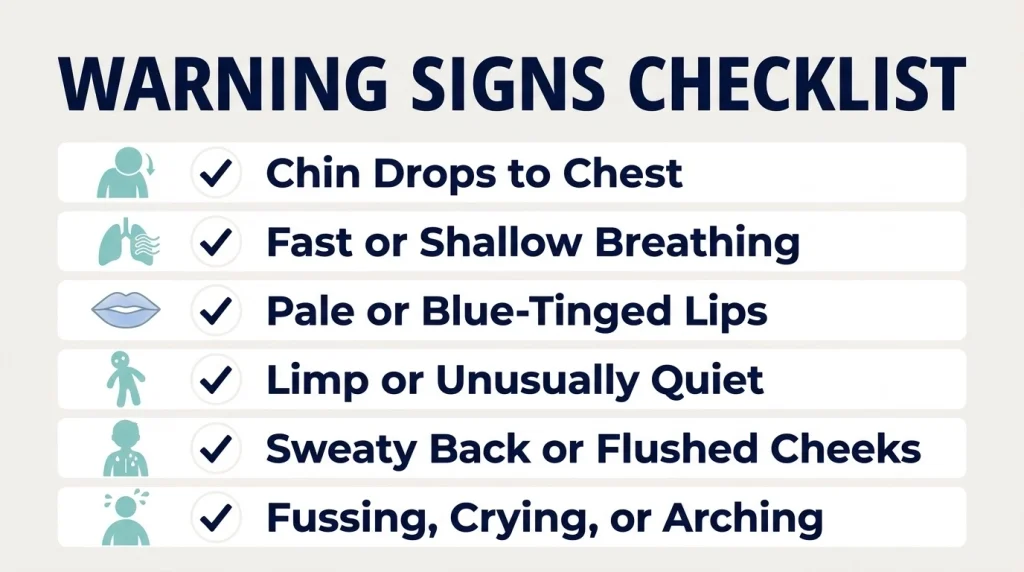
Slumping is the clearest one. If your baby’s chin drops to their chest, pull over and fix their position.
Other signs are easy to miss on a busy road. Watch for fast or shallow breathing, pale or blue-tinged lips, and a baby who goes limp or unusually quiet.
Heat is another warning. A sweaty back, flushed cheeks, or a hot head means your baby needs air and a break from the padding.
Fussing is the most common sign, and it is the easiest to dismiss. A baby who cries, arches, or fights the straps is often telling you they are uncomfortable.
Do not try to soothe a baby back to sleep while you keep driving. Pull over somewhere safe first, then take them out and check them.
If your baby slumps often, the seat angle may be wrong. A newborn needs a recline that keeps the airway open, and a rolled towel or insert should only be used if your seat manual allows it.
Head position matters as much as time. Our guide on how to position a newborn’s head safely in a car seat shows what good head support looks like.
Slumping has its own causes too. If it keeps happening, read why a newborn slumps in a car seat before your next trip, and check the fit again.
For a wider view of what safe travel looks like, HealthyChildren.org from the American Academy of Pediatrics covers car seat safety by age in plain language.
Section Takeaway: Slumping, shallow breathing, heat, and sudden quiet are stop-now signs. Never wait out the two hours if your baby shows them.
How to Plan Breaks on Long Trips
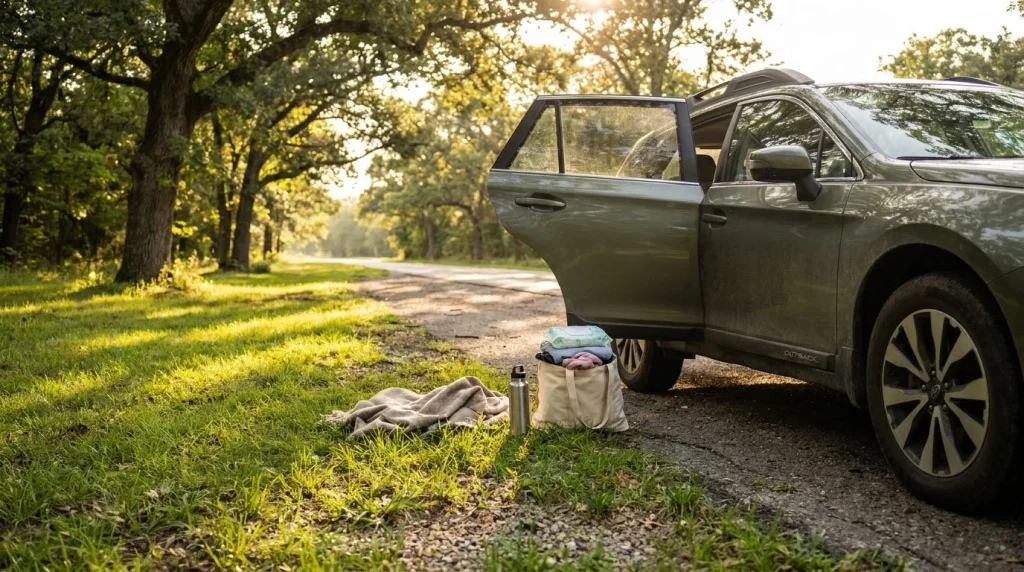
Long trips work better when the breaks are planned, not improvised. Map your stops before you leave, and build in extra time for them.
Pick stops with shade, space, and a safe place to park. A rest area with grass beats a busy petrol station forecourt every time.
Plan a break every 90 minutes to two hours. For a newborn, plan every 30 to 60 minutes instead, even if that means a slower day.
At each stop, take your baby out of the seat. Hold them upright for a few minutes, let them stretch, and change their nappy if needed.
Feed on the break, not in the moving car. A baby who eats while held upright burps more easily and settles faster.
Use the break to check the seat too. Straps loosen as a baby shifts, so re-tighten them before you set off again.
Pack a small break kit in the front seat. It saves you digging through the boot with a crying baby in your arms.
- Nappies and wipes: Pack more than you think you need.
- A blanket: Use it for tummy time or a clean floor space.
- Water and snacks: Keep them in reach for older babies and for you.
- A change of clothes: Spills happen most when you are far from home.
Do not rush the break. Ten to fifteen minutes out of the seat is a good minimum, and twenty minutes is better for a newborn.
If your trip runs past bedtime, stop for the night. A tired driver and a tired baby are a bad pair, and no schedule is worth pushing through.
Before any long trip, run through our essential car seat safety checklist for parents. It catches the small fit mistakes that cause the most trouble on the road.
For independent buying and safety research, Consumer Reports tests car seats and explains the ratings in plain terms.
Section Takeaway: Plan stops first, drive second. A 15-minute break every two hours keeps your baby comfortable and your driving safer.
Can a Baby Sleep in a Car Seat?
Yes, a baby can sleep in a car seat while you drive. Sleep itself is normal, and most babies do it on longer trips.
The problem is not the sleep. It is leaving a sleeping baby in the seat for hours after the drive ends.
A car seat is safe for travel, not for unsupervised sleep. Once you arrive, move your baby to a flat, firm sleep surface.
That means a crib, bassinet, or play yard. It does not mean the car seat on the kitchen floor or the sofa.
Never let a baby sleep in a car seat that is not installed in the car. A seat on a soft surface can tip, and the recline angle changes when it is not buckled in.
Watch your baby while they sleep in the car. Check their breathing at each stop, and make sure their chin has not dropped to their chest.
If your baby falls asleep in the car, let them finish the trip. Then move them as soon as you park, even if it wakes them.
Sleep in a car seat is one of the most asked-about parts of this topic. Our guide to whether a baby can sleep in a car seat covers the safe-sleep rules in more detail.
For car seat choices and fit, Edmunds has clear buying and safety explainers that help you compare seats by size and fit.
Section Takeaway: Sleeping in the car is fine. Sleeping in the seat for hours after the drive is not. Move your baby to a flat sleep surface when you arrive.
Frequently Asked Questions
How long can a newborn be in a car seat?
A newborn should stay in a car seat for about 30 minutes at a time in the first few weeks. Build toward two hours as they gain head control, and always take them out for breaks.
Is the two-hour rule a law?
No, the two-hour limit is a safety precaution, not a law in most places. It comes from pediatric and safety guidance, so treat it as a strong habit rather than a legal limit.
Can I drive for three hours if my baby is asleep?
No, do not drive for three hours without a break, even if your baby sleeps through it. Stop by the two-hour mark, take them out, and check their breathing and position.
What if my baby was born early?
Premature babies need shorter stretches and extra checks. Ask your pediatrician about a car seat test and the time limit they recommend before a long trip.
Does the two-hour rule apply to toddlers?
Yes, toddlers should still take a break every two hours. They handle the seat better than newborns, but they still get stiff, hot, and restless without a stop.
Can my baby sleep overnight in a car seat?
No, a baby should never sleep overnight in a car seat. Move them to a crib or bassinet on a flat, firm surface as soon as you arrive.
The two-hour rule is simple, but it only works if you plan around it. Set your stops before you leave, watch for slumping and fussing, and take your baby out for a real break.
Your baby cannot ask for a stop. You can plan one for them, and that small habit makes every trip safer.

Daniel Brooks is an automotive writer and product researcher focused on car accessories, car tech, maintenance, and practical driving guides. At Plug-in Car World, he helps drivers make smarter automotive decisions through honest reviews and research-driven content.