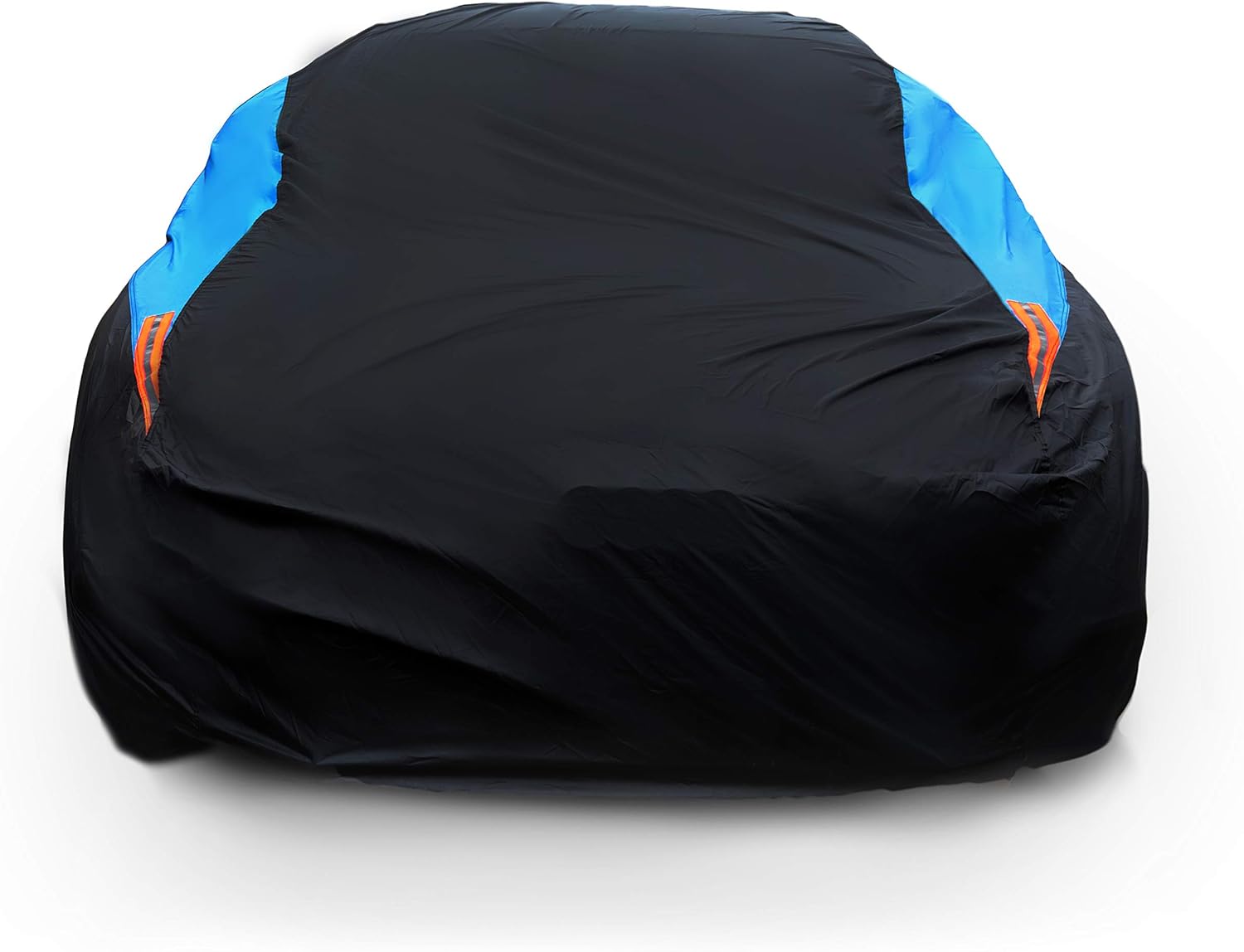
Is Your Car Cover Too Tight? Signs to Watch For
⚡ Quick Answer
Yes, a car cover can be too tight — and it will show clear signs. If the cover strains over mirrors, won’t pull more than 3 inches from the body, or leaves pressure marks on paint, it’s too tight. A cover this snug can scratch paint, stress mirrors, and tear seams over time.
Warning signs your car cover is too tight:
- Mirror strain: Cover pulls hard against side mirrors, causing visible tension.
- Failed pull test: Cover won’t lift more than 3 inches from the body.
- Difficult removal: You need to tug hard or stretch the cover to get it off.
What to do right now:
-
✓
Do the pull test — if it won’t lift 3 inches, replace the cover -
✓
Never force a tight cover over mirrors or bumpers -
✓
Switch to a custom-fit cover sized for your exact make and model
# Is Your Car Cover Too Tight? Signs to Watch For
You pull the car cover off one morning and something feels wrong — the fabric clings, the mirrors get yanked, and getting it free takes real effort. Michael here, and that struggle is a clear signal worth paying attention to. A car cover that’s too tight isn’t just annoying — it can scratch your paint, crack mirror housings, and tear itself apart from the inside.
This guide covers every sign of a too-tight car cover, what damage it causes, and exactly how to fix the problem for good.
📌 Key Takeaways
-
→
A cover under 3 inches of pull slack from the body is officially too tight and risks paint damage. -
→
Mirror stress is the first visible sign — a tight cover puts constant pressure on your side mirrors and their mounts. -
→
Tight covers trap dust against paint — when you remove them, the friction grinds particles into the clear coat. -
→
Custom-fit covers solve the problem permanently — universal covers are the most common cause of a too-tight fit.
How Tight Should a Car Cover Actually Be?
A car cover should fit snugly — but not like a second skin. The goal is a secure fit that won’t flap in wind, while still allowing a little give around the contours of the body.
The industry standard is clear: pull the cover away from the car’s side. If it won’t lift more than 3 inches from the exterior, the cover is too tight and will likely tear or cause paint damage. If it lifts more than 8 inches, it’s too loose and risks flapping against the paint in wind.
The sweet spot is between 3 and 8 inches of slack. That range gives the cover enough room to sit over body curves without creating tension on mirrors, antennas, or bumpers. So if your cover is only pulling 1 or 2 inches, that’s your answer.
⚠️ Warning
Never force a tight cover over your mirrors. Repeated stretching stresses the mirror housing and the cover’s seams — both will fail faster than you expect.
What Are the Signs a Car Cover Is Too Tight?
A too-tight car cover sends clear signals. Most car owners notice at least one of these within the first few uses — but they dismiss them as normal. They aren’t.
📋 Signs your car cover is too tight
-
Extreme mirror tension: The cover stretches visibly around side mirrors and you need both hands to pull it past them. -
Failed pull test: You pull the cover sideways and it won’t lift more than 3 inches from the car’s body. -
Hard removal: Taking the cover off requires significant pulling, tugging, or shimmying it loose from bumpers. -
Seam stress marks: Visible stretching or white stress lines appear along the seams after it’s on the car. -
Uneven pressure points: The cover sits flat in some areas but digs in at curves, bumpers, or spoilers. -
Early tearing: Small holes or tears appear near corners, mirrors, or antenna areas after just a few weeks of use.
You might be thinking: “My cover is tight but the inside is soft — so it won’t scratch.” Here’s why that’s not safe to assume: dust particles collect between the cover and the paint. When you pull a tight cover off, those particles grind against the clear coat under friction. Soft lining helps, but it doesn’t eliminate the risk when there’s constant tension.
Next, let’s look at what that constant pressure actually does to your car over time.
Can a Too-Tight Car Cover Damage Your Car’s Paint?
Yes — a too-tight car cover can scratch and damage paint. The damage doesn’t happen in one dramatic moment. It builds slowly over dozens of cover removals.
Here’s how the damage chain works. Dust settles on the car’s surface. The tight cover presses that dust firmly against the paint. Every time you remove the cover, the fabric drags those abrasive particles across the clear coat, leaving micro-scratches and swirl marks. On dark-colored cars, these become visible fast.
The damage goes beyond paint alone. A cover that’s too tight puts constant stress on side mirrors, antennas, and spoilers. That stress is the same as applying a slow, continuous force — over weeks, it can crack mirror housings or loosen antenna mounts from their base.
💡 Key Insight
A tight car cover touching the paint is not the same as a soft cover resting gently on it. Tension transforms that soft contact into friction — and friction is what scratches paint.
Covers that fail the 3-inch pull test are also more likely to develop tears quickly. When the fabric is stretched beyond its capacity at every use, seams loosen and the material thins out at stress points — especially around corners and mirror areas.
How to Do the Pull Test to Check Your Cover’s Fit
The pull test is the fastest way to know if your car cover fits correctly. It takes 30 seconds and gives you a clear answer.
🔢 Step-by-Step: Car Cover Pull Test
-
1
Apply the cover fully
Put the cover on your car completely, without tightening straps. Let it settle naturally.
-
2
Pull the cover sideways
Grip the cover along the side of the car and pull it outward with firm but not excessive force.
-
3
Measure the gap
Note how far the cover lifts from the car body. Under 3 inches = too tight. Over 8 inches = too loose.
-
✓
Act on the result
If the cover fails, stop using it and find a correctly sized replacement before your next use.
The 3-inch minimum matters because your car’s body panels and curves need room. A cover that allows zero slack will create uneven pressure at every contour — and those are exactly the spots where paint damage starts.
Why Do Car Covers End Up Too Tight in the First Place?
Most too-tight car covers aren’t a manufacturing defect. They’re a fitment mistake — and it almost always comes down to one of 3 causes.
The table below shows the most common reasons car covers end up too tight and what each cause leads to.
Universal covers are the #1 cause. They’re sized for an “average” vehicle — so anything wider, longer, or with protruding parts will stretch the cover past its limit.
But here’s the thing most people don’t know: even a cover made for your car’s model year can run tight if it was designed for a European-spec bumper and you’re running a US-spec vehicle. This exact issue has been reported by Porsche owners whose OEM covers wouldn’t clear the rear bumperettes on US models.
The fix isn’t to force the cover. It’s to get the right one.
What Damage Can a Too-Tight Car Cover Cause Over Time?
Time is the multiplier here. A cover that’s slightly too tight for one use isn’t catastrophic. A cover that’s too tight for 6 months is a different story.
The damage falls into 3 categories. Paint damage is the most common. As described, micro-scratches and swirl marks form over repeated tension-and-removal cycles. These show up first on flat panel areas where the cover sits tightest against the surface.
Structural damage is the second category. Side mirrors and their stalks take direct stress from a cover that won’t pass over them cleanly. Over time, the mount where the mirror attaches to the door can weaken. Antennas and spoilers face the same risk — constant tension from a too-tight cover works like a slow, persistent tug.
Cover damage itself is the third issue. Stretched fabric loses elasticity. Seams that are stressed every time the cover goes on will start to split — usually at corners, mirror points, or along the hem. The cover tears, exposing the car anyway — making the whole purchase pointless.
✅ Tip
If your cover is tearing at the seams, check whether the tears are appearing at pressure points like mirror areas or bumper corners. That pattern confirms the cover is too tight — not just worn out.
What Most People Get Wrong About Car Cover Tightness
Myth 1: Tighter means better protection
This is the most common mistake. Many car owners assume that a snug, body-hugging fit seals out more dust and moisture. In reality, a too-tight cover creates pressure points at bumpers and mirrors, and traps dust between the fabric and paint — then grinds it in during removal.
A correct fit is snug, not strained. The cover should follow the car’s shape without pulling at any single point.
Myth 2: A soft inner lining protects against a tight cover
Soft linings help — but they don’t solve the problem. A tight cover with a fleece lining still drags that lining across your paint under friction and tension. The lining reduces risk, it doesn’t eliminate it. A correctly sized cover with a soft lining is ideal. A tight cover with soft lining is still a problem.
Myth 3: Universal covers are fine for most cars
Universal covers are sized for an average vehicle. Your car is almost certainly not average. It has specific mirror placement, bumper depth, body curves, and accessories. A custom-fit cover from brands like Covercraft or Coverking accounts for every one of those dimensions. Universal covers lead to too-tight or too-loose fits far more often than car owners realize.
How to Fix a Car Cover That’s Too Tight
Once you’ve confirmed the cover is too tight, the solution depends on the cause.
If the cover shrank from improper washing, check the care label. Most car covers should be washed cold and air-dried flat. Machine drying on heat will shrink polyester and polypropylene fabrics permanently — there’s no reversing it. Replace a cover that has shrunk.
If the cover was always too tight, it’s the wrong size. Stop using it. Forcing it on and off will accelerate every type of damage described above.
The correct fix is a cover sized for your exact make, model, and year. Custom-fit covers — sometimes called “tailored” or “model-specific” covers — are cut with pockets for your mirror placement, allowances for your bumper style, and fabric proportioned to your body dimensions. They fit like a tailored jacket instead of an off-the-rack guess.
For a well-regarded option on Amazon that offers model-specific sizing, the Kayme Sedan Car Cover Waterproof All Weather uses a vehicle size chart system to get you closer to the right fit — available for a wide range of sedan lengths.
Recommended Product
Kayme Sedan Car Cover Waterproof All Weather for Automobiles with Zipper
★★★★☆ Highly rated on Amazon (4.3 avg across 34,000+ reviews)
Uses a vehicle size chart so you select the right fit for your sedan’s actual length — reducing the risk of a too-tight or too-loose fit compared to generic universal covers.
As an Amazon Associate, we earn from qualifying purchases.
For the most precise fit, a fully custom-fit cover from a brand like Covercraft — made to your specific vehicle’s dimensions — is the gold standard. Learn more about custom cover fit standards at CarCover.com’s guide to choosing the correct car cover and at Seal Skin Covers’ guide on tight-fitting car covers.
Conclusion
A car cover that’s too tight isn’t protecting your car — it’s slowly damaging it. The signs are clear: mirror strain, a failed pull test, seam stress, and hard removal. A correct fit gives 3 to 8 inches of slack in the pull test, sits over contours without pressure, and comes off easily without forcing.
The fastest fix is doing the pull test today. If the cover fails — stop using it and replace it with a size-specific or custom-fit option. That one swap removes the risk entirely.
**One thing to do right now:** Grab your car cover’s side panel and pull it outward. If it won’t lift 3 full inches — take the cover off and don’t put it back on until you have the right size.
Frequently Asked Questions
How tight should a car cover fit?
A car cover should be snug but not strained. The standard pull test says the cover must lift at least 3 inches and no more than 8 inches from the body when pulled sideways. Anything under 3 inches is too tight and will cause damage over time.
Can a tight car cover scratch my paint?
Yes. A tight cover traps dust particles between the fabric and the paint surface. Every time the cover is removed, those particles drag across the clear coat under friction, creating micro-scratches and swirl marks — especially visible on dark-colored vehicles.
Should a car cover touch the car directly?
Yes, car covers sit directly on the paint — that’s by design. The key is that the contact must be light and even, with no tension pulling the fabric tight. A soft inner lining and a correctly sized fit are what make that direct contact safe.
Why is my car cover so hard to put on and take off?
Difficulty putting on or removing a car cover almost always means the cover is too small for the vehicle. This happens most often with universal covers sized for an “average” car. It can also happen if the cover has shrunk from being machine-dried on heat.
Can a car cover damage mirrors or antennas?
Yes. A too-tight cover puts continuous pressure on side mirrors, antennas, and spoilers. Over weeks of use, this stress can loosen mirror mounts, crack housings, or damage antenna bases. Covers with built-in mirror pockets reduce this risk significantly.
Is a custom-fit car cover worth it over a universal one?
For most car owners, yes. Custom-fit covers are cut to your exact make, model, and year — with mirror pockets in the right position and body proportions that match your vehicle. This eliminates the too-tight and too-loose problems that universal covers cause regularly.
Why is my car cover tearing around the mirrors?
Tearing at the mirror area is a direct sign the cover is too tight for your vehicle. The fabric stretches maximally at mirror points every time the cover goes on. That repeated stress weakens the seams until they split. Replace the cover with a model-specific or custom-fit option.

Daniel Brooks is an automotive writer and product researcher focused on car accessories, car tech, maintenance, and practical driving guides. At Plug-in Car World, he helps drivers make smarter automotive decisions through honest reviews and research-driven content.