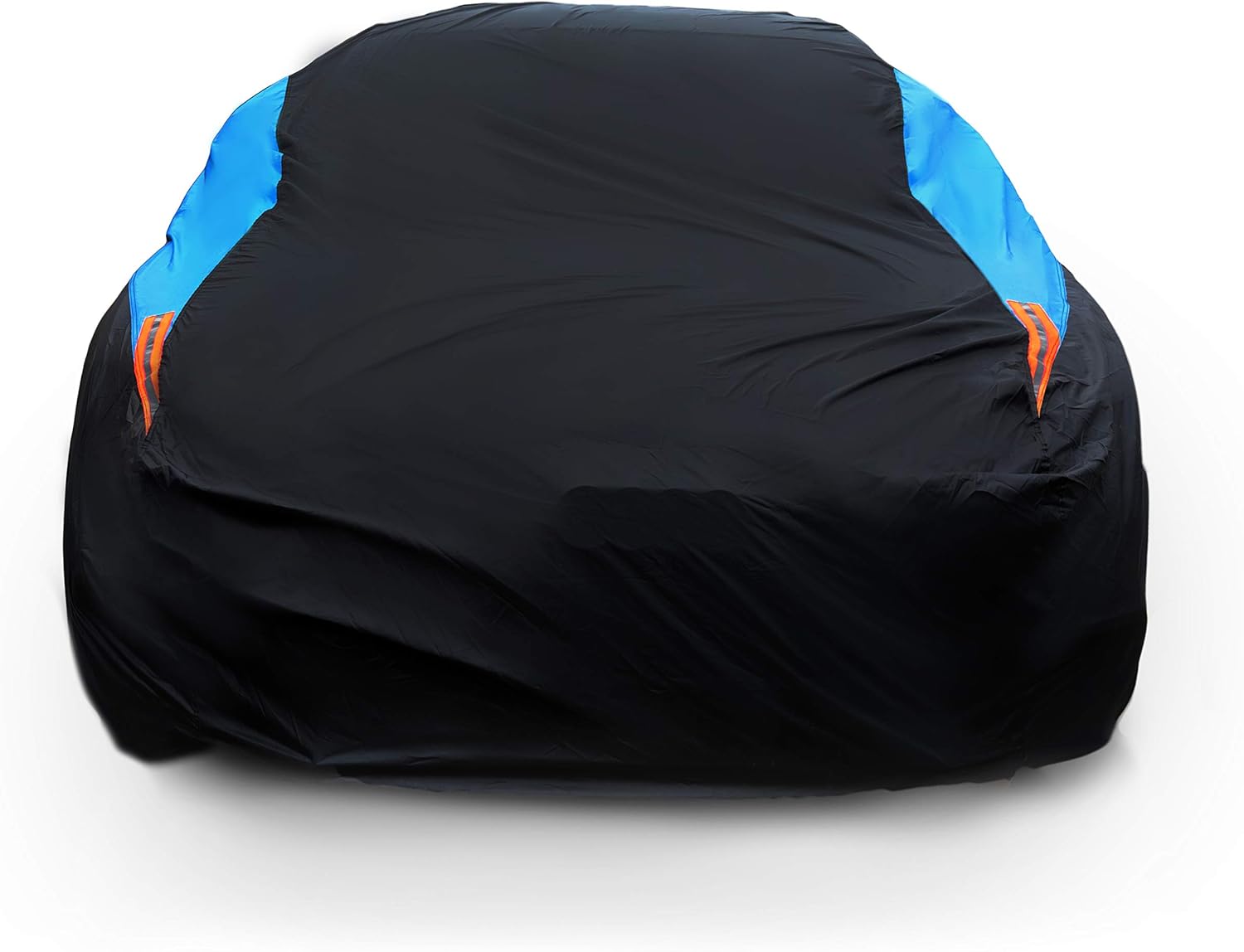
SUV Car Cover Fitment Issues and Solutions — Why It Doesn’t Fit
⚡ Quick Answer
SUV car covers fail to fit because SUVs vary too much in height, length, and width for a one-size approach to work. The 3 causes are: wrong size selection, ignoring roof or mirror accessories, and buying a universal cover that’s designed for a much broader vehicle range.
The 3 most common SUV fitment problems:
- Too loose: Cover flaps in wind, lets in dust, and rubs paint
- Too tight: Strains over mirrors, stresses seams, tears over time
- Wrong shape: Doesn’t account for roof racks, spare tires, or lift kits
Fix it fast:
-
✓
Measure length, width, and height before ordering -
✓
Add 2 inches for any roof-mounted accessories -
✓
Choose custom-fit over universal for precise protection
You pull the cover over your SUV and something’s already off. One corner won’t reach the bumper. The sides billow out like a tent. Or worse — it’s so tight you’re yanking it over the mirrors with both hands. I’m Daniel Brooks, and after covering dozens of SUVs with the wrong covers before finding what works, I can tell you: this is one of the most common mistakes SUV owners make. Here’s exactly why it happens and how to get it right.
📌 Key Takeaways
-
→
SUVs span 5 size classes, from subcompact crossovers to full-size extended models — a single “SUV size” cover won’t fit all of them. -
→
Most budget brands offer only 3–5 sizes for all SUVs, which almost always results in a poor fit and eventual paint damage. -
→
Accessories like roof racks and lift kits change your SUV’s shape enough that even a correctly sized cover will fail without accounting for them. -
→
A loose cover that flaps in wind causes micro-scratches on your paint — the same damage you were trying to prevent.
Why Do SUV Car Covers Fail to Fit Properly?
SUV car covers fail to fit because the SUV category spans an enormous range of shapes and sizes — more than any other vehicle type. A subcompact crossover like a Toyota RAV4 is nearly 15 inches shorter and 5 inches lower than a full-size Ford Expedition. No single “SUV cover” can bridge that gap.
The problem runs deeper than just length. SUVs have varied rooflines, rear-mounted spare tires, boxy or sloped rear ends, and tall cargo areas. A cover sewn for one SUV silhouette will fight a different one every time.
The Cover Is Too Loose
A loose cover doesn’t just look untidy. It actively damages your SUV. When wind gets under a loose cover, the fabric whips against your paint constantly.
That movement traps any dust particles sitting between the cover and your paint. Those particles act like sandpaper. The result is a pattern of fine scratches across your finish — exactly what a cover is meant to prevent.
Loose covers also collect rainwater in pockets on the roof and hood. That pooled water can seep through a non-breathable fabric. It sits against the paint and accelerates rust over time.
The Cover Is Too Tight
A cover that’s too tight puts constant pressure on your mirrors, antenna, and any trim pieces that stick out. Over weeks and months, that pressure causes wear on the plastic and chrome.
You might also think — “tight means it won’t blow off.” But here’s the problem: a tight cover stretches the fabric beyond its design limits. The seams loosen, the elastic hem weakens, and after a few months you have a worn-out cover that no longer protects anything.
Removing a tight cover is also a scratch risk. If any grit or dust is present, dragging a tight cover across the paint creates clear-coat damage instantly.
The Shape Doesn’t Match Your SUV’s Profile
This is the most overlooked problem. Your SUV may be the right length and width for the cover — but the shape is completely different.
A cover cut for a flat-roofed SUV sits like a tent over a sloped-roof crossover. A cover designed for a standard rear end bunches awkwardly around a rear-mounted spare tire or tow hitch. The fabric has nowhere to go, so it pulls in the wrong direction and leaves parts of your SUV exposed.
💡 Key Insight
The SUV category includes everything from compact crossovers at 167 inches to extended full-size models at over 220 inches. That’s a 53-inch difference in length — the same as buying pants for someone who is 5’2″ and someone who is 6’6″ using one pair.
So what’s the fix? The next section covers exactly how to measure your specific SUV so you never order the wrong size again.
How to Measure Your SUV for a Car Cover (The Right Way)
Accurate measurements solve most fitment problems before they start. SUV covers require 3 measurements: length, width, and height. All 3 must be taken correctly or the cover will still fail.
Industry guides from sources like CarCovers.com’s cover selection guide consistently emphasize straight-line measurements — not tracing the vehicle’s curves. Here’s the full process:
🔢 Step-by-Step: How to Measure Your SUV for a Car Cover
-
1
Measure the length (bumper to bumper)
Pull a tape measure in a straight horizontal line from the very front of your front bumper to the very back of your rear bumper. Include any tow hitch or rear-mounted spare tire in this measurement. Round up to the next inch.
-
2
Measure the width (mirror to mirror)
Measure from the outermost point of the driver’s side mirror to the outermost point of the passenger’s side mirror. If you fold your mirrors in when covering the SUV, measure with them folded. Round up to the next inch.
-
3
Measure the height (ground to roof peak)
Measure from the base of the tire on the ground straight up to the highest point of the vehicle — usually the roof. If you have roof rails, roof racks, or a cargo box, measure to the top of those accessories. This step is critical for tall SUVs.
-
4
Add clearance for accessories
For any roof-mounted accessory, add 2–3 inches to your height measurement. For a rear-mounted spare tire or swingarm, add 4–6 inches to your length measurement. Accessories that aren’t in your measurements will always create a poor fit.
-
✓
Compare your measurements to the sizing chart
Enter your make, model, and year into the manufacturer’s vehicle selector, then cross-check your 3 measurements against the sizing chart. If your measurements fall between two sizes, always choose the larger size for an SUV.
⚠️ Warning
Never trace your measurements along the curves of the body panels. Always pull the tape measure in a straight line from point to point. Curved measurements add false length and produce an oversized cover that won’t fit snugly.
With your 3 numbers in hand, you’re ready to choose the right type of cover. That’s where most people get the next decision wrong.
Universal vs. Custom-Fit SUV Car Cover: Which One Solves Your Fitment Problem?
The fitment type you choose determines how well the cover protects your SUV — and whether you’ll be dealing with fit issues all over again in 6 months. There are 3 options on the market: universal, semi-custom, and custom-fit.
Here’s what each type actually delivers for SUV owners:
For most SUV owners using their vehicle daily in all weather, a semi-custom cover using a full size-chart system hits the best balance of fit, protection, and cost.
You might be thinking: “A universal cover is cheaper and I can just get a bigger size to be safe.” That logic backfires every time. A cover that’s too big on an SUV catches wind like a sail, pulling against the finish all night. The slightly higher price of a semi-custom or custom cover pays for itself by preventing one round of paint correction.
The EzyShade 10-Layer Car Cover is one of the few products that bridges the gap well — it uses a detailed size-chart system so you can match your SUV’s exact dimensions rather than guessing from 3 vague universal sizes.
Recommended Product
EzyShade 10-Layer Car Cover Waterproof All Weather — Full Exterior Covers — Winter Rain Sun SUV Sedan (See Size Chart)
★★★★☆ Highly rated on Amazon
Uses a detailed vehicle size chart so you can match your specific SUV’s dimensions — the right way to avoid fitment problems without paying for a full custom cover.
As an Amazon Associate, we earn from qualifying purchases.
But even a perfectly sized cover can fail if your SUV has been modified. Here’s what changes everything about fitment.
Do Roof Racks, Lift Kits, and Accessories Change How a Car Cover Fits?
Yes — and this surprises most SUV owners. Even a cover that was perfectly sized for your stock vehicle will fail once you add exterior accessories. Any modification that changes the outside profile of your SUV changes what cover you need.
Here are the most common accessories that cause fitment problems — and exactly how they affect your measurements:
📋 SUV Accessories That Affect Car Cover Fitment
-
Roof racks and rails: Add height. A standard roof rack adds 2–4 inches above the roof. A cover that stops at the roofline will stretch and tear over the rack frame. -
Rooftop cargo boxes: Add significant height and bulk. A rooftop cargo carrier can add 8–14 inches. Most standard covers will not stretch over it — you need an oversized or custom cover explicitly designed for cargo box clearance. -
Lift kits: Add height from the ground up. A 3-inch lift kit means the cover’s elastic hem now sits 3 inches higher than designed — leaving the lower rocker panels exposed. -
Rear-mounted spare tire or swingarm: Adds length to the rear. A spare tire mounted on a swingarm can add 6–10 inches behind the factory bumper. A standard cover will bunch up and not cover the lower rear panels. -
Brush guards and winches: Add width and depth to the front. A bull bar or winch bumper extends the front profile enough to prevent the cover’s front hem from sitting flush under the bumper. -
Oversized tires: Add width. Wide off-road tires increase the vehicle’s stance. A cover sized for factory tire width will struggle to pull down and secure under the wider tire footprint.
So what’s the rule? Measure your SUV with every accessory installed — not from the factory spec sheet. The cover needs to fit the SUV you actually own, not the one that rolled off the assembly line.
If your SUV is heavily modified, a custom-fit cover is the only real solution. Semi-custom covers can handle mild modifications with added clearance, but significant lift kits or cargo setups need a cover built around those specific dimensions.
How Tight Should a Car Cover Fit on an SUV?
The right fit feels like a well-fitted jacket — snug enough to stay in place, loose enough to slide on and off without pulling. A cover that fits correctly shouldn’t require any yanking, stretching, or struggling.
There are 3 clear signs your SUV car cover fits correctly:
✓ Signs Your SUV Car Cover Fits Correctly
-
✓
The elastic hem sits flush under the bumper on all 4 sides without gaps or pulling -
✓
The fabric lies flat against the roof and hood — no sagging, no tenting, no pooling spots -
✓
You can slide two fingers between the cover and the body panel — not your whole hand, but not zero clearance
⚠️ Warning
Never force a cover onto your SUV if it resists at the mirrors or roofline. Forcing a tight cover causes the fabric to drag across the paint on removal — and any trapped grit becomes sandpaper against your clear coat.
One important note: covers stretch slightly over the first 3–4 uses as the fabric loosens. If your new cover feels mildly snug at first but goes on without forcing — that’s normal. If it requires real effort to get over the mirrors from day one, the size is wrong.
What Damage Does a Poorly Fitting SUV Car Cover Actually Cause?
A bad-fitting cover doesn’t just fail to protect — it actively harms your SUV’s exterior. The damage is slow enough that many owners don’t connect it to their cover until the finish is already compromised.
Wind
Flapping cover scrapes dust particles across paint daily
Water
Pooled rainwater under cover causes paint oxidation and rust
Mold
Trapped moisture with no breathability breeds mildew under cover
The scratch risk from a loose cover is especially misunderstood. Most SUV owners believe scratches come from hail or road debris. But a loose cover that shifts just 1–2 inches every 30 minutes of wind exposure creates dozens of micro-scratches over a season.
Those scratches aren’t deep — but they dull the clear coat. Under sunlight, the paint looks hazy rather than glossy. Correcting that damage takes professional paint polishing, which typically costs $150–$400 on a full-size SUV.
You can learn more about selecting the right fit level for your vehicle from CarCovers.com’s frequently asked questions on car cover fitment, which addresses exactly how cover movement causes paint damage.
What Most People Get Wrong About SUV Car Cover Fitment
Most fitment problems start with a wrong assumption. Here are the 3 beliefs that send SUV owners back to the store after a poor first purchase.
“If the cover reaches all 4 bumpers, it fits.” This is the most common mistake. A cover that reaches all 4 bumpers but sags in the middle or pulls tight over the roofline doesn’t fit — it just covers. A properly fitting cover sits flush against every panel without tension or bunching anywhere. Length is only one of 3 dimensions that matter.
“Bigger is safer than smaller for an SUV.” Many owners intentionally buy one size up, believing a larger cover will be easier to put on and less likely to rip. The opposite is true. An oversized cover on an SUV catches more wind, pools more water, and creates more movement against the paint. A cover 10 inches too long on a full-size SUV is more damaging than no cover at all in windy conditions.
“Universal SUV covers are all basically the same.” They’re not. Some universal covers labeled “SUV” are designed around compact crossover dimensions. Put one of those on a full-size Chevrolet Suburban and the hem won’t reach the rocker panels. Always read the specific length and height range listed in the product specifications — not just the category label on the packaging.
How to Stop Your SUV Car Cover from Blowing Off
Even a correctly fitted cover can blow off in strong wind if you don’t secure it properly. Wind gets under the elastic hem and lifts the cover from the bottom. Here’s how to keep it in place:
✓ Wind Security Checklist for SUV Car Covers
-
✓
Use the underbody straps that came with your cover — thread them under the vehicle and buckle securely on both sides -
✓
Thread a cable lock through the grommets on each side of the cover and around a door handle or wheel for added security -
✓
In persistent high wind, add a separate gust strap across the roof of the cover — these attach to the door jambs and hold the cover down from the top -
✓
If your cover keeps blowing off even with straps, the size is wrong — a properly fitted cover with a snug elastic hem should stay in light to moderate wind without any straps at all
A cover that requires 4 straps just to stay put is always a fitment problem in disguise. The right-sized cover with a good elastic hem sits stable in 20–25 mph winds without anything more than the built-in straps.
Conclusion
SUV car cover fitment problems almost always come down to one of three things: wrong size selection, not accounting for roof or rear accessories, or choosing a universal cover designed for too wide a range of vehicles. Getting the right fit isn’t complicated — it starts with 3 accurate measurements and a cover sized to your specific SUV’s dimensions.
A well-fitted cover shouldn’t fight you. It should slide on cleanly, sit flush, and stay put. If yours does any of the opposite — it’s the wrong size, not a bad product category.
One thing to do right now: Grab a tape measure and check your SUV’s length from bumper to bumper. If it doesn’t match the size range listed on your current cover’s packaging — that’s why it doesn’t fit, and that single number will tell you exactly what to order next.
Frequently Asked Questions
Why doesn’t my car cover fit my SUV even though it says “SUV size”?
Most budget brands use only 3–5 generic sizes to cover all SUVs. Since SUVs span from 167-inch compact crossovers to 225-inch full-size models, a single “SUV size” label is nearly meaningless. Always check the specific length, width, and height range listed in the product specifications before buying.
How do I know what size car cover to get for my SUV?
Measure your SUV’s bumper-to-bumper length, mirror-to-mirror width, and ground-to-roof height with a tape measure pulled in straight lines. Round each measurement up to the next inch. Compare those numbers to the manufacturer’s sizing chart — not just the “SUV” category label. If you fall between two sizes, choose the larger one.
Can a loose car cover scratch my SUV’s paint?
Yes. A loose cover that shifts in the wind traps dust particles between the fabric and your paint. That movement turns those particles into an abrasive that creates micro-scratches across your clear coat. Over one season outdoors, this damage dulls the finish noticeably and typically requires professional correction to fix.
Why does my car cover keep blowing off my SUV?
A cover that blows off is almost always too large. The loose elastic hem allows wind to get underneath and lift the fabric. The fix is a better-fitting cover first, then use underbody straps and grommets with a cable lock as secondary security. A correctly fitted cover stays in place in moderate wind without straps.
Do roof racks affect which car cover I need for my SUV?
Yes. Roof racks, cargo carriers, and roof rails all add height to your SUV’s profile. A standard cover sized to your factory roof height won’t stretch over the rack — it will pull tight against the frame, leaving the rack exposed and straining the fabric seams. Always add the rack height to your height measurement before ordering.
Should I get a universal or custom-fit car cover for my SUV?
For daily outdoor use, a semi-custom cover with a detailed size chart is the best balance of fit and cost. Universal covers are acceptable for short-term indoor use only. Custom-fit covers are worth the higher price if you store your SUV long-term or have significant exterior modifications like a lift kit or rear spare tire mount.
What happens if my SUV car cover is too small?
A cover that’s too small puts constant pressure on your mirrors, antenna, and trim. The elastic hem won’t reach under the bumpers, leaving the lower panels exposed. Over time, the fabric stretches beyond its capacity, seams loosen, and the cover tears. A too-small cover also scratches paint on removal because the tight fabric drags across any surface grit.

Daniel Brooks is an automotive writer and product researcher focused on car accessories, car tech, maintenance, and practical driving guides. At Plug-in Car World, he helps drivers make smarter automotive decisions through honest reviews and research-driven content.