
How Tight Should Car Seat Harness Straps Be? A Parent’s Guide
Quick Answer
Car seat harness straps should be snug, with no slack you can pinch at your child’s collarbone. Bulky coats and unapproved car seat covers can hide slack, so check those layers before you buckle.
The 30-second check
- Pinch test: Try to pinch the strap webbing at the collarbone, and tighten it if you can grab a fold.
- Chest clip: Slide the clip up to armpit level after the straps are snug.
- Strap height: Match the slot height to rear-facing or forward-facing rules in your seat manual.
- Flat straps: Smooth out twists, since a twisted strap can cut in and hide uneven tension.
- Final tug: Pull the adjuster strap until the harness lies flat against your child’s body.
Do not drive off yet if
- You can still pinch slack, or the chest clip sits on the belly.
- A thick coat or insert sits between your child and the straps.
This guide answers one simple question with care, because strap tightness is easy to get almost right. It covers the pinch test, chest clip position, strap height, and the everyday things that loosen a harness without you noticing.
You will also learn how to tell too tight from too loose, and when to recheck. Keep your seat manual close, since slot positions and adjuster styles vary by model.
In This Guide
What Does “Snug” Actually Mean for Harness Straps?
A car seat harness is the strap system built into a child safety seat. It spreads crash forces across the strongest parts of a child’s body.
Snug means the straps lie flat and close against the body, with no loose webbing to gather. It does not mean pulled hard enough to squeeze or restrict breathing.
Think of snug as firm contact, not pressure. The straps should follow the shape of the shoulders and hips without gaps.
- Shoulders: Straps sit flat over each shoulder, with no strap sliding off to one side.
- Hips: The lap portion stays low and flat, rather than riding up over soft tissue.
- Chest: The chest clip holds the straps in place at armpit level, once the harness is tight.
Slack matters because it gives a child room to move before the harness can do its job. A short check at the collarbone catches most slack in seconds.
Section takeaway: Snug means flat, firm contact with no pinchable slack, not straps pulled as hard as they will go.
How Do You Do the Pinch Test?
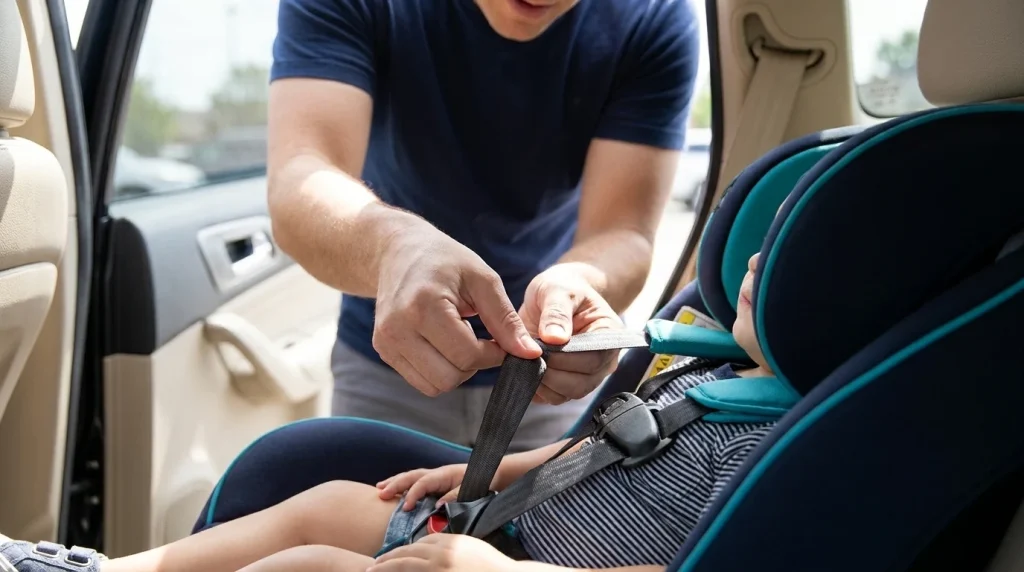
Use the pinch test after you buckle and tighten the harness. It gives a clear pass or fail result, without guessing from how the straps look.
Step-by-step pinch test
- Buckle the harness and slide the chest clip to armpit level.
- Pull the adjuster strap until the harness feels firm against your child’s body.
- Go to one collarbone, where the strap crosses the shoulder.
- Try to pinch the strap webbing between your thumb and forefinger.
- Tighten a little more if you can grab a fold, then test again.
Test at the collarbone, not at the belly or leg. Slack often hides near the shoulder, even when the lower straps look tight.
Stop when you cannot pinch a fold, but your child still breathes and moves normally. That balance is the goal on every ride.
Pro tip: Check your seat manual for the adjuster location, since some seats tighten from the front and others use a different pull point.
Section takeaway: If you can pinch strap webbing at the collarbone, the harness needs tightening before you drive.
Where Should the Chest Clip and Straps Sit?
Tightness alone is not enough, since position controls where the harness holds. A snug harness with a low chest clip can still let straps slide off the shoulders.
Chest clip position
Place the chest clip at armpit level, centered on the chest. Move it up after tightening, not before, so you judge the final strap tension.
- Too low: The clip sits near the belly, and straps can slip outward.
- Too high: The clip presses near the neck, and your child will likely squirm against it.
- Just right: The clip lines up with the armpits and keeps both straps evenly spaced.
Rear-facing vs. forward-facing strap height
For a rear-facing seat, use harness slots at or below the shoulders. This setup helps hold a younger child back into the seat during a frontal crash.
For a forward-facing seat, use harness slots at or above the shoulders. This setup helps keep the child from rising up and out of the harness.
Move the straps up as your child grows, and recheck the height after a growth spurt. A slot that fit last month can sit too low after a few inches of growth.
Flatten any twist before you tighten, since a twisted strap feels tighter than it is. Run a finger along each strap and smooth the webbing flat.
Section takeaway: Armpit-level clip, correct slot height for the seat direction, and flat straps turn a snug harness into a safe one.
Too Tight vs. Too Loose: How Do You Tell the Difference?
Too loose is the more common and more dangerous error, but too tight can still cause problems. Use the table below as a quick side-by-side check.
| Check | Too loose | Just right | Too tight |
|---|---|---|---|
| Pinch test | You can pinch a fold at the collarbone. | You cannot pinch a fold, but the strap still lies flat. | The strap digs in and leaves a deep, lasting mark. |
| Chest clip | The clip slides down, or straps slip off. | The clip stays at armpit level. | The clip presses hard into the chest or neck. |
| Child’s movement | Your child leans far forward with ease. | Your child breathes normally and sits upright. | Your child strains, cries from pressure, or cannot settle. |
| What to do | Tighten the adjuster and retest. | Leave it as is and recheck next ride. | Loosen slightly, then retest for slack. |
A faint strap line after a ride does not always mean the harness was too tight. Look instead for lasting red marks, skin pinching, or clear distress.
Comfort still matters, since a child who fights the harness each ride invites rushed buckling. Aim for firm and even, then add a thin layer for warmth if needed.
Section takeaway: Too loose fails the pinch test, too tight causes pressure or distress, and just right passes the pinch test while letting your child breathe normally.
What Affects Harness Tightness?
Several everyday changes can loosen a harness that felt perfect yesterday. Check these factors whenever a fit suddenly feels off.
- Bulky clothing: Puffy coats compress in a crash, and that compression can leave hidden slack.
- Seat covers and inserts: Unapproved padding can sit under straps and change how they route.
- Growth: A taller child needs higher slots and a fresh tension check.
- Twisted straps: A twist can make one side feel tight while the other side stays loose.
- Recline and install angle: A seat that shifted after reinstalling can change strap geometry.
- Washing and reassembly: Straps routed through the wrong slots after cleaning will not fit as before.
For winter, dress your child in a thin fleece layer for the ride. Buckle first, tighten second, then place a blanket over the harness for extra warmth.
For covers, use only inserts and covers approved by your seat maker. An unapproved layer can also void the guidance in your manual, so check that manual before adding anything behind your child.
As an illustrative example only, not a child-seat approval, see how a Sprints car seat cover fits before you judge any cover by looks alone. Fit, strap routing, and maker approval matter more than softness or style.
On hot days, keep layers thin and check for sweat-soaked straps that slide. A cooling car seat cover is a comfort choice for an adult seat, not a fix for a loose child harness.
Pro tip: For recalls and current child-seat guidance, check your seat manual and NHTSA, or ask a certified child passenger safety technician to check the install.
Section takeaway: Coats, covers, growth, twists, and reinstalls can all change tension, so treat any fit change as a reason to retest.
How Often Should You Recheck Harness Straps?
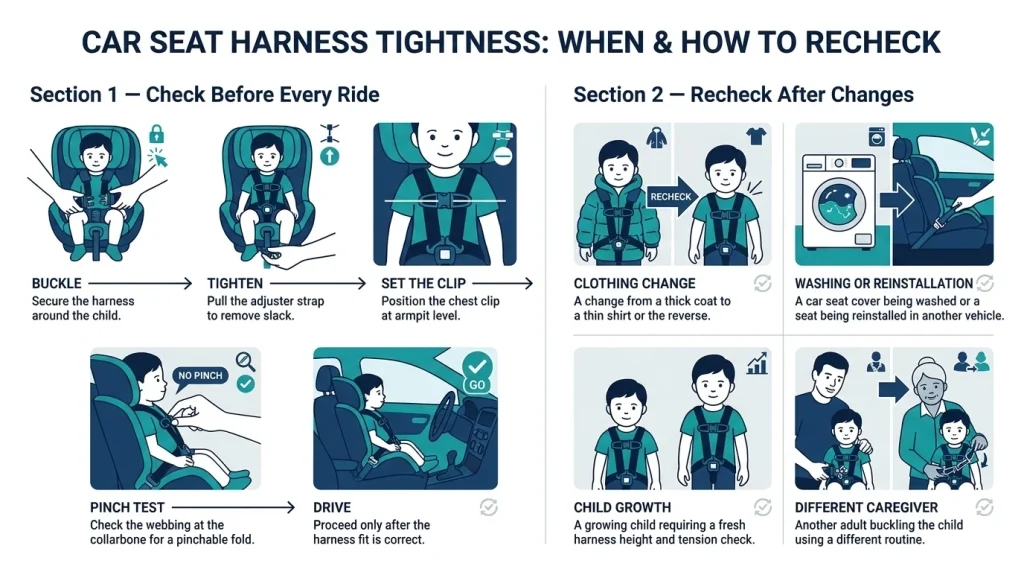
Recheck harness tightness on every ride, as of October 2026. A 30-second pinch test costs little time and catches most daily changes.
Recheck right away after any of these changes, since each one can alter fit.
- Your child switches from a coat to a T-shirt, or the reverse.
- You wash the cover, remove the seat, or reinstall it in another car.
- Your child has a visible growth spurt or moves to new harness slots.
- Another caregiver buckles your child and uses a different routine.
Build the check into the same routine each time. Buckle, tighten, set the clip, pinch test, then drive.
After a crash, follow your seat manual and maker guidance before using the seat again. Some seats need replacement after certain crashes, even when damage looks minor.
For independent ratings and fit notes, Consumer Reports publishes child-seat testing information alongside its other safety coverage. Use it as background, not as a substitute for your seat manual.
Section takeaway: Check every ride, recheck after clothing, growth, washing, or reinstall changes, and treat a crash as a manual-check moment.
Frequently Asked Questions
Should harness straps be as tight as possible?
No, straps should be snug, not forced to their limit. A harness passes when you cannot pinch slack at the collarbone, yet your child still breathes normally and sits without pressure marks.
Can my child wear a winter coat in a car seat?
A thick, puffy coat should come off before buckling, since it can compress and leave slack. Dress your child in a thin fleece layer, buckle and tighten, then add a blanket over the harness for warmth. HealthyChildren.org also covers winter car-seat clothing in its parent guidance.
Where should the chest clip go?
Place the chest clip at armpit level, centered on the chest. A clip near the belly lets straps slip, while a clip near the neck can press and cause your child to squirm out of position.
How do I know if the straps are too loose?
Use the pinch test at the collarbone after tightening and setting the chest clip. If you can pinch a fold of webbing, tighten the adjuster a little more and test again before driving.
Do harness straps loosen over time?
Straps can feel looser after clothing changes, growth, washing, or a reinstall. That is why a quick pinch test each ride matters more than a single perfect adjustment from weeks ago.
What should I do if a strap keeps twisting?
Flatten the strap fully before tightening, and check that it passes through the correct slots. A twisted strap can feel tight in one spot while leaving slack elsewhere, so do not judge tension until the webbing lies flat.
Before your next drive, run the pinch test one more time. A snug harness, an armpit-level clip, and the right slot height give your child the best protection your seat can offer.

Daniel Brooks is an automotive writer and product researcher focused on car accessories, car tech, maintenance, and practical driving guides. At Plug-in Car World, he helps drivers make smarter automotive decisions through honest reviews and research-driven content.
