
What Is a Child Passenger Safety Technician (CPST)? A Complete Parent’s Guide
Quick Answer
A Child Passenger Safety Technician (CPST) is a trained, certified professional or volunteer who teaches families how to select, install, and use child car seats correctly. A CPST checks car seat fit, installation, harness positioning, and proper use using manufacturer instructions and recognized safety guidance, including NHTSA’s child passenger safety recommendations.
What a CPST can help you with
- Car seat selection: Identify a seat appropriate for your child’s age, size, and developmental needs.
- Installation checks: Review seat belt or lower-anchor installation, positioning, and stability.
- Harness adjustments: Demonstrate correct strap height, tightness, and buckle positioning.
- Safety education: Explain common mistakes, manufacturer instructions, and safer everyday habits.
- Hands-on training: Teach caregivers to repeat the installation independently.
Good to know: Many U.S. car seat inspection stations offer free appointments. You can often find certified technicians through NHTSA or Safe Kids Worldwide.
Installing a child’s car seat can feel straightforward until you encounter unfamiliar anchors, confusing labels, or a harness that never seems quite right. A Child Passenger Safety Technician can help turn that uncertainty into practical, repeatable safety habits.
I believe the most valuable part of a car seat inspection isn’t simply getting the seat installed. It’s learning why the setup works and how to check it yourself before every trip.
This guide explains what CPSTs do, how certification works, what happens during an inspection, and when families should seek professional assistance.
In This Guide
What Is a Child Passenger Safety Technician?
A Child Passenger Safety Technician is someone who has completed specialized training in child restraints and passenger safety. The credential is commonly abbreviated as CPST, and the field is called child passenger safety, or CPS.
In the United States, the national certification program operates through Safe Kids Worldwide. Its curriculum is developed with the National Highway Traffic Safety Administration (NHTSA).
What is the primary purpose of a CPST?
A CPST’s main job is education. Technicians help parents and caregivers understand how to use a suitable child restraint correctly in their own vehicle.
Their work includes several important responsibilities:
- Preventing misuse: Finding installation and harness errors before they become routine.
- Explaining compatibility: Reviewing car seat instructions alongside the vehicle owner’s manual.
- Supporting growth transitions: Helping families understand when a child has outgrown a restraint.
- Demonstrating correct use: Teaching caregivers how to install and buckle the child independently.
- Sharing safety resources: Directing families toward manufacturer guidance, recalls, and trusted safety information.
Who works as a child passenger safety technician?
CPSTs come from different professional and personal backgrounds. Certification is not limited to one career or job title.
- Firefighters and emergency medical services personnel
- Police officers and community safety educators
- Nurses and hospital staff
- Public health professionals
- Parents and trained community volunteers
- Child passenger safety advocates
Not every firefighter, police officer, or hospital employee is a certified technician. Always confirm the person’s current CPST qualification.
Is a CPST different from a regular car seat installer?
Yes. Someone may have experience installing car seats without completing nationally recognized CPST training.
The important difference is documented training in child passenger safety, practical assessments, and ongoing certification requirements.
| Comparison | Certified CPST | Uncertified helper |
|---|---|---|
| Formal CPS training | Required | Not established |
| Hands-on assessment | Required for certification | May vary |
| Certification renewal | Every two years | Not necessarily required |
| Caregiver education | Core responsibility | Depends on experience |
| Safety expertise | Assessed against a standardized curriculum | Cannot be assumed |
Section Takeaway: A CPST is a trained educator, not simply someone who installs seats. Their goal is to leave you capable of using the restraint correctly.
What Does a CPST Check on a Car Seat?
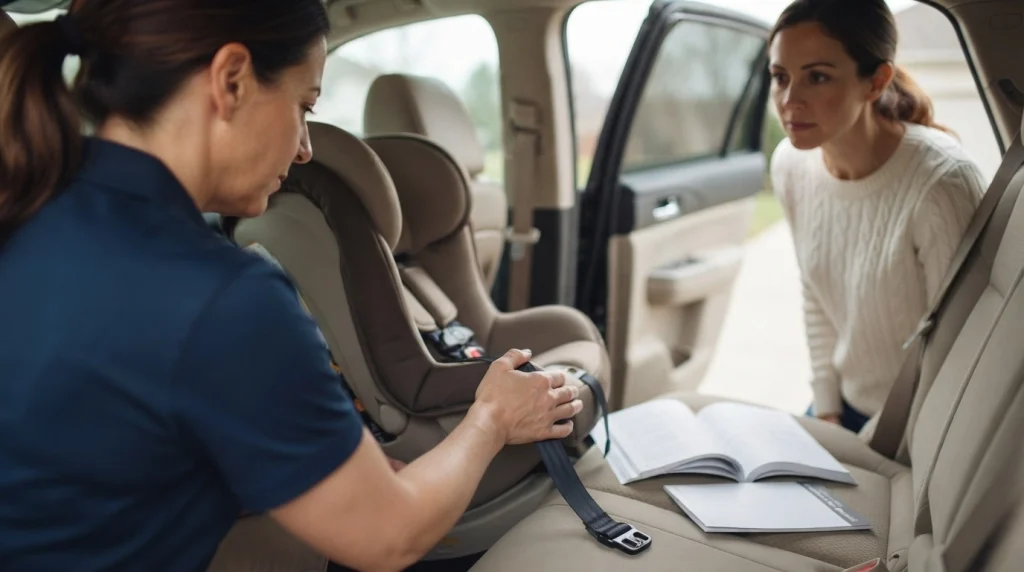
A CPST reviews both the installation and how the child fits inside the restraint. A secure-looking car seat can still have an incorrect harness or unsuitable installation method.
1. Choosing the correct type of car seat
The technician starts by checking whether the restraint suits the child. Age, height, weight, seat limits, and developmental considerations all matter.
Common restraint categories include:
- Rear-facing-only seats: Designed for rear-facing travel, commonly used for infants.
- Convertible seats: Designed for rear-facing and forward-facing use within specified limits.
- Forward-facing harness seats: Restrain children using an integrated harness.
- Booster seats: Position the vehicle seat belt properly across a child who has outgrown a harnessed seat.
A technician also reviews whether a child should remain rear-facing longer. The correct decision depends on the seat’s limits and applicable safety recommendations.
2. Checking the installation method
CPSTs examine how the restraint connects to the vehicle. Many harnessed car seats use either an approved seat belt installation or lower anchors.
LATCH means Lower Anchors and Tethers for Children. A technician explains the system’s components and any vehicle-specific restrictions.
- Confirm the approved installation method.
- Check the correct belt path.
- Review seat belt locking or lower-anchor attachment.
- Check applicable lower-anchor weight limits.
- Inspect the top tether on a forward-facing installation.
- Verify rear-facing recline angle when applicable.
Using both lower anchors and a seat belt together is not automatically safer. The manuals must explicitly permit that combination.
3. Testing car seat movement
For a conventional installed harnessed seat, the technician checks movement at the belt path. NHTSA’s general guideline is no more than one inch of movement side-to-side or front-to-back at that point.
Checking the upper shell instead can produce a misleading result. Follow the instructions for the specific restraint.
You can review the official NHTSA car seat installation tips for additional guidance.
4. Inspecting harness fit and positioning
A CPST also checks how the child sits inside the restraint. Even a correctly installed seat cannot provide its intended protection if the harness is used incorrectly.
- Rear-facing harness straps generally start at or below shoulder level.
- Forward-facing harness straps generally start at or above shoulder level.
- Harness webbing should lie flat without twists.
- Straps should fit snugly, following the seat’s instructions.
- For seats with a standard chest clip, it should generally sit at armpit level.
- Bulky clothing should not prevent proper harness tightening.
The technician can demonstrate the pinch test and explain how harness fit changes with clothing and growth.
5. Reviewing seat condition and safety labels
Technicians may review model identification, expiration information, recalled components, and visible condition. They can also explain manufacturer rules for using a seat after a crash.
A CPST cannot certify that a damaged seat is crashworthy or perform a laboratory crash test. Questions about hidden damage or defective components must follow manufacturer guidance.
Pro tip: Keep both instruction manuals available. If guidance conflicts or a part appears damaged, contact the restraint or vehicle manufacturer before using the questionable setup.
Section Takeaway: A complete check looks beyond tight installation. It also addresses seat suitability, harness fit, attachment methods, and safe everyday use.
What Happens During a CPST Appointment?
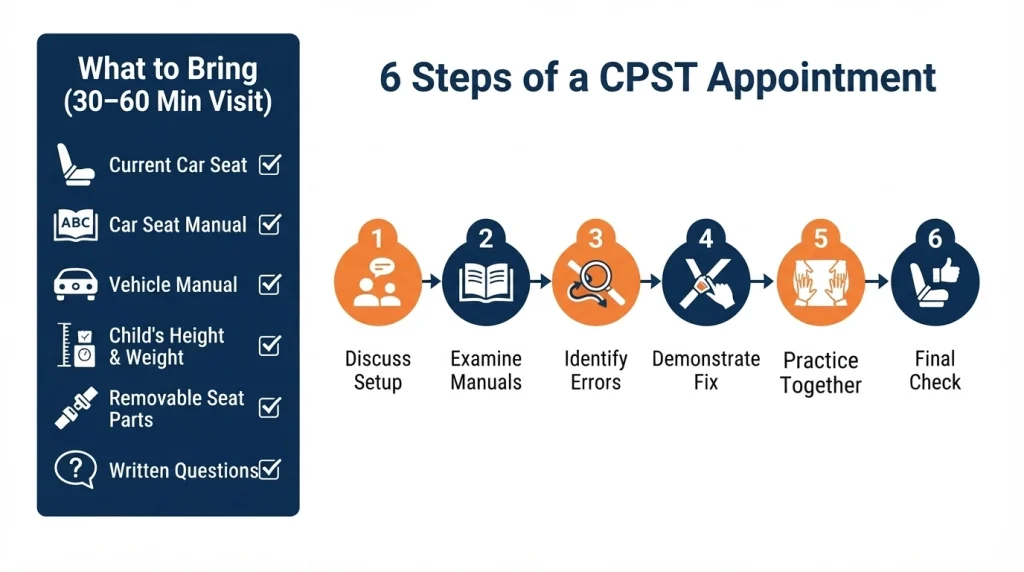
A typical CPST appointment combines observation, hands-on practice, and practical instruction. The exact process varies by inspection station and family needs.
Before the inspection
Prepare your vehicle and car seat so the technician can review the actual setup. Bringing the child, when practical, makes harness fitting more accurate.
Useful items include:
- The car seat currently used by your child
- The car seat instruction manual
- The vehicle owner’s manual
- Your child’s current height and weight
- Any removable seat parts supplied by the manufacturer
- A written list of installation questions
If you’re expecting a baby, you can arrange a check before birth. A technician can review the installation even when the child is not yet available for fitting.
During the inspection
The technician typically starts by asking about the child, vehicle, restraint, and installation history. They then inspect the setup and demonstrate any necessary corrections.
- Discuss the setup: Review the child’s size, seat model, and vehicle seating position.
- Examine instructions: Check relevant installation and restraint requirements.
- Identify errors: Look for incorrect routing, excessive movement, harness issues, or other misuse.
- Demonstrate corrections: Explain the approved method for the specific seat and vehicle.
- Practice together: Have the caregiver reinstall or adjust the seat with guidance.
- Complete a final check: Review the finished installation and answer questions.
Will the technician install the seat for you?
A technician may demonstrate or assist with installation. However, teaching the caregiver to do the job independently is central to the service.
Consider a common situation: the seat appears secure, but the parent has checked movement at the headrest instead of the belt path. A CPST can explain the correct testing point and guide the parent through the adjustment.
That practical knowledge remains useful whenever the car seat needs to be removed, cleaned, or transferred.
How long does an appointment take?
Appointment duration varies according to the number of restraints, installation difficulty, and available staff. As a planning estimate, allow around 30–60 minutes for one seat, and confirm the expected duration when booking.
Complex installations or several children may require more time.
When Should You See a CPST?
You don’t need to discover a serious problem before requesting a car seat inspection. Preventive education is one of the best reasons to schedule an appointment.
Before bringing a newborn home
Newborn restraint installation can raise questions about recline angles, harness positioning, and vehicle compatibility. A prenatal appointment lets caregivers practice before the first ride.
After purchasing a new car seat or vehicle
A familiar seat may install differently in another vehicle. Anchor locations, seat belt designs, and seating geometry can change the approved setup.
Get help when switching restraint models or moving the seat into an unfamiliar vehicle.
When your child reaches a new growth stage
Children eventually outgrow their current restraint by height, weight, or another manufacturer limit. A CPST can explain when to change configurations without transitioning prematurely.
This is particularly useful when comparing rear-facing, forward-facing, and booster options.
When installation problems keep returning
A technician can help when the seat moves excessively, the belt won’t lock properly, or the harness seems difficult to adjust.
Other useful reasons include:
- Difficulty identifying the correct tether anchor
- Uncertainty about lower-anchor limits
- Confusing manufacturer’s labels
- Questions about a premature or medically complex child’s positioning
- Uncertainty after a collision
- Questions about an older or secondhand restraint
For children with complex medical or positioning needs, ask whether the technician has specialized training. Some cases require a CPST with additional special-needs expertise and input from the child’s healthcare team.
Section Takeaway: Arrange a CPST check whenever the child, car seat, vehicle, or installation circumstances change. You don’t have to wait for visible misuse.
How Do You Find a Certified CPST?
In the United States, families can locate child passenger safety technicians through recognized certification and safety organizations. Start with official directories rather than assuming every local safety agency offers inspections.
Use the Safe Kids technician directory
The Safe Kids Worldwide Find a Tech directory is a useful starting point. It helps families locate certified technicians who have chosen to make their information publicly available.
Not every certified technician appears in public search results. Some restrict their public contact information.
Check local inspection stations
Many communities offer checks through public safety agencies, hospitals, or nonprofit programs. NHTSA also provides inspection station information through its car seat safety resources.
Possible local contacts include:
- Fire departments with designated inspection programs
- Police department community safety units
- Children’s hospitals and maternity centers
- County or municipal public health departments
- Safe Kids coalitions and community events
Call first to confirm the location has a currently certified CPST. A fire station’s normal operating hours do not necessarily mean inspection appointments are available.
What should you ask before booking?
A short phone call can make the appointment more useful. Confirm the technician’s qualifications and the services offered.
- Is a currently certified CPST available?
- Do I need an appointment?
- Is the inspection free, or does a fee apply?
- Can I bring more than one car seat?
- Is my child required to attend?
- Do you offer virtual consultations?
- Can you assist with my child’s specific restraint or medical needs?
As of 2026, NHTSA indicates that inspections are free in most cases, although individual programs can have different policies.
Can you get CPST help outside the United States?
Yes, child passenger safety educators and technicians also work in other countries. However, certification systems, legal requirements, and restraint standards differ.
The U.S. CPST credential does not automatically establish expertise in every country’s regulations. Seek someone familiar with locally approved seats and vehicle requirements.
How Does Someone Become a CPST?
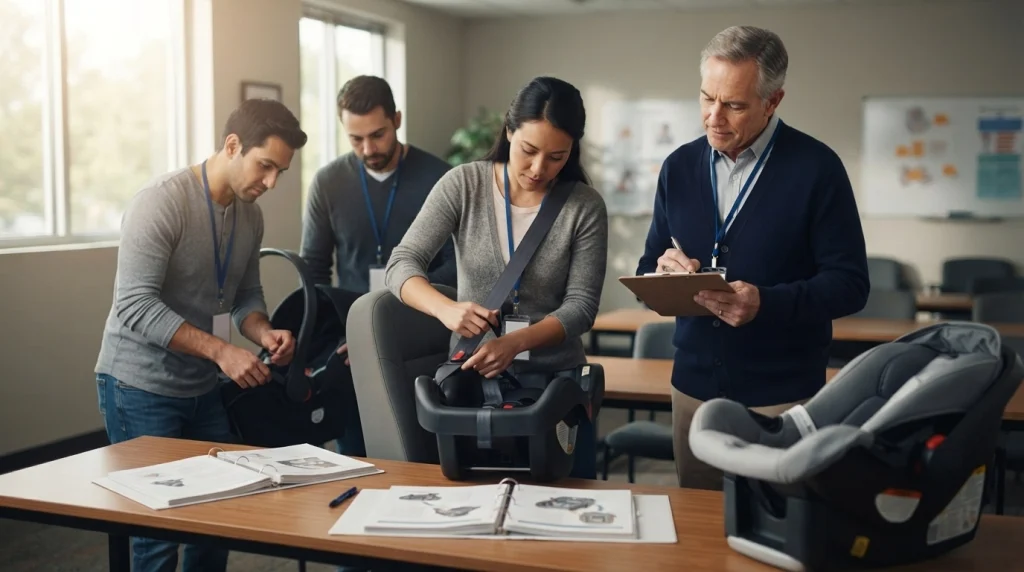
Becoming a nationally certified CPST requires specialized training and successful completion of a standardized certification course. In the United States, Safe Kids Worldwide manages the national program.
What are the certification requirements?
Applicants must be at least 18 years old when the course begins. They must attend the required training and pass written and practical assessments.
The standard certification course usually lasts three to four days. It covers child restraints, crash protection, installation techniques, and caregiver education.
Participants must complete:
- All required classroom and practical instruction
- Three open-book written quizzes with a combined passing score of at least 84%
- Four hands-on skills assessments
- A community seat check event demonstrating practical and teaching skills
Successful candidates earn certification for two years. You can review the official CPST certification course requirements before registering.
How much does CPST certification cost?
Safe Kids lists a national certification course fee of $95. Additional local expenses, such as travel or other training arrangements, may apply.
The initial training fee is separate from what a family might pay for a seat inspection.
Do CPSTs need continuing education?
Yes. Certification expires after two years unless the technician completes recertification requirements.
Current program requirements include:
- Five specified types of verified seat checks
- At least one community education activity
- At least six continuing education units
- Payment of the applicable recertification fee
Safe Kids currently lists a $55 recertification fee for technicians. Requirements and fees should be checked again before applying.
Regular education matters because car seat models, vehicle features, and installation instructions continue to change.
Pro tip: Ask about current certification when arranging an inspection. For a specific installation, the manufacturer’s latest instructions remain the primary technical reference.
Frequently Asked Questions About CPSTs
1. Do I need a CPST to install a car seat?
No. In general, parents can install a car seat themselves by carefully following the restraint and vehicle manuals. However, a CPST inspection can identify overlooked problems and provide hands-on education. An inspection is especially useful when you’re unfamiliar with the installation system.
2. Are child passenger safety technicians free?
Many community car seat inspection programs in the United States offer free assistance. NHTSA states that certified technicians generally provide free inspections at participating stations. Some private providers may charge, so confirm any fee before scheduling.
3. Can a CPST recommend the safest car seat?
A CPST can help identify appropriate options based on a child’s measurements, vehicle fit, and manufacturer limits. However, no single car seat is universally best for every family. Correct fit and proper use matter more than choosing a seat solely because it costs more.
4. Can a CPST tell whether a car seat is expired?
Yes. A technician can help locate manufacturing labels, model information, and manufacturer-defined expiration guidance. They may also help you check for recalls. If a date or label is unclear, the restraint manufacturer should confirm whether continued use is permitted.
5. Is a CPST the same as a car seat safety inspector?
People sometimes use these terms interchangeably, but CPST describes a specific training credential. A person offering inspections may or may not hold that certification. Ask for proof of current CPST status rather than relying on a job title.
6. Can a CPST help with three car seats across one back seat?
Yes. A CPST can review the seating arrangement, restraint dimensions, approved installation methods, and vehicle restrictions. However, not every three-across combination will fit or install correctly. The technician cannot approve a configuration that conflicts with manufacturer instructions.
7. Can a CPST guarantee a child will be safe in a crash?
No. A CPST can help reduce preventable misuse and teach correct restraint practices, but no installation or product eliminates crash risk. The goal is to use an appropriate, properly installed restraint every time the child travels.
Final Takeaway: A CPST Helps Families Travel More Safely
A Child Passenger Safety Technician offers more than a quick installation check. A qualified technician teaches families how to choose, install, adjust, and maintain child restraints according to the relevant instructions.
That education becomes especially valuable as children grow and vehicles change. It also helps caregivers recognize problems before their next journey.
If you’re unsure whether a car seat suits your child, start with NHTSA’s car seat finder and arrange an inspection with a currently certified CPST.
Your next step: Gather your car seat and vehicle manuals, check your child’s current measurements, and schedule a hands-on seat check. Leave the appointment knowing how to repeat the correct setup yourself.

Daniel Brooks is an automotive writer and product researcher focused on car accessories, car tech, maintenance, and practical driving guides. At Plug-in Car World, he helps drivers make smarter automotive decisions through honest reviews and research-driven content.
