
How to Adjust Car Seat Straps Correctly for a Safe Fit
Quick Answer
Adjust car seat cover straps so the cover sits flat, stays centred, and does not slide when you get in or out. Loosen every strap first, centre the cover, then tighten the backrest straps before the cushion straps in small, even steps. The same snug-but-not-stretched fit matters on padded and mesh styles, including cooling car seat covers. Finish with a seatbelt, airbag-seam, and headrest check, and recheck the fit after a short drive.
Quick strap checks
- Loosen first: Start loose so you can centre the cover before tension locks it in the wrong place.
- Centre it: Line up the seams with the seat edges before you tighten any strap.
- Tighten evenly: Adjust the left and right sides in small steps, not one side all at once.
- Test the slide: Press the cover and try to move it sideways with one hand.
- Check safety parts: Confirm the seatbelt, buckle, airbag area, and seat controls stay clear.
Stop and refit if
- The cover blocks a seatbelt buckle or traps seatbelt webbing.
- A strap crosses an airbag seam, a headrest lock, or a seat control.
- The cover bunches, lifts at an edge, or slides after a short sit test.
A loose seat cover bunches up at the worst moment, usually when you slide in with shopping bags or wet shoes.
This guide shows a simple order for adjusting the straps, so the cover stays put without pulling the fabric out of shape.
You will learn the main strap types, the right tightness, and the safety checks to run before you drive.
No special tools are needed for most covers, and the whole job often takes 15 to 30 minutes for one front seat.
In This Guide
What Are Car Seat Cover Straps?
A car seat cover strap is a fabric, elastic, or webbing strap that holds a seat cover to the seat frame or seat cushion.
It stops the cover from sliding, bunching, or lifting at the edges during normal use.
Most universal covers use a mix of straps, not one single system.
You may find straps at the headrest, behind the backrest, under the cushion, or along the sides.
- Headrest straps: Hold the top of the backrest cover in place.
- Backrest straps: Pull the back panel snug against the seat back.
- Cushion straps: Run under the seat cushion to stop side-to-side movement.
- Side or rear straps: Anchor the edges and stop the cover from riding up.
These straps are not seatbelt straps, and they are not child-restraint harness straps.
If you need help with a child seat harness, follow that restraint maker’s instructions and your vehicle owner’s manual instead.
A cover strap should hold fabric, never change how a seatbelt or airbag works.
That distinction guides every step below.
Section takeaway: Cover straps hold fabric in place; they must never replace, cover, or redirect a seatbelt, airbag seam, or child-restraint harness.
How Do You Adjust Car Seat Cover Straps Step by Step?
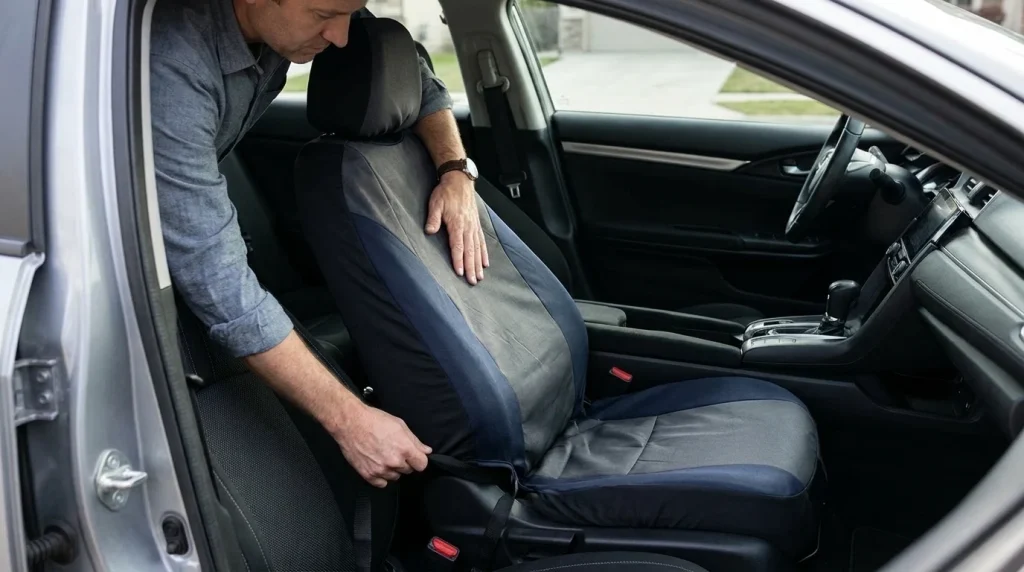
Start with the car parked, the engine off, and the seat in its normal driving position.
That position gives a true fit, not a fit that only works when the seat is pushed back.
You may want:
- A flashlight for under-seat hooks and dark anchor points.
- A dry cloth to wipe dust from the seat before fitting.
- Your cover maker’s instructions, if you still have them.
- Loosen all straps: Undo or slacken every strap so the cover can move freely.
- Fit the top first: Place the headrest and backrest sections, then line up the centre seam.
- Centre the cover: Match the side seams to the seat edges and smooth out large folds.
- Tighten the backrest: Adjust the backrest straps in small steps, left and right in turn.
- Route the cushion straps: Pass them under the cushion, clear of rails and moving parts.
- Tighten the cushion: Take up slack evenly until the cushion panel lies flat.
- Smooth and tuck: Push fabric from the centre outward, then tuck loose edges neatly.
- Sit and test: Sit normally, slide in and out, and move the seat back and forth once.
Drive a short, familiar route, then park and check the straps again.
Heat, movement, and sitting can settle fabric in ways a static fit check will miss.
What Changes for a Rear or Split Seat?
Rear covers often need separate straps for each seat section.
Tighten each section on its own, so one side does not pull the other out of line.
Leave split-fold gaps clear, and test the fold after fitting.
A strap across a split can stop the seat from folding and wear the fabric at the joint.
Section takeaway: Loosen everything, centre the cover, tighten backrest then cushion in small even steps, and recheck after a short drive.
How Tight Should Car Seat Cover Straps Be?
Correct tension feels snug, flat, and even, with no loose folds and no pulled seams.
The cover should stay in place when you slide in, but the fabric should not look stretched or distorted.
Use a simple hand test before you drive.
Press the cover and try to slide it sideways with one hand.
- Too loose: The cover slides easily, bunches at the cushion edge, or lifts when you stand up.
- Correct: The cover stays put, lies flat, and leaves all controls and buckles clear.
- Too tight: Seams pucker, hooks strain, or seat movement feels stiff and restricted.
Tighten in small steps, not one hard pull.
A hard pull can hide uneven tension and stress one hook or seam.
Illustrative example: a universal front-seat cover may need one extra small adjustment on the outer cushion strap after the first sit test.
That small, even change can stop edge lift without pulling the inner side tight.
Section takeaway: Aim for flat, even, and still, not drum-tight; if the fabric puckers or a control binds, you have gone too far.
What Strap Type Is on Your Cover?
Strap type changes the adjustment method, so find yours before you pull anything.
A hook needs a clear anchor point, while a buckle needs slack taken up evenly.
Material also changes how straps behave.
Stretchy mesh and neoprene may settle more after fitting, while stiff leather-style covers may need more smoothing at the edges.
| Strap type | How to adjust | Best for | Watch out for |
|---|---|---|---|
| Elastic loop | Stretch it over the seat section, then let it settle evenly. | Quick-fit universal covers | Stretched elastic that no longer springs back |
| Hook under the seat | Hook it to a firm frame point, then check it cannot slip off. | Cushion panels that need a firm anchor | Hooks near rails, wires, or moving seat parts |
| Buckle strap | Clip it, then pull the free end in short, even pulls. | Covers that need repeat adjustment | One side pulled much tighter than the other |
| Hook-and-loop strap | Press it flat after pulling it snug, with no fold or twist. | Backrest and side panels | Lint, dust, or worn fastening that weakens the grip |
| Tie or lace | Tie it firm and flat, then tuck the ends out of the way. | Custom and older-style covers | Loose ends that catch, plus uneven knots |
Check the maker’s label or care tag when the type is unclear.
It often shows the strap layout, even when the box is long gone.
For general guidance on interior products and care, see Consumer Reports.
Use its product guidance alongside your cover maker’s instructions, not instead of them.
Fit can vary by cover style, so a Sprints car seat cover review can help you see how one style handles straps and cushion fit.
Compare its strap layout with yours before you assume the same steps apply.
Section takeaway: Match the method to the strap type, and never force a hook, buckle, or fastener that does not sit flat and secure.
What Safety Checks Come Before You Drive?
Run safety checks after every adjustment, even a small one.
A strap that looks neat can still sit over a part that must stay clear.
- Seatbelt buckle: It stays fully visible and easy to reach, with no webbing trapped under the cover.
- Airbag area: The cover does not cover, stitch over, or block a side-airbag seam or label.
- Headrest and controls: Headrest locks, recline levers, and seat switches move freely.
- Moving parts: No strap sits near seat rails, motors, or the recline mechanism.
- Loose ends: No strap end hangs where it can catch on clothing, a bag, or a pedal area.
If a cover blocks a seatbelt, airbag area, or control, remove or refit it before driving.
Do not cut a strap or seam to force a fit, unless the maker clearly allows that change.
If your seat has heating or ventilation, check those openings before you tighten the final straps.
A cover that blocks vents or heating elements can feel warm in one spot and cool in another.
Pro tip: check your vehicle owner’s manual and NHTSA for safety and recall information before you change anything near an airbag or seatbelt.
Material and cut also affect safety clearance, which is one reason to compare styles in an Astonish car seat cover review before you buy a replacement.
Look for airbag-compatible design and clear buckle openings in that style.
Section takeaway: A neat fit is not a safe fit until the seatbelt, airbag area, headrest, and controls are all clear and free to move.
Why Won’t My Car Seat Cover Straps Stay Put?
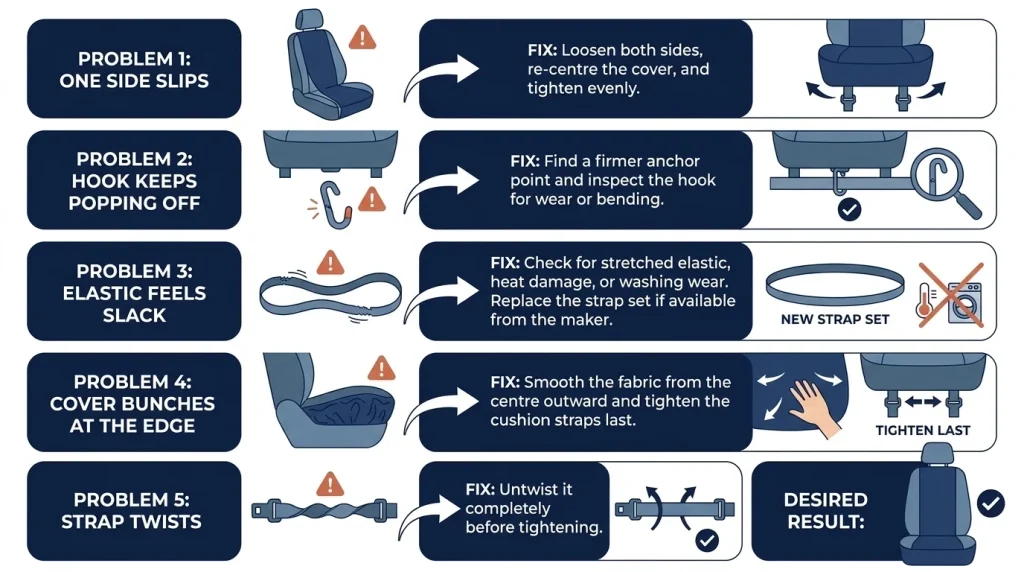
Most strap problems come from uneven tension, worn elastic, or the wrong cover size.
Fix the cause first, because extra pulling only hides it for a short time.
- One side slips: Loosen both sides, re-centre the cover, then tighten in small, even steps.
- Hook keeps popping off: Find a firmer anchor point and check the hook shape for wear or bending.
- Elastic feels slack: Check for stretched elastic, heat damage, or washing wear, and replace the strap set if the maker offers one.
- Cover bunches at the edge: Smooth the fabric from the centre outward, then tighten the cushion straps last.
- Strap twists: Untwist it fully before tightening, since a twisted strap grips less and wears faster.
Strap failure is common enough that a related guide covers car cover straps not working, with causes that can also help you spot a worn hook or stretched elastic.
Use it as a checklist, not as proof that an exterior-cover fix fits your seat cover.
Recheck straps after washing, after a long trip, and when seasons change.
Fabric and elastic settle with use, so a fit that felt perfect in spring may need a small change in summer.
Edmunds offers general vehicle and accessory guidance that can help you match a cover to your seat type.
Still, your cover maker’s fit instructions should win when the two differ.
Section takeaway: Slipping usually points to uneven tension, worn elastic, or wrong size, so fix that cause instead of just pulling harder.
Frequently Asked Questions
These answers cover the questions drivers ask most after a first fit.
How often should I adjust car seat cover straps?
Check them right after fitting, again after the first few drives, and then every few months of regular use. Recheck sooner after washing, a long trip, or any time the cover starts to slide, bunch, or lift at an edge.
Should car seat cover straps go under the seat?
In most universal designs, cushion straps route under the seat and fasten to a hook, buckle, or elastic anchor. Keep them clear of seat rails and moving parts, and never route a cover strap over seatbelt webbing, a buckle, or an airbag seam.
Why does my car seat cover keep slipping on one side?
Uneven tension is the usual cause, often after one side was tightened more than the other. Loosen both sides, re-centre the cover, then tighten in small, even steps and test the fit by sitting and sliding as you normally would.
Can tight straps damage my car seats?
Over-tight straps can strain seams, pull fabric out of shape, and press hooks into soft trim over time. Tighten only until the cover stays flat and still, and move any hook that digs into leather, vinyl, or a seat control.
Can I adjust car seat cover straps without removing the seat?
Yes, most covers are made for in-car adjustment, and you only need access under and behind the seat. Park safely, move the seat forward or back for access, then return it to your normal driving position before the final tension check.
Are car seat cover straps the same as child car seat straps?
No, they serve different jobs, and cover straps must never hold a child or replace a child-restraint harness. Follow the child-restraint maker’s instructions and your vehicle owner’s manual for harness height, tightness, and routing, and keep cover straps clear of the harness.
Ready to refit?
Start with loose straps, centre the cover, and tighten in small, even steps.
Then run the seatbelt, airbag, and control checks before you drive.
A ten-minute recheck after your first drive can save weeks of slipping and bunching.
Fix it now, and the cover will feel like part of the seat, not an extra layer on top of it.

Daniel Brooks is an automotive writer and product researcher focused on car accessories, car tech, maintenance, and practical driving guides. At Plug-in Car World, he helps drivers make smarter automotive decisions through honest reviews and research-driven content.
