
When Should You Replace a Car Seat After an Accident?
Quick Answer
You should replace a child car seat after a moderate or severe accident, even when it looks undamaged. After a minor accident, replacement may not be necessary if all five conditions in the NHTSA car seat crash guidelines are met and the car seat manufacturer permits continued use.
A crash is considered minor only when all five conditions apply:
- Vehicle drivable: The vehicle could be driven away from the accident scene.
- Nearest door undamaged: The vehicle door closest to the car seat sustained no damage.
- No passenger injuries: Nobody inside the vehicle was injured.
- No airbag deployment: None of the vehicle’s airbags deployed during the crash.
- No visible seat damage: The child restraint shows no visible signs of damage.
What should you do?
- Replace the seat if any condition is not satisfied.
- Check the manual because some manufacturers require replacement after every crash.
- Contact your insurer to ask whether replacement costs are covered.
- Avoid reuse until you have confirmed that the seat meets the manufacturer’s instructions.
After a car accident, parents naturally focus on injuries and vehicle damage. But there’s another important question: is the child’s car seat still safe for the next journey?
I’ve learned that judging automotive safety equipment by appearance alone is a mistake. A clean-looking child restraint can still raise serious questions after a collision.
In this guide, I’ll explain when replacement is necessary, how to evaluate minor crashes, and what to ask your insurance company. We’ll also cover choosing and installing a safe replacement without unnecessary guesswork.
In This Guide
- When Must You Replace a Car Seat After an Accident?
- What Makes a Crash Minor? The Five-Point NHTSA Test
- Do Infant Seats, Convertible Seats, and Boosters Follow the Same Rules?
- How Do You Check a Car Seat After a Collision?
- What Should You Do Next, and Will Insurance Help?
- How Do You Choose and Install a Replacement Safely?
- Frequently Asked Questions
When Must You Replace a Car Seat After an Accident?
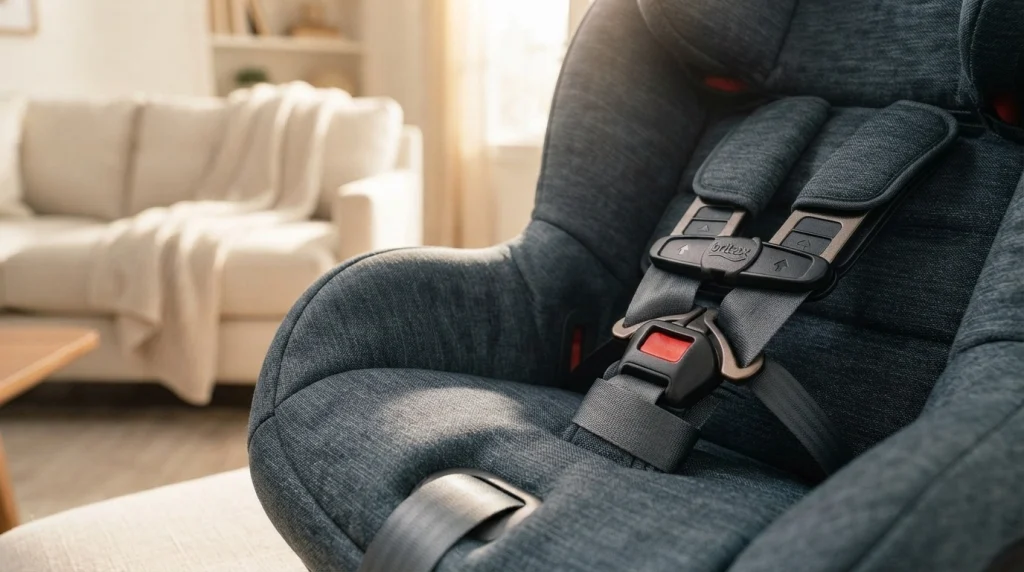
A child car seat must be taken out of service after a moderate or severe crash. A minor collision is different, but continued use depends on both the crash circumstances and manufacturer instructions.
A child car seat is a specially designed restraint system that helps protect children during vehicle travel. Its shell, harness, padding, and attachment components work together to manage crash forces.
Why Can an Accident Make a Car Seat Unsafe?
During a collision, the restraint holds the child and helps distribute forces through its structure. Those forces can stress components even when the outer shell appears normal.
Important safety components include:
- Plastic shell: Provides the main structural support for the child restraint.
- Harness straps: Help hold a child securely in a harness-equipped seat.
- Harness adjuster: Maintains the required strap tension.
- Buckle: Keeps the harness fastened during normal use and crash loading.
- Energy-absorbing materials: Help manage impact forces according to the seat’s design.
- Base and attachment points: Secure compatible restraints to the vehicle.
Not every collision damages these parts. However, a seat’s appearance cannot establish whether its crash performance remains acceptable.
This is why safety guidance relies on accident severity and manufacturer recommendations rather than a visual inspection alone.
Should You Replace a Car Seat Even When It Looks Fine?
Yes, if the crash was moderate or severe. Visible damage is not required for the replacement recommendation to apply.
Parents sometimes assume that an intact fabric cover means the restraint survived without damage. The cover is only one part of a much larger safety system.
Consider the difference between a vehicle’s upholstery and a child’s restraint. I may assess a scuffed vehicle seat cover for cosmetic repair, but child restraint safety requires a separate decision.
The American Academy of Pediatrics’ car seat guidance also emphasizes checking the seat’s crash history and following manufacturer instructions.
Can You Reuse a Car Seat After a Small Fender Bender?
Possibly, but only when every NHTSA minor-crash condition is satisfied and the manufacturer allows reuse. The size of a dent or bumper scratch is not enough to determine the answer.
A low-speed parking-lot collision might qualify as minor. However, a crash with an injured occupant or deployed airbag fails the minor-crash test.
Don’t make the decision using vehicle repair costs alone. The actual crash circumstances matter more than the estimate from a body shop.
What Makes a Crash Minor? The Five-Point NHTSA Test
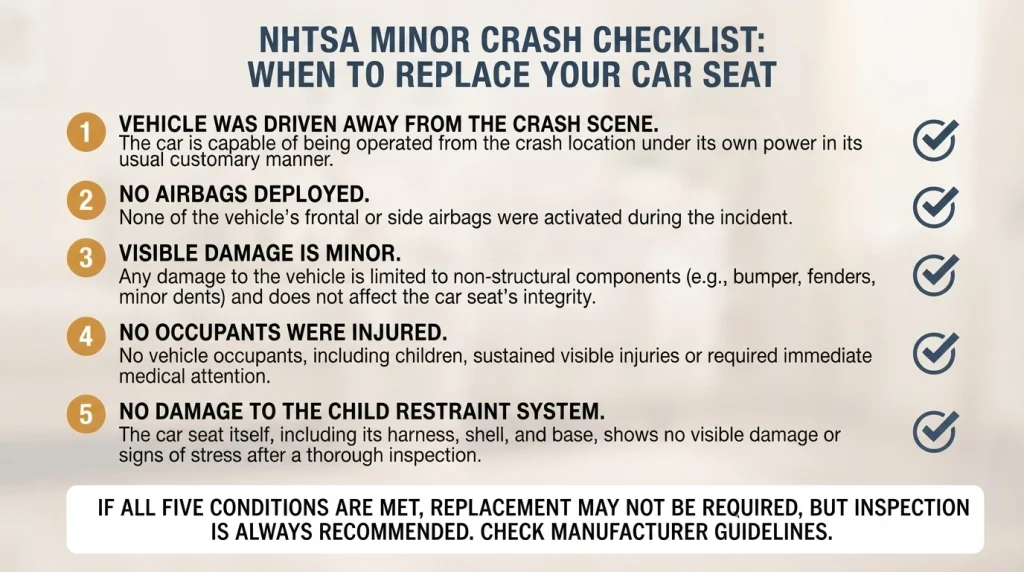
NHTSA defines a minor crash through five specific conditions, and every condition must be satisfied. If even one fails, the crash does not qualify as minor under these guidelines.
As of 2026, this remains the central U.S. safety guidance for evaluating child car seats after a collision.
The Five Conditions Explained
- The vehicle could be driven away. If collision damage prevented the vehicle from being driven, this condition is not met. A vehicle that was drivable but towed for convenience requires careful evaluation of the actual circumstances.
- The closest door was undamaged. Check the door nearest the child’s car seat position. Damage to that door means the crash does not meet the minor-crash definition.
- No occupant was injured. This requirement includes the driver and every passenger. An injury to any vehicle occupant means the crash fails the test.
- No airbags deployed. Airbag deployment disqualifies the crash from the minor category. This applies even when the child restraint was positioned away from the deployed airbag.
- The car seat has no visible damage. Check the restraint for cracks, broken components, deformation, or other damage. Remember that the absence of visible damage does not satisfy the other four conditions.
Minor Crash vs. Crash Requiring Replacement
| Crash circumstance | Minor-crash test | Recommended action |
|---|---|---|
| All five NHTSA conditions are satisfied | Passes | Check manufacturer guidance before considering reuse. |
| Airbag deployed | Fails | Replace the child restraint. |
| Nearest vehicle door damaged | Fails | Replace the child restraint. |
| Any vehicle occupant injured | Fails | Replace the child restraint. |
| Car seat visibly cracked or deformed | Fails | Stop using and replace it. |
| Vehicle could not be driven away | Fails | Replace the child restraint. |
Does Driving Speed Determine Whether a Crash Was Minor?
There is no universal speed threshold in NHTSA’s five-point minor-crash definition. Speed alone cannot confirm that a child car seat is safe to reuse.
Two collisions at similar speeds may produce different vehicle damage and occupant injuries. That is why a simple miles-per-hour rule is unreliable.
For example, a parking collision that damages the door nearest the restraint fails the minor-crash test. It doesn’t matter that the vehicles were moving slowly.
Does a Rear-End Collision Count as Minor?
A rear-end collision can qualify as minor, but it does not automatically qualify. You must apply all five conditions without making exceptions for the impact direction.
A car that drives away with an undamaged nearby door may satisfy part of the test. Yet an injured occupant, deployed airbag, or damaged restraint changes the decision.
Section Takeaway: A crash is minor only when all five NHTSA conditions are satisfied. Manufacturer instructions can still require replacement.
Do Infant Seats, Convertible Seats, and Boosters Follow the Same Rules?
Crash-replacement guidance applies to child restraint systems, including infant car seats, convertible car seats, and booster seats. The exact replacement requirements can vary by model and manufacturer.
The safest approach is to identify the restraint type, locate its model number, and consult its instructions.
Infant Car Seats and Detachable Bases
Infant car seats are typically rear-facing restraints designed for younger children within specified size limits. Many use a detachable carrier attached to a separate installed base.
After an accident, examine the manufacturer’s guidance for both components. Don’t assume a replacement carrier will make a crash-exposed base safe to reuse.
Ask the manufacturer whether the carrier, base, or both must be replaced. The answer depends on the model and accident circumstances.
Convertible and All-in-One Car Seats
Convertible car seats support rear-facing and forward-facing configurations within their approved limits. All-in-one models may also provide booster functionality.
These seats contain structural components and restraint hardware that may experience crash forces. The same minor-crash evaluation applies regardless of the mode used during the accident.
Check the model’s instructions rather than assuming a sturdier-looking seat can withstand additional collisions.
Booster Seats
Booster seats position a vehicle’s seat belt to fit an older child correctly. They come in high-back and backless designs.
Boosters are also covered by post-crash replacement guidance. Their simpler appearance does not establish that continued use is safe.
If replacement is required, select a new booster appropriate for the child’s current measurements and vehicle seating position.
Do Manufacturer Policies Differ?
Yes, and these differences matter. Some manufacturers allow continued use after qualifying minor crashes, while others require replacement more broadly.
For example, the official Britax after-crash guidance refers owners to NHTSA’s criteria for minor collisions. You should still check the instructions for the exact model you own.
When contacting a manufacturer, have the following information available:
- Brand and complete model name.
- Model number and date of manufacture.
- Date and description of the accident.
- Whether the restraint was occupied.
- Whether the vehicle remained drivable.
- Whether airbags deployed or occupants were injured.
Request written clarification when the instructions are unclear. This can help document your decision and support an insurance claim.
Pro tip: The instructions for your specific child restraint take priority over general assumptions about a brand. Contact the manufacturer directly if you cannot find the applicable manual.
How Do You Check a Car Seat After a Collision?
Start by looking for obvious damage, but never treat an inspection as proof that the seat remains safe. The crash criteria and manufacturer instructions must guide your decision first.
A visual inspection can identify a reason to stop using a seat immediately. It cannot rule out all possible structural damage.
Inspect the Shell and Supporting Components
Check accessible surfaces for cracks, unusual deformation, or broken plastic components. Avoid disassembling the seat beyond what its manufacturer allows.
Potential warning signs include:
- Cracks around the shell or attachment areas.
- Broken pieces of plastic.
- Visible deformation or unusual gaps.
- Damaged energy-absorbing material.
- Loose or broken components that previously fitted securely.
Any visible damage is a reason to discontinue use. Do not attempt to glue or reinforce damaged structural components.
Inspect Harness Straps and Buckles
Harness-equipped seats rely on properly functioning straps, adjusters, and buckles. Examine accessible components for obvious changes without modifying them.
Look for:
- Frayed, cut, or unusually stretched webbing.
- Damaged buckle components.
- Broken or malfunctioning harness adjusters.
- Disconnected or displaced attachment hardware.
- Parts that no longer function as the manual describes.
Never substitute generic harness straps or buckles for manufacturer-approved components. These parts are part of the complete child restraint system.
Can the Fabric Seat Cover Hide Problems?
Yes, a removable fabric cover may conceal visible surfaces of the restraint. However, taking it off does not allow you to determine whether hidden structural damage exists.
Remove the cover only as permitted in the user manual. Never cut, stretch, or alter restraint components to expose hidden areas.
Also distinguish a child’s car seat from an aftermarket cover fitted over the vehicle’s adult seat. Replacing the vehicle’s upholstery cover does not resolve questions about child restraint crash safety.
Should You Ask a Mechanic to Inspect the Car Seat?
A mechanic can assess collision damage to the vehicle, but that is not a substitute for child restraint manufacturer guidance. Child Passenger Safety Technicians can help with selection and installation questions.
Neither a routine visual check nor an installation inspection should be treated as certification that a crash-exposed restraint remains structurally sound.
Pro tip: If crash history, damage, or model-specific instructions leave uncertainty, contact the restraint manufacturer before using the seat again.
What Should You Do Next, and Will Insurance Help?
After checking for injuries and securing the accident scene, document the child restraint and contact its manufacturer. Then ask your auto insurance provider whether replacement is covered.
Insurance reimbursement depends on the policy, local requirements, fault determination, and claim circumstances. Coverage is not automatic.
What Should You Do Immediately After an Accident?
- Prioritize personal safety. Check for injuries and contact emergency services when necessary.
- Secure transportation. Do not place a child back into a seat that requires replacement.
- Document the accident. Record the date, location, vehicle damage, and relevant crash circumstances.
- Identify the restraint. Photograph its brand, model, serial information where available, and manufacturing label.
- Review the manual. Locate the manufacturer’s post-crash replacement instructions.
- Contact the manufacturer. Ask for model-specific guidance when necessary.
- Contact your insurer. Request information about reimbursement and required documentation.
If the car seat must be replaced, arrange an appropriate restraint before the child’s next vehicle journey. Do not use an unsafe or unsuitable restraint simply to complete a short trip.
Will Car Insurance Replace a Car Seat After an Accident?
Some auto insurance policies or applicable laws provide a path to reimbursement for crash-exposed child restraints. Other claims depend on the insurer’s assessment and specific policy wording.
You may be asked to provide documentation such as:
- Insurance claim number.
- Accident report or incident details.
- Photographs of the child restraint and vehicle damage.
- Car seat model and manufacturing information.
- Original purchase receipt, when available.
- Manufacturer’s written replacement instructions.
- Receipt for an eligible replacement seat.
Keep copies of everything you submit. Ask the insurer whether you must retain the damaged seat until the claim is processed.
Does Insurance Cover an Empty Car Seat?
It may, depending on the policy and circumstances. A child restraint can be subject to replacement guidance even when no child occupied it during the crash.
Do not assume that an empty seat was unaffected. Inform the insurer that the restraint was in the vehicle and explain what the manufacturer requires.
Can You Claim a More Expensive Replacement?
Reimbursement limits depend on the insurer and applicable requirements. Some claims may consider a comparable replacement rather than any new model you choose.
Before purchasing, ask the claims representative:
- Is a new replacement covered?
- Is preapproval required?
- Must the replacement be the same brand or model?
- What purchase documentation is needed?
- How should the old restraint be handled?
A replacement must also suit your child’s current height, weight, and developmental needs. An identical model isn’t always appropriate if the child has outgrown it.
Section Takeaway: Document the crash and confirm manufacturer requirements before making an insurance claim. Keep the old seat until the insurer explains its documentation and disposal requirements.
How Do You Choose and Install a Replacement Safely?
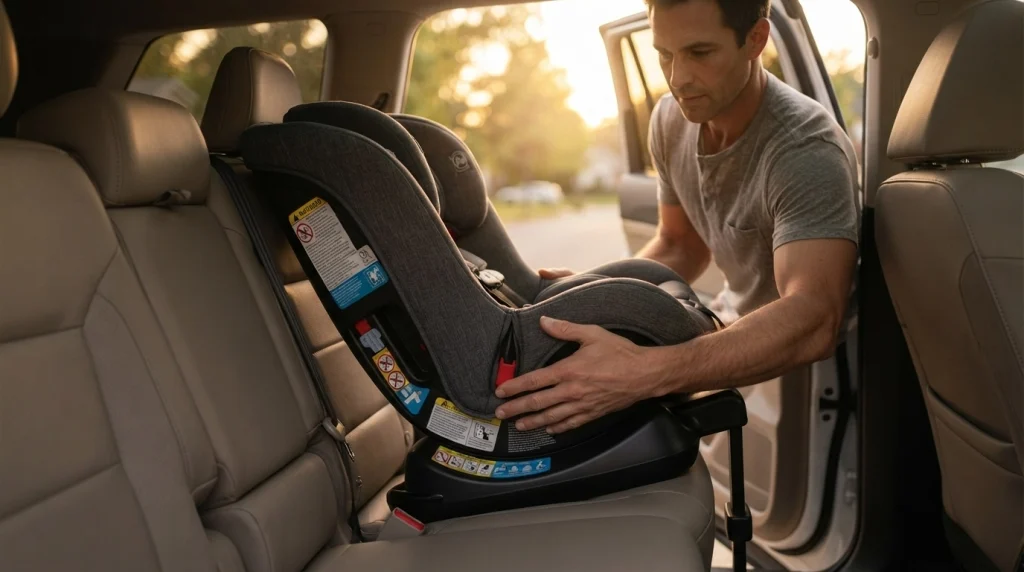
Choose a replacement based on your child’s size, the restraint’s approved limits, and your vehicle’s compatibility. Correct installation matters just as much as choosing a suitable model.
A higher price does not automatically make a seat safer for your particular child or vehicle. Focus on an approved restraint you can use correctly every time.
What Should You Look for in a New Car Seat?
Before buying a replacement, verify the essential fit and safety requirements.
- Child’s height: Confirm the current height falls within the manufacturer’s approved range.
- Child’s weight: Check the maximum and minimum limits for the intended seating mode.
- Seat orientation: Select the appropriate rear-facing, forward-facing, or booster configuration.
- Vehicle compatibility: Review seating position and installation requirements.
- Manufacturing information: Check the date of manufacture and usable service life.
- Recall status: Verify that safety recalls have been addressed.
- Clear instructions: Make sure the seat includes or provides access to its official manual.
Consider ease of use, too. A restraint that is difficult to install or adjust may increase the risk of everyday misuse.
Can You Buy a Used Replacement Car Seat?
A used child restraint requires a known, trustworthy history and must meet all safety requirements. Avoid secondhand seats when you cannot confirm their crash history.
The NHTSA used car seat checklist provides criteria for evaluating a previously owned restraint.
Important checks include:
- No history of moderate or severe crash exposure.
- Readable manufacturer and model identification.
- No unresolved safety recalls.
- All required parts present.
- Access to the correct instruction manual.
- Compliance with manufacturer service-life limits and replacement instructions.
A used seat with unknown crash history is a poor gamble. A low purchase price does not justify uncertainty about its safety.
How Should You Install the Replacement Car Seat?
Start with the restraint manual and the vehicle owner’s manual. The correct installation method depends on the seat, seating position, and available restraint anchors.
- Choose the correct rear seating position. Confirm the position is approved for the child restraint.
- Select the approved installation method. Use the vehicle seat belt or lower anchors as directed, not both unless both manufacturers explicitly permit it.
- Route the belt correctly. Use the designated rear-facing or forward-facing belt path.
- Secure the restraint firmly. Tighten and lock the seat belt or lower-anchor system according to the instructions.
- Check movement. The installed restraint should move no more than 1 inch (2.54 cm) side-to-side or front-to-back when tested at its belt path.
- Check the angle and tether. Follow recline instructions for rear-facing seats and use the top tether for forward-facing seats as directed.
- Fit the child correctly. Position the harness or vehicle seat belt according to the restraint’s instructions.
These steps reflect the general principles in the NHTSA car seat installation recommendations. Your particular model may have additional requirements.
Should You Reuse the Old Seat’s Base or Accessories?
Do not reuse a base that requires replacement after the accident. A new carrier is not a substitute for following the base manufacturer’s post-crash instructions.
For covers, inserts, padding, and other accessories, use only parts approved for the specific child restraint. Unapproved additions can interfere with the intended fit or operation.
Even when parts look compatible, they may not be approved for the replacement model. Check the manual before transferring anything.
What Should You Do With the Damaged Car Seat?
Once the insurer and manufacturer confirm that the restraint should be discarded, follow local disposal instructions. Prevent another family from unknowingly reusing an unsafe seat.
Practical options may include:
- Using a qualifying car seat trade-in or recycling program.
- Following municipal disposal instructions.
- Clearly marking a discarded restraint as unsafe for use.
- Making it unusable only when instructed and after any inspection or claim requirements are complete.
Never sell or donate a seat that must be replaced because of a crash. Its safety history matters to the next family.
Section Takeaway: Replacement is only the first step. Select an appropriate model, follow both manuals, and verify installation before your child’s next ride.
Frequently Asked Questions
1. Do car seats always need to be replaced after an accident?
No. NHTSA recommends replacement after moderate or severe crashes, but a seat may remain usable after a minor crash.
All five minor-crash conditions must be satisfied, and the manufacturer must permit continued use. If those requirements are not met, replace the child restraint.
2. Should I replace a car seat after a rear-end collision?
Replace it when the rear-end collision fails any part of NHTSA’s minor-crash test. A seat may remain eligible for reuse after a qualifying minor crash if its manufacturer permits it.
Rear-end impact alone does not establish crash severity. Evaluate injuries, airbags, vehicle drivability, nearest-door damage, and visible seat damage.
3. Can a car seat have hidden damage after an accident?
Yes. Crash forces may affect restraint components without leaving obvious external damage.
A visual inspection cannot confirm that a crash-exposed child restraint retains its original protective performance. Follow the crash-replacement guidelines and manufacturer instructions rather than relying on appearance alone.
4. Do you replace a car seat if the airbags deploy?
Yes. Airbag deployment means the crash fails one of NHTSA’s five conditions for a minor collision.
The affected child restraint should be replaced, even if it appears undamaged or was positioned far from the deployed airbag. Follow the manufacturer’s disposal and replacement instructions.
5. Does an empty car seat need replacing after a crash?
An empty seat may still require replacement. Whether the child occupied it does not automatically determine its continued suitability.
Apply the crash criteria and consult the manufacturer for the exact restraint model. Contact your insurer about potential reimbursement, even when the seat was unoccupied.
6. Can I use the car seat while waiting for insurance reimbursement?
Do not use a restraint that requires replacement while waiting for your claim. Insurance processing does not change a child’s safety needs.
Arrange a suitable replacement before traveling with your child. Ask your insurer whether preapproval is necessary and how to document the purchase.
7. Can I repair a car seat instead of replacing it?
Do not attempt structural repairs on a crash-damaged child restraint. Glue, replacement padding, improvised straps, or other modifications cannot establish that the seat is safe.
Use only manufacturer-authorized procedures and components for permitted maintenance. If the restraint requires replacement after a collision, repair is not an acceptable substitute.
Final Takeaway: If you’re wondering when to replace a car seat after an accident, start with the five NHTSA conditions and the manufacturer’s instructions. Replace the restraint after a moderate or severe crash, and never assume an undamaged appearance means it is safe.
Before your child’s next ride, confirm the car seat’s status, document any insurance claim, and install an appropriate replacement correctly. A careful decision today helps protect your child on every journey ahead.

Daniel Brooks is an automotive writer and product researcher focused on car accessories, car tech, maintenance, and practical driving guides. At Plug-in Car World, he helps drivers make smarter automotive decisions through honest reviews and research-driven content.
