
Are Car Seat Toys Safe for Babies? A Parent’s Safety Guide
Quick Answer
Are car seat toys safe for babies? Some lightweight, soft, age-appropriate toys can be reasonable choices during supervised car rides, but no toy is completely risk-free. Avoid hard toys and unapproved accessories attached to the car seat, harness, or handle. Safe Kids Worldwide’s car seat guidance recommends soft toys and securing loose objects.
Five important safety rules
- Choose soft materials: Lightweight fabric toys are generally preferable to heavy plastic or wooden toys.
- Avoid unapproved attachments: Do not attach accessories to the car seat unless its manufacturer permits them.
- Check choking hazards: Avoid detachable pieces, beads, buttons, and toys unsuitable for your baby’s age.
- Protect the harness: Toys must never interfere with straps, buckles, or the chest clip.
- Keep breathing clear: Nothing should cover your baby’s face or obstruct their airway.
My recommended approach
- For young infants, a correctly installed car seat without extra toys is often the simplest choice.
- For older babies, consider one small, soft toy when an adult can monitor them safely.
Car rides can feel much longer when a baby becomes restless. A colorful toy may seem like the perfect distraction, but I always put crash protection ahead of entertainment.
This guide explains which baby car seat toys deserve caution, what safety experts recommend, and how to keep your child comfortable without compromising their restraint.
In This Guide
What Are Car Seat Toys, and Are They Necessary?
Car seat toys are play items intended to entertain babies while they travel in child safety seats. They include handheld fabric toys, soft rattles, teething toys, hanging toys, and activity bars.
Some products attach directly to a car seat. Others simply rest in a baby’s hands.
Definition: A car seat toy is an entertainment accessory used around a child restraint, not a required part of the restraint’s crash-protection system.
Why do parents use car seat toys?
Babies gradually become more interested in colors, movement, textures, and sounds. An age-appropriate toy may keep an awake infant occupied during part of a journey.
Parents commonly use toys for several reasons:
- Visual interest: Contrasting patterns can attract a young baby’s attention.
- Sensory exploration: Fabric textures and gentle sounds offer opportunities for exploration.
- Comfort: A familiar toy may help an older baby settle during travel.
- Entertainment: Simple toys provide an alternative to screens.
These benefits don’t make toys essential. A baby can travel safely and comfortably without holding anything.
Does a toy make a car seat safer?
No. Toys don’t improve crash protection, correct positioning, or harness performance.
The car seat itself provides the protection. Its installation, recline angle, and harness fit matter far more than entertainment accessories.
The National Highway Traffic Safety Administration’s car seat glossary explains that aftermarket accessories aren’t recommended unless the original car seat manufacturer makes or permits them.
That distinction matters when shopping. A product marketed as compatible with infant seats isn’t automatically approved for your specific model.
As of 2026, I would still treat the car seat manual as the deciding authority for seat-mounted accessories. General marketing claims cannot replace model-specific instructions.
Why Can Car Seat Toys Be Dangerous for Babies?
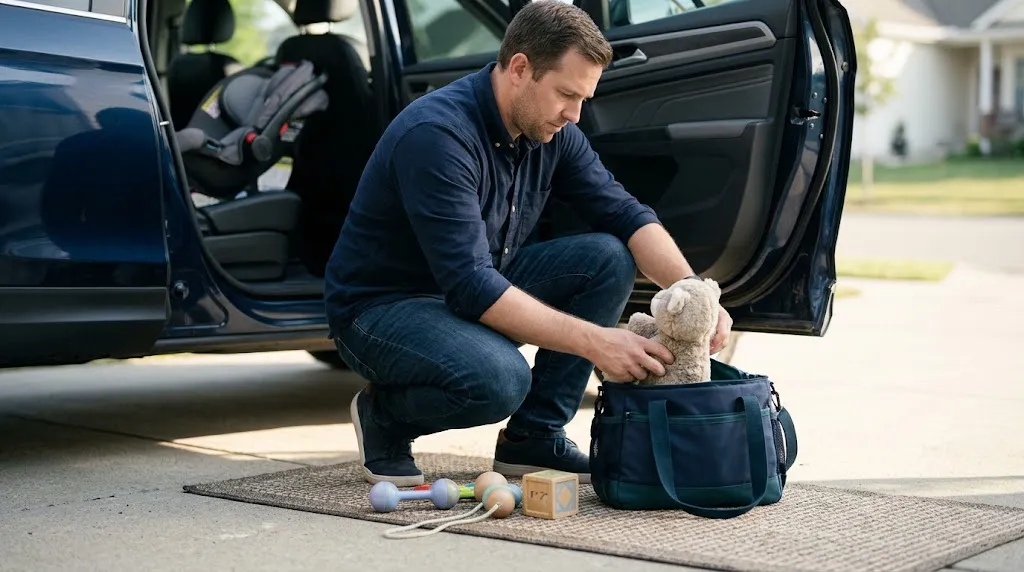
Car seat toys can introduce several hazards, including impact injuries, choking, entanglement, and interference with safety restraints. The level of concern depends on the toy’s construction, placement, and use.
Understanding these risks makes shopping decisions much easier.
1. Hard toys can cause injuries during sudden stops
During a crash, an unsecured object can continue moving through the vehicle. A hard rattle or plastic toy could strike a passenger.
Even something harmless during ordinary play can become dangerous under sudden deceleration.
For this reason, I prefer lightweight, soft materials over rigid toys for babies riding in cars.
Consider these examples:
- A small fabric toy without hard attachments presents less impact concern than a wooden block.
- A heavy musical toy could become a dangerous projectile.
- A rigid activity bar may create another object a baby could strike during a collision.
Soft materials reduce some impact concerns, but they don’t eliminate every hazard. Size, construction, and positioning still matter.
2. Small parts can become choking hazards
Babies explore objects with their mouths. A loose bead, detachable eye, or broken plastic component can create a choking risk.
The Consumer Product Safety Commission’s toy guidance advises keeping toys with small parts away from children younger than three.
Inspect toys for:
- Loose buttons or decorative eyes
- Detachable beads and plastic pieces
- Damaged seams or exposed stuffing
- Broken squeakers or rattle components
- Peeling materials or detachable decorations
Remove a damaged toy immediately. Don’t assume a previously safe toy remains safe after repeated chewing or washing.
3. Strings and clips can create entanglement risks
Some hanging toys use long cords, ribbons, elastic straps, or homemade clips. These can create entanglement or strangulation hazards.
A moving vehicle also makes it harder for a caregiver to respond immediately.
Avoid tying toys to your baby’s neck, wrist, harness, or other body parts. Never add homemade cords to prevent a dropped toy.
4. Extra accessories can interfere with the harness
The harness must fit directly and securely according to the seat manufacturer’s instructions. Toys and clips that change strap positioning may compromise that fit.
Anything covering the buckle can also complicate emergency access. Keep both the buckle and chest clip unobstructed.
5. Toys can obstruct breathing or distract the driver
A large plush toy can move against a young infant’s face. Babies with limited head control may struggle to reposition themselves.
Driver distraction presents another concern. Reaching backward to retrieve toys takes attention away from the road.
Section Takeaway: The biggest concerns are hard impacts, loose parts, cords, obstructed breathing, and changes to the harness. No toy is worth weakening the car seat’s protective function.
Which Car Seat Toys Are Safer or Riskier?
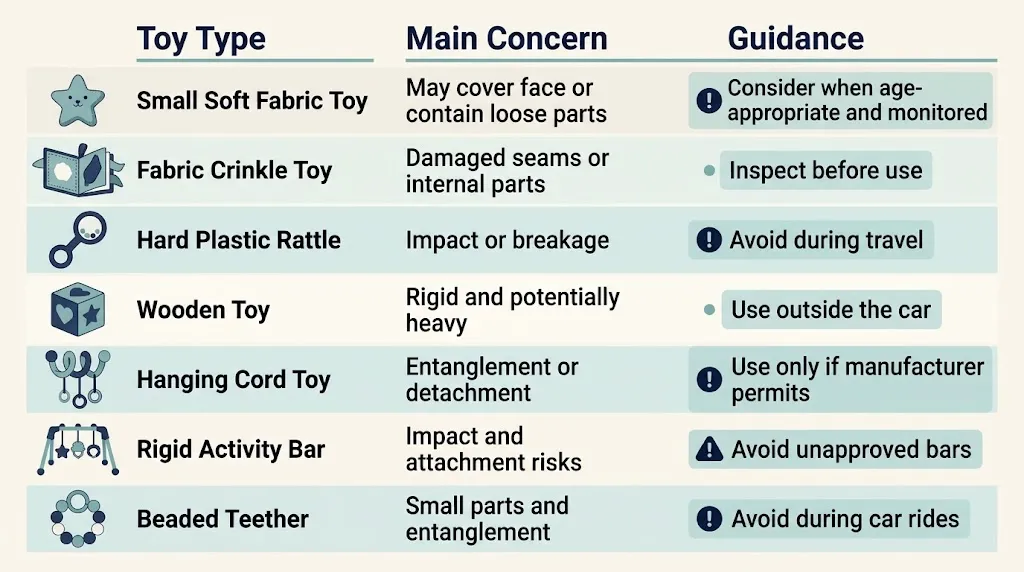
Small, lightweight fabric toys are generally more suitable than hard, heavy, or complicated accessories. However, no material alone guarantees that a toy is safe in every situation.
The following comparison can help parents recognize common concerns.
| Toy Type | Main Concern | Recommendation |
|---|---|---|
| Small, soft fabric toy | May cover the face or contain loose parts | Relatively preferable when age-appropriate and monitored |
| Lightweight fabric crinkle toy | Damaged seams or internal components | Consider only if intact and suitable for the baby’s age |
| Hard plastic rattle | Impact injuries or breakage | Avoid during vehicle travel |
| Wooden toy | Rigid, potentially heavy construction | Better suited to play outside the car |
| Hanging toy with cords | Entanglement, detachment, or seat interference | Avoid unless specifically allowed by the car seat manufacturer |
| Rigid toy bar or activity arch | Impact and attachment concerns | Do not add an unapproved bar to the seat |
| Beaded teether or clip | Detachable beads and entanglement | Avoid during car rides |
Are soft stuffed animals safe in a car seat?
A small, lightweight stuffed animal can be a more reasonable option than a rigid toy for an older baby. Choose one without detachable eyes, buttons, or other small decorations.
Still, a stuffed animal must not obstruct the baby’s face or affect harness positioning.
For newborns, I’d keep the seating area especially simple. Their limited head control makes unobstructed breathing a priority.
Are musical toys appropriate for car rides?
Some musical toys are bulky, battery-powered, or made from hard plastic. Those features make them less desirable near an infant during vehicle travel.
A small, soft toy that produces a gentle sound without hard external components may be more suitable. Inspect it carefully and follow its age labeling.
Are baby teething toys safe in the car?
Teethers vary considerably in shape and construction. A small, one-piece soft teether has different risks from a heavy ring or beaded teething accessory.
For a young infant or a baby who cannot be monitored, skipping the teether is the more cautious option.
Can You Attach Toys to a Car Seat Handle or Harness?
Don’t attach toys to a car seat handle, harness, canopy, or frame unless the car seat manufacturer specifically permits that accessory and installation. An attachment designed for one model may be unsuitable for another.
This is especially important for aftermarket toys.
Why are car seat handle toys controversial?
Infant car seats often have carrying handles that move between different positions. Manufacturers specify which positions are permitted during vehicle travel.
A hanging toy may interfere with handle movement, detach, or swing toward the baby.
Some companies sell clip-on toys labeled for car seat handles. That label alone doesn’t prove compatibility with your restraint.
Before attaching anything, check:
- Whether the car seat manual allows accessories on the handle
- Whether the exact accessory is approved for that seat model
- Whether it interferes with required handle positions
- Whether the attachment could detach or contact the baby
- Whether it creates any cord or entanglement hazard
If approval isn’t clear, leave the accessory off.
Can you clip a toy onto the harness?
No unapproved clips should be added to the harness straps. The straps are safety components designed to restrain your baby during a crash.
Even small accessories can affect positioning or create distractions near the buckle.
Do not attach toys to:
- Shoulder harness webbing
- The chest clip
- The harness buckle
- Harness adjustment hardware
- Any restraint component not approved for accessories
Are stroller toys interchangeable with car seat toys?
Not necessarily. A toy designed for a stroller hasn’t automatically been assessed for use inside a moving vehicle.
Stroller activity bars, hanging arches, and clips may have different attachment arrangements. Don’t transfer them onto a car seat without explicit manufacturer permission.
Pro tip: Check the exact car seat model’s instruction manual before adding accessories. When instructions are unclear, contact the manufacturer or consult a certified Child Passenger Safety Technician.
How Do You Choose Safer Car Seat Toys for Babies?
Start with your child’s age and the toy’s physical design. Then consider whether it can be used without altering the seat or distracting the driver.
My approach is to eliminate possible hazards before considering entertainment value.
Use this six-step safety checklist
- Check the age recommendation. Select products intended for your baby’s developmental stage, without small detachable components.
- Prioritize lightweight materials. Avoid heavy, rigid objects that could strike someone during a sudden stop.
- Inspect every component. Look for loose seams, broken pieces, exposed stuffing, or damaged attachments.
- Avoid cords and added clips. Do not use improvised tethers or modifications to secure the toy.
- Keep the restraint untouched. Never position toys between the child and harness or modify the car seat to hold them.
- Consider supervision. If an adult cannot safely monitor a young baby, leaving toys out may be preferable.
What should parents check before every drive?
The most important checks involve the car seat, not the toy. A correctly adjusted restraint is the foundation of safe travel.
Review the following before leaving:
- The car seat is installed according to both the vehicle and restraint manuals.
- The rear-facing recline angle matches the manufacturer’s indicator.
- The harness straps lie flat without twists or excess slack.
- The chest clip is positioned at armpit level where the seat uses one.
- No toy, blanket, or accessory blocks the baby’s face.
- Loose heavy objects elsewhere in the vehicle are properly secured.
The NHTSA car seat installation guide explains how to check installation, recline, harness tightness, and chest clip positioning.
Does a higher price mean a safer toy?
No. An expensive toy isn’t necessarily better suited for vehicle travel than a simple fabric toy.
Price, appearance, and online reviews don’t establish compatibility with a particular restraint.
Look for clear manufacturer instructions and appropriate age labeling instead of relying on claims such as “premium safety” or “crash-tested.
If a product makes a crash-testing claim, determine exactly what was tested. Testing a toy alone isn’t the same as confirming compatibility with your car seat.
How Can You Keep a Baby Entertained Without Unsafe Car Seat Toys?
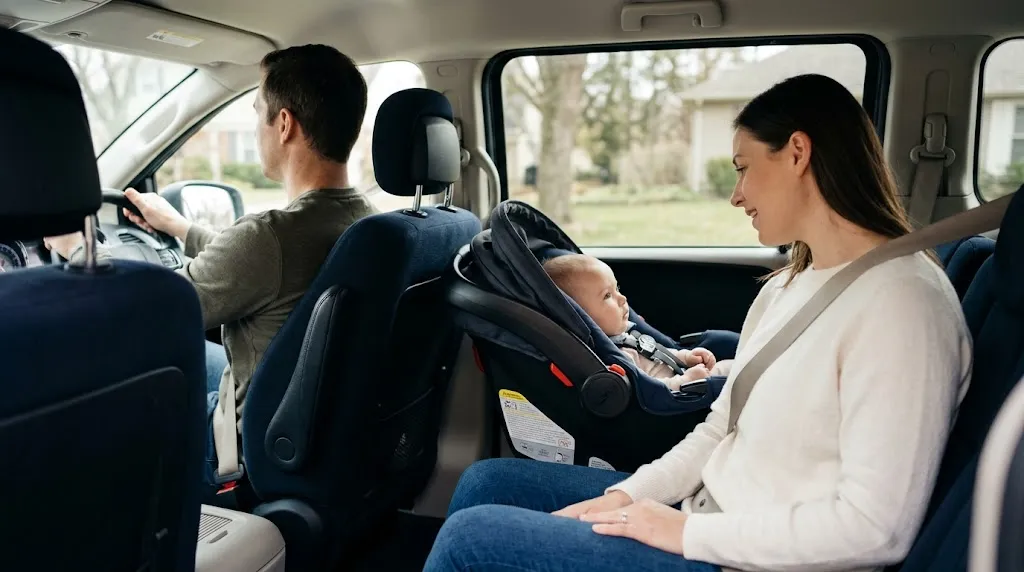
You can often soothe a baby without adding accessories to the restraint. Predictable routines, familiar sounds, and planned breaks may help.
These alternatives avoid many of the concerns associated with bulky toys.
Try simple entertainment first
- Use your voice: Talk or sing to your baby while keeping your attention on the road.
- Play gentle music: Use the vehicle’s audio system at a comfortable volume.
- Travel after routine care: Check feeding, diaper, and comfort needs before departure.
- Choose quiet moments: When practical, schedule short drives around your baby’s normal routine.
- Use a rear-seat caregiver: Another adult can monitor the baby while the driver focuses on driving.
Not every method works for every child. The important point is to avoid compromising driving attention or car seat fit.
What if your baby drops a toy?
Don’t reach backward while driving to retrieve it. Wait until you can safely pull over, or let another passenger help without leaving their seat belt.
A dropped toy is inconvenient, but distracted driving creates a much greater problem.
Never loosen the harness simply to make a toy easier to reach.
What if your baby cries throughout the trip?
First, consider whether the baby may need feeding, changing, or another form of comfort. If the crying continues, stop somewhere safe before checking the restraint or removing your baby.
Don’t remove a baby from a car seat while the vehicle is moving.
For longer journeys, plan opportunities to stop and attend to your child’s needs. Follow any individualized travel advice from your pediatrician.
Should you remove toys when a baby falls asleep?
Yes, remove toys that could move against a sleeping baby’s face when it is safe to do so. Avoid reaching into the rear seat while driving.
Sleeping infants still need a correctly positioned and secured car seat. Toys should never act as head supports or positioning devices.
The American Academy of Pediatrics also recommends moving a baby who falls asleep in a car seat to a firm, flat sleep surface as soon as possible when travel ends, as explained in its safe sleep guidance.
Car seats are designed for transportation, not routine sleep outside the vehicle.
Section Takeaway: Entertainment should remain optional. Secure positioning, attentive driving, and a clear airway always come first.
Frequently Asked Questions About Baby Car Seat Toys
1. Are hanging car seat toys safe for newborns?
Hanging toys can introduce attachment, impact, or entanglement hazards. Avoid them unless the car seat manufacturer specifically permits the accessory for your model. For newborns, keeping the restraint free of unnecessary additions is usually the more cautious approach.
2. Can babies hold stuffed animals in a car seat?
An older baby may be able to hold a small, lightweight, age-appropriate stuffed toy during a monitored ride. Avoid large plush toys, detachable decorations, and anything that might cover the face. Never place a stuffed animal between the baby and the harness.
3. Are car seat toy bars safe?
Rigid toy bars and activity arches aren’t automatically safe because they’re advertised for infant car seats. They may introduce impact hazards or interfere with restraint components. Use only accessories expressly permitted by the car seat manufacturer for your particular model.
4. Can I attach a toy to my baby’s car seat strap?
Don’t clip an unapproved toy onto the harness or chest clip. These components need to function exactly as intended by the restraint manufacturer. A toy attachment could interfere with positioning, create loose parts, or obstruct access to the buckle.
5. Are car seat toys safer than tablets for babies?
A small, soft toy avoids some concerns associated with screens, but it isn’t automatically safe during travel. For babies, talking, singing, and other simple interactions can provide entertainment without additional objects. Choose activities that don’t distract the driver.
6. Can a teething toy be used in a car seat?
Some soft, age-appropriate teethers may be suitable for supervised use, but hard or beaded teethers introduce additional concerns. Never attach one using a homemade cord. When a young baby cannot be monitored, skipping the teether is a sensible precaution.
7. Should I remove car seat toys during a long drive?
Remove any toy that affects the harness, obstructs breathing, becomes damaged, or causes concern. A baby doesn’t need continuous entertainment during travel. If your child becomes uncomfortable, stop safely and check their needs rather than adding more accessories.
Final Takeaway:
Car seat toys can offer entertainment, but they should never interfere with your baby’s protection. Soft, lightweight, age-appropriate toys present fewer concerns than hard objects, while unapproved seat-mounted accessories are best avoided.
Before your next trip, check your car seat manual, inspect any toys, and make sure your baby’s harness fits properly. A simple, correctly used car seat is always a better starting point than a collection of accessories.

Daniel Brooks is an automotive writer and product researcher focused on car accessories, car tech, maintenance, and practical driving guides. At Plug-in Car World, he helps drivers make smarter automotive decisions through honest reviews and research-driven content.
