
What Car Seat Safety Labels Mean: A Complete Guide to Reading Every Important Marking
Quick Answer
Car seat safety labels explain how a child restraint should be used, which children it can accommodate, when it was manufactured, and which safety requirements it meets. They also provide manufacturer and model information needed to identify recalls. In the United States, federal labeling requirements are covered by Federal Motor Vehicle Safety Standard 213.
What the main car seat labels tell you
- Weight and height limits: Show the manufacturer’s approved size range for children using the seat.
- Manufacturing date: Identifies when the seat was made and helps determine its usable lifespan.
- Model number: Identifies the exact car seat for instructions and recall searches.
- Safety certification: Indicates that the restraint conforms to applicable federal motor vehicle safety standards.
- Airbag warning: Warns against placing a rear-facing car seat in front of an active passenger airbag.
- Installation instructions: Explain approved installation methods and important restrictions.
A quick safety check
- Find the model number and manufacturing date before checking recalls.
- Compare your child’s measurements with the seat’s limits.
- Read the warning labels and the complete manufacturer’s manual.
- Check the expiration date or service-life guidance supplied by the manufacturer.
Buying or using a car seat involves more than choosing a comfortable design. The labels attached to the seat contain important information that helps parents make safer decisions.
I’ve organized this guide around the markings you’ll encounter, what they mean, and how to use them when checking a car seat. Understanding these details can help you avoid installation mistakes and identify seats that may no longer be suitable for use.
What Are Car Seat Safety Labels?
Car seat safety labels are permanent or attached markings that provide essential information about a child restraint system. They identify the seat, communicate safety warnings, and explain important usage restrictions.
In the United States, manufacturers must follow applicable federal labeling requirements under Federal Motor Vehicle Safety Standard 213 (FMVSS 213). These requirements cover information such as the manufacturer’s name, model identification, manufacturing date, certification statement, and child-use recommendations.
You’ll usually find these labels in several locations:
- Back of the seat: Often contains the manufacturing date, model number, and identification information.
- Side of the seat: May display weight limits, height limits, and installation warnings.
- Near the child’s head: May contain important airbag warnings on rear-facing seats.
- On the seat base: May include additional identification or installation information.
Different manufacturers arrange their labels differently. Therefore, don’t assume every important marking will appear in the same place.
What Do the Different Car Seat Safety Labels Mean?
Each label communicates a different part of the seat’s safety information. Some explain who can use the seat, while others identify the product or warn against dangerous installation practices.
Here are the most important labels to understand.
1. Weight Limit Labels
Weight limit labels explain the minimum and maximum child weight recommended for a particular car seat configuration. These numbers help determine whether the restraint is appropriate for your child.
For example, a convertible car seat might display different weight limits for rear-facing and forward-facing use.
- Minimum weight: The lowest recommended weight for using the particular configuration.
- Maximum weight: The highest recommended weight for that configuration.
- Configuration details: Explain whether the limits apply to rear-facing, forward-facing, or booster use.
Don’t assume that reaching the maximum weight automatically means your child has outgrown every possible configuration. Check the separate limits and instructions for the seat’s other approved positions.
Also, weight alone doesn’t determine when a child should move to another seating position. Height restrictions and the manufacturer’s instructions matter too.
2. Height Limit Labels
Height limit labels identify the maximum or minimum child height recommended for using a particular car seat. They help parents understand whether their child’s physical size remains within the seat’s approved range.
Some restraints provide a maximum standing height. Others include additional guidance about the child’s head position relative to the top of the seat shell.
Pay attention to these details:
- Maximum standing height: The highest child height permitted by the manufacturer.
- Head clearance: The required space between the child’s head and the top of the seat.
- Harness position: Instructions about the correct harness slots for the child’s size and seating direction.
A child can reach a seat’s height limit before reaching its weight limit. That’s why checking both measurements is important.
3. Manufacturing Date Labels
The manufacturing date identifies when the car seat was produced. Manufacturers use this information to help establish the product’s age, determine its service life, and identify affected products during recalls.
Look for wording such as:
- Manufactured on
- Date of manufacture
- Manufactured in
- DOM
For example, a label showing October 2025 indicates that the seat was manufactured during that month if the date format specifies month and year.
Don’t confuse the manufacturing date with the purchase date. A seat bought in 2026 might have been manufactured several months earlier.
This distinction matters because the manufacturer’s service-life calculation may begin on the manufacturing date rather than the day you purchased the seat.
4. Model Number and Serial Number Labels
The model number and serial number help identify the exact car seat you own. Both are important when looking for instructions, replacement parts, manufacturer support, and recall information.
Although these numbers may appear close together, they serve different purposes.
- Model number: Identifies the particular product design or version.
- Serial number: Identifies an individual manufactured unit or production sequence.
- Manufacturing code: May provide additional production or batch information.
For example, two seats can share the same model number but have different serial numbers and manufacturing dates.
When checking a recall, record the complete model number and manufacturing date. If the manufacturer requests a serial number, provide that information too.
5. Federal Safety Certification Labels
A federal safety certification label communicates that the child restraint conforms to applicable Federal Motor Vehicle Safety Standards. In the United States, FMVSS 213 establishes performance and labeling requirements for child restraint systems.
You may encounter wording similar to:
This child restraint system conforms to all applicable Federal motor vehicle safety standards.
This statement is important because it identifies the manufacturer’s certification regarding applicable federal requirements.
However, it doesn’t mean that every car seat performs identically in every crash. Nor does it guarantee that a seat will protect a child if someone installs or uses it incorrectly.
Certification is not a replacement for checking the instructions, fit, installation method, or recall status.
6. Airbag Warning Labels
Airbag warning labels communicate a critical restriction involving rear-facing child restraints. A rear-facing car seat must never be placed in front of an active passenger airbag.
During a crash, an inflating frontal airbag can strike the back of a rear-facing seat with tremendous force. This can cause severe or fatal injuries to a child.
Look for warning wording such as:
WARNING. DO NOT place rear-facing child seat on front seat with air bag. DEATH OR SERIOUS INJURY can occur.
These warnings are particularly important when installing an infant seat or a convertible seat in its rear-facing configuration.
The safest general choice is the vehicle’s back seat, following both the vehicle manufacturer’s instructions and the car seat manufacturer’s guidance.
Never assume that switching off an airbag is appropriate without consulting the vehicle owner’s manual and applicable safety guidance.
7. Installation Warning Labels
Installation warning labels explain restrictions and requirements for securing the car seat correctly. They may cover seat belt routing, lower anchors, tether use, and approved seating positions.
Common installation-related markings include:
- Lower anchor instructions: Identify the approved lower anchor attachment points and restrictions.
- Seat belt routing: Show the correct path for the vehicle seat belt.
- Top tether warning: Explain when and how to use the tether in an approved forward-facing installation.
- Recline indicators: Help identify the correct angle for the seat’s configuration.
- Locking instructions: Explain any required vehicle seat belt locking procedure.
These labels are useful reminders, but they don’t replace the complete installation instructions. Always check the manual for the approved installation method in your particular vehicle.
How Do You Read a Car Seat Safety Label?
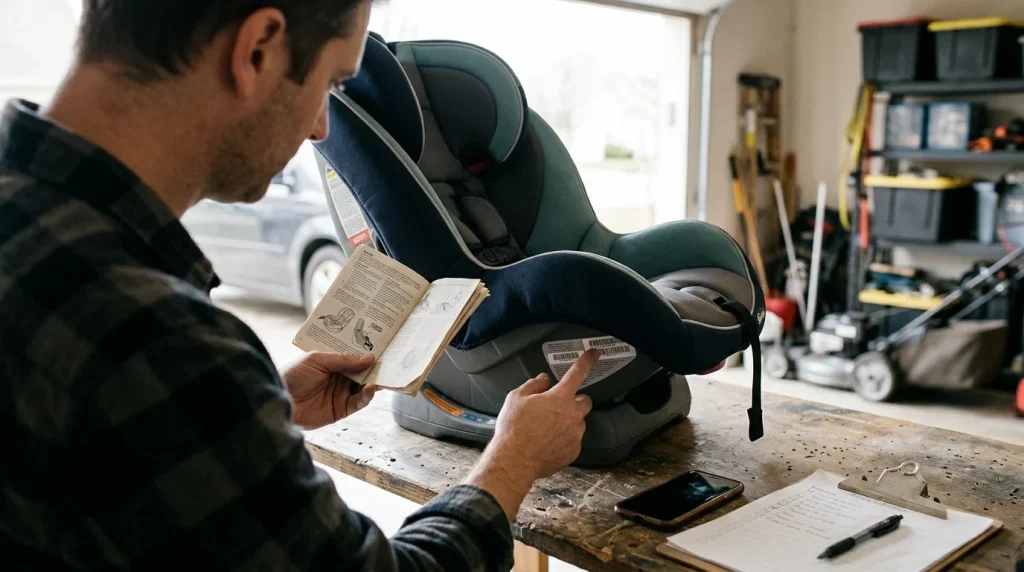
The easiest approach is to examine the seat systematically instead of trying to understand every marking at once. Start with product identification, then review the child’s limits and safety warnings.
Follow these steps when inspecting a car seat.
- Locate the identification label: Check the back, bottom, and sides of the seat for the manufacturer and model information.
- Find the manufacturing date: Record the complete date or month and year shown on the label.
- Check the model number: Write it down accurately, including letters and numbers.
- Review weight and height limits: Identify the limits for the configuration you intend to use.
- Read the warning labels: Pay particular attention to airbag, harness, and installation warnings.
- Find the certification statement: Check the applicable compliance wording.
- Compare everything with the manual: Confirm that the seat’s instructions match its labels and intended configuration.
I recommend recording the model number and manufacturing date somewhere accessible. This makes future recall checks and manufacturer inquiries much easier.
What Is the Difference Between a Safety Label, Warning Label, and Certification Label?
These labels are related, but they don’t communicate exactly the same information. Understanding their differences makes it easier to identify which details deserve your attention.
| Label type | Main purpose | What to check |
|---|---|---|
| Safety label | Provides general product safety and usage information. | Usage limits and identification details. |
| Warning label | Highlights dangerous conditions or incorrect usage. | Airbags, installation restrictions, and harness warnings. |
| Certification label | Communicates the manufacturer’s compliance certification. | Applicable federal safety standards. |
| Manufacturing label | Identifies the product and when it was made. | Manufacturing date, model, and manufacturer. |
| Weight and height label | Defines the manufacturer’s recommended child-use limits. | Maximum and minimum measurements for each configuration. |
One important distinction is that a warning label doesn’t certify a seat’s overall performance. It communicates a specific hazard or restriction that users must understand.
Similarly, a certification statement doesn’t tell you whether your child currently fits the seat. You need to check the individual size limits for that information.
Why Are Car Seat Safety Labels Important for Recall Checks?
Safety labels help parents identify whether their particular car seat is affected by a recall. The model number and manufacturing date are especially important because recalls may involve specific production periods or product versions.
Manufacturers need accurate identification information to determine which products require attention.
Here’s how to perform a basic recall check:
- Find the model information: Locate the model name or number on the car seat.
- Record the manufacturing date: Check the permanent product label.
- Visit the manufacturer’s website: Look for its recall or product safety section.
- Check official recall information: Use the relevant government recall database.
- Follow the recall instructions: Contact the manufacturer if your seat is affected.
For U.S. products, you can also visit the National Highway Traffic Safety Administration recall website.
Don’t continue using a recalled seat without understanding the manufacturer’s remedy and instructions. Some recalls require replacement parts, repairs, or replacement of the entire restraint.
Registration is another important step. Registering your car seat allows the manufacturer to contact you about applicable recalls and safety notices.
What Does the Expiration Date on a Car Seat Label Mean?
The expiration date identifies the end of the manufacturer’s stated service life for a car seat. Manufacturers establish these limits based on factors such as materials, product design, and expected use.
Not every car seat displays an expiration date in the same format. Some show a specific expiration date, while others provide a manufacturing date and service-life instructions.
For example, a manufacturer might state that a particular seat should not be used beyond a specified number of years after manufacture.
Check for wording such as:
- Do not use after
- Expiration date
- Service life
- Useful life
Don’t calculate an expiration date using a general rule found online. Different manufacturers and models can have different service-life limits.
If the expiration marking is missing or difficult to understand, contact the manufacturer with the model number and manufacturing date.
What Should You Do If a Car Seat Safety Label Is Missing or Damaged?
A missing or unreadable label can make it difficult to identify a car seat and verify its safety information. This is particularly concerning when the manufacturing date or model number cannot be established.
Before using the seat, take these precautions:
- Inspect the entire seat: Look underneath the padding and around the back and base for identification markings.
- Check the instruction manual: Compare the product’s physical design with the manufacturer’s documentation.
- Contact the manufacturer: Provide photographs and any available product identification information.
- Ask about missing labels: Find out whether replacement identification labels or official documentation are available.
- Avoid guessing: Don’t assume the seat’s age, model, or limits based on appearance alone.
If you cannot establish the seat’s identity, manufacturing date, applicable limits, and recall status, don’t rely on it for transporting a child until the manufacturer or a qualified child passenger safety technician helps resolve the uncertainty.
Never remove, cover, or modify safety labels simply to improve the seat’s appearance.
Can You Use a Car Seat Without Reading Its Safety Labels?
You might be able to install a car seat without reading every label, but doing so increases the chance of overlooking an important restriction. The labels and manual work together to explain how the restraint should be used.
For example, a seat may look suitable for your child while exceeding its permitted height limit. Another seat might have an airbag warning that changes where it can safely be installed.
At a minimum, review these details before using any car seat:
- Approved rear-facing, forward-facing, or booster configurations.
- Minimum and maximum weight recommendations.
- Height restrictions and head-position requirements.
- Manufacturing date and service-life information.
- Installation instructions and vehicle compatibility.
- Warning labels and recall information.
Also remember that the car seat’s instructions and your vehicle owner’s manual must both be considered. A restraint can be approved for a particular installation method without every vehicle seat position supporting that method.
Do Car Seat Safety Labels Look Different Between Manufacturers?
Yes. Manufacturers can use different label layouts, colors, symbols, and wording, even when the labels communicate similar safety information.
One brand might place its manufacturing information on a white label underneath the seat. Another might position it on the back or side of the restraint.
Some labels use illustrations to explain harness routing or installation. Others rely more heavily on written instructions.
However, differences in appearance don’t mean you can ignore the information. For U.S. products, applicable federal requirements still determine which information manufacturers must provide.
When comparing labels from different brands, focus on the actual information rather than the label’s design.
Important Changes to Car Seat Labeling and Safety Standards in 2026
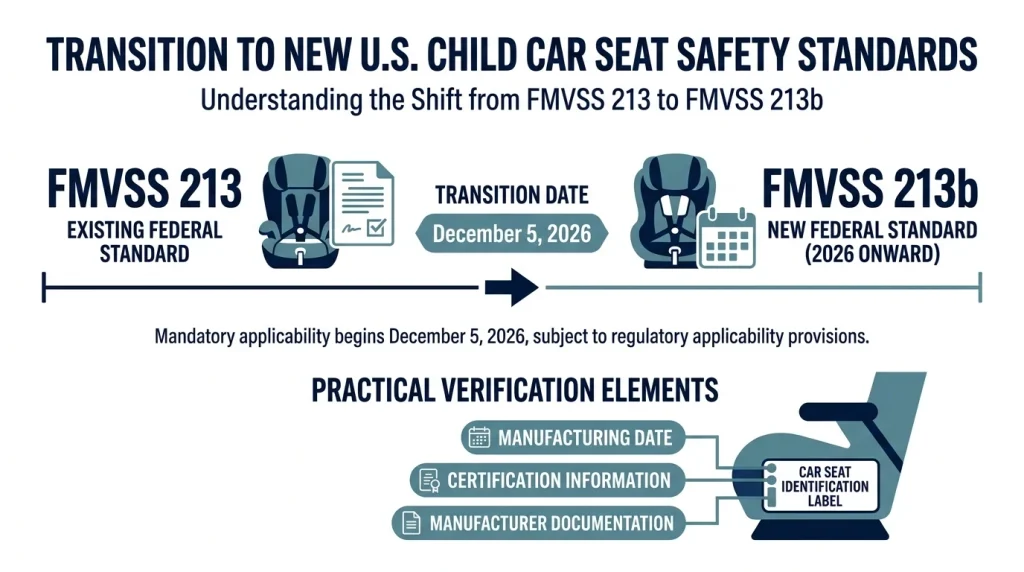
Car seat labeling requirements and safety standards can change over time. As of October 2026, U.S. readers should also be aware of the transition involving FMVSS 213b.
Federal regulations establish FMVSS 213b for child restraint systems, with mandatory applicability beginning December 5, 2026, subject to the regulation’s applicability provisions.
This means that the applicable requirements can depend on the manufacturing date and certification status of a particular restraint. Don’t assume that every car seat manufactured before or after a particular date will have identical labels.
For accurate information, consult the current federal regulation and the manufacturer’s documentation rather than relying on older label examples.
The key takeaway is straightforward: always read the labels attached to your specific car seat. General online examples cannot replace its individual instructions and restrictions.
Frequently Asked Questions About Car Seat Safety Labels
Where Can I Find the Safety Labels on a Car Seat?
Most car seats have safety labels on the back, sides, bottom, or near the child’s head. The exact location depends on the manufacturer and model. Check underneath removable padding when appropriate, but never remove sewn or attached safety labels to find additional information.
What Does the Federal Safety Certification Label Mean?
The certification statement indicates that the manufacturer certifies the restraint conforms to applicable federal motor vehicle safety standards. In the United States, FMVSS 213 establishes requirements for child restraints. However, certification doesn’t guarantee correct installation or eliminate the need to follow the manufacturer’s instructions.
Does the Manufacturing Date Tell Me When a Car Seat Expires?
Not by itself. The manufacturing date identifies when the seat was produced, while its service-life limit depends on the manufacturer’s instructions. Some manufacturers provide a separate expiration date, while others specify how many years the seat can be used after manufacture.
Can I Use a Car Seat If Its Safety Label Is Missing?
A missing identification label can make it difficult to verify the seat’s model, manufacturing date, and recall status. Contact the manufacturer before using it. If its identity and safety history cannot be established, don’t rely on it to transport a child.
Are Weight and Height Labels More Important Than Warning Labels?
Both are important because they address different safety concerns. Weight and height labels establish the child’s permitted size range, while warning labels explain hazards and usage restrictions. Read both, along with the complete instruction manual, before installing or using the restraint.
Final Takeaway: Always Read Your Car Seat Safety Labels
Car seat safety labels aren’t just product identification stickers. They provide essential information about child size limits, manufacturing dates, safety certification, installation restrictions, and recall identification.
Before using a car seat, take a few minutes to locate and understand its important markings. Confirm that your child fits the manufacturer’s recommendations and that the restraint hasn’t expired or been recalled.
Most importantly, never treat a certification label as permission to ignore installation instructions. A properly selected, correctly installed, and appropriately used car seat is an important part of protecting your child during vehicle travel.

Daniel Brooks is an automotive writer and product researcher focused on car accessories, car tech, maintenance, and practical driving guides. At Plug-in Car World, he helps drivers make smarter automotive decisions through honest reviews and research-driven content.
