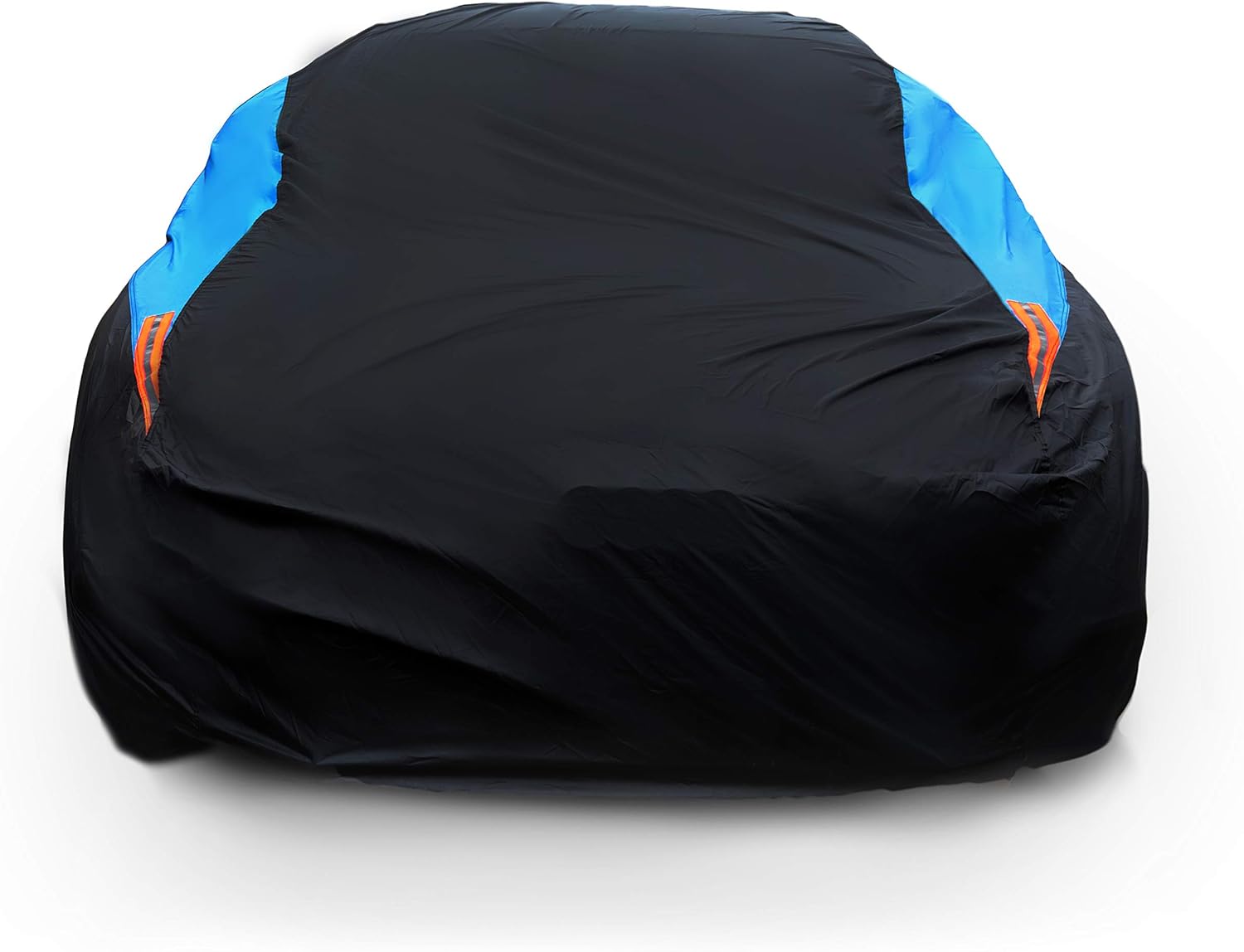
How UV Rays Damage Car Covers Over Time — and What You Can Do About It
⚡ Quick Answer
UV rays damage car covers by breaking apart polymer chains in the fabric through a process called photodegradation. UVA and UVB radiation generate free radicals inside the material, weakening molecular bonds. Over 1–3 years outdoors, even quality covers become brittle, faded, and porous — and stop protecting the car underneath.
How UV Rays Destroy Car Cover Fabric:
- Photodegradation: UV energy breaks chemical bonds inside synthetic fabric fibers.
- Free radical chain reactions: Broken bonds release free radicals that attack neighboring molecules.
- Oxidation: Oxygen reacts with damaged polymer chains, causing brittleness and cracking.
- Color loss: UV breaks apart dye molecules, turning vivid fabric pale and faded.
How to Slow UV Cover Damage:
-
✓
Choose covers with UV-inhibitor coatings or solution-dyed acrylic fibers. -
✓
Pick light-colored covers — they absorb less solar heat and degrade slower. -
✓
Replace covers showing cracks, chalking, or stiffness — they no longer protect.
Your car cover looked crisp when you first put it on. Now it’s brittle, faded, and starting to crack — and you haven’t done anything wrong. UV radiation from the sun is destroying it from the molecular level, every single day it sits outside. I’m Daniel Brooks, and after researching automotive protection materials extensively, I can tell you most car owners have no idea how quickly and silently this process happens. Here’s exactly what UV rays do to your cover — and how to stop the damage before it reaches your paint.
📌 Key Takeaways
-
→
UV photodegradation breaks polymer chains in fabric, making the cover brittle within 1–3 years outdoors. -
→
Polypropylene covers are the most UV-vulnerable; solution-dyed acrylic is the most UV-resistant common material. -
→
A UV-damaged cover can actually scratch your paint as its degraded fibers abrade the clear coat underneath. -
→
UV inhibitor coatings work by absorbing or reflecting UV energy before it reaches the fiber’s polymer chains.
How Do UV Rays Actually Break Down a Car Cover?
UV rays destroy car cover fabric through a chemical process called photodegradation. When UVA and UVB radiation strike synthetic fibers, the energy is absorbed by molecular structures inside the polymer called chromophores. This energy breaks chemical bonds, releasing highly reactive fragments called free radicals.
Those free radicals don’t stop at one molecule. They attack neighboring polymer chains in a cascade reaction. Each broken bond weakens the fiber’s structural integrity. Over time, the fabric loses tensile strength, flexibility, and the ability to repel water or block light.
Here’s the part most people don’t expect: this damage happens even on cloudy days. UVA rays — which cause the deepest polymer damage — penetrate cloud cover and reach your cover’s surface whether the sky is bright or overcast. You can’t see it happening. But the chemistry is running constantly.
💡 Key Insight
UV damage to car cover fabric is not surface-level. It’s a molecular event happening inside the fiber itself — which is why a cover can look fine for months before suddenly becoming brittle and tearing. The damage accumulates invisibly until it hits a threshold.
Research on synthetic polymer photodegradation confirms that polypropylene — one of the most common car cover materials — has peak UV absorption wavelengths at 290–300 nm, 330 nm, and 370 nm. These are all wavelengths present in everyday sunlight. The result is accelerated photo-oxidation that weakens fibers far faster than most buyers realize. You can learn more about the full science of UV radiation effects on synthetic materials from peer-reviewed research.
The takeaway: UV damage isn’t a slow fade — it’s an accelerating chemical reaction. The longer a cover stays in the sun without UV inhibitors, the faster the breakdown compounds.
Which Car Cover Materials Are Most Vulnerable to UV Damage?
Not all car cover fabrics break down at the same rate. The chemistry of each material determines how quickly UV energy can attack its polymer chains. Understanding this helps you buy smarter — and replace at the right time.
This table shows how common car cover materials compare in UV resistance, expected outdoor lifespan, and typical failure mode.
Solution-dyed acrylic wins because the pigment is embedded inside each fiber during manufacture — so UV can’t bleach it out from the surface. This is the most meaningful material difference to check when buying.
The key factor isn’t just the base material — it’s whether UV inhibitors are woven into the fiber itself or simply coated onto the surface. A surface coating wears off after 6–12 months of outdoor use. A molecularly bonded UV stabilizer stays active for the life of the fiber.
What Are the 5 Stages of UV Damage on a Car Cover?
UV degradation on a car cover follows a predictable pattern. Knowing which stage your cover is in tells you exactly how much protection it still offers — and when to act.
🔢 Step-by-Step: 5 Stages of UV Cover Degradation
-
1
Early UV Absorption (0–3 months)
No visible damage yet. UV energy is absorbed by chromophores and dissipated. The cover still performs at full capacity.
-
2
Surface Fading (3–9 months)
Dye molecules begin breaking down. Color looks slightly washed out. UV protection is still mostly intact but slowly declining.
-
3
Polymer Chain Weakening (9–18 months)
Free radical reactions have degraded fiber strength. The cover feels slightly stiff. Seams may start to pull apart under wind stress.
-
4
Brittleness and Cracking (18–30 months)
Oxidized polymer chains are now rigid. The fabric cracks when you fold it, leaves white powder residue, and tears easily. Water-resistance is gone.
-
!
Active Damage Stage (30+ months, cheap covers)
Degraded fibers abrade the car’s clear coat directly. The cover is now causing damage. Replace immediately.
The jump from Stage 3 to Stage 4 happens faster in hot climates. Heat accelerates the photo-oxidation process significantly. A cover that lasts 18 months in Seattle may crack after just 9 months in Phoenix or Miami.
Does a UV-Damaged Car Cover Still Protect Your Paint?
Once a car cover reaches Stage 3 or beyond, it no longer reliably protects your paint — and at Stage 4, it actively harms it. Stiffened, brittle fibers drag across the clear coat when wind moves the cover, creating fine scratches. Those scratches catch UV light and deepen the oxidation damage on the paint underneath.
There’s a second problem. Degraded covers lose their breathability. The microporous structure that allows moisture to escape collapses. Heat and humidity get trapped between the cover and paint — creating a greenhouse effect that accelerates paint fading and can cause moisture-related damage to rubber seals and door trim.
⚠️ Warning
A car cover that leaves chalky white residue on your hands when you touch it has entered advanced UV degradation. The chalky powder is oxidized polymer material. Do not continue using it on your vehicle — remove it and replace it immediately to protect your paint.
You might be thinking: “Isn’t a damaged cover still better than nothing?” For dust, yes. But for UV protection and paint safety, a severely degraded cover is no longer neutral — it’s a net negative. Protecting your paint means using a cover that’s still structurally sound.
What Makes a Car Cover Actually UV Resistant?
The difference between a cover that lasts 1 year and one that lasts 7 years comes down to 3 specific engineering features. These aren’t marketing buzzwords — they’re measurable material properties that determine how UV energy is handled at the molecular level.
📋 Features That Define a Truly UV-Resistant Car Cover
-
Molecularly bonded UV stabilizers: Look for “UV-stabilized fabric” or “inhibitor-infused polymers.” These are built into each fiber — not applied on top. They don’t wash or wear off. They intercept UV energy before it can break polymer bonds. -
Reflective outer layer: Silver or light-colored outer surfaces physically reflect UV radiation away before it reaches the fabric. Aluminum-based reflective layers are most effective, reducing both UV penetration and heat buildup. -
Solution-dyed fibers: In solution-dyed acrylic, pigment molecules are injected into the molten fiber before it’s formed. UV light can’t bleach the surface because the color is inside the fiber, not on it. This extends color and UV protection life dramatically. -
Multi-layer construction: Each added layer increases the UPF (Ultraviolet Protection Factor) of the cover. A 3-layer or more cover forces UV radiation to pass through multiple barriers — dramatically reducing the energy that reaches the car beneath.
For a deeper dive into how UV stabilizers like Hindered Amine Light Stabilizers (HALS) and UV absorbers work at the polymer level, the industry overview at Craftech Industries’ polymer UV degradation guide is an excellent technical reference.
A warranty period is also a real signal here. A manufacturer offering a 5–10 year warranty on an outdoor cover is telling you they trust their UV stabilization to last that long. A cover with a 1-year warranty almost certainly uses surface coatings only — not integrated UV protection.
What Most People Get Wrong About Car Cover UV Protection
Most car owners make the same 3 mistakes when it comes to UV protection and car covers. Each one costs real money — either in a prematurely ruined cover or in paint damage that’s expensive to correct.
Myth 1: “Any car cover blocks UV.”
This is the most expensive myth. A standard single-layer polyester or polypropylene cover has almost no meaningful UV blocking ability. It keeps off dust and light rain — but UV radiation passes straight through it. You need a cover specifically engineered with UV-inhibitor treatments, reflective layers, or solution-dyed fibers to actually block ultraviolet radiation.
Myth 2: “A faded cover still has its UV resistance.”
Fading is visible proof that UV photodegradation is already underway. If UV rays can break apart dye molecules on the surface, they’ve already been attacking the structural fibers too. A visibly faded cover has reduced UV resistance — not just reduced color. The two go together because both depend on the same molecular stability.
Myth 3: “Dark covers absorb UV and protect better.”
Dark covers absorb more solar radiation — which means more heat is transferred to the car’s surface. Light-colored or silver covers reflect UV and solar heat away from the vehicle. A silver or white car cover keeps the car cooler and causes less thermal stress on the paint, rubber seals, and interior materials.
✅ Tip
When shopping for an outdoor car cover, check the spec sheet for “UV inhibitors,” “UV-stabilized fabric,” or “solution-dyed acrylic” — not just “UV protection.” That phrase on its own is marketing. The material details tell you whether the protection is real and how long it will last.
How to Tell If Your Car Cover Has UV Damage
UV degradation gives off clear signals if you know what to check. Run through this inspection every 6 months — it takes 2 minutes and tells you exactly where your cover stands.
✓ Car Cover UV Damage Inspection Checklist
-
✓
Color check: Is the fabric visibly faded or patchy compared to when you bought it? Uneven fading means UV photodegradation is active. -
✓
Flex test: Fold a section of the cover and bend it sharply. If it cracks or shows white stress marks, the polymer chains are already brittle. -
✓
Chalk test: Rub the fabric firmly with your fingers. White or chalky residue on your skin means oxidized polymer breakdown — the cover is in Stage 4. -
✓
Water test: Pour a small amount of water on the cover. If it soaks in instead of beading off, the waterproof coating has degraded — UV resistance has likely failed too. -
✓
Seam check: Run your fingers along all stitched seams. Separating seams mean the surrounding fabric has lost tensile strength — a direct result of UV fiber breakdown.
Any 2 or more of these signs in combination means your cover needs replacement. One sign on its own warrants closer monitoring every 4–6 weeks.
When Should You Replace a UV-Damaged Car Cover?
The right answer depends on where you live, what material your current cover is made from, and how many of the damage signs above are already present. Here’s a clear decision framework.
🎯 When to Replace Your Car Cover
If you are…
In a high-UV climate (AZ, FL, TX, CA) with a standard polyester cover
→ Replace every 12–18 months
If you are…
In a temperate climate with a quality multi-layer cover with UV inhibitors
→ Replace every 3–5 years
If you are…
Seeing chalk residue, cracking, or seam separation regardless of age
→ Replace immediately
When you’re ready to replace, invest in a cover with genuine UV protection built into the material. The Budge Ultra Duro is a well-regarded option that uses UV-resistant polypropylene in a 3-layer construction with ultrasonically welded seams for long-term durability.
Recommended Product
Budge Ultra Duro Car Cover, 3-Layer UV & Water Resistant Outdoor Protection, Fits Cars up to 228″, Gray, Size D-4
★★★★☆ Highly rated on Amazon
A 3-layer UV-resistant polypropylene cover from a brand with over 70 years of experience — built specifically to block UV degradation while keeping breathability intact so your paint doesn’t trap heat or moisture.
As an Amazon Associate, we earn from qualifying purchases.
Conclusion
UV rays damage car covers through photodegradation — a process that begins the first day the cover goes outside and accelerates with every hour of sun exposure. The fabric doesn’t just fade; it breaks down at the molecular level until it can no longer protect your paint. Choosing a cover with integrated UV stabilizers and a reflective layer isn’t a luxury — it’s the only way to get real long-term protection from the sun.
The one thing to do right now: grab your current car cover, rub it firmly with your fingers, and flex a corner section. If you see chalk residue or cracking, your cover is already in Stage 4. Replace it before it starts scratching your clear coat.
Frequently Asked Questions
Do UV rays damage car covers?
Yes. UV rays degrade car cover fabric through photodegradation — breaking polymer chains inside synthetic fibers. This leads to brittleness, fading, and structural failure over time. Even high-quality covers lose UV resistance after prolonged outdoor exposure without proper UV inhibitors built into the material.
How long does a car cover last in the sun?
A cheap single-layer cover may last only 6–12 months outdoors before UV damage becomes critical. A quality multi-layer cover with UV-stabilized fabric typically lasts 3–5 years. Solution-dyed acrylic covers with integrated UV inhibitors can last 7–10 years in full sun exposure.
What happens if you leave a car cover on too long?
A severely UV-degraded cover can scratch your clear coat as brittle fibers rub against the paint surface. It also traps heat and moisture when breathability fails, which accelerates paint oxidation and rubber seal deterioration. A cover past its service life causes more harm than no cover at all.
Does a car cover protect paint from UV rays?
A properly rated car cover does protect paint from UV rays by blocking ultraviolet radiation before it reaches the clear coat. However, a cover must have genuine UV-blocking properties — reflective layers, UV-stabilized fabric, or multi-layer construction. A basic dust cover provides little to no UV protection for paint.
Do cheap car covers provide UV protection?
Most cheap car covers do not provide meaningful UV protection. Budget single-layer polyester or polypropylene covers lack UV inhibitor treatments and reflective layers. UV radiation passes through them easily. They protect against dust and light rain — but not solar degradation of your paint or interior.
What is photodegradation in car covers?
Photodegradation is the process where UV radiation breaks chemical bonds inside synthetic fabric fibers. The energy is absorbed by molecular structures called chromophores, which then release free radicals. These radicals attack neighboring polymer chains, causing brittleness, fading, and loss of structural strength over time.
Does cover color affect UV damage to the car underneath?
Yes. Light-colored and silver car covers reflect UV radiation and solar heat away from the vehicle. Dark covers absorb solar energy, increasing heat buildup under the cover and accelerating paint fading and rubber deterioration. A silver or white cover is the better choice for UV and heat protection in any climate.

Daniel Brooks is an automotive writer and product researcher focused on car accessories, car tech, maintenance, and practical driving guides. At Plug-in Car World, he helps drivers make smarter automotive decisions through honest reviews and research-driven content.