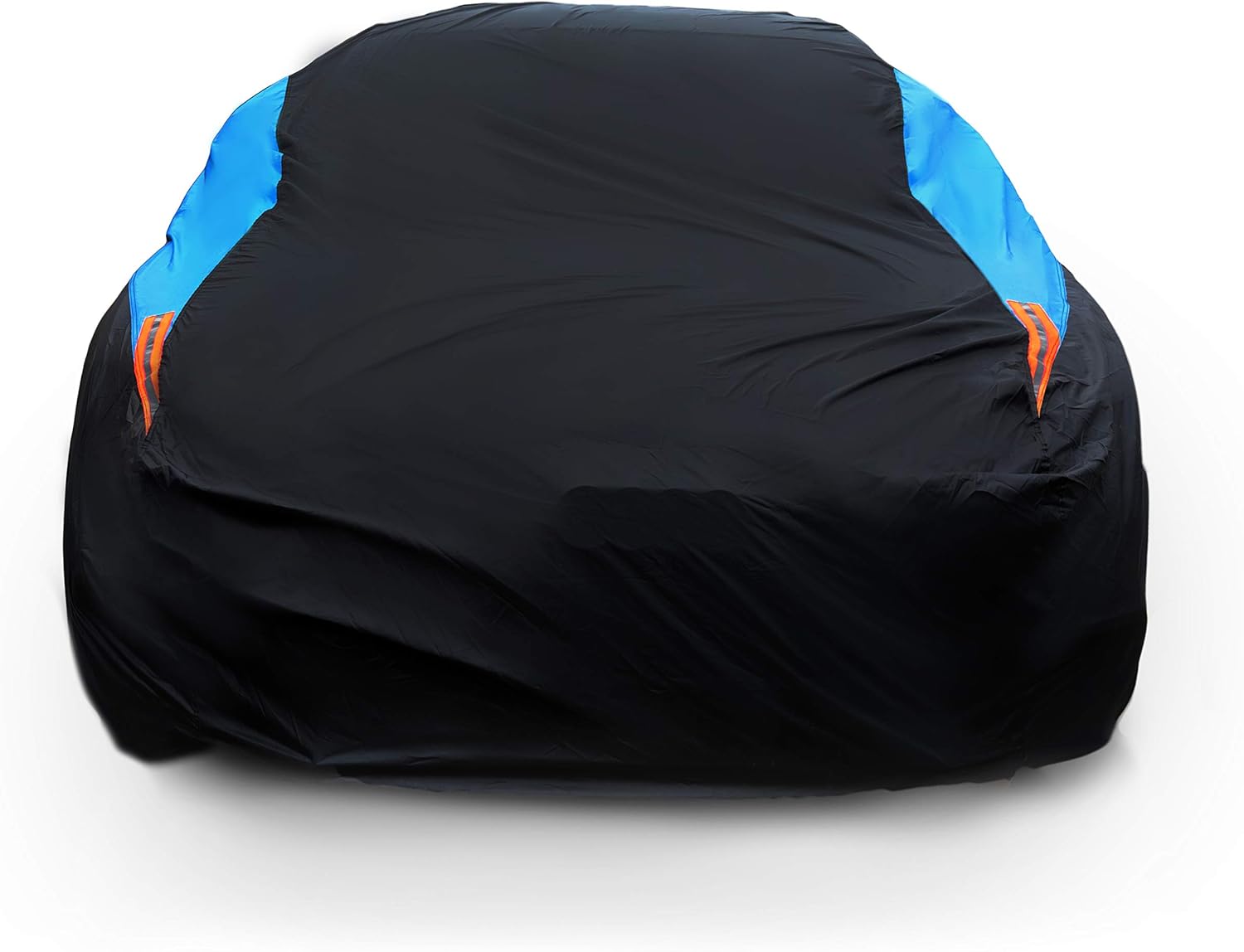
Covercraft vs Coverking — Which Car Cover Actually Protects Better?
Quick Answer
Covercraft wins for harsh outdoor storage. Its 5-layer WeatherShield HD fabric is roughly 40% heavier than a
standard outdoor cover, giving it more cushioning against hail and tree debris. Coverking wins for hot, sunny
daily-driver climates, since its Silverguard fabric is built specifically to reflect heat and UV. Both are
made-to-order and fit only one vehicle at a time.
Which cover handles extreme weather vs. everyday sun exposure:
- Covercraft’s WeatherShield HD adds real physical padding against dents and hail
- Choose Covercraft if you store outdoors through snow, hail, or falling debris
- Choose Coverking if your car sits in direct sun or heavy rain most of the year
⚡ Quick Verdict — Covercraft vs Coverking
Coverking
$181 to $789 (varies by fabric & vehicle)
✅ Best for:
Daily drivers parked outdoors in hot, sunny, or rainy climates
Covercraft
$215 to $530 (varies by fabric & vehicle)
✅ Best for:
Long-term outdoor storage through snow, hail, or heavy debris
| Category | Coverking | Covercraft |
|---|---|---|
| Overall Winner | — | 🏆 |
| Best Entry-Level Value | ✅ | ❌ |
| Hail & Debris Protection | ❌ | ✅ |
| Heat & UV Reflection | ✅ | ❌ |
| Snow & Ice Shedding | ✅ | ✅ |
Bottom line: Covercraft wins for owners who store a car outdoors through harsh winters or
hail season — the heavier fabric holds up better under physical impact. Coverking is worth it only if
your climate is dominated by sun and rain rather than hail, snow load, or falling branches.
- Covercraft’s WeatherShield HD is roughly 40% heavier than its own HP fabric, adding real cushioning against dents and hail.
- Coverking’s entry-level Coverbond and Triguard fabrics start around $181, undercutting Covercraft’s cheapest outdoor option by 30 to 40 dollars.
- Covercraft’s 5-layer construction is the better pick for classic cars stored outdoors through winter.
- Coverking’s Silverguard uses a reflective coating built specifically for desert and sun-belt heat.
- The single biggest real-world gap: Covercraft resists impact damage better, while Coverking resists heat and UV fade better.
Picking between these two brands gets confusing fast, because both make dozens of fabric options for
thousands of vehicles. I’m Daniel Brooks, and I’ve spent time researching both brands’ fabric engineering,
warranty terms, and real owner complaints across forums, the Better Business Bureau, and verified retailer reviews.
At first glance, Covercraft and Coverking look nearly identical. Both are custom-patterned, both offer
outdoor and indoor fabric lines, and both promise a snug, glove-like fit. The real difference shows up in
how each fabric behaves once your car sits outside for months, not days.
Covercraft leans on a heavier, layered build. Coverking leans on fabric chemistry — coatings and weaves
engineered for specific weather threats. That distinction decides which cover actually protects your paint
in your climate.
Let’s break down what each brand does best, where owners run into trouble, and which one fits your
situation.
Product Overview: Covercraft
| ✅ Best for | Owners storing a car outdoors year-round in hail, snow, or falling-debris conditions |
| ❌ Not ideal for | Buyers on a tight budget — Coverking’s entry fabrics run cheaper for basic protection |
| 💰 Price | Currently $215 to $530 depending on fabric and vehicle (check for latest price) |
Covercraft has built custom vehicle patterns since 1965, and that pattern library now covers more than
80,000 vehicle configurations. Its flagship outdoor fabric, WeatherShield HD, uses a 300-denier fiber that’s
roughly 40% heavier than the brand’s own HP line, built specifically for harsh sun, snow, and long-term storage.
For indoor storage, Covercraft’s Form-Fit line uses a polyester-spandex knit with a soft cotton-terry lining.
It’s currently priced lower than the outdoor WeatherShield HD line, since indoor covers don’t need weatherproof coatings.
Covercraft is made for owners who treat outdoor storage seriously — collectors, daily drivers in snow-belt
states, or anyone parked under trees. Most buyers who choose WeatherShield HD are doing so because they’ve
already had a thinner cover fail during a storm.
Pros and Cons
Covercraft’s biggest strength is physical durability under impact — its heavier fabric construction is the
main reason owners choose it over lighter competitors. Its biggest weakness is price: the WeatherShield HD
line costs more than Coverking’s comparable outdoor fabric on many vehicles.
Covercraft Custom Fit Car Covers WeatherShield HD
The right buy if your car sits outdoors through winter or hail season and you want real physical
cushioning, not just a rain shield.
Product Overview: Coverking
| ✅ Best for | Daily drivers in hot, sunny, or rain-heavy climates who want budget-friendly outdoor fabrics |
| ❌ Not ideal for | Owners in hail or heavy-snow regions — Covercraft’s thicker build holds up better under impact |
| 💰 Price | Currently $181 to $789 depending on fabric and vehicle (check for latest price) |
Coverking designs its own fabrics in-house rather than relying on third-party textiles. Its two flagship
lines take opposite approaches to weather: Stormproof is a single-layer woven microfiber that’s inherently
water-resistant, meaning the water resistance is built into the fiber itself instead of a surface coating.
Silverguard, by contrast, is a 300-denier polyester with a reflective silver coating engineered for sun-belt heat.
Because the water resistance is woven in rather than sprayed on, Stormproof tends to hold its performance
longer as the fabric ages. A coated fabric can lose water resistance once the coating wears thin from UV
exposure and repeated folding.
Coverking’s lower-tier Coverbond and Triguard fabrics currently start under $200, making the brand the
more budget-friendly entry point of the two — especially useful for owners covering multiple vehicles.
Pros and Cons
Coverking’s strongest advantage is UV and heat performance — Silverguard is purpose-built for exactly
that job. Its most common complaint, based on BBB and Trustpilot filings, involves inconsistent custom fit,
particularly around mirror pockets and seat covers.
Coverking Custom Fit Car Cover — Silverguard
The right buy if your car spends most of its life in direct sun or a hot, dry climate and impact
protection isn’t your main concern.
Full Spec Comparison: Covercraft vs Coverking
Covercraft’s WeatherShield HD leads on physical protection, using a 300-denier, 40%-heavier build than
its own HP fabric. Coverking’s Silverguard leads on heat rejection with its reflective coating. Neither
fabric wins every category — the right pick depends on which weather threat your car actually faces.
| Spec | Covercraft | Coverking | Winner |
|---|---|---|---|
| Price Range | $215–$530 | $181–$789 | Coverking (entry) |
| Outdoor Fabric | WeatherShield HD, 300 denier, 5-layer | Stormproof, woven microfiber, single layer | Covercraft |
| UV/Heat Reflection | Moderate | Silverguard reflective coating | Coverking |
| Indoor Fabric | Form-Fit, cotton-terry lining | Satin Stretch | Tie |
| Warranty (top fabric) | Up to 6 years | 1 to 3 years | Covercraft |
| Vehicle Pattern Library | 80,000+ patterns | Smaller, growing catalog | Covercraft |
| Unique Feature | 5-layer impact cushioning | Woven-in water resistance (doesn’t wear off) | Tie |
Raw Weather Protection: Which Cover Holds Up Better Outdoors?
Covercraft wins for physical impact protection. Its WeatherShield HD fabric is roughly 40% heavier than
the brand’s own HP line, and that extra bulk translates directly into better cushioning against hail,
falling branches, and dents from careless parking-lot neighbors.
Coverking takes a different approach entirely. Rather than adding layers, it engineers the fiber itself
to resist water and reflect sunlight. Stormproof’s woven microfiber is water-resistant by design, not by
coating, so it won’t lose that property as the surface wears down over years of folding and unfolding.
Owner reports back this up in practice. One long-term Autopia forum discussion described a Covercraft
cover shedding wind more easily than expected but providing noticeably more cushioning against tree limbs,
while a Coverking Stormproof cover on the same forum shed snow and ice more easily but offered less padding.
Never park under a tree with any single-layer cover during hail season. Even Covercraft’s
padded fabric reduces damage — it doesn’t eliminate it. For serious hail regions, indoor or covered
parking is still the safer choice.
Winner: Covercraft, for anyone whose main threat is physical impact rather than sun or rain.
Fit, Pattern Accuracy & Vehicle Coverage: Which Brand Fits Tighter?
Covercraft wins on pattern breadth, with a library covering more than 80,000 vehicle configurations,
including many classic and rare models that smaller competitors skip entirely.
Fit accuracy, though, is where both brands draw real complaints. Multiple BBB filings against Coverking
describe mirror pockets and seat covers arriving oversized despite being sold as custom-fit. Covercraft
owners report the opposite problem on some vehicles: a cover too tight around ground effects and too loose
at the rear bumper.
This isn’t a brand-wide failure — most buyers report a good fit. But it’s common enough on both sides
that ordering the exact trim level and confirming aftermarket accessories (roof racks, spoilers, wide-body
kits) matters more than which brand you choose.
Before ordering either brand, measure your car with any installed accessories — roof racks,
antennas, spoilers — and list them in the order notes. Most fit complaints trace back to unlisted
modifications, not a manufacturing defect.
Winner: Covercraft, by a narrow margin, mainly due to its larger pattern library covering
more exact vehicle configurations.
Price & Value: Is Covercraft Worth More Than Coverking?
Coverking wins on entry-level value. Its Coverbond and Triguard fabrics start under $200, undercutting
Covercraft’s cheapest comparable outdoor fabric by roughly 30 to 40 dollars on many vehicles.
Covercraft pulls ahead at the premium tier. Its WeatherShield HD line, while pricier than Coverking’s
mid-tier Stormproof on some vehicles, comes with up to a 6-year warranty — nearly double what Coverking
offers on its comparable premium fabric.
If you’re covering a daily driver in a mild climate, Coverking’s cheaper entry fabrics deliver solid value.
If you’re protecting a car for the long haul in a harsh climate, Covercraft’s longer warranty offsets the
higher upfront cost.
Winner: Tie — Coverking wins on entry price, Covercraft wins on long-term warranty value.
Warranty, Durability & Unique Fabric Technology
Covercraft wins on warranty length, backing its premium WeatherShield and Sunbrella fabrics with
warranties up to 6 years, compared to Coverking’s 1 to 3 years on comparable premium lines.
Coverking’s unique advantage is its woven-in water resistance on Stormproof — since the water resistance
isn’t a surface coating, it won’t degrade the way a coated fabric’s water resistance can as the coating
wears thin from repeated folding and UV exposure over several seasons.
Covercraft’s unique advantage is sheer physical bulk. The WeatherShield HD’s 300-denier, 5-layer build
gives it meaningfully more cushioning against hail and dents than any single-layer fabric on the market,
Coverking included.
Covercraft: longer warranty, more physical protection. Coverking: water resistance that
lasts the life of the fabric, plus a purpose-built heat-reflective option in Silverguard.
Winner: Covercraft, for warranty length and impact resistance — though Coverking’s woven
water resistance is a genuine long-term advantage worth weighing.
Real-World Use Cases: Which One Wins?
Covercraft wins 4 of 6 real-world scenarios we compared, mostly tied to outdoor storage in harsh climates.
Coverking takes over when heat, UV, or budget matter more than impact protection.
- Outdoor storage in hail-prone regions: Covercraft wins — its heavier fabric cushions impact better.
- Daily parking in desert heat: Coverking wins — Silverguard is purpose-built for UV reflection.
- Coastal climates with heavy rain: Coverking wins — Stormproof’s woven water resistance holds up longer.
- Indoor garage-kept classic cars: Covercraft wins — Form-Fit’s plush lining and deep classic-car pattern library are hard to match.
- Snow-heavy winters: Covercraft wins — its thicker construction handles snow load with less sagging.
- Fleet or multi-vehicle coverage on a budget: Coverking wins — its entry fabrics scale cheaper across several vehicles.
Is the Price Difference Between Covercraft and Coverking Worth It?
At the entry level, Coverking is worth the lower price for buyers in mild climates who mainly need dust
and light-rain protection. At the premium level, Covercraft’s extra cost is worth it if you’re storing
outdoors through hail or snow season, since the longer warranty and heavier fabric offset the higher price.
Covercraft’s premium WeatherShield HD currently costs more per vehicle than Coverking’s comparable
Stormproof fabric on many models, but that gap narrows once you factor in Covercraft’s longer warranty
period. Prices on both brands often drop during major retail sales events — it’s worth checking current
pricing before you order, since both are made-to-order and pricing shifts with vehicle size.
Value verdict: Coverking wins for budget-conscious mild-climate buyers. Covercraft wins
for anyone protecting a vehicle through genuinely harsh outdoor conditions.
Who Should Buy Which?
Buy Covercraft if you store your car outdoors through hail, heavy snow, or falling debris and want the
longest warranty available. Buy Coverking if your climate is dominated by sun and rain rather than physical
impact, or if you’re covering multiple vehicles on a budget.
- Store your car outdoors through winter or hail season
- Own a classic or rare vehicle needing an exact pattern match
- Want the longest available warranty on a premium fabric
- Value physical impact protection over UV reflection
- Park mostly in direct sun or a hot, dry climate
- Live somewhere with heavy rain but little hail or snow
- Want a lower entry price on a basic outdoor fabric
- Are covering more than one vehicle on a budget
- You only need occasional light dust protection — a cheaper universal-fit cover will do
- You need next-week delivery — both brands build to order and can take weeks to ship
- You’ve had repeated custom-fit problems before — a semi-custom “ready-fit” option may suit you better
What Are Real Buyers Saying About Both Brands?
Both brands earn largely positive feedback for fabric quality and weather performance. Covercraft is
widely praised for durability through extreme weather, while Coverking is consistently rated well for its
UV and heat protection. Complaints on both sides cluster around order fulfillment speed and custom-fit
accuracy rather than the fabric itself.
⭐ What Verified Buyers Are Saying
- Fabric holds up well through high winds, snow, and intense sun
- Custom fit “hugs” the vehicle when patterns match correctly
- Grommets and elastic hems hold the cover securely in place
- Uneven fit reported on some vehicles — tight in front, loose at the rear
- Order fulfillment delays for custom builds, especially dash accessories
- Strong UV and heat reflection in sunny climates
- Snow and ice shed off more easily than heavier competing fabrics
- Entry-level fabrics deliver solid protection for the price
- Mirror pockets and seat covers reported as oversized on some orders
- Customer service response times criticized in BBB and Trustpilot filings
Bottom line from buyers: Most buyers agree both brands protect a
vehicle well once the fit is right. The recurring theme in complaints for both companies is the
ordering and fulfillment process, not the fabric performance itself.
How to Maintain Your Custom Car Cover
Shake off loose debris and let the cover fully dry before folding it for storage — trapped
moisture is the single biggest cause of mildew on any custom car cover, Covercraft or Coverking.
Wash both fabrics with a mild soap and cool water, never a harsh detergent, since strong chemicals
break down the water-resistant coating or weave over time.
Store the cover in a dry bag when not in use. A damp cover folded into its storage sack is the most
common cause of mildew odor reported by owners of both brands.
Re-tension the elastic hem periodically. After a few seasons, the elastic in either brand’s hem can
loosen, letting wind get underneath the cover and increasing the risk of it blowing off in a storm.
Check grommets and cable-lock points for corrosion if you live near the coast. Salt air degrades
metal hardware faster than inland climates, regardless of brand.
Final Verdict — Covercraft or Coverking: Which Should You Buy?
Covercraft is the overall winner for anyone storing a vehicle outdoors through genuinely harsh weather.
Its WeatherShield HD fabric’s heavier, layered build gives real cushioning against hail and debris that
Coverking’s single-layer Stormproof can’t fully match, and its warranty runs up to twice as long on
premium fabrics. Coverking earns the win for hot, sunny, or budget-conscious buyers, since Silverguard is
purpose-built for UV reflection and its entry fabrics start cheaper.
If you need maximum protection against snow, hail, or falling branches, go with Covercraft. If your
biggest threat is sun and heat rather than physical impact, or you’re covering several vehicles on a
budget, Coverking is the smarter buy. Both brands have earned strong reputations from verified buyers,
with most complaints tied to order fulfillment rather than fabric performance.
Covercraft Custom Fit Car Covers WeatherShield HD
Best choice if you need maximum protection against hail, snow, and outdoor storms.
Coverking Custom Fit Car Cover — Silverguard
Best choice if you need strong UV and heat protection at a lower entry price.
Frequently Asked Questions
Which is better, Covercraft or Coverking?
Covercraft is better for outdoor storage through hail, snow, or heavy debris, thanks to its thicker
5-layer fabric. Coverking is better for hot, sunny climates because its Silverguard fabric is built
specifically to reflect UV and heat. The right choice depends on your local weather threat.
What is the main difference between Covercraft and Coverking?
Covercraft relies on heavier, layered fabric construction for physical protection. Coverking relies on
engineered fiber chemistry, weaving water resistance directly into the fabric instead of coating it. One
adds bulk for impact protection; the other adds chemistry for weather resistance.
Is Covercraft worth the extra money over Coverking?
It’s worth it if you store your car outdoors through hail or heavy snow, since the thicker fabric and
longer warranty justify the higher price. If your climate is mild, Coverking’s cheaper entry fabrics
deliver comparable everyday protection for less money.
Does Coverking work well in cold, snowy weather?
Yes, snow and ice shed off Coverking’s Stormproof fabric fairly easily. However, it offers less
cushioning against hail or falling branches than Covercraft’s thicker WeatherShield HD, so it’s a better
fit for snow without heavy hail risk.
How long does a custom car cover from either brand typically last?
Covercraft’s premium fabrics carry warranties up to 6 years, and owners report several years of use
with proper care. Coverking’s premium fabrics carry 1 to 3-year warranties. Actual lifespan depends heavily
on climate exposure and storage habits between uses.
Affiliate Disclosure:
As an Amazon Associate, I earn from qualifying purchases.
If you click a link on this page and make a purchase,
I may receive a small commission — at no extra cost to you.
I only recommend products I genuinely believe will help you.
This helps keep the site free and running. Thank you for your support.
Daniel Brooks is an automotive writer and product researcher focused on car accessories, car tech, maintenance, and practical driving guides. At Plug-in Car World, he helps drivers make smarter automotive decisions through honest reviews and research-driven content.