Car Cover Causing Mirror Damage? Here’s What’s Happening
⚡ Quick Answer
Yes, a car cover can damage your side mirrors. The damage comes from 3 sources: trapped grit acting as sandpaper, a rough inner lining abrading the housing paint, and wind-driven flapping pressing the fabric against mirror edges. A cover with mirror pockets, a soft fleece lining, and a snug custom fit prevents all 3.
3 Ways a Car Cover Damages Mirrors:
- Trapped Grit: Dust between cover and mirror acts like sandpaper on every gust.
- Rough Inner Lining: Non-woven polypropylene fiber ends scratch mirror housing paint daily.
- Wind Flapping: A loose cover whips hardest at corners and mirrors, causing micro-abrasion.
-
✓
Always wash the car before covering it -
✓
Choose a cover with built-in mirror pockets and fleece lining -
✓
Use tie-down straps to stop the cover from flapping in wind
You pull off the car cover one morning and notice it — tiny scratches along the mirror housing that weren’t there before. Daniel Brooks has seen this happen more times than he can count, and the culprit is almost always the cover itself. Your car cover is supposed to protect your vehicle. But under the right conditions, it becomes the very thing doing the damage.
This article explains exactly why it happens, which cover features prevent it, and how to use any car cover without scratching your mirrors.
📌 Key Takeaways
-
→
Car covers can scratch mirrors through trapped grit, rough fabric linings, and wind-driven flapping against the housing. -
→
Wind speeds of just 10–20 mph cause sustained fabric movement across mirror edges, creating micro-abrasion with each gust. -
→
Mirror pockets are essential — they lock the cover in place over each mirror and prevent pressure and friction on mirror housing edges. -
→
Fleece or satin inner linings glide safely across surfaces; non-woven polypropylene linings act as micro-abrasives even on a clean car. -
→
Always wash your car first — covering a dusty car traps silica grit that grinds against mirror housing paint every time the cover shifts.
Can a Car Cover Actually Damage Your Side Mirrors?
Yes — a car cover can damage your side mirrors. But it doesn’t happen the way most people think. The cover itself isn’t usually the direct cause. The damage comes from what happens between the cover and the mirror surface during everyday conditions like wind, dust, and improper installation.
Side mirrors are the most exposed part of any car cover installation. They jut out from the body, which means a loose cover hits them hardest when it moves. Edges and high points — including mirror housings — take the worst abrasion from a shifting cover.
The good news is this damage is fully preventable. Understanding exactly how it happens is the first step to stopping it.
How Does a Car Cover Cause Mirror Damage? (3 Real Mechanisms)
There are 3 distinct ways a car cover damages side mirrors. Each one works differently. All 3 can happen at the same time if your cover is the wrong type or used incorrectly.
Mechanism 1 — Abrasive Grit Trapped Under the Cover
This is the most common cause of mirror damage. When you place a cover on a dusty car, any grit between the cover and the mirror housing stays there. When wind moves the cover even slightly, that grit grinds directly against the paint on the mirror shell.
Silica particles found in everyday road dust are hard enough to scratch automotive clear coat. So if you cover a dirty car, the cover becomes a large sheet of slow-moving sandpaper. The mirror housing edges — where the cover fabric makes the most contact — are the first places to show scratches.
⚠️ Warning
Never put a car cover on a dusty or dirty vehicle. Even light road grime trapped under the cover will abrade your mirror housing paint every time the cover shifts or you put it on and take it off.
Mechanism 2 — Rough Inner Lining Material
The inner lining is the only layer that touches your car. Most cheap covers use non-woven polypropylene — a spunbonded material whose fiber ends stand perpendicular to the surface like tiny bristles. These fibers act as micro-abrasives on mirror housing paint even on a clean car.
Covers with a fleece or satin inner lining behave differently. Their fibers lie flat and glide across surfaces instead of abrading them. On a mirror housing, this difference is significant — fleece linings don’t trap grit the same way and don’t scratch even when the cover shifts in light wind.
Most $80–$160 covers on major retail sites use non-woven polypropylene as the inner lining. Check the product specs before buying.
Mechanism 3 — Wind-Driven Flapping and Pressure
A loose cover doesn’t stay still. Wind speeds of just 10–20 mph cause sustained fabric movement. The cover lifts, drops, and re-contacts the car dozens of times per minute. Mirror housings — because they protrude — catch the most force from this motion.
Over one stormy night, a loose cover can abrade mirror housing paint down through the clear coat. This isn’t gradual over months — it can happen fast. The critical insight is that paint damage from wind isn’t a single dramatic event. It’s an accumulation of micro-abrasion, gust by gust, until the mirror finish loses its depth and gloss.
💡 Key Insight
If your cover doesn’t move, it can’t abrade. The entire goal of mirror protection is eliminating cover movement. Mirror pockets, tie-down straps, and a snug fit all work toward this one goal.
How to Stop a Car Cover From Scratching or Damaging Your Mirrors
Preventing car cover mirror damage comes down to 3 things: what goes on before the cover, how the cover fits, and how it’s secured. Follow these steps every time you cover your car.
🔢 Step-by-Step: Cover Your Car Without Mirror Damage
-
1
Wash or wipe down the car first
Any grit on the mirror housing will become a grinding agent the moment you cover it. Use a quick detailer spray and microfiber cloth on mirrors before covering.
-
2
Seat the mirror pockets first
Position the mirror pockets over each side mirror before you pull the cover down the rest of the car. This anchors the cover and prevents it from shifting as you adjust the rest.
-
3
Roll, don’t drag the cover onto the car
Roll the cover from both ends toward the middle, place it on the roof, then unroll toward the front and rear. This stops sliding friction across the mirror housing.
-
4
Fasten all tie-down straps
Thread straps under the chassis and fasten buckles firmly. A snug cover that can’t shift in wind won’t abrade your mirrors. Don’t skip this step when parking outdoors.
-
✓
Check mirrors are fully enclosed
Run your hand along each mirror after covering. There should be no exposed housing edge and no loose fabric flapping around the mirror area. Your mirrors are now protected.
What Cover Features Actually Protect Your Side Mirrors?
Not all car covers protect mirrors equally. 3 specific design features determine whether your cover shields your mirrors or slowly damages them. Check for all 3 before buying.
Mirror Pockets
Mirror pockets are cut-out fabric pouches built into the car cover that slip over each side mirror. They do 2 things: they enclose the mirror housing completely to stop direct contact with the cover’s outer fabric, and they anchor the cover’s position so it can’t shift sideways in wind.
Without mirror pockets, the cover simply drapes over the mirror. Every gust of wind then presses and slides the fabric across the housing edge. Covers with mirror pockets eliminate this by locking the cover in place at the mirror itself — the highest-movement point on the car.
✅ Tip
Always seat the mirror pockets first when putting on your cover. This positions the entire cover correctly and stops it from sliding while you adjust the rest of the fit.
Soft Inner Lining
The inner lining is the only part of the cover that touches your mirror housing. Fleece and satin linings have fibers that lie flat — they glide safely across paint and don’t trap grit. Non-woven polypropylene linings have upright fiber ends that act as micro-abrasives with every contact cycle.
This distinction matters more for mirrors than for flat body panels. Mirror housings have curves and edges where fabric contact is more concentrated. A rough lining on a mirror edge grinds the same small area repeatedly every time the cover shifts.
Custom Fit vs Universal Fit
A universal cover is sized to fit a range of vehicles. It’s always too loose somewhere — and mirror areas are the first places where that looseness causes movement. A custom-fit cover, shaped to your exact year, make, and model, conforms around the mirrors instead of draping over them.
When a cover fits snugly, the interior stays in steady contact with the mirror housing instead of lifting and dropping. This steady contact eliminates the friction that causes abrasion. A universal cover in wind becomes an abrasive tool; a well-fitted cover in wind stays still.
Recommended Product
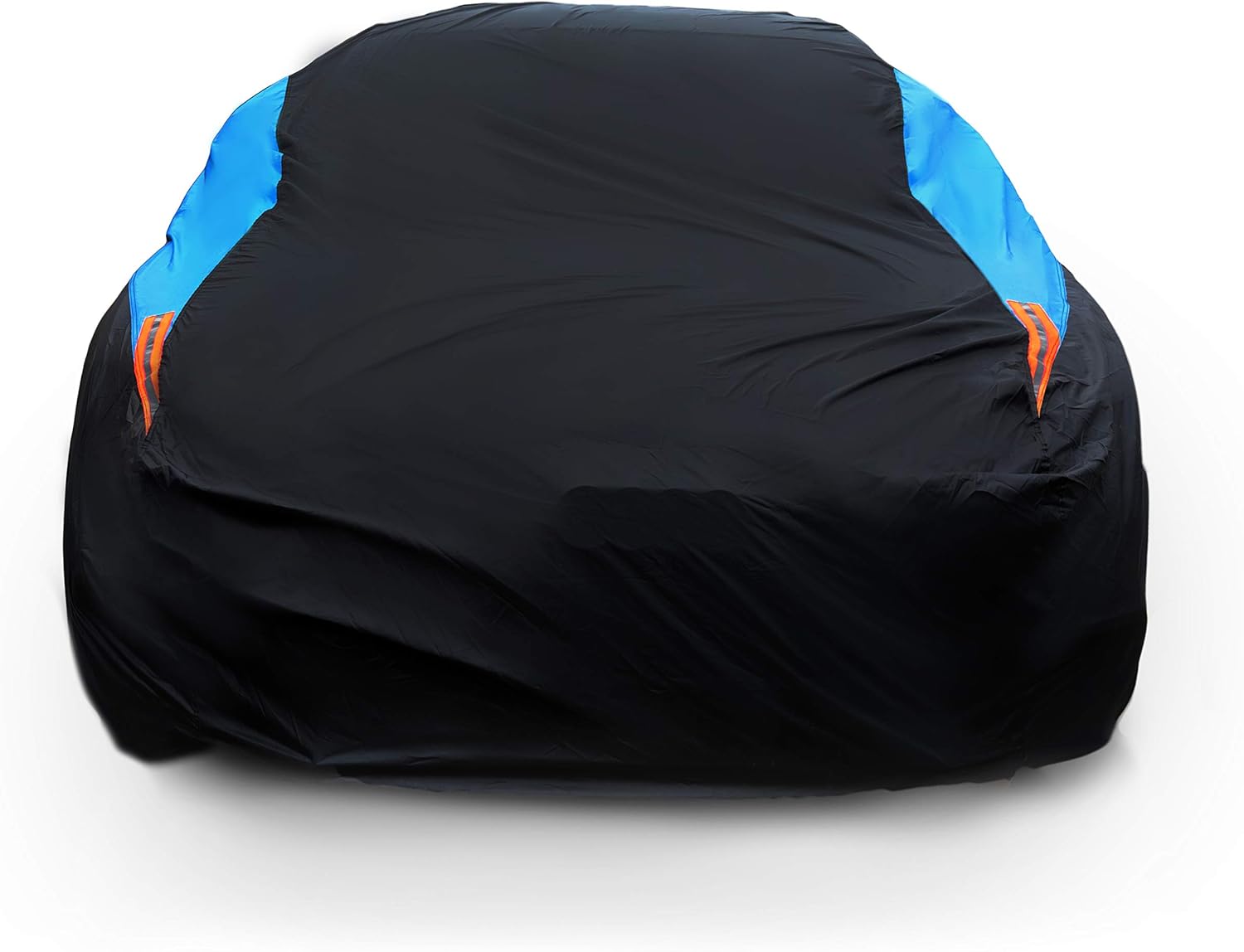
uxcell YXL Heavy-Duty Waterproof & Breathable Car Cover with Mirror Pockets
★★★★☆ 4.0 stars — 5,559 ratings on Amazon
A budget-friendly outdoor cover that includes built-in mirror pockets to anchor the cover over your side mirrors and reduce wind-driven abrasion against mirror housings.
As an Amazon Associate, we earn from qualifying purchases.
Should You Fold Your Mirrors Before Putting On a Car Cover?
Folding your mirrors before covering depends on whether your cover has mirror pockets. If it does, keep them extended — mirror pockets are designed to fit over your mirrors in their open position, and they protect the housing from contact with the cover fabric.
If your cover has no mirror pockets, folding your mirrors in reduces the surface area exposed to the cover. A folded mirror sits closer to the door and gives the loose fabric less of a protrusion to catch on and abrade against. It’s a reasonable workaround if you can’t replace the cover right now.
But folding isn’t a full solution for a loose or cheap cover. The real fix is a cover with mirror pockets that eliminates cover movement at the mirror area entirely. You might be wondering: “won’t the cover still rub on the door near the folded mirror?” Yes — and that’s why a secure fit with tie-down straps is still essential even when mirrors are folded.
What Most People Get Wrong About Car Cover Mirror Damage
Most car owners believe that a “soft” car cover can’t hurt their mirrors. This is wrong. The issue isn’t the cover’s outer feel — it’s the inner lining material and whether the cover moves in wind. A cover that feels smooth on the outside can still have a non-woven inner lining that scratches every time it shifts.
A second common belief is that the cover needs to drag across the mirror to cause damage. In reality, very little movement is needed. The cover makes contact, lifts slightly, re-contacts the same spot. Repeated thousands of times in a single windy night, even this minor movement accumulates into visible swirl marks on mirror housing paint.
The third misconception is that more cover layers means better mirror protection. The number of layers has nothing to do with it. A 7-layer cover with a non-woven polypropylene inner lining will scratch your mirror housing. A 3-layer cover with a fleece inner lining will not. What touches the mirror is what matters.
Can a Car Cover Harm Your Power-Fold Mirrors?
A car cover can stress power-fold mirrors in 2 ways: direct pressure on the folded mirror housing, and wind load pulling against extended mirrors. Power-fold mirrors have internal motors that are not designed to resist sustained sideways force from a flapping cover.
Strong winds can stretch a loose cover against your extended mirror and put sideways pressure on the motor’s pivot point. Over time, this repeated stress can loosen or damage the motor gearing. A custom-fit cover with mirror pockets eliminates this risk by holding the cover stationary over the mirror rather than pulling against it.
If you have power-fold mirrors, one safe option is to fold them in before covering with a universal cover. But the better long-term solution is a fitted cover with mirror pockets that removes the wind load on the mirror assembly entirely.
Conclusion
A car cover can absolutely damage your side mirrors — through grit abrasion, a rough inner lining, and wind-driven fabric movement. All 3 causes are preventable with the right cover and the right technique. The single most important thing you can do right now: check whether your current cover has a fleece or satin inner lining and built-in mirror pockets.
If it doesn’t have those 2 features, your mirrors are at risk every time you use it. That’s the fix — and it’s a straightforward one.
One thing to do right now: Pull out your car cover and check the inner lining. Rub it gently between your fingers. If it feels rough or stiff — not soft like fleece — that lining is abrading your mirror housing every time the cover moves.
Frequently Asked Questions
Can a car cover scratch side mirrors?
Yes. A car cover scratches side mirrors when grit is trapped between the fabric and mirror housing, when the inner lining is rough, or when wind causes the cover to flap repeatedly against the mirror edge. Using a cover with mirror pockets, a soft fleece lining, and tie-down straps prevents all 3 causes.
What are mirror pockets on a car cover?
Mirror pockets are fabric pouches built into both sides of a car cover that fit snugly over each side mirror. They fully enclose the mirror housing to stop the cover from rubbing against it, and they anchor the cover’s position to reduce wind-driven movement across the rest of the car.
Should I fold my mirrors before putting on a car cover?
Only if your cover has no mirror pockets. Folding mirrors in reduces the protrusion the cover can catch against and abrade. If your cover has mirror pockets, keep mirrors extended — the pockets are designed to fit over extended mirrors and protect the housing from direct cover contact.
Is a universal car cover bad for side mirrors?
Universal covers are higher risk for mirror damage than custom-fit covers. Because they’re sized for a range of vehicles, they’re always too loose in some areas — and mirror protrusions catch the most movement from a loose cover in wind. A custom-fit cover shaped to your specific model reduces this risk significantly.
What car cover material won’t scratch mirrors?
Car covers with a fleece or satin inner lining won’t scratch mirror housing paint. These materials have fibers that lie flat and glide safely across surfaces. Avoid covers with non-woven polypropylene inner linings — their upright fiber ends act as micro-abrasives on mirror housing paint every time the cover moves.
Can a car cover damage power-fold mirrors?
Yes. A loose cover in strong wind puts sideways stress on the motor gearing inside power-fold mirrors. Over time this can loosen or damage the pivot mechanism. A custom-fit cover with mirror pockets holds the cover stationary over the mirror and removes this wind load entirely.
How do I stop my car cover from flapping against my mirrors in wind?
Use 3 methods together: fit mirror pockets over each mirror to anchor the cover, use all tie-down straps under the chassis, and upgrade to a custom-fit cover that conforms to your car’s shape. A cover that can’t shift in wind can’t abrade your mirrors. Gust guards are also available as an add-on for windy locations.

Daniel Brooks is an automotive writer and product researcher focused on car accessories, car tech, maintenance, and practical driving guides. At Plug-in Car World, he helps drivers make smarter automotive decisions through honest reviews and research-driven content.