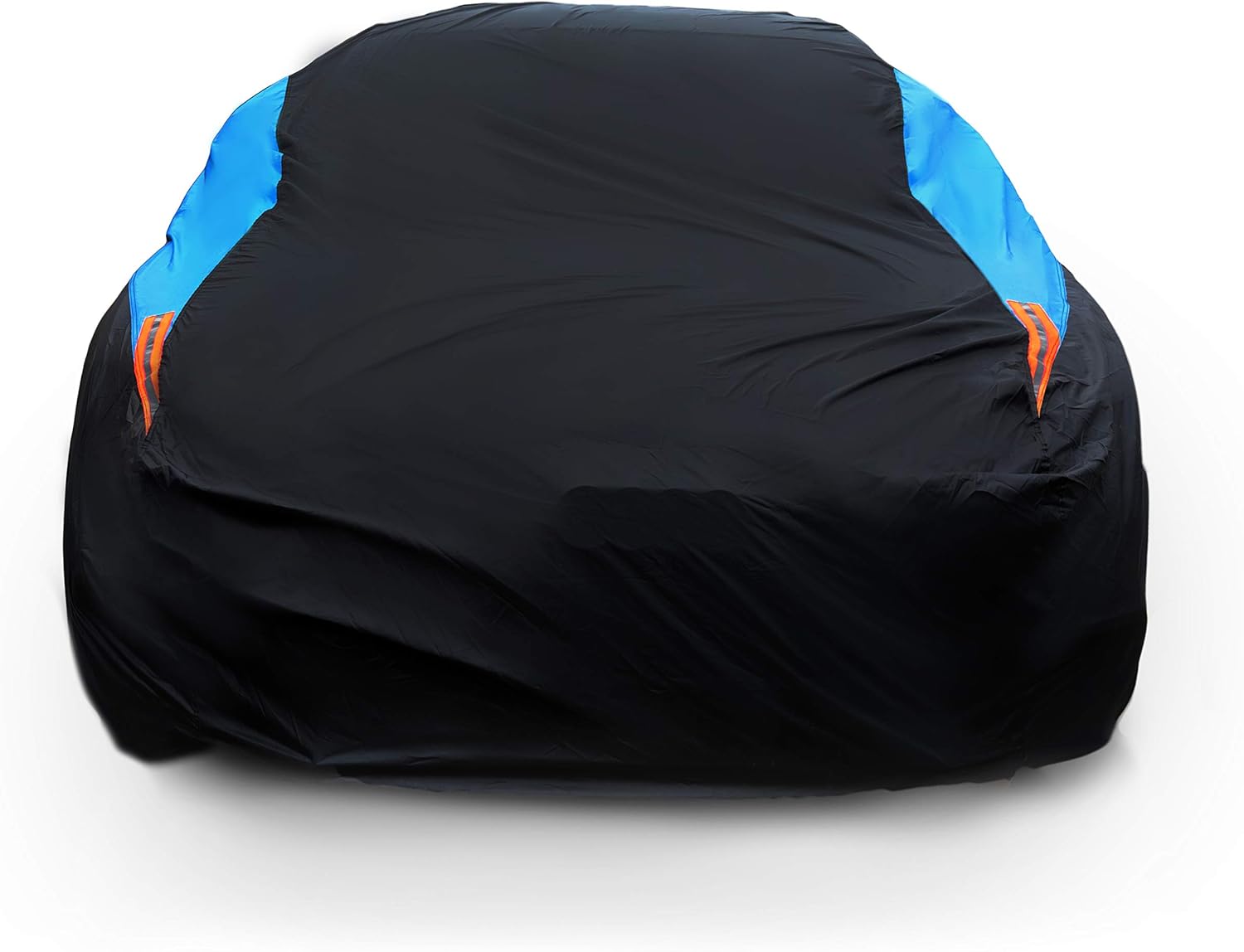
Wrong Size Car Cover: What Goes Wrong and How to Fix It
You bought a car cover to protect your vehicle, but now it sags at the front, bunches around the doors, or barely reaches the rear bumper. The cover is the wrong size — and using it anyway will cause exactly the kind of damage you were trying to prevent.
A poorly fitting car cover is not just useless. It can actively scratch your paint, lock in moisture, and leave key panels exposed to UV rays and debris. This guide covers every consequence of wrong-size covers, how to measure correctly, and how to choose between universal, semi-custom, and custom-fit options.
What Happens When a Car Cover Is Too Big?
A cover that is too large creates excess fabric that pools around the lower body and bunches at the wheels. Wind gets underneath the loose sections, and the cover starts to billow and beat against the panels it was meant to shield.
The damage mechanism is direct. Wind loads of 10 to 20 mph are enough to cause sustained fabric movement. Each time the cover lifts and falls, it picks up any dust or grit sitting between the fabric and the paint — then grinds that particulate across the clear coat. Tiny silica particles from road film and brake dust are especially abrasive. After a few weeks outdoors, the result is a network of fine swirl marks and micro-scratches visible under direct sunlight.
Excess material also creates gaps at the front and rear. Rain and debris enter through those gaps, so the underside of the cover becomes a damp, dirty environment pressed against your paint. In humid climates, trapped moisture accelerates rust on exposed metal edges and promotes mold growth on trim pieces.
Can a Loose Cover Blow Off Entirely?
Yes — if the cover has no tie-down straps or the elastic hem is overstretched, a strong gust will lift the whole cover off the car. Beyond the obvious exposure risk, a flying car cover can hit other vehicles or people nearby. Universal covers rated for vehicles 10 to 20 inches longer than your car are the most common culprits, because the hem sits several inches above the rocker panels and offers no grip point for the elastic.
What Happens When a Car Cover Is Too Small?
A cover that is too small cannot reach the bumpers, leaving the front fascia, lower doors, or trunk lid uncovered. Those exposed sections get full UV exposure, bird droppings, and tree sap — exactly the hazards you paid to avoid.
Forcing a tight cover over a car creates a different set of problems. The fabric pulls hard against side mirrors, antennas, and spoilers. That constant tension can crack plastic mirror caps, snap flexible antennas at the base, and stress the mounting points of aftermarket spoilers. On classic or modified cars, where these components may already have aged rubber seals, a too-small cover applies enough force to cause real structural damage over a storage season.
A tight cover also abrades specific high points. The roof, door handles, and trunk edges contact the underside of the fabric with consistent pressure. If the inner lining is not soft fleece — and many budget covers use rough nonwoven polypropylene — those high-contact zones develop paint transfer marks and scuffs within weeks.
Does a Tight Cover Protect Better Than a Loose One?
No. A snug fit is not the same as a tight fit. The correct fit has the fabric lying flat against the contours of the car with no stretching at any point and no pooling or bunching elsewhere. Custom-fit covers achieve this because they are patterned specifically for your vehicle’s body lines. Universal covers with elastic hems can approximate it if the vehicle falls within the middle of the cover’s size range — not at either extreme.
How to Measure Your Car for a Cover
Three measurements determine car cover size: length, width, and height. Each one has a specific technique, and getting any one wrong sends you back to the wrong-size problem.
For length, run a tape measure parallel to the ground along the side of the car — from the outermost point of the front bumper to the outermost point of the rear bumper. Do not drape the tape over the hood and trunk; that measures surface contour, not the straight-line dimension that cover manufacturers use. If your car has a rear-mounted spare tire, a tow hitch, or a bike rack, include those in your length measurement.
For width, measure across the widest point of the car — usually side mirror to side mirror. Some manufacturers ask for body width only (excluding mirrors) because their covers have separate mirror pockets. Check the brand’s sizing guide to confirm which measurement they want before ordering.
For height, measure from the ground to the highest fixed point on the roof. If you have a roof rack or roof box, include it. A retractable antenna in the down position does not need to be included — but if your antenna does not retract, measure to its tip and verify the cover has an antenna grommet or pocket.
Always round up to the nearest inch, then compare against the manufacturer’s size chart. If your car falls at the upper end of one size range, go up to the next size. A cover with 2 to 3 inches of clearance fits correctly. A cover with 8 or more inches of excess length on a sedan will behave like a too-large cover — even if it technically falls within the listed range.
| Measurement | How to Take It | Common Mistake to Avoid |
|---|---|---|
| Length | Bumper to bumper, straight line parallel to the ground | Measuring over the hood/trunk contour adds 6–12 inches of error |
| Width | Side mirror to side mirror (or body only — check brand’s guide) | Using Google specs instead of measuring your actual trim level |
| Height | Ground to highest fixed roof point, including roof racks | Forgetting roof racks, spoilers, or bull bars in the measurement |
| Accessories | Measure spoilers, hitches, brush guards separately and add to relevant dimension | Assuming stock specs — aftermarket bumpers and spoilers change the numbers |
Universal vs. Semi-Custom vs. Custom-Fit Car Covers
The three cover types represent three very different levels of protection, and the wrong-size problem is almost always tied to choosing the wrong type for your situation.
Universal covers are designed to fit a broad category of vehicle — “mid-size sedan” or “full-size SUV” — using elastic hems and generic proportions. They are the least expensive option ($30–$80), but they fit correctly only if your car sits near the middle of the stated size range. A vehicle at the top or bottom of that range will have significant loose spots or tight zones. Universal covers are acceptable for short-term indoor storage where wind is not a factor.
Semi-custom covers are patterned for a specific body style — a four-door sedan, a two-door coupe, a pickup with a short bed — and sized in narrower increments than universals. They fit far better than universals for outdoor use and typically cost $80–$200. They still lack the mirror pockets and body-line contouring of a custom cover, so they carry a small amount of excess fabric around protrusions like spoilers and side steps.
Custom-fit covers are manufactured to your exact make, model, year, and sometimes trim level. They include mirror pockets, antenna grommets, and contoured wheel arches. They slip on and off without tugging or fighting the car’s shape. They run $200–$500 but eliminate the wind-flapping problem entirely because there is no excess fabric to catch air. For vehicles parked outdoors year-round, or for classic and high-value cars in long-term storage, a custom cover is the correct choice.
Which Type Should You Choose?
- Indoor, short-term parking, budget priority → universal cover is workable, provided you wash the car first and confirm the cover reaches all four bumpers.
- Outdoor, daily-use vehicle, mixed weather → semi-custom cover in the correct body-style category, with tie-down straps to manage wind.
- Outdoor, year-round storage, high-value or modified vehicle → custom-fit cover is the only option that prevents all wrong-size problems.
What Most People Get Wrong About Car Cover Sizing
Misconception 1: “A cover that’s a little too big is safer than one that’s too small.” This is backwards. A cover that is too large in an outdoor environment causes more paint damage than no cover at all — the fabric becomes an abrasive flap loaded with grit. A slightly small cover that still reaches the bumpers is less harmful than a loose one that thrashes against the paint in wind.
Misconception 2: “I can just use tie-down straps to fix a too-large cover.” Straps tighten the hem at the bottom but do nothing for the excess fabric above the rocker panels. The mid-section of the cover still has slack that catches wind. Straps are a supplement for a well-fitting cover, not a correction for a wrong-size one.
Misconception 3: “The make and model dropdown on the website guarantees the right size.” Manufacturer databases are useful but not infallible. They use stock specifications and often do not account for different trim-level dimensions, aftermarket body kits, added roof racks, or vehicles with extended front bumpers. Measuring your actual car and comparing those numbers to the cover dimensions is the only reliable method — the dropdown is a starting point, not a final answer.
How to Tell If Your Current Car Cover Fits Correctly
A properly fitting car cover has the fabric lying flat against the car’s body on all sides, with the hem sitting close to the rocker panels — within 2 to 4 inches of the ground on a sedan. There should be no visible pooling of fabric along the doors, no stretched sections at the roof or mirrors, and the front and rear bumpers should be fully covered.
To test for a too-large cover, grab the fabric at the middle of the driver’s door and pull it sideways. More than 4 inches of slack means the cover will shift in moderate wind. To test for a too-small cover, check the four corners. If the cover pulls tight before reaching any bumper, or if the elastic hem is fully extended and still does not sit flat at the bottom of the door, the cover is undersized.
Check the mirror zones specifically. A universal cover without mirror pockets will tent outward at the mirrors, creating two gaps where rain and dust enter directly. If your current cover does this, moisture is reaching your door panels every time it rains — regardless of how well the rest of the cover fits.
Steps to Take If You Already Have the Wrong Size Cover
If you have a cover that is too large for outdoor use, the immediate step is to stop using it outside. A too-large indoor cover is usable for dust protection in a garage where there is no wind — but only if you wash the car beforehand, because any grit trapped under the cover will still scratch during removal.
If the cover is only slightly oversized — within 4 to 6 inches of your car’s length — adding an elastic garter strap around the middle section reduces billowing significantly. Position the strap at the widest point of the doors, snug enough to hold the fabric against the body but not tight enough to indent it. This is a short-term workaround, not a permanent fix.
If you need to return or exchange the cover, most cover manufacturers accept returns within 30 days provided the cover is unused and in its original packaging. Check whether the brand offers an exchange rather than a refund — some will ship a replacement in the correct size and apply the original purchase price as credit, which avoids return shipping costs.
Car Cover Material and Fit Work Together
A correct size in the wrong material still causes problems. For outdoor use, the cover must be breathable — meaning the fabric allows water vapor to escape from underneath even while blocking liquid rain on the outside. A non-breathable cover in the right size will trap condensation against the paint, softening the clear coat over time and accelerating corrosion on any exposed metal.
For indoor storage, the priority reverses. An outdoor-rated waterproof cover traps humidity inside a garage because it prevents air circulation. Indoor covers use soft, breathable materials — cotton flannel, polypropylene fleece, or microfiber — that let the car breathe while blocking dust. A multi-layer outdoor cover used indoors is overkill in terms of material but also creates a warm, moist microclimate under the fabric that promotes mildew on rubber seals and wiring.
The inner lining matters more than the outer layers for paint safety. A soft fleece inner lining distributes contact pressure and does not hold grit the way a rough woven outer layer does. When comparing covers at the same price point, prioritize the inner lining specification over the number of outer layers.
Frequently Asked Questions
Can a too-large car cover cause rust?
Yes. A loose cover lets rain, dew, and road spray enter through the gaps at the front, rear, and mirror zones. That moisture collects under the cover and has no way to escape if the fabric is non-breathable. Prolonged contact with trapped moisture accelerates rust on bare metal edges, door sill trim, and any paint chips already present on the body.
Is it okay to use a universal cover on a modified car?
Generally not for outdoor storage. Aftermarket spoilers, bull bars, widebody kits, and roof racks change your car’s effective dimensions beyond what universal size charts account for. A universal cover will either leave modifications exposed or tent unevenly around them, creating entry points for debris. Custom or semi-custom covers designed with your modifications in mind are the correct choice.
How much size difference is acceptable between my car and the cover?
For length, a cover up to 4 inches longer than your car fits acceptably for outdoor use if it has a fitted elastic hem. Beyond 6 inches of excess length, the cover will shift in wind. For width, the cover should be within 2 inches of your car’s mirror-to-mirror measurement. Height tolerances are the most forgiving — up to 3 inches over your car’s actual height is typically fine.
Do car cover sizes vary between brands for the same vehicle?
Yes, and significantly. One brand’s “large sedan” range might be 185 to 200 inches, while another’s starts at 196 inches. Never order based on category labels alone. Always check the brand’s stated cover dimensions in inches, then compare those to your measured car dimensions. The dimension printed on the cover’s label refers to the cover itself, not the maximum car size it fits.
Will a car cover in the wrong size void any paint warranty?
Most paint warranties from manufacturers cover defects in the factory finish, not damage from external products. However, if a dealer inspection shows clear coat damage consistent with abrasion — the fine swirl marks a flapping cover leaves — they will attribute it to owner error, not a factory defect, and decline the claim. Using the correct-size cover with a soft inner lining is the way to keep your paint in warranty-claimable condition.
The single most important takeaway here is this: a car cover’s size is not a minor detail. It determines whether the cover protects your paint or damages it. Measure your car in straight-line dimensions, confirm those measurements against the brand’s specific size chart, and choose a cover type — universal, semi-custom, or custom-fit — that matches both your vehicle’s proportions and where you park it. Get your tape measure out today, write down three numbers, and you have everything you need to buy the right cover the first time.

Daniel Brooks is an automotive writer and product researcher focused on car accessories, car tech, maintenance, and practical driving guides. At Plug-in Car World, he helps drivers make smarter automotive decisions through honest reviews and research-driven content.