Can Wind Damage Your Car Through a Cover? (Yes — Here’s What’s Actually Happening)
⚡ Quick Answer
Yes — wind can damage your car through a cover. A loose or poorly fitted cover flaps against the paint, causing scratches. Debris lifted underneath the cover acts like sandpaper. The cover itself is not the danger. Poor fit and lack of securing straps are.
When wind damages your car through a cover:
- Loose cover flapping: fabric rubbing against paint causes micro-scratches fast
- Debris under cover: dirt and grit trapped beneath act like abrasive paper
- Winds above 35 mph: not recommended to leave any cover on without straps
How to prevent wind damage through your cover:
-
✓
Use gust straps or bungee cords to anchor the cover underneath -
✓
Choose a custom-fit or semi-custom cover — not a loose universal one -
✓
Remove the cover before winds exceed 35 mph if it has no straps
You put a cover on your car to protect it. Then a wind storm rolls through — and you’re left wondering if the cover just made things worse. Michael here, and after testing car covers across dozens of weather conditions, I can tell you: the cover itself isn’t your enemy. How it fits and how it’s secured is everything. Read on to find out exactly what’s happening to your paint when the wind picks up.
📌 Key Takeaways
-
→
A loose cover flapping in wind can scratch your car’s paint faster than no cover at all. -
→
Debris trapped beneath the cover during wind acts like sandpaper against the clear coat. -
→
Winds above 35 mph are the threshold where car cover experts say you should remove or strap down your cover. -
→
Gust straps, grommets, and a proper fit eliminate all three causes of wind-related cover damage.
How Does Wind Damage Your Car Through a Cover?
Wind damages your car through a cover in 3 specific ways — and all 3 come down to the cover not staying still. A properly secured, well-fitted cover protects your paint. A loose one becomes the very thing attacking it.
Here’s what’s actually happening during a windy night:
📋 3 Ways a Car Cover Causes Wind Damage
-
Flapping fabric abrasion: When wind gets under a loose cover, it lifts and drops the fabric repeatedly against your car’s surface. Each slap grinds any dust or grit on the cover’s inner lining directly into your clear coat, leaving fine scratches. -
Debris pushed under the cover: High winds carry sand, grit, and fine dirt particles. These squeeze under a loose cover’s edges and get trapped between the fabric and your paint. Once there, every movement of the cover grinds them in like sandpaper. -
Pressure buildup causing cover shift: Wind enters gaps in a loose cover and creates pressure underneath — like inflating a sail. This pressure can drag the cover sideways, tearing it against mirrors, antennas, or wipers as it goes.
So if you find small swirl marks or fine scratches on your hood after a windy night — and you had a cover on — the cover was the likely culprit, not the wind itself.
⚠️ Warning
A universal-fit cover is oversized by design. That extra fabric has nowhere to go in wind — it becomes a flapping, scratching hazard. If you own one, use gust straps every time you cover the car outdoors.
The good news: none of this happens with a snug-fitting, properly secured cover. The next section explains exactly what wind does to an uncovered car — so you can see why a cover (done right) still beats nothing.
What Does Wind Actually Do to an Uncovered Car?
Wind alone doesn’t scratch your car. What wind carries does. This is the key fact that explains everything about car cover decisions in windy conditions.
Wind acts as a delivery system for damage. It picks up fine sand, road grit, salt particles, and tiny stones — then drives them into your paint at speed. According to Key Collision Center’s breakdown of how wind damage affects your car’s exterior, these particles can cause gouges that cut straight through the clear coat into bare metal.
Sandstorm-level winds are the worst case. Billions of particles moving at high speed act exactly like industrial sandblasting on your hood and roof. Even light everyday wind still carries grit. Over time, it causes micro-abrasions that dull your paint’s finish.
A properly fitted car cover blocks all of this. The cover takes the hit so your paint doesn’t. But when the cover itself starts moving in wind — it joins the problem.
35 mph
Wind speed where covers become risky without straps
3 layers
Paint layers wind debris can penetrate (primer, color, clear coat)
0 mph
Wind needed for debris already under a loose cover to cause scratches
So here’s the situation: without a cover, wind-blown debris attacks your paint directly. With a loose cover, the cover itself becomes a tool for that debris to grind against your paint. The solution is a cover that stays put.
What Wind Speed Is Too High for a Car Cover?
The answer is clear: 35 mph is the limit. At winds above 35 mph, cover manufacturers including Coverking officially state that covers should not be used without securing straps because dirt and debris can be lifted under the cover, which also wears down seams.
Below 35 mph, a well-fitted cover with built-in straps handles normal wind fine. Above 35 mph, the dynamics change fast.
The table below shows what happens at different wind speeds with different cover types:
Wind speed vs cover behavior — understanding when your cover becomes a risk.
At storm-level winds, even a good cover can become dangerous. When in doubt, remove it and store it safely before the storm arrives.
But knowing the limit is only half the battle. Next, let’s look at the exact steps to keep your cover from becoming a paint-scratching hazard.
How to Stop Your Car Cover from Blowing Off in Wind
Stopping a cover from blowing off is straightforward. It takes less than 5 minutes and protects both your cover and your paint. Here’s the full process, in the right order:
🔢 Step-by-Step: Securing a Car Cover Against Wind
-
1
Fit the cover front-to-back correctly
Every cover has a labeled front and back. Put the front end over the hood first. A wrong-way cover creates gaps that catch wind immediately.
-
2
Tuck the elastic hem under the bumpers
Tuck the bottom edge under both the front and rear bumper. This seals the low entry points where wind most easily gets under.
-
3
Attach gust straps under the chassis
Thread gust straps or bungee cords through the cover’s grommets and under the vehicle. This creates downward tension that fights lift. See 5 proven methods for securing a car cover in high winds for detailed strap options.
-
4
Add a cable lock for storms
Thread a vinyl-coated steel cable through the grommets and lock it underneath. This also deters theft and adds serious storm resistance.
-
✓
Check for gaps and test tension
Walk around the car and press down on the cover edges. No section should lift more than 2 inches. Your cover is now wind-secured.
You might be thinking: “My cover has no grommets — can I still secure it?” Yes. Heavy-duty binder clips attached to the hem at the front and rear bumpers work as a temporary fix. They’re not as reliable as gust straps, but they add meaningful resistance in moderate wind.
Can a Loose Car Cover Damage Mirrors or Antennas?
Yes — and this is one of the most common wind-related cover complaints. When a poorly fitted cover shifts in wind, it drags across whatever sticks up: side mirrors, radio antennas, and wiper blades.
Strong winds can stretch the cover material and press it hard against these parts. If the fabric snags on a mirror and then whips in a gust, it can crack the mirror housing or snap a flexible antenna. Wiper blades get bent when covers slide over them under pressure.
The fix is simple. If your cover has mirror pockets, always use them. Custom-fit covers are shaped around mirrors so the fabric doesn’t rest directly on them. If your cover is universal, tuck a small cloth around each mirror before covering to act as a buffer.
✅ Tip
Fold your antenna down before putting the cover on in windy weather. A folded antenna can’t be snapped. Most modern car antennas fold flat against the roof for exactly this reason.
Now let’s look at which cover type actually stays put in wind — so you never have to worry about this again.
What Type of Car Cover Is Best for Windy Areas?
The right cover for wind has 3 things: a snug fit, elastic hems, and built-in securing straps. Universal covers have none of these by default. Custom and semi-custom covers have all 3.
Here’s how the main types compare:
Comparing cover types for wind resistance — what matters most when parking outdoors.
| Feature | Universal Fit | Custom / Semi-Custom ✓ Best |
|---|---|---|
| Fit tightness | Loose, excess fabric | ✓ Snug, shaped to vehicle |
| Mirror pockets | Rarely included | ✓ Built-in mirror and antenna pockets |
| Wind resistance | Low without add-on straps | ✓ High — elastic hem + built-in straps |
| Debris entry risk | High — gaps around edges | ✓ Low — sealed fit |
| Cost | $20–$50 | ✓ $50–$200 (worth it outdoors) |
If you park outdoors regularly in windy conditions, a semi-custom cover with an underbody strap system is the right long-term choice over a cheap universal cover.
If budget is the main concern, a universal cover with gust straps added works well for moderate wind. For areas with regular storms, a custom-fit cover pays for itself in paint protection.
Recommended Product
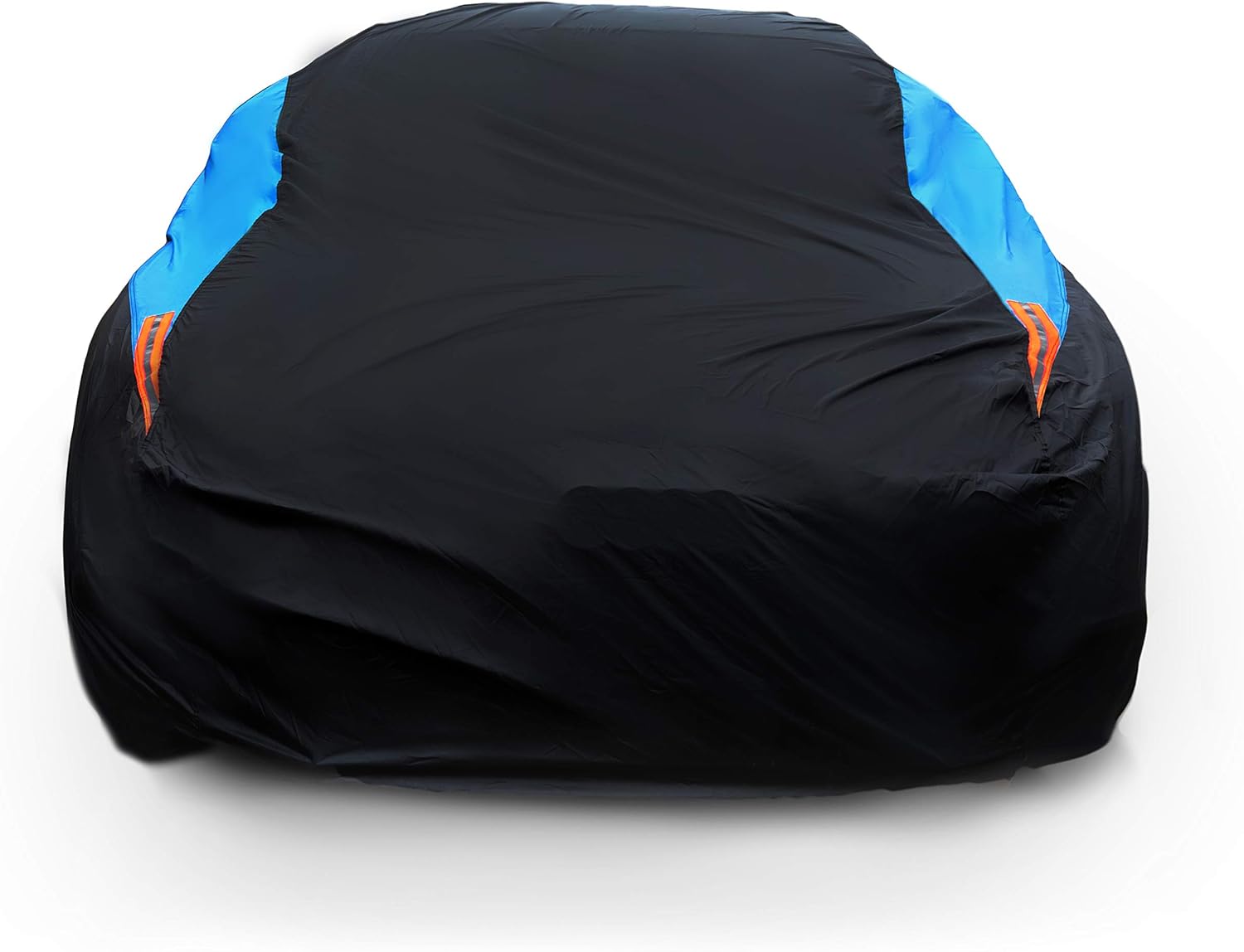
MORNYRAY Waterproof Car Cover All Weather Snowproof UV Protection Windproof Outdoor Full Car Cover, Universal Fit for Sedan (Fit Sedan Length 194-206 inch, Blue)
★★★★☆ Highly rated on Amazon
Includes 3 built-in securing straps and a windproof elasticized hem — making it one of the better budget options for outdoor parking in windy conditions.
As an Amazon Associate, we earn from qualifying purchases.
Should You Remove Your Car Cover Before a Storm?
It depends on your wind speed forecast and whether your cover is strapped down. Here’s the clear decision framework:
🎯 Remove the Cover or Keep It On?
If winds will be under 35 mph…
And your cover is strapped or has elastic hems
→ Keep the cover on. It’s protecting your car.
If winds will exceed 35 mph…
And your cover is not strapped down
→ Remove it. A loose cover will scratch your paint.
If a severe storm is forecast…
Winds over 50 mph, hail, or tornado watch
→ Remove the cover. Get the car into a garage if possible.
A storm-level event can shred even a good cover, or send it flying into a neighbor’s car. Your cover is a protection tool for ordinary weather — not a shield for extreme weather. Store it safely before the big stuff arrives.
What Most People Get Wrong About Car Covers and Wind
Myth 1: “Any car cover protects against wind damage.”
A loose universal cover can cause more paint damage than no cover at all. The cover fabric rubbing against your paint in wind is abrasive — especially when it traps dust and grit underneath. Protection only works when the cover stays still and tight.
Myth 2: “Wind itself scratches the car through the cover.”
Wind doesn’t scratch paint through fabric directly. What actually does the damage is the movement of the cover and the debris it collects. A cover that doesn’t move can’t scratch. The fix is securing the cover — not avoiding covers entirely.
Myth 3: “Heavier covers are always better in wind.”
Cover weight matters less than cover fit. A heavy, poorly fitted universal cover is still a sail in wind. A lightweight custom-fit cover with a snug hem and gust straps outperforms a heavy universal cover in every windy condition. Weight without fit is not protection.
💡 Key Insight
The best wind protection from a car cover is 90% about fit and 10% about material. A $50 semi-custom cover beats a $200 loose heavy cover in every windy scenario. Buy for fit first.
Conclusion
Wind can absolutely damage your car through a cover — but only when that cover is loose, poorly fitted, or unsecured. A properly fitted car cover with gust straps and an elastic hem stays in place, keeps debris out, and protects your paint even in strong wind.
The one thing to do right now: check your current cover for gaps at the front and rear bumpers. If you can lift the edge more than 2 inches with one finger, your cover needs straps before the next windy night.
Frequently Asked Questions
Can a car cover scratch your car?
Yes. A car cover scratches your car when it moves against the paint surface, trapping grit or dust beneath it. This happens most often with loose-fitting universal covers in wind. A clean, snug-fitting cover that stays still will not scratch your paint.
Is it bad to leave a car cover on in high winds?
It depends on your cover type and securing method. An unstrapped universal cover in high winds will flap, scratch, and may blow away. A secured custom-fit cover handles winds under 35 mph well. Above 35 mph without straps, remove the cover to avoid paint damage.
How do I stop my car cover from blowing off?
Use gust straps or bungee cords threaded through the cover’s grommets and pulled under the vehicle chassis. Tuck the elastic hem under both bumpers. For storms, add a vinyl-coated cable lock. A custom-fit cover with built-in straps is the most reliable long-term solution.
What wind speed is too high for a car cover?
35 mph is the widely accepted limit. Cover manufacturers including Coverking state that above 35 mph, debris can be lifted under the cover, which also wears down seams. At this speed and above, either remove the cover or use a heavy-duty strap and lock system.
Can wind get under a car cover?
Yes. Wind enters through any gap between the cover and the car body — especially at the front bumper and wheel wells of universal covers. Once under the cover, it creates upward pressure that lifts the fabric off the paint and allows debris in. Tight edges eliminate this entirely.
Can a loose car cover damage side mirrors or antennas?
Yes. When wind shifts a loose cover sideways, it drags across mirrors and antennas. Strong gusts can crack mirror housings or snap flexible antennas if the cover fabric catches and pulls. Custom-fit covers with mirror pockets prevent this by keeping fabric off these parts entirely.
Does a car cover protect against wind damage?
A secured, well-fitted car cover protects against wind damage by blocking debris from reaching your paint. Wind-carried sand, grit, and particles that would otherwise abrade your clear coat are stopped by the cover fabric. The key is that the cover must stay still and sealed to provide this protection.

Daniel Brooks is an automotive writer and product researcher focused on car accessories, car tech, maintenance, and practical driving guides. At Plug-in Car World, he helps drivers make smarter automotive decisions through honest reviews and research-driven content.