
Steering Wheel Cover Keeps Coming Off? How to Fix It
Quick Answer
Your steering wheel cover keeps coming off most often because it is too large, does not match your steering wheel’s grip thickness, was not installed evenly, or has a worn or slippery inner surface. Remove a cover that moves or rotates, check the fit and condition, and reinstall it only if it can sit securely without interfering with the wheel, airbag, horn, or controls.
A steering wheel cover should stay firmly in place during normal steering. If it slides toward one side, lifts off the rim, or rotates when you turn the wheel, the problem usually involves fit, installation, material condition, or contamination between the cover and the original steering wheel.
The important distinction is whether the cover is simply difficult to install or actually moves after installation. A snug cover can be challenging to fit, but once properly installed, it should not rotate independently of the steering wheel.
1. The Steering Wheel Cover Is the Wrong Size
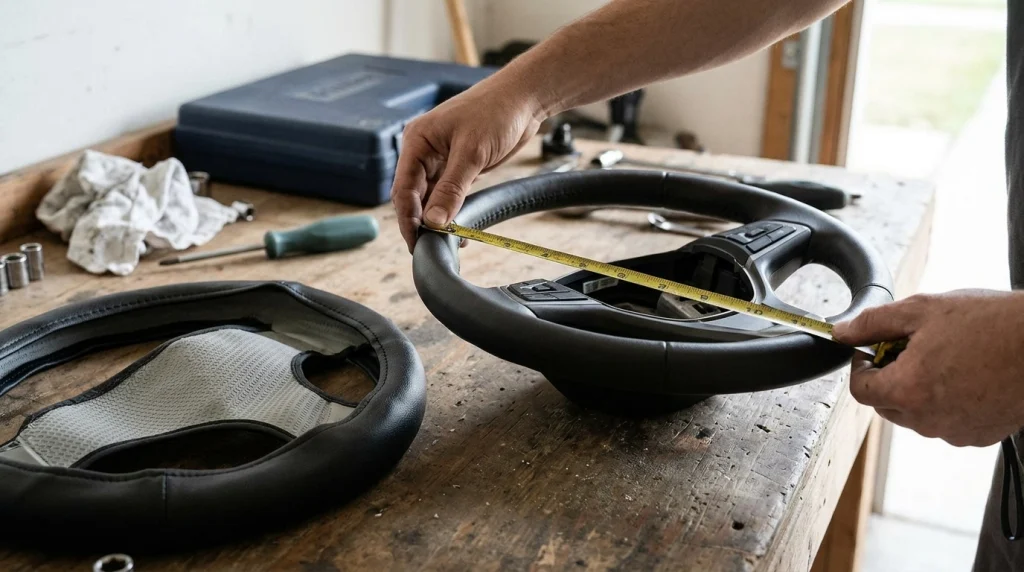
An oversized cover is one of the first things to check when a steering wheel cover repeatedly slips off. A cover that is too loose cannot maintain consistent contact with the steering wheel, even if its material looks thick or its exterior feels grippy.
Steering wheel covers are sold in different sizes and fit categories. A cover labeled universal may fit many wheels without fitting every wheel equally well. The outside diameter is only part of the equation; the thickness and shape of the rim also affect how securely the cover sits.
For example, a cover might match your wheel’s diameter but still feel loose around a relatively thin grip. Conversely, a cover designed for a thinner rim may be excessively tight on a thicker wheel and could stretch or strain its seams.
What to do:
- Check the cover’s stated size range and vehicle-fit information.
- Measure the steering wheel’s outside diameter according to the manufacturer’s instructions.
- Check the grip thickness or circumference if the manufacturer specifies it.
- Compare the measurements with the cover’s actual fit requirements instead of relying only on the vehicle’s make and model.
If the cover is visibly loose or can rotate after installation, replace it with one designed for the correct dimensions. Do not attempt to compensate for a poor fit with glue, tape, or improvised padding.
2. The Cover Was Not Installed Properly
A cover can have the correct dimensions and still come off if one section has not been seated properly. Uneven installation can leave excess material, an unseated edge, or inconsistent tension around the wheel.
This is particularly relevant to stretch-on covers, which rely on a close fit around the rim. If the final section is not fully seated, the cover may gradually shift during steering and eventually loosen further.
How to check the installation
- Park safely. Turn off the vehicle and make sure it is stationary before inspecting the cover.
- Inspect the entire rim. Look for lifted edges, uneven seams, folds, gaps, or areas that have not settled around the wheel.
- Check the alignment. Confirm that the cover is centered and that its seams and openings are positioned as intended by the manufacturer.
- Reinstall only if the fit is correct. Follow the supplied instructions, working evenly around the rim rather than forcing one section into place.
- Check the result while parked. The cover should remain stationary relative to the wheel and must not obstruct the horn, airbag area, or vehicle controls.
If the cover repeatedly lifts at the same location despite careful installation, it may be the wrong shape or size, or its structure may have been damaged. Repeatedly stretching it into place is not a reliable fix.
3. The Inner Surface Is Worn, Smooth, or Damaged
The inside of a steering wheel cover must maintain a suitable fit against the steering wheel. If its lining has become compressed, torn, stretched, or unusually smooth, the cover may no longer stay in position.
Age and repeated handling can change a cover’s shape. A cover that fitted securely when new may loosen after extensive use, especially if its elastic sections or seams have deteriorated.
Inspect the inside for these warning signs:
- Stretching: The material no longer returns to its original shape or feels slack around the rim.
- Torn lining: Sections of the inner surface are split, peeling, or missing.
- Damaged seams: Stitching has separated or the cover’s edges are pulling apart.
- Uneven wear: One section fits differently from the rest of the wheel.
A damaged cover should be replaced rather than stretched, glued, or stitched in a way that leaves its fit uncertain. Repairs that change the cover’s shape or create hard, uneven sections can introduce additional problems.
4. Dirt, Oil, or Cleaning Products Are Making the Cover Slip
Contamination can contribute to slipping when it leaves a slippery film on the steering wheel or the cover’s inner surface. Hand oils, lotions, food residue, dressing products, and unsuitable cleaners are possible sources.
However, cleaning is not a solution for every loose cover. If the cover is oversized, stretched, or damaged, removing residue will not correct the underlying fit problem.
How to clean the contact surfaces safely
- Remove the cover if it can be taken off without damaging it.
- Check the vehicle manufacturer’s care instructions for the original steering wheel material.
- Clean the wheel and cover separately with products suitable for their respective materials.
- Remove any cleaner residue as directed by the product instructions.
- Allow both surfaces to dry completely before reinstalling the cover.
Avoid soaking leather, applying oily dressings, or using solvents that could damage the wheel or cover. Do not apply adhesive cleaners or sticky coatings in an attempt to increase grip.
If the cover remains loose after cleaning and drying, return to the size and condition checks rather than repeatedly cleaning the same surfaces.
5. Temperature Changes Have Affected the Fit
Temperature can affect the flexibility and dimensions of some cover materials. A cover that becomes stiff in cold conditions may be difficult to install evenly, while certain materials may soften or change shape when exposed to substantial heat.
These effects depend on the cover’s construction, so temperature should be treated as a possible contributing factor rather than the automatic explanation for a loose fit.
If a cover is unusually stiff, allow it to reach the temperature recommended by its manufacturer before installation. A warm indoor environment may help some materials become more flexible, but avoid using a heat gun, open flame, boiling water, or excessive direct heat to stretch it.
After installation, check whether the cover remains secure under ordinary conditions. If it repeatedly loosens after temperature changes, verify that it is designed for the wheel’s dimensions and intended operating environment.
6. The Steering Wheel’s Shape Is Not Compatible With the Cover
Two steering wheels with similar outside diameters can have different rim thicknesses, cross-sectional shapes, contours, and spoke arrangements. A cover that works on one wheel may not fit another securely, even if both vehicles are described as having standard-size steering wheels.
Compatibility becomes especially important with unusual rim shapes, flattened-bottom wheels, heavily contoured grips, or covers designed for a specific steering wheel profile.
Before purchasing another cover, check:
- The wheel’s outside diameter and grip dimensions.
- The shape of the rim around its entire circumference.
- The cover’s stated compatibility and installation requirements.
- Whether the vehicle manufacturer permits a cover on that steering wheel.
Some vehicles have heated steering wheels, touch-sensitive controls, or hands-on detection systems used by driver-assistance features. An aftermarket cover may interfere with a feature even when it fits mechanically. Check the vehicle’s owner manual and the cover manufacturer’s compatibility guidance; if the cover is not approved for that setup, leave the wheel uncovered.
How to Identify the Cause Without Guessing
The location and pattern of the movement can help narrow down the problem. Use the following table to decide what to inspect first.
| What you notice | Possible cause | What to check |
|---|---|---|
| The whole cover rotates | Oversized cover, poor fit, or slippery contact surfaces | Dimensions, fit, and contamination |
| One edge keeps lifting | Uneven seating, incompatible shape, or damage | Installation, seams, and rim contours |
| It was secure but gradually became loose | Stretching, wear, or a change in material condition | Inner lining, elastic sections, and stitching |
| It feels slippery after cleaning | Cleaner residue or unsuitable surface treatment | Care instructions and complete drying |
| It becomes difficult to fit in cold conditions | Material stiffness | Recommended installation temperature and fit |
These clues are not definitive diagnoses. For example, an edge that lifts may indicate either incorrect installation or a cover that is fundamentally incompatible with the wheel. Confirm the dimensions and inspect the material before deciding on a fix.
What You Should Never Do to Keep a Steering Wheel Cover On
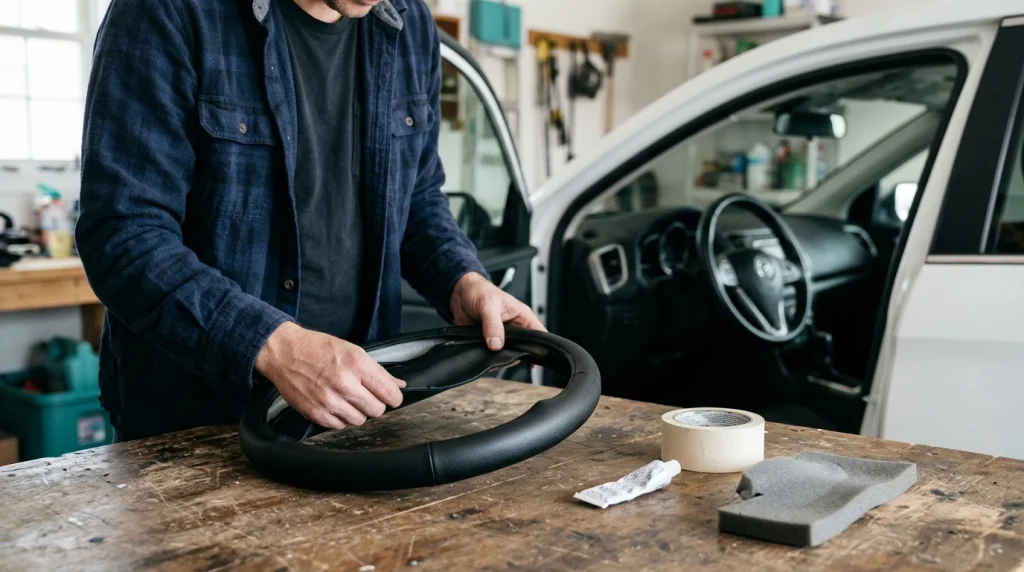
Do not use improvised fixes that make the cover appear secure without correcting the fit. A cover that moves independently of the wheel can interfere with accurate steering inputs.
- Do not glue the cover to the wheel. Adhesives can damage the original surface, complicate removal, or create an uneven repair without solving a sizing problem.
- Do not rely on tape or loose padding. These materials can shift, bunch up, or create an inconsistent grip.
- Do not force an undersized cover onto the wheel. Excessive force can damage the material, seams, or the original steering wheel surface.
- Do not keep driving with a cover that rotates or slips. Remove it before driving again if you can do so safely.
- Do not modify the airbag cover or its deployment area. Keep accessories away from airbag covers and follow vehicle-specific safety instructions.
Safety Warning
A loose steering wheel cover is a driving-control concern, not merely a cosmetic problem. Do not drive with a cover that slips during steering. Never attach decorative aftermarket emblems or objects over the steering wheel airbag cover; the National Highway Traffic Safety Administration warns that such objects can become dangerous projectiles during airbag deployment.
The National Highway Traffic Safety Administration’s steering wheel decal warning explains why altering the airbag cover with aftermarket decorations can create a serious injury risk. Although that warning concerns decorative decals rather than ordinary rim covers, it reinforces the need to keep the airbag area unobstructed and unmodified.
When Should You Replace the Cover Instead of Trying Another Fix?
Replace the cover when it is the wrong size, has stretched beyond a secure fit, has damaged seams, or continues to rotate after correct installation and cleaning. Buying another cover makes sense only after checking the wheel’s dimensions and confirming compatibility.
If the original steering wheel itself feels loose, has damaged material, or appears to have a structural problem, do not assume the cover is responsible. Have the steering wheel or steering system inspected by a qualified technician before continuing to drive if steering control or the wheel’s integrity is in question.
For a vehicle with heated-wheel functions, capacitive hand detection, or other steering-wheel-specific technology, consult the owner manual or manufacturer before installing a replacement cover. A cover that stays in place is not necessarily compatible with every vehicle feature.
Frequently Asked Questions
Can I make a loose steering wheel cover tighter?
Only if the manufacturer provides an approved adjustment or installation method for that cover. A stretch-on cover that is too large generally needs to be replaced with the correct size. Do not use glue, tape, or makeshift inserts to compensate for an incorrect fit.
Should a steering wheel cover be difficult to install?
Many stretch-on covers are intentionally snug, but installation should follow the manufacturer’s instructions and should not damage the cover or wheel. If the cover slides on easily and remains loose, or if fitting it requires excessive force, check the dimensions and compatibility before proceeding.
Will cleaning the steering wheel stop the cover from slipping?
Cleaning may help if oil, residue, or another contaminant is reducing grip. It will not correct an oversized cover, stretched material, damaged seams, or a mismatch between the cover and wheel shape. Clean compatible surfaces and allow them to dry fully before reassessing the fit.
Can I use double-sided tape to hold a steering wheel cover in place?
Do not use improvised tape to secure a loose cover. If a specific cover requires positioning tape as part of its approved installation, follow the manufacturer’s directions and use it only for its intended purpose. Tape is not a substitute for a secure mechanical fit.
Is it safe to drive if the steering wheel cover moves only a little?
No. Even slight independent movement can change the grip position and interfere with steering control. Remove a cover that moves or rotates and do not drive with it installed until the problem has been corrected.
Can a steering wheel cover interfere with heated steering wheels or driver-assistance systems?
Yes, depending on the vehicle and the cover. A cover may affect heat transfer or interfere with certain touch-sensitive controls or hands-on detection systems. Check the vehicle’s owner manual and manufacturer guidance before fitting one, and do not use it if compatibility is not confirmed.
Conclusion
If your steering wheel cover keeps coming off, start by checking its size, fit, and condition rather than trying to hold it in place with adhesive or tape. Make sure it matches the wheel’s diameter, grip thickness, and shape, then inspect the lining and seams for wear. Clean the contact surfaces only when appropriate for their materials, and reinstall the cover according to the manufacturer’s instructions.
If the cover still moves independently of the wheel, replace it with a compatible model or leave the steering wheel uncovered. Do not drive with a slipping cover, and check vehicle-specific restrictions before using any cover on a heated or sensor-equipped steering wheel.

Daniel Brooks is an automotive writer and product researcher focused on car accessories, car tech, maintenance, and practical driving guides. At Plug-in Car World, he helps drivers make smarter automotive decisions through honest reviews and research-driven content.
