
Are Steering Wheel Knobs Illegal? State Laws & Regulations
Quick Answer
Steering wheel knobs (often called suicide knobs or spinner knobs) are not outright illegal in most U.S. states, but many jurisdictions regulate their use based on vehicle type, equipment configuration, and commercial application. While federal OSHA standards allow them for certain commercial and industrial material handling equipment, individual states maintain varying traffic codes governing passenger vehicles. Drivers should check specific state vehicle safety statutes before installation, as unauthorized or improperly placed devices can violate equipment regulations or draw traffic citations if they obstruct steering operation or airbag deployment.
Understanding Steering Wheel Knobs and Their Regulatory Status
Steering wheel knobs have a long history rooted in agricultural and industrial machinery, where operators required rapid one-handed steering control while simultaneously managing implements, loaders, or transmissions.
Over time, these accessories found their way into standard consumer automobiles, commercial trucks, and vehicles operated by drivers with specific physical adaptations. However, their presence in everyday passenger cars has frequently intersected with state traffic laws governing safe vehicle control and interior equipment modifications.
The regulatory landscape is marked by a lack of a single federal ban for private passenger vehicles, leaving individual state transportation departments and law enforcement agencies to interpret general safety statutes.
As a result, legality often depends heavily on how a state defines unsafe vehicle modifications, driver distraction, or equipment obstruction.
Why Steering Wheel Knobs Face Legal Scrutiny
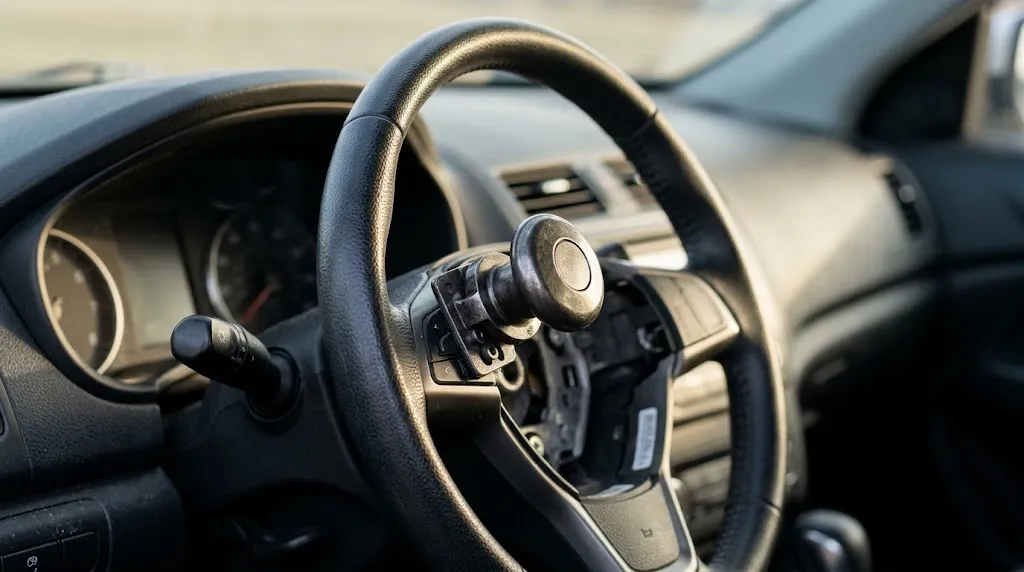
Traffic safety authorities and law enforcement agencies scrutinize steering wheel spinner knobs due to specific mechanical and operational risks associated with their placement and daily use.
When mounted incorrectly or used in high-speed passenger vehicles, these devices can introduce distinct hazards that compromise driver safety.
Interference With Airbag Deployment
Modern passenger vehicles are equipped with steering wheel-mounted airbags designed to deploy in milliseconds during a frontal collision.
A rigid metal or heavy plastic knob attached to the rim can become a dangerous projectile if an airbag deploys directly behind it, potentially deflecting the cushion unevenly or striking the driver with high velocity.
Entanglement and Hand Injury Risks
During sudden maneuvers, emergency steering corrections, or collisions, loose clothing, sleeves, or the driver’s fingers can catch on a protruding spinner knob.
This unexpected snag can prevent the driver from completing a necessary evasive maneuver or cause painful hand and wrist trauma.
Unintended Steering Inputs
Passenger cars feature high-ratio steering systems designed for responsive, two-handed control at highway speeds.
Using a spinner knob on a quick-ratio steering wheel can lead to over-steering, loss of smooth control during sudden lane changes, or accidental engagement when resting hands on the wheel.
Commercial Vehicles vs. Passenger Cars
A major distinction in the legality and acceptance of steering wheel knobs involves the type of vehicle being operated.
Federal and state regulations frequently draw a sharp line between commercial utility vehicles and standard passenger automobiles.
| Vehicle Category | Typical Regulatory Stance | Primary Operational Context |
|---|---|---|
| Commercial Forklifts & Heavy Machinery | Generally Permitted / Recommended | Low-speed material handling requiring continuous tight turns. |
| Agricultural Tractors & Equipment | Widely Standardized | Off-road farming operations managed at reduced speeds. |
| Commercial Semi-Trucks (Interstate) | Subject to FMCSA / State Inspection | Permitted under specific operational conditions if securely mounted. |
| Standard Passenger Automobiles | Variable / Subject to Officer Discretion | General highway driving where secondary equipment may violate safety codes. |
While commercial operators often benefit from specific exemptions—particularly when dealing with suicide knobs on large equipment—passenger car drivers rarely receive the same leniency if a law enforcement officer determines the device creates an unsafe driving condition.
Exceptions for Drivers With Disabilities
An important legal distinction across many jurisdictions involves adaptive driving equipment for individuals with physical disabilities.
When a steering wheel knob is installed as part of a certified adaptive driving system prescribed by a medical professional or installed by a licensed mobility equipment dealer, state laws frequently provide explicit exemptions.
These specialized spinner knobs are often paired with modified hand controls for braking and acceleration, allowing drivers with limited mobility to safely operate a motor vehicle.
Drivers utilizing adaptive equipment should always keep proper documentation or certification in the vehicle to verify the legality of the modification during a traffic stop.
What to Check Before Installing a Steering Wheel Knob
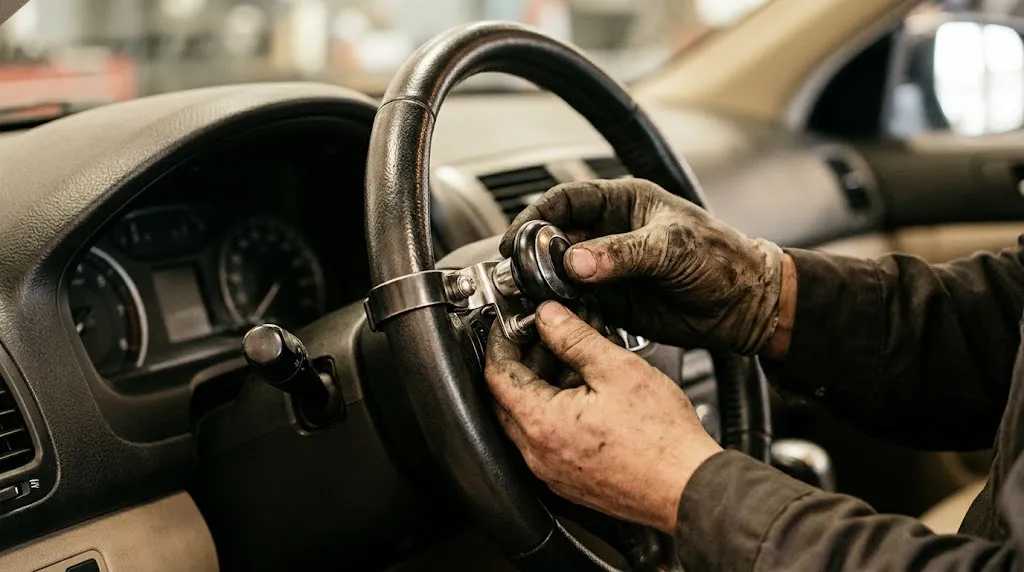
Drivers considering the installation of a spinner knob for convenience or specialized utility should evaluate several key factors to ensure compliance and safety:
- Review state-specific vehicle equipment codes and local traffic statutes regarding interior modifications.
- Inspect the steering wheel for integrated airbag modules to ensure the accessory does not obstruct deployment zones.
- Verify that the mounting clamp fits securely without slipping, marring the steering wheel rim, or creating play in the steering mechanism.
- Confirm whether the vehicle is used for commercial, agricultural, or standard passenger travel, as legal standards differ significantly.
- Consult with a certified mobility specialist if the device is intended to assist with a physical disability or adaptive driving requirement.
Warning
Installing a generic spinner knob on a modern passenger vehicle equipped with a steering wheel airbag can create a serious safety hazard and may result in a traffic citation under general unsafe equipment laws, even if the state does not maintain an explicit statute naming steering knobs.
Related Product
Steering Wheel Cover and Grip Accessories
Enhance steering comfort and grip control safely without adding unauthorized mechanical devices that could interfere with vehicle safety systems.
As an Amazon Associate, we earn from qualifying purchases.
Frequently Asked Questions
Are steering wheel knobs illegal in all 50 states?
No, steering wheel knobs are not explicitly outlawed by name in every single state statute. However, many states enforce broader equipment and safety laws that allow law enforcement officers to cite drivers if an aftermarket accessory interferes with safe vehicle operation or obstructs standard steering control.
Why are they commonly called suicide knobs?
The term originated decades ago from early automotive designs where loose clothing could catch on the protruding knob during sudden maneuvers, or where the spinning handle could whip back and injure the driver’s hand or wrist if the front wheels hit a deep rut at high speed.
Can I use a spinner knob legally if I have a physical disability?
Yes. Many states provide clear exemptions or legal allowances for drivers who require adaptive equipment. When prescribed by a medical professional and installed as part of a certified mobility solution, steering knobs are generally compliant with state and federal regulations.
Are steering wheel knobs allowed on commercial trucks?
Regulations vary by jurisdiction and fleet policy, but commercial utility vehicles, forklifts, and slow-moving agricultural machinery frequently permit or even recommend spinner knobs to reduce operator fatigue during repetitive low-speed maneuvering.
Do steering wheel knobs interfere with modern airbags?
Yes, attaching a rigid metal or hard plastic knob to a modern steering wheel can create a dangerous projectile hazard if the integrated driver-side airbag deploys during a collision, potentially altering how the airbag inflates or striking the occupant.
What should I do if I receive a ticket for a steering wheel knob?
If cited for an unsafe equipment violation, review the exact wording of the local traffic statute referenced on the citation. Consulting with a local traffic attorney or contacting your state’s department of motor vehicles can clarify whether the device violates specific regional equipment codes.
Conclusion
Steering wheel knobs occupy a legal gray area that largely depends on vehicle classification, intended use, and specific state equipment statutes. While valuable and widely accepted on industrial machinery, agricultural equipment, and specialized adaptive vehicles, their use on standard passenger cars carries potential safety risks and legal vulnerabilities. Drivers must carefully verify local vehicle codes and prioritize unobstructed airbag and steering performance before adding aftermarket control accessories to their daily-driven automobiles.

Daniel Brooks is an automotive writer and product researcher focused on car accessories, car tech, maintenance, and practical driving guides. At Plug-in Car World, he helps drivers make smarter automotive decisions through honest reviews and research-driven content.
