
What Should You Look for in an Infant Car Seat? 7 Checks for Your Newborn
Quick Answer
Look for an infant car seat that fits your newborn from day one, clicks into a base that installs tight in your car, and keeps the harness snug at the shoulders. Start with the weight and height limits, the recline angle, side-impact protection, and the carrier weight you will lift every day. If the base will not sit level and tight, do not buy that seat — learn how to install an infant car seat before you pay.
The 7 checks in short
- Newborn fit first: The seat must fit a 4-pound baby, not just an average 9-month-old.
- Carrier or convertible: A carrier lifts out with the baby; a convertible stays in the car.
- Real safety: Look for federal safety labels, a five-point harness, and side-impact protection.
- Base and vehicle fit: Test the base in your exact car, in the exact seating position.
- Recline and head support: A newborn needs the right angle and a supported head.
- Daily carry weight: Carrier plus baby gets heavy fast, so lift it before you buy.
Before you leave the store
- Put a doll or a rolled towel in the seat, tighten the harness, and try the carrier in your car if the store allows it.
- Keep the manual and the receipt until you have done a full install at home.
I have carried infant seats in and out of cars in the rain, and I have installed bases in tight back seats in my own garage. The boxes all promise safety and comfort, but the seat that works is the one that fits a tiny newborn and your car.
This guide walks through the seven checks I use for an infant seat, in the order that matters for a baby’s first months. You will leave knowing what to test, what to skip, and what to ask before you buy.
In This Guide
- Does It Fit a Newborn From Day One?
- Should You Buy an Infant Carrier or a Convertible Seat?
- What Safety Features Actually Matter in an Infant Seat?
- Will the Base Fit Your Car?
- How Do Recline, Head Support, and the Harness Work?
- What About Carry Weight, Comfort, and Cleaning?
- How Long Will an Infant Seat Last?
Does It Fit a Newborn From Day One?
An infant car seat is a rear-facing-only carrier that clicks into a base in your car and lifts out with the baby in it. It is built for the first months, when a baby is small, floppy, and unable to hold their head up.
Start with the lower weight limit, not the upper one. Many infant seats start at 4 pounds, while a few start higher, and that gap matters for a small or early baby.
Check the upper limit too, but read it as a pair. Many infant seats top out near 30 to 35 pounds or near 30 to 32 inches, and your baby will hit the height limit first in most cases.
Look for the harness slots. The lowest slots should sit at or below a newborn’s shoulders, and the crotch buckle should sit close to the body without a big gap.
Check the infant insert that comes in the box. A good insert fills the space around a tiny baby, yet it must come from the seat maker and fit the model you buy.
Never add a rolled blanket behind the baby to fix a poor fit. Use only the insert and the padding the maker supplies, and follow the manual for when to remove each piece.
For a newborn-specific starting point, read how to choose a car seat for a newborn alongside this guide, and bring your baby’s birth weight and length to the store if you already know them.
Section takeaway: A good infant seat fits the smallest baby you may bring home, with harness slots low enough and an insert that supports a newborn without added padding.
Should You Buy an Infant Carrier or a Convertible Seat?

Should you buy an infant carrier or a convertible seat for a newborn? Buy a carrier if you want to lift a sleeping baby in and out of the car, and buy a convertible if you want one seat that stays in the car for years.
A carrier clicks into a base and lifts out by the handle. You can carry a sleeping baby into the house, into a store, or onto a stroller frame without waking them.
A convertible seat stays bolted in the car. It works rear-facing first, then forward-facing later, so it lasts far longer than a carrier.
That long life comes with a trade-off at the newborn stage. A convertible can feel wide and deep for a tiny baby, and the lowest harness slots may sit too high for a small newborn.
Think about your daily routine before you pick. Do you move the seat between two cars, take the baby in and out many times a day, or park in a tight garage?
A carrier helps most in the first six months. A convertible helps most after that, when the baby is heavier and the lifting gets harder.
| Feature | Infant carrier | Convertible seat |
|---|---|---|
| Newborn fit | Built for tiny babies, low slots | Varies, some fit newborns well |
| Carry the baby | Lifts out with the baby in it | Stays in the car, baby lifts out |
| How long it lasts | About 9 to 12 months for most babies | Birth to preschool years |
| Second car use | Easy with a second base | Needs a second seat or a reinstall |
| Weight to lift | Carrier plus baby, every trip | Baby only, seat stays put |
Compare the two designs in detail in infant vs convertible car seat before you decide, and test both types in your car if you can.
Section takeaway: Pick the carrier for easy lifting in the first months, or the convertible for one long-lasting seat — and test the newborn fit in person either way.
What Safety Features Actually Matter in an Infant Seat?
What safety features should an infant car seat have? It should meet federal safety standards, use a five-point harness, and offer side-impact protection and a stable base.
Start with the label. Every seat sold in the United States must meet Federal Motor Vehicle Safety Standard 213, and the label should state that compliance clearly.
Check the harness next. A five-point harness spreads crash forces across the shoulders, hips, and crotch, and it holds a small baby far better than a three-point belt.
Look for side-impact protection in the headrest and shell. Deep side wings and energy-absorbing foam help in a side crash, though no label tells you exactly how much protection one seat gives over another.
Consider a load leg if the base offers one. A load leg braces the base against the floor, and it limits how far the seat rotates in a crash.
Check recalls before you buy, and register the seat after you buy it. The NHTSA site lists recalls and safety information, and registration means the maker can reach you if a fault is found.
Pro tip: Check the seat’s manual and the NHTSA recall lookup before you install it, and ask a certified child passenger safety technician if anything in the manual is unclear.
For the full list of labels and standards, read understanding car seat safety standards before you shop.
Section takeaway: A compliant label, a five-point harness, side-impact protection, and a tight base beat fancy extras every time.
Will the Base Fit Your Car?
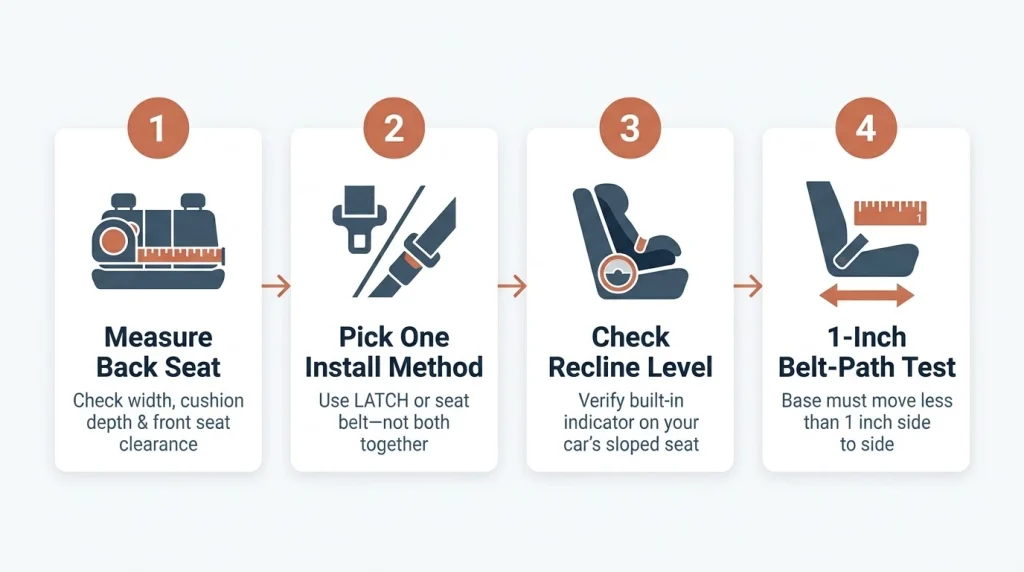
Will an infant car seat base fit in your car? It fits when the base sits flat, moves less than one inch at the belt path, and leaves room for the front seats.
I learned this the hard way in a compact sedan. The carrier looked fine on the shelf, yet rear-facing it pushed the driver’s seat so far forward that I could not drive it safely.
Measure your back seat before you shop. Note the width at the belt path, the depth of the seat cushion, and the distance from the back seat to the front seatbacks.
Test the base in your exact car when you can. Many stores will let you carry a floor model out to the parking lot, and that five-minute test saves a return trip.
Check the recline angle in the car, not just on the floor. A base that looks level in the store can tilt too far on a sloped vehicle seat, and the built-in level indicator will show it.
Learn the difference between LATCH and seat belt install. LATCH, short for Lower Anchors and Tethers for Children, uses built-in anchors in your car, while a seat belt install uses the car’s belt and a lock-off.
Use one method at a time, unless the manual says both are allowed for your base. Both methods are safe when done right, so pick the one that gives you the tightest fit.
Test for movement at the belt path only. Grab the base where the belt or LATCH strap passes through, and try to move it side to side and front to back.
It should move less than one inch in any direction. If it moves more, tighten the strap, check the recline, and try a different seating position.
Look up your vehicle in a fit guide as a second check. Edmunds publishes vehicle dimensions and reviews that help you compare cabin space, and your car maker’s manual lists the seating positions approved for child seats.
For a step-by-step fit check, use how to check car seat compatibility with your vehicle with your car parked on level ground.
Section takeaway: A base that fits on paper can still fail in your car, so test it in your exact vehicle before you commit.
How Do Recline, Head Support, and the Harness Work?
How should a newborn sit in an infant car seat? The seat should recline far enough to keep the airway open, the head should stay supported, and the harness should sit snug at the shoulders.
Start with the recline angle. A newborn needs a reclined seat, often near 45 degrees, so the head does not flop forward and block the airway.
Check the level indicator on the base or the carrier. Most seats show a line, a bubble, or a colour zone, and the indicator must sit in the correct range with the seat installed in your car.
Adjust the recline foot or the base angle if the indicator is off. Do not fix a bad angle with a rolled towel under the base unless the manual allows that exact fix for your model.
Look at the head support next. A newborn’s head is heavy for their neck, so the headrest and the insert should cradle the head without pushing the chin to the chest.
Watch for slumping on a test fit. If the baby’s chin drops to the chest, the recline is too upright, the insert is wrong, or the seat does not fit that baby well.
Check the harness height. The straps should pass through slots at or below the shoulders for rear-facing use, and the chest clip should sit at armpit level.
Do the pinch test every time you buckle the baby in. Try to pinch the harness strap at the collarbone, and tighten it until you cannot pinch any slack.
Remove bulky coats before you buckle the baby in. A thick coat leaves slack in the harness, and that slack lets the baby move too far in a crash.
Pro tip: Read your seat manual for the exact recline range and harness slot rules for your model, because those numbers vary by make and model.
Section takeaway: The right recline, a supported head, and a snug harness matter more for a newborn than any comfort extra on the box.
What About Carry Weight, Comfort, and Cleaning?
What makes an infant car seat easy to live with every day? A light carrier, a handle that balances well, breathable fabric, and a cover you can remove and wash without a tool kit.
Lift the carrier in the store, with a doll or a bag inside it if you can. A carrier that feels light empty can feel very different with a baby, a blanket, and a nappy bag in your other hand.
Check the handle position. A good handle balances the carrier over your arm, and it locks firmly in the carry position and in the driving position.
Feel the fabric and the padding. Smooth, breathable fabric stays cooler in summer, and thin padding over a hard shell will show up as fussing on a long drive.
Check the buckle and the chest clip with one hand. A stiff buckle is hard with a wiggly baby, and a chest clip that slides too easily will drift out of place.
Look at the canopy next. A large canopy blocks sun and wind, and it should move smoothly without snapping back or blocking your view of the baby.
Ask how the cover comes off and what you can wash. Spills, car sickness, and nappy leaks are a matter of when, not if, so a machine-washable cover saves real time.
Section takeaway: A light carrier, a balanced handle, and a washable cover get used correctly far more often than a heavy seat with fussy straps.
How Long Will an Infant Seat Last?

How long does an infant car seat last? Most babies outgrow a carrier by height or weight in about 9 to 12 months, and the seat itself expires six to ten years after manufacture.
Check the expiry date before you buy, even for a new seat. A seat that sat in a warehouse for two years has two fewer years left, and that matters if you plan to use it for a second child.
Track height and weight every few months. Your baby outgrows the seat when they pass the weight limit, pass the height limit, or have less than one inch of shell above their head.
Secondhand carriers need extra care. Only take one from a person you trust, with the full history, the manual, and all original parts.
Skip any seat with a crash history, missing parts, cracked plastic, frayed straps, or an expired date. Skip it too if you cannot confirm the model and its recall status.
Read independent test notes before you spend. Consumer Reports publishes car seat ratings and ease-of-use notes that help you compare models side by side as of 2026.
For the full switch timing, read when to switch from an infant car seat before you move your baby into the next seat.
Section takeaway: Buy the longest useful life you can, check the expiry date on the label, and walk away from any used carrier with an unknown history.
Frequently Asked Questions
What is the most important thing to look for in an infant car seat?
Newborn fit is the most important thing. The seat must fit a tiny baby from day one, fit your car, and install tight every time you use it.
Should I buy an infant carrier or a convertible seat first?
Buy a carrier if you want to lift a sleeping baby in and out of the car. Buy a convertible if you want one seat that lasts from birth into the preschool years.
How do I know if an infant car seat is safe?
Check for the federal safety label, a five-point harness, and side-impact protection. Then check the model for recalls and register it with the maker.
What recline angle does a newborn need?
A newborn needs a reclined seat, often near 45 degrees, so the head does not flop forward. Check the level indicator on your base or carrier, and follow the manual for your model.
Can I use an infant car seat in a small car?
Yes, if you test it first. Measure the back seat, try the base rear-facing, and check that the front seats still have enough room to drive safely.
When should my baby move out of an infant car seat?
Move your baby when they pass the weight or height limit, or have less than one inch of shell above their head. Most babies reach that point in about 9 to 12 months.
An infant car seat is not about finding the most expensive box on the shelf. It is about finding the carrier that fits your newborn, your car, and your daily routine — and installing the base tight every single time.
Take your baby’s measurements, test the base in your car, and check the label, the recline, and the expiry date before you pay. That one hour of checking will pay off on every drive after it.

Daniel Brooks is an automotive writer and product researcher focused on car accessories, car tech, maintenance, and practical driving guides. At Plug-in Car World, he helps drivers make smarter automotive decisions through honest reviews and research-driven content.