
What Should You Look for in a Convertible Car Seat? 7 Checks Before You Buy
Quick Answer
Look for a convertible car seat that fits your baby rear-facing from the start, installs tight in your exact car, and still fits when your child grows. Start with the rear-facing weight and height limits, the harness height, side-impact protection, and the width in your back seat. If it will not sit level and tight rear-facing, do not buy it — compare it first with an infant vs convertible car seat before you pay.
The 7 checks in short
- Rear-facing fit first: The seat must fit a newborn, not just a toddler.
- Convertible or all-in-one: A convertible covers two stages; an all-in-one adds a booster stage.
- Real safety: Look for federal safety labels, a five-point harness, and side-impact protection.
- Vehicle fit: Test the seat rear-facing in your exact car, in the exact seating position.
- Recline and harness: The angle must stay correct and the straps must sit at the right height.
- Daily use: Check the weight, the fabric, and how the cover cleans.
Before you leave the store
- Try the seat rear-facing in your car if the store allows it, and check the front seats still have room to drive safely.
- Keep the manual and the receipt until you have done a full install at home.
I have installed convertible seats in a compact sedan, a family SUV, and a tight two-door in my own garage. The boxes all promise years of use, but the seat that works is the one that fits rear-facing now and still fits when your child is three.
This guide walks through the seven checks I use for a convertible seat, in the order that matters for a growing child. You will leave knowing what to test, what to skip, and what to ask before you buy.
In This Guide
Does It Fit From Birth?
A convertible car seat is a seat that stays in the car and works rear-facing first, then forward-facing later. It does not lift out like an infant carrier, and it is built to last through more than one stage of growth.
Start with the lower rear-facing limit, not the upper one. Many convertible seats start rear-facing at 5 pounds, while a few start higher, and that gap matters for a small or early baby.
Check the lowest harness slots next. The lowest slots should sit at or below a newborn’s shoulders, and the crotch buckle should sit close to the body without a big gap.
Look for the infant insert that comes in the box. A good insert fills the space around a tiny baby, yet it must come from the seat maker and fit the model you buy.
Never add a rolled blanket behind the baby to fix a poor fit. Use only the insert and the padding the maker supplies, and follow the manual for when to remove each piece.
Check the upper rear-facing limit too, because that is where a convertible earns its keep. Many models allow rear-facing to 40 pounds or more, and a higher limit lets you keep a toddler rear-facing longer.
For a newborn-specific starting point, read how to choose a car seat for a newborn alongside this guide, and bring your baby’s birth weight and length to the store if you already know them.
Section takeaway: A good convertible fits the smallest baby you may bring home rear-facing, with harness slots low enough and an insert that supports a newborn without added padding.
Should You Buy a Convertible or an All-in-One Seat?
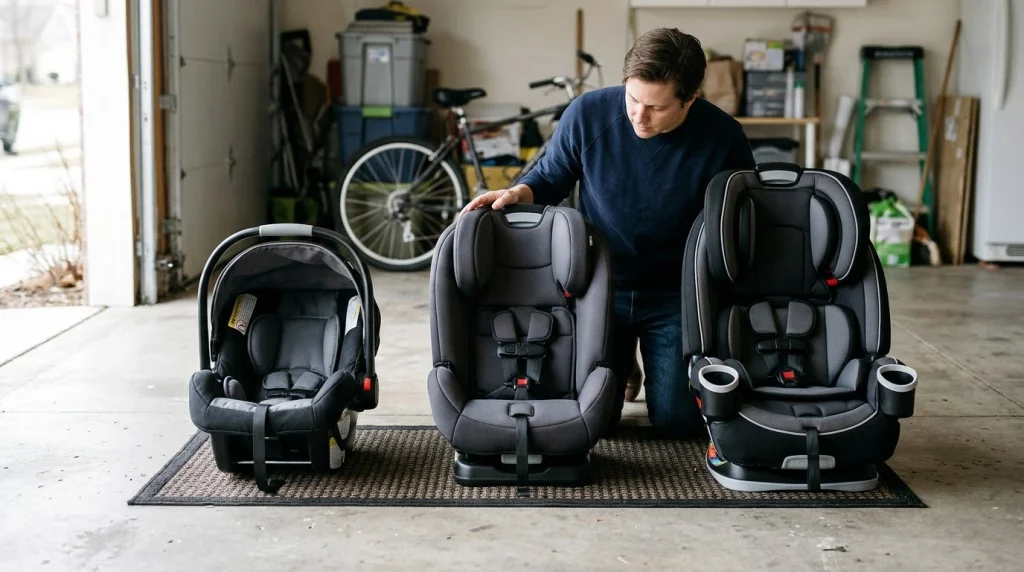
Should you buy a convertible or an all-in-one seat? Buy a convertible if you want a seat for the rear-facing and forward-facing years, and buy an all-in-one if you want that seat to become a booster later too.
A convertible works in two modes. It starts rear-facing for a baby and a toddler, then turns forward-facing for an older child, and it stays in the car through both stages.
An all-in-one works in three modes. It adds a high-back booster mode, and some models add a backless booster mode, so it can cover birth through the booster years in one shell.
That extra stage sounds like a clear win, yet it comes with trade-offs. An all-in-one can feel wide and heavy, and the booster mode may not fit as well as a dedicated booster when your child reaches that stage.
| Feature | Infant carrier | Convertible seat | All-in-one seat |
|---|---|---|---|
| Modes | Rear-facing only | Rear-facing, then forward-facing | Rear-facing, forward-facing, booster |
| Newborn fit | Built for tiny babies | Varies, some fit newborns well | Varies, check the lowest slots |
| How long it lasts | About 9 to 12 months | Birth to about 5 to 7 years | Birth to about 10 years |
| Lifts out | Yes, with the baby in it | No, stays in the car | No, stays in the car |
| Weight to move | Carrier plus baby, every trip | Seat only, when you move it | Heaviest of the three types |
For the full switch timing, read when to switch a convertible car seat before you move your child into the next stage.
Section takeaway: Pick a convertible for the two main stages, or an all-in-one for a possible booster stage — and test the newborn fit in person either way.
What Safety Features Actually Matter in a Convertible Seat?
What safety features should a convertible car seat have? It should meet federal safety standards, use a five-point harness, and offer side-impact protection and a stable install.
Start with the label. Every seat sold in the United States must meet Federal Motor Vehicle Safety Standard 213, and the label should state that compliance clearly.
Check the harness next. A five-point harness spreads crash forces across the shoulders, hips, and crotch, and it holds a small child far better than a three-point belt.
Look for side-impact protection in the headrest and shell. Deep side wings and energy-absorbing foam help in a side crash, though no label tells you exactly how much protection one seat gives over another.
Consider a load leg if the seat offers one. A load leg braces the base or the seat against the floor, and it limits how far the seat rotates in a crash.
Check the top tether for forward-facing use. The tether anchors the top of the seat to your car, and it limits how far the seat moves forward in a crash.
Check recalls before you buy, and register the seat after you buy it. The NHTSA site lists recalls and safety information, and registration means the maker can reach you if a fault is found.
Pro tip: Check the seat’s manual and the NHTSA recall lookup before you install it, and ask a certified child passenger safety technician if anything in the manual is unclear.
For the full list of labels and standards, read understanding car seat safety standards before you shop.
Section takeaway: A compliant label, a five-point harness, side-impact protection, and a tight install beat fancy extras every time.
Will It Fit Your Car?
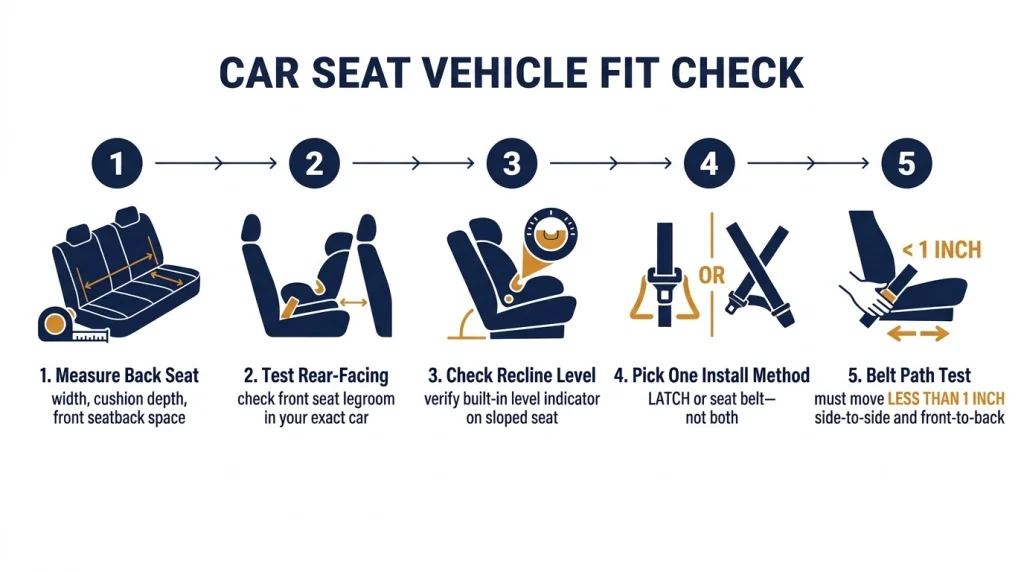
Will a convertible car seat fit in your car? It fits when the seat sits flat, moves less than one inch at the belt path, and leaves room for the front seats.
I learned this the hard way in a compact sedan. The seat looked fine on the shelf, yet rear-facing it pushed the driver’s seat so far forward that I could not drive it safely.
Measure your back seat before you shop. Note the width at the belt path, the depth of the seat cushion, and the distance from the back seat to the front seatbacks.
Test the seat rear-facing in your exact car when you can. Many stores will let you carry a floor model out to the parking lot, and that five-minute test saves a return trip.
Check the recline angle in the car, not just on the floor. A seat that looks level in the store can tilt too far on a sloped vehicle seat, and the built-in level indicator will show it.
Learn the difference between LATCH and seat belt install. LATCH, short for Lower Anchors and Tethers for Children, uses built-in anchors in your car, while a seat belt install uses the car’s belt and a lock-off.
Use one method at a time, unless the manual says both are allowed for your seat. Both methods are safe when done right, so pick the one that gives you the tightest fit.
Test for movement at the belt path only. Grab the seat where the belt or LATCH strap passes through, and try to move it side to side and front to back.
It should move less than one inch in any direction. If it moves more, tighten the strap, check the recline, and try a different seating position.
Look up your vehicle in a fit guide as a second check. Edmunds publishes vehicle dimensions and reviews that help you compare cabin space, and your car maker’s manual lists the seating positions approved for child seats.
For a step-by-step fit check, use how to check car seat compatibility with your vehicle with your car parked on level ground.
Section takeaway: A seat that fits on paper can still fail in your car, so test it rear-facing in your exact vehicle before you commit.
How Do Recline, Harness, and Head Support Work?
How should a baby sit in a convertible car seat? The seat should recline far enough to keep the airway open, the head should stay supported, and the harness should sit snug at the shoulders.
Start with the recline angle. A newborn needs a reclined seat, often near 45 degrees, so the head does not flop forward and block the airway.
Check the level indicator on the seat. Most seats show a line, a bubble, or a colour zone, and the indicator must sit in the correct range with the seat installed in your car.
Adjust the recline foot or the seat angle if the indicator is off. Do not fix a bad angle with a rolled towel under the seat unless the manual allows that exact fix for your model.
Look at the head support next. A baby’s head is heavy for their neck, so the headrest and the insert should cradle the head without pushing the chin to the chest.
Watch for slumping on a test fit. If the baby’s chin drops to the chest, the recline is too upright, the insert is wrong, or the seat does not fit that baby well.
Check the harness height for rear-facing use. The straps should pass through slots at or below the shoulders, and the chest clip should sit at armpit level.
Check the harness height again for forward-facing use. The straps should pass through slots at or above the shoulders in that mode, so you must move them as your child grows.
Do the pinch test every time you buckle your child in. Try to pinch the harness strap at the collarbone, and tighten it until you cannot pinch any slack.
Remove bulky coats before you buckle your child in. A thick coat leaves slack in the harness, and that slack lets a child move too far in a crash.
For the rear-facing and forward-facing rules in full, read rear-facing vs forward-facing car seats before you turn the seat around.
Pro tip: Read your seat manual for the exact recline range and harness slot rules for your model, because those numbers vary by make and model.
Section takeaway: The right recline, a supported head, and a snug harness matter more for a baby than any comfort extra on the box.
What About Comfort, Cleaning, and Everyday Use?
What makes a convertible car seat easy to live with every day? A seat that adjusts without a fight, breathable fabric, and a cover you can remove and wash without a tool kit.
Check the weight of the seat before you buy it. A convertible is heavy by nature, and a seat you must move between cars should not feel like a piece of furniture.
Test the harness adjuster with one hand. A stiff adjuster is hard with a wiggly toddler, and a chest clip that slides too easily will drift out of place.
Feel the fabric and the padding. Smooth, breathable fabric stays cooler in summer, and thin padding over a hard shell will show up as fussing on a long drive.
Ask how the cover comes off and what you can wash. Spills, car sickness, and snack crumbs are a matter of when, not if, so a machine-washable cover saves real time.
Section takeaway: A seat that adjusts easily, breathes well, and washes clean gets used correctly far more often than a heavy seat with fussy straps.
How Long Will a Convertible Seat Last?
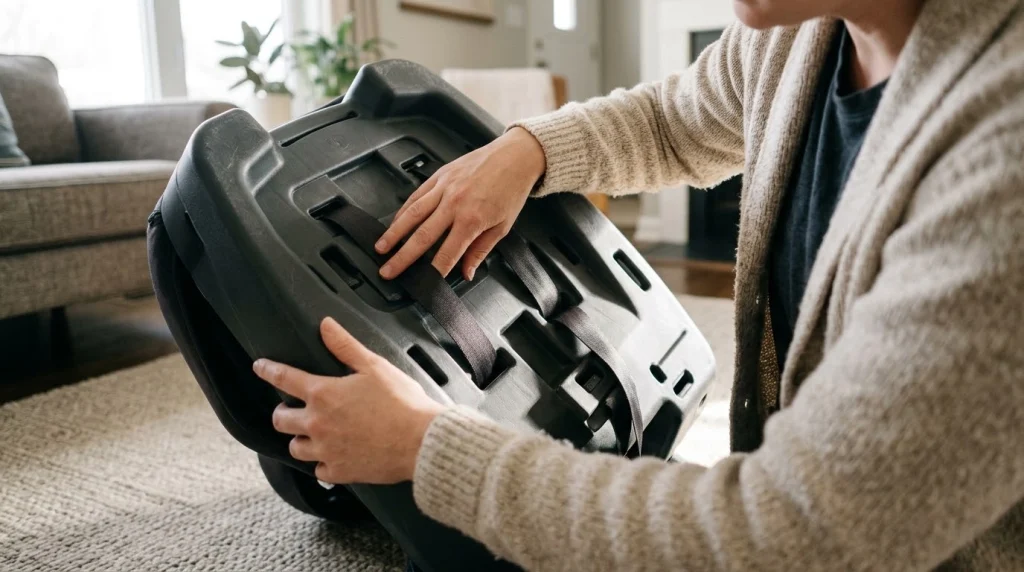
How long does a convertible car seat last? Most children outgrow the rear-facing limits first, then the forward-facing limits, and the seat itself expires six to ten years after manufacture.
Check the expiry date before you buy, even for a new seat. A seat that sat in a warehouse for two years has two fewer years left, and that matters if you plan to use it for a second child.
Track height and weight every few months. Your child outgrows rear-facing when they pass the rear-facing weight limit, pass the height limit, or have less than one inch of shell above their head.
Track the forward-facing limits the same way. Your child outgrows that mode when they pass the weight or height limit, or when the harness slots sit below their shoulders.
Secondhand convertible seats need extra care. Only take one from a person you trust, with the full history, the manual, and all original parts.
Skip any seat with a crash history, missing parts, cracked plastic, frayed straps, or an expired date. Skip it too if you cannot confirm the model and its recall status.
Read independent test notes before you spend. Consumer Reports publishes car seat ratings and ease-of-use notes that help you compare models side by side as of 2026.
Section takeaway: Buy the longest useful life you can, check the expiry date on the label, and walk away from any used seat with an unknown history.
Frequently Asked Questions
What is the most important thing to look for in a convertible car seat?
Rear-facing fit is the most important thing. The seat must fit a tiny baby from day one, fit your car, and install tight every time you use it.
Should I buy a convertible or an infant carrier first?
Buy a carrier if you want to lift a sleeping baby in and out of the car. Buy a convertible if you want one seat that stays in the car from birth into the preschool years.
How long can my child stay rear-facing in a convertible seat?
Many convertible seats allow rear-facing to 40 pounds or more, and the exact limit depends on the model. Keep your child rear-facing until they pass the weight or height limit for your seat.
Is LATCH or a seat belt better for installing a convertible seat?
Both methods are safe when done right. Use the method that gives you the tightest fit, and switch to a seat belt install when your child passes the LATCH weight limit in your manual.
Can I use a convertible car seat in a small car?
Yes, if you test it first. Measure the back seat, try the seat rear-facing, and check that the front seats still have enough room to drive safely.
When should my child move out of a convertible car seat?
Move your child when they pass the forward-facing weight or height limit, or when the harness slots sit below their shoulders. Most children reach that point after several years of use.
A convertible car seat is not about finding the most expensive box on the shelf. It is about finding the seat that fits your baby rear-facing, your car, and your daily routine — and installing it tight every single time.
Take your child’s measurements, test the seat rear-facing in your car, and check the label, the recline, and the expiry date before you pay. That one hour of checking will pay off on every drive after it.

Daniel Brooks is an automotive writer and product researcher focused on car accessories, car tech, maintenance, and practical driving guides. At Plug-in Car World, he helps drivers make smarter automotive decisions through honest reviews and research-driven content.