
How Can You Keep a Baby From Crying in a Car Seat? 7 Calm-Drive Fixes That Work
Quick Answer
You keep a baby from crying in a car seat by fixing the cause first, then soothing the baby: check the harness, recline, warmth, hunger, and tiredness before you drive, and use calm sound, gentle motion, and a planned stop when crying will not settle. A baby who keeps crying after those checks needs a stop, not a louder toy, so pull over, lift them out, and learn can a baby sleep in a car seat before a long trip, because sleep and crying share the same fit and recline rules.
The calm-drive loop
- Check fit first: A loose strap, a twisted strap, or a wrong recline can turn a short drive into a cry.
- Check comfort next: Hunger, a wet nappy, heat, cold, and tiredness cause most car seat crying.
- Use sound and motion: A steady voice, a soft song, and smooth driving calm many babies.
- Keep hands on the wheel: Never unbuckle a baby, reach back, or hold a toy while driving.
- Stop when crying lasts: Pull over, lift the baby out, comfort them, then refit the harness.
One rule to remember
- If crying sounds weak, the baby goes limp, breathing looks hard, or the skin turns pale or blue, stop at once and seek medical help.
I’ve driven with a crying baby in the back seat, and I know how fast a calm trip turns tense. This guide covers why babies cry in car seats, what to fix before you leave, and what to do when crying starts.
How can you keep a baby from crying in a car seat? Fix the cause, keep the ride calm, and stop when soothing stops working.
In This Guide
- Why does my baby cry in the car seat?
- How do I check the fit before I drive?
- What can I do before the drive to prevent crying?
- How can I soothe a crying baby while driving safely?
- Which car seat mistakes make crying worse?
- Crying vs discomfort vs something wrong: how do I tell?
- What should I do on long drives with a baby?
- Frequently asked questions
Why does my baby cry in the car seat?
A baby cries in a car seat for the same reasons a baby cries at home: hunger, tiredness, discomfort, boredom, or pain. The seat adds one more cause, because the baby cannot move, roll, or change pose to fix the problem.
A car seat cry is a signal, not a habit to ignore. The baby tells you the seat, the ride, or the body needs a change.
I first saw this clearly while fitting an infant carrier into a Honda CR-V for a niece at 4 months old. She cried within two minutes, and the cause was a strap digging into her shoulder, not the car or the road.
What are the most common causes?
- Hunger: A baby who last fed 3 hours ago may cry as soon as the car starts moving.
- Tiredness: An overtired baby fights sleep, and the seat gives them no way to wind down.
- Wet nappy: A wet or soiled nappy chafes fast in a warm seat.
- Heat or cold: A sunny window heats one side of the seat, while cold air from a vent chills the other.
- Reflux or wind: A baby with reflux or trapped wind cries more when lying back.
- Boredom: An older baby who can see nothing but the seat back gets bored fast.
Some babies cry only in the car because the seat holds them in one pose. At home, a parent picks them up and shifts them, and the cry stops.
Read why a newborn slumps in a car seat if the crying starts when the head drops forward. A slumped head can narrow the airway, and a baby who cannot breathe with ease will cry hard.
Section takeaway: A car seat cry is a signal about hunger, tiredness, fit, heat, or pain, and the fastest fix is to find which one changed just before the crying started.
How do I check the fit before I drive?
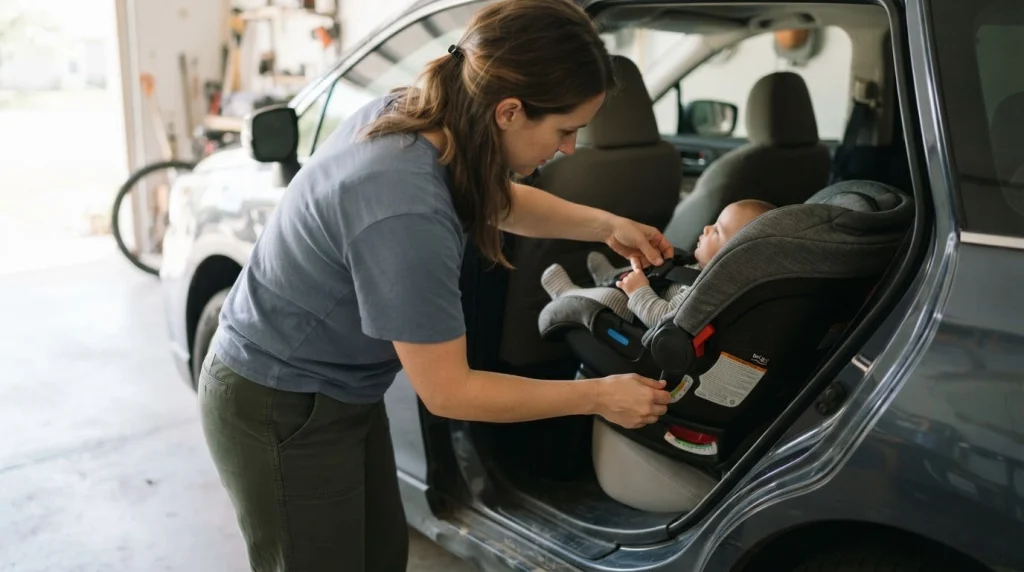
Check the fit before you drive, because a fit fault is the easiest cry to prevent. A two-minute check at home saves a long cry on the road.
Start with the harness, then the recline, then the head. Each check takes seconds.
How tight should the harness be?
The harness should sit snug, with no slack at the shoulders. Try the pinch test: pinch the strap at the shoulder, and if you can grip a fold, tighten it.
The chest clip should sit at armpit level, not on the belly or up at the neck. A low clip lets the straps slide, and a high clip presses the throat.
How do I check the recline and head position?
Check the recline gauge on the side of the seat, and set it to the range the manual gives for your baby. A seat that sits too upright lets a newborn’s head fall forward.
Look at the head from the side. The chin should stay clear of the chest, with a gap you can see.
Read how to position a newborn’s head safely in a car seat before you change the recline or add a support. The head rule matters most for a newborn, because a newborn cannot lift the head back up alone.
Grip the seat at the belt path and pull side to side; it should move less than an inch. Use only the infant insert that came with the seat, and press each buckle until it clicks, then tug it to confirm it holds.
Pro tip: check your car seat for recalls on the NHTSA site, and read the seat manual for the exact recline range, strap slot height, and insert limits for your baby.
Section takeaway: A snug harness, a chest clip at armpit level, a correct recline, and a clear chin gap remove the fit faults that cause most car seat crying.
What can I do before the drive to prevent crying?
Prevent crying before the drive, because a calm start lasts longer than a fix on the road.
Feed, change, and settle the baby before you leave. A baby who starts the drive full, dry, and drowsy has far less to cry about.
What does a calm pre-drive routine look like?
- Feed first: Feed the baby, burp them, and wait a few minutes before you buckle them in.
- Change the nappy: Put on a fresh nappy, even if the last change was recent.
- Dress for the car: Use thin layers, and keep a light blanket ready for after the harness is on.
- Settle before you buckle: Hold the baby upright for a short while, so wind and spit-up settle.
- Warm or cool the car: Run the air or heat for a few minutes, so the seat is not hot or cold to the touch.
How do toys and sound help before the drive?
Clip a soft toy to the seat handle, where the baby can see it without reaching for it. A toy in view gives an older baby a focus point, and that cuts boredom.
Read are car seat toys safe for babies before you hang anything near the baby’s face. A toy must be soft, light, and fixed in place, so it cannot fall, swing, or block the airway.
Pack a small bag for the back seat, with a spare nappy, wipes, a dummy if your baby uses one, and a spare top for you. Keep it where a passenger can reach it without unbuckling.
Section takeaway: Feed, change, dress in thin layers, settle the baby, warm or cool the car, and clip one safe toy in view, and the drive starts calm.
How can I soothe a crying baby while driving safely?
Soothing a crying baby while driving starts with one rule: the driver keeps driving. You cannot reach back or unbuckle the baby while the car is moving.
Use your voice, the sound in the car, and smooth driving first. If those steps fail, pull over and comfort the baby out of the seat.
What can the driver do without taking hands off the wheel?
- Talk in a calm voice: Speak in a low, steady tone, and keep talking even if the baby keeps crying.
- Sing a short song: Pick one song and repeat it, so the baby hears a familiar pattern.
- Play steady sound: Use white noise, a lullaby playlist, or soft music at a low volume.
- Drive smoothly: Brake early, steer gently, and keep speed steady, so the ride feels calm.
What can a passenger do?
A passenger can sit in the back seat, talk to the baby, and hold a toy where the baby can see it. A familiar face close by often calms a baby faster than a toy alone.
A passenger must stay belted in, and must never unbuckle the baby, hold the baby, or feed the baby while the car is moving. The passenger can offer a dummy only if the baby can take it without the straps being loosened.
When should I pull over?
Pull over when crying lasts more than a few minutes or sounds different from the usual cry. A short stop costs minutes, and a calm baby is worth that time.
Take the next safe exit, a car park, or a side street. Park fully off the road, switch off, and lift the baby out to comfort them.
Pro tip: Consumer Reports covers car seat fit and safety checks in plain language, and their guides are a good second check on harness snugness and recline before a trip.
Section takeaway: Talk, sing, play steady sound, and drive smoothly while you drive, and pull over to lift the baby out when crying lasts or changes.
Which car seat mistakes make crying worse?
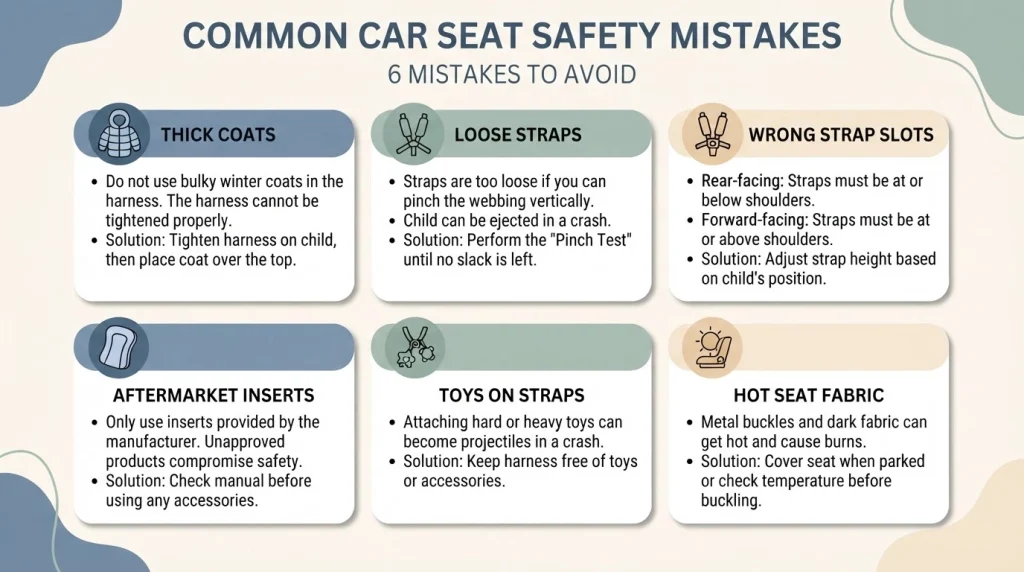
Some car seat mistakes make crying worse, and most of them look harmless at first. A thick coat or a loose strap can turn a small fuss into a long cry.
Fix the mistakes at home, not on the road. A seat set up right gives the baby no extra reason to cry.
What are the worst mistakes?
- Thick coats: A puffy coat holds the harness away from the body, so the straps feel loose and the baby slides.
- Loose straps: Loose straps let the baby shift with each turn, and shifting feels unsafe to a baby.
- Wrong strap slots: Straps set too high or too low pull at the shoulders and neck.
- Aftermarket inserts: A pad or insert that did not come with the seat can change the fit and push the head forward.
- Toys on the straps: A toy clipped to a strap can press on the chest or swing into the face.
- Hot seat fabric: A seat left in the sun can burn the skin on contact, and a crying baby may be telling you it hurts.
Heat makes a baby cry fast, because a baby cannot cool down as well as an adult. Aim vents away from the baby, and check the seat fabric with your hand before you buckle them in.
Read how to keep a baby warm in a car seat safely for the thin-layer rule, because warmth belongs over the harness, not under it. A blanket over a snug harness keeps a baby warm without loosening the straps.
Section takeaway: Remove thick coats, tighten the harness, use only the parts that came with the seat, and check the seat heat with your hand, and you remove the mistakes that turn a fuss into a long cry.
Crying vs discomfort vs something wrong: how do I tell?
A baby’s cry changes with the cause, and a parent who knows the pattern can act faster. A hunger cry sounds different from a pain cry.
Watch the body as well as the sound. A baby who arches, pulls legs up, or goes stiff is telling you more than the cry alone can tell you.
| What you see and hear | Likely cause | What to do |
|---|---|---|
| Rhythmic cry, rooting, hands to mouth | Hunger | Stop, lift baby out, feed upright, then refit the harness. |
| Whiny cry, rubbing eyes, yawning | Tiredness | Lower the sound, dim the light if you can, and let the baby drift off. |
| Squirming, red face, arching back | Discomfort or wind | Stop, check the nappy and straps, lift baby out, and burp them. |
| Sudden sharp cry, stiff body, inconsolable | Pain or illness | Stop at once and call your pediatrician. |
| Fussing, looking around, quiet between cries | Boredom | Talk, sing, or show a safe toy, and keep the ride calm. |
| Weak cry, limp body, hard breathing, pale or blue skin | Medical emergency | Stop at once and seek medical help without delay. |
A cry that never stops, even after a feed, a change, and a cuddle out of the seat, needs a call to your pediatrician. You know your baby’s normal cry, and a cry that sounds new or wrong is worth a call.
Section takeaway: Match the cry to the body, hunger, tiredness, and pain each look different, and a weak cry, a limp body, or hard breathing means stop and seek help at once.
What should I do on long drives with a baby?

Long drives need a plan, because a baby cannot sit in a car seat for hours without a break. Let the baby’s clock set the pace.
Take the baby out of the seat at least every 2 hours, and more often for a newborn. A break lets the baby stretch and feed.
How do I plan stops that calm crying?
Plan a stop every 2 hours, at a town, a service station, or a park. A 6-hour drive becomes an 8-hour day, and a calm 8-hour day beats a rushed 6-hour one.
Feed before you leave, then drive one leg, stop to feed and change, and repeat. Each break covers food, comfort, and a stretch.
Read how long a newborn can stay in a car seat before you set your stop times, because the 2-hour outer limit shapes the whole plan. A newborn may need a break after 60 to 90 minutes, not after 2 hours.
If crying starts far from a stop, take the next safe exit, even if it adds time to the trip. Never drive faster to reach a stop sooner, because a calm stop now beats a fast drive with a crying baby in the back.
Pro tip: Edmunds covers family road trip planning and car seat fit, and their checklists help to map stops before you leave, so crying never lands on an empty stretch of road.
Section takeaway: Stop at least every 2 hours, feed and change at the same break, and take the next safe exit when crying starts, because a planned stop is the best soothing tool on a long drive.
Frequently asked questions
Why does my baby cry every time I put them in the car seat?
A baby who cries at every buckle-in may hate the fit, the recline, or the sudden change from arms to straps. Check the harness, recline, and head position first.
Is it safe to let a baby cry in a car seat?
A short fuss while you drive to a safe stop is common, yet you should not leave a baby crying for a long time. Pull over, lift the baby out, and check hunger, nappy, and fit.
What is the fastest way to calm a crying baby in a car?
Talk in a calm voice, play steady sound, and drive smoothly, then pull over if crying lasts. A stop and a cuddle out of the seat often calm a baby faster than any toy.
Can a dummy help a baby stop crying in a car seat?
Yes, a dummy can help, if your baby already uses one and can keep it in without the straps being loosened. Never tape or tie it in place.
Should I take my baby out of the car seat while driving?
No, never take a baby out of the car seat while driving. Pull over, park safely, switch off, and then lift the baby out to comfort them.
When should I call a doctor about car seat crying?
Call your pediatrician if crying lasts for hours, the baby refuses feeds, has a fever, or seems limp. Seek help at once if breathing looks hard or the skin turns pale or blue.
Fix the cause, keep the ride calm, and stop when soothing from the front seat stops working. A baby who starts the drive full, dry, and well-fitted has far less to cry about.
Plan your next drive around that loop, and the car seat will feel less like a battle.

Daniel Brooks is an automotive writer and product researcher focused on car accessories, car tech, maintenance, and practical driving guides. At Plug-in Car World, he helps drivers make smarter automotive decisions through honest reviews and research-driven content.