How to Entertain a Toddler in a Car Seat: Complete Guide
Quick Answer
You can entertain a toddler in a car seat with soft toys, songs, simple games, and short stories that keep their hands and mind busy without loosening the harness. Rotate two or three small items, talk and sing with them, and plan a stop every two hours on a long drive. Check first that every toy and add-on is safe for a car seat, as explained in our guide to whether car seat toys are safe for babies.
What works best on most trips
- Soft and simple toys: Choose light, soft toys with no hard edges, long cords, or small parts that can break off.
- Your voice first: Songs, rhymes, and silly sound games cost nothing and work even when a toy drops out of reach.
- Rotate, do not overload: Offer one toy at a time and swap it after a few minutes to keep it fresh.
- Match the trip length: Use one quick game for a short drive and a small kit with snacks, books, and music for a long one.
- Keep the harness snug: Nothing you add should sit behind your child, under the straps, or between the straps and their chest.
I have driven with toddlers who sang the whole way home, and I have driven with toddlers who lost interest in every toy by the second traffic light.
This guide covers safe, screen-free ideas first, then long-drive kits, songs and games, and the screen question, so you can pick what fits your child and your trip.
In This Guide
- Why Do Toddlers Get Bored in a Car Seat?
- What Makes a Car Seat Activity Safe?
- What Are the Best Screen-Free Ideas for Short Trips?
- How Do You Build a Long-Drive Entertainment Kit?
- Which Songs, Games, and Talking Tricks Work Best?
- Should You Use a Screen in the Car?
- What Mistakes Make Car Rides Harder?
- Frequently Asked Questions
Why Do Toddlers Get Bored in a Car Seat?
A toddler gets bored in a car seat because they cannot move, reach, or choose what happens next.
They sit still, face one way, and watch the same door panel while adults control the route, the music, and the stops.
That mix of stillness and low control wears thin fast for a one to three year old.
Most toddlers can focus on one thing for only a few minutes at a time.
A toy that thrilled them at home can feel dull after two minutes in the car, because the car adds noise, light, motion, and a tight harness.
Rear-facing toddlers face an extra limit.
They see the back seat, not the road ahead, and they cannot watch where the car is going.
That view can feel cut off, even when the seat is fitted well and the child is safe.
I learned this on a drive with my nephew in a compact hatchback.
He stayed calm for ten minutes, then kicked the seat back and asked to get out.
He did not need a new seat.
He needed a job to do, a song to join, and a reason to look forward to the next stop.
Boredom also grows when a child feels hot, hungry, tired, or stuck in a damp nappy.
Check those basics first, before you blame the toy bag, and if your toddler often hates the seat itself, read our guide on how to keep a toddler rear-facing longer.
A cool cabin, a drink, and a snug but comfy harness fix more fuss than a new gadget ever will.
Section takeaway: Toddlers get bored because they sit still with little control, so give them small choices, fresh swaps, and your voice to join in.
What Makes a Car Seat Activity Safe?
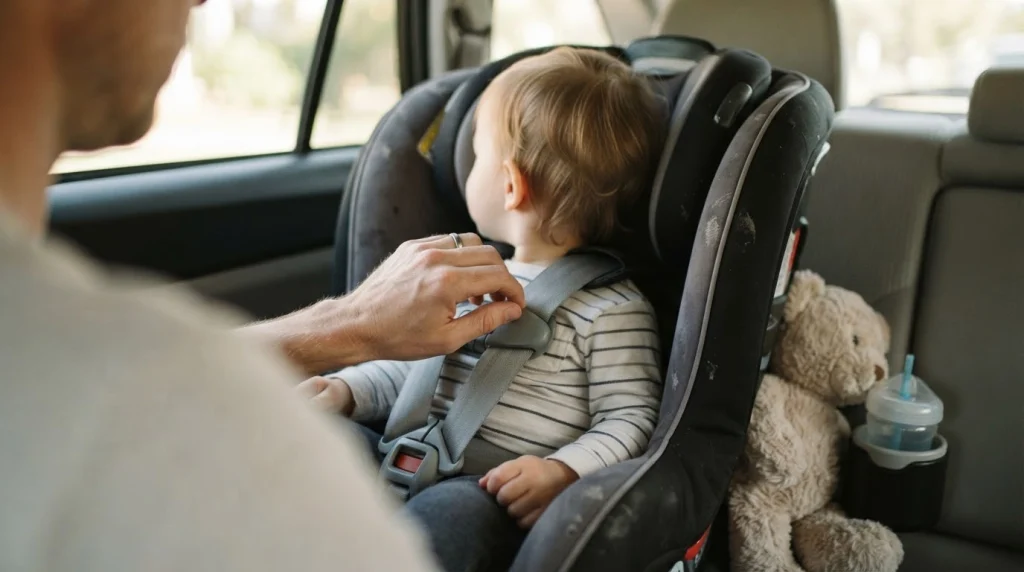
A safe car seat activity keeps the harness snug, keeps hard objects away from your child, and never asks you to look away from the road.
If an idea fails any of those three tests, skip it.
Start with the harness.
Straps should lie flat on the shoulders, sit at or just below shoulder level for a rear-facing seat, and pass the pinch test at the collarbone.
No toy, blanket, or snack should sit behind your child or under the straps.
That rule matters more than any game.
Next, check the toy itself.
Pick soft, light items that cannot turn into a hard object in a sudden stop.
Avoid toys with long strings, cords, ribbons, or beads that can wrap, choke, or break into small parts.
Skip anything that clips to the harness straps unless the car seat manual clearly allows it.
Many manuals ban strap covers, inserts, and add-ons that did not come with the seat.
Pro tip: check your car seat manual and the NHTSA site before you add any accessory, and ask a certified child passenger safety technician if the manual leaves you unsure.
The NHTSA site is a good first stop for seat fit, recall checks, and safe-use guidance.
Keep heavy items in a door pocket or the boot, and hand your child only light items they can hold with one hand.
Food follows the same logic.
Offer snacks only when your child sits upright, stays awake, and can chew without rushing.
Never hand food to a sleeping child, and never reach back to feed them while you drive.
Pull over first if they need help.
For a fuller check on add-ons, see our guide to whether aftermarket car seat accessories are safe before you buy a tray, mirror mount, or toy bar.
Section takeaway: Safe fun never changes the harness fit, never adds a hard or loose object, and never pulls your eyes off the road.
What Are the Best Screen-Free Ideas for Short Trips?
Short trips need one quick idea, not a full kit.
Pick something you can start in ten seconds and stop without a fuss when you park.
Soft books work well here.
Choose cloth or thick board books with bright pictures, flaps, or touch patches.
Let your child turn the pages, point at animals, and tell you what they see.
Keep the book light and soft, so a dropped book hurts no one.
Busy toys help too, when they stay simple.
A soft stacking ring, a small plush animal, or a toy with buttons that click can hold a toddler for a few minutes.
Offer one toy, not five at once.
Too many choices can overwhelm a tired child and fill the footwell with dropped toys.
A mirror can help a rear-facing toddler feel less alone.
Some children love to see their parent in a mirror, and some love to watch their own face.
Use only a mirror made for car seats, fit it as the maker directs, and check it stays firm before every trip.
Read our guide on whether baby car seat mirrors are safe to use before you fit one, because a loose mirror can become a hard object in a crash.
Talking games beat most toys on a short drive.
Try these quick starters, one at a time:
- Name that sound: Make an animal sound and let your child guess the animal.
- Colour hunt: Ask them to spot a red car, a blue sign, or a green tree.
- Peekaboo voice: Hide your face behind your hand at a red light, then pop back with a smile.
- Copy me: Clap a simple beat and let them copy it back.
Section takeaway: For short trips, one soft toy, one book, or one talking game is enough, and your voice does most of the work.
How Do You Build a Long-Drive Entertainment Kit?
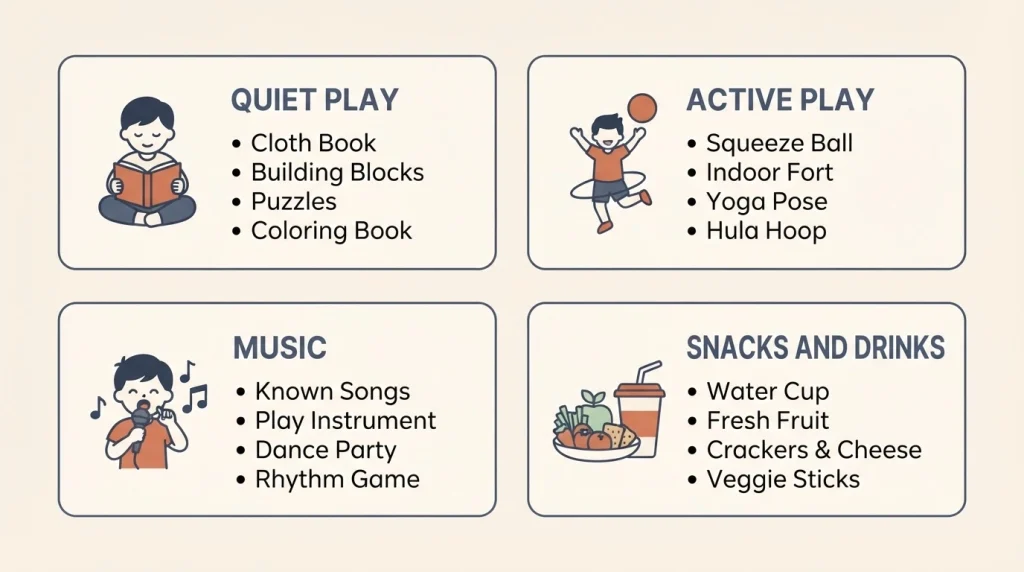
A long-drive kit is a small bag of fresh ideas, packed before you leave.
It works because you rotate items, not because you pack more stuff.
Start with a small, soft bag your child can reach from their seat.
Pack three to five items, not ten.
Wrap two of them in tissue paper for a surprise reveal at the halfway point.
That small reveal can reset a tired mood better than a new toy bought at a service station.
Include a mix of quiet and active play.
- Quiet play: A cloth book, a soft doll, or a small drawing pad with chunky crayons.
- Active play: A soft ball to squeeze, a toy steering wheel, or finger puppets for a quick story.
- Music: A short playlist of songs your child knows, plus one new song to learn together.
- Snacks and drinks: Water, soft fruit, and a snack cup with a lid, packed where you can reach them at a stop.
Plan stops into the kit, not just toys into the bag.
A stop every two hours lets your child stretch, walk, use the toilet, and reset.
That break often matters more than any toy.
If your child falls asleep, let them sleep.
Do not wake them for a game or a snack.
For sleep rules, see our guide on whether a baby can sleep in a car seat and the two-hour limit it explains.
Use the table below to match the kit to the trip.
| Trip length | What to pack | What to plan |
|---|---|---|
| Under 30 minutes | One soft toy or book, one song | No stop needed, one talking game |
| 30 to 90 minutes | Two toys, one book, water | One stretch stop if they fuss |
| Over 90 minutes | Small kit, snacks, playlist | Stop every two hours at most |
| Overnight or long day | Kit plus spare clothes, wipes | Longer meal stop, nap time |
Consumer Reports is a useful place to check toy safety recalls and age guidance before you add a new item to the kit.
Section takeaway: A good long-drive kit is small, fresh, and paired with planned stops, not a bag full of toys.
Which Songs, Games, and Talking Tricks Work Best?
Songs work because toddlers love rhythm, repeat lines, and a voice they know.
You do not need a good voice.
You need a steady beat and a smile they can hear.
Start with songs your child already knows from home or nursery.
Sing the first line, then pause and let them fill in the next word.
That pause turns a song into a game.
Add hand moves they can do while strapped in.
Clap, wave, wiggle fingers, or tap knees in time with the beat.
Keep moves small and inside the harness.
Try a mix of calm and lively songs.
- Calm songs: Use a slow lullaby or a soft rhyme when your child feels tired or overstimulated.
- Lively songs: Use a counting song or an action song when they need energy and focus.
- Story songs: Turn a short trip into a tale, with your child as the hero who spots animals or waves at trucks.
Talking games work just as well, and they build language too.
Narrate what you see in short, simple lines.
Say, “I see a white van,” then ask, “What do you see?”
That back-and-forth keeps a toddler engaged without a single toy.
I Spy works from age two, if you keep it simple.
Use colours and big shapes, not letters.
Say, “I spy something red,” and give a clue after a few seconds if they get stuck.
Section takeaway: Songs and talking games work best when you pause for your child to join in, keep moves small, and stop while they still enjoy it.
Should You Use a Screen in the Car?
A screen can help on a long trip, but it should not be the first tool you reach for.
Try voice, toys, and a stop first.
Save the screen for the hardest stretch, such as the last hour of a long drive.
If you do use a screen, keep it short and shared.
Pick one show or song video your child already loves.
Watch it together, talk about it, and turn it off before they get glassy-eyed or cranky.
Mount the screen safely, if you use one at all.
Use a mount made for car use, fit it as the maker directs, and keep it out of reach of the airbag zone.
Never hand your child a loose tablet or phone to hold.
A loose device can fly forward in a sudden stop.
Set a clear end point before you start.
Say, “We will watch one show, then we sing,” and stick to it.
A clear end stops most screen battles before they start.
For car buying and tech context, Edmunds is a useful homepage for family car and in-car tech guides.
Section takeaway: A screen can help on a long trip if it stays short, shared, safely mounted, and never the only plan.
What Mistakes Make Car Rides Harder?
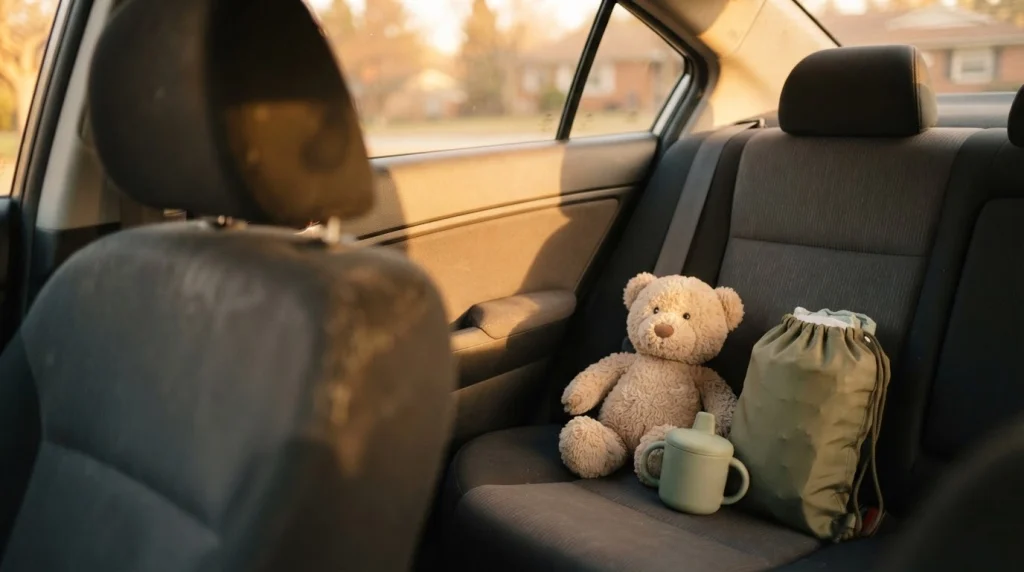
Most car ride battles come from a few common mistakes, not from a difficult child.
Fix the mistake, and the ride often fixes itself.
The first mistake is packing too much.
A seat full of toys, books, and snacks leaves no room to play, and dropped items cause tears.
Pack less, rotate more, and keep spares in the boot.
The second mistake is starting a game while you drive and then going quiet.
Toddlers notice fast when the fun stops.
If you start a song, finish it, or hand the game to a passenger before you go quiet.
The third mistake is adding gear that changes the seat fit.
Thick inserts, bulky coats, and strap covers can loosen the harness, even when they feel soft.
Check the manual before you add anything.
For a quick check on what is usually fine, see our guide on which car seat accessories are safe to use.
The fourth mistake is skipping stops on a long drive.
Adults can push through an extra hour, but toddlers cannot.
A ten-minute stop to walk, stretch, and drink can save an hour of crying.
The fifth mistake is using food as the only calm tool.
Snacks help, but a child who only calms with food learns to ask for food every time they feel bored.
Mix snacks with songs, books, and talk.
Section takeaway: Pack less, finish what you start, keep the seat fit clean, stop on time, and stay calm yourself.
Frequently Asked Questions
Car seat entertainment is any safe, harness-friendly activity that keeps a toddler busy in a car seat, such as a soft toy, a song, a talking game, or a short story, without loosening the straps or adding a hard object.
What is the best way to entertain a toddler in a car seat?
The best way is to mix your voice with one soft toy and rotate often. Sing a familiar song, play a short talking game, then swap the toy after a few minutes.
Keep the harness snug and stop the game while your child still enjoys it.
Are toys safe in a car seat?
Soft, light toys are usually safe when they do not sit behind your child or under the straps. Avoid hard toys, long cords, small parts, and anything that clips to the harness unless the manual allows it.
Check the toy for loose parts before every trip.
How can I entertain a toddler on a long car ride?
Pack a small kit with two or three toys, a book, water, and snacks, then plan a stop every two hours. Rotate items, sing together, and use a screen only for the hardest stretch.
Let your child sleep when they drift off.
Can a toddler watch a tablet in a car seat?
A toddler can watch a tablet for a short time on a long trip, if the screen is safely mounted and the show is short and shared. Never hand them a loose tablet, keep the volume low, and set a clear end point before you start.
What should I do if my toddler cries in the car seat?
Pull over in a safe place, check the harness, nappy, hunger, and temperature, then offer a drink or a calm song. Do not reach back while you drive, and do not loosen the straps to calm them.
Reset with a short walk if they need it.
How do I keep a toddler happy without a screen?
Use songs, rhymes, colour hunts, animal sounds, and simple stories, and swap the activity every few minutes. A fresh toy, a new song, and your voice together work well on most trips.
Plan stops, so boredom does not build up.
Start small on your next trip.
Pack one soft toy, pick one song, and plan one game you can start in ten seconds.
If it works, keep it in your kit, and swap one item next week to keep it fresh.

Daniel Brooks is an automotive writer and product researcher focused on car accessories, car tech, maintenance, and practical driving guides. At Plug-in Car World, he helps drivers make smarter automotive decisions through honest reviews and research-driven content.