Can You Use a Car Seat Instead of a Carrycot? Safety Guide
Quick Answer
Yes, you can use a car seat instead of a carrycot for short trips, but not as a full replacement for long sleep. A car seat holds your baby in a semi-reclined position for safe travel, while a carrycot lets your baby lie flat.
Use the car seat for the drive and short errands, then move your baby to a flat surface for longer naps. Learn when a baby can sleep in a car seat before you plan a long day out.
The short version
- Short trips only: A car seat works well on a pram frame for quick shops and school runs.
- Flat is best: A carrycot gives a newborn a flat, open space for longer sleep.
- Watch the clock: Keep car seat time short and build in breaks on longer days.
- Check the fit: Use only the adapters made for your seat and pram frame.
- Move them over: Transfer your baby to a cot, carrycot, or flat pram seat for a long nap.
If you remember one thing
- Think of the car seat as travel gear and the carrycot as a bed on wheels.
I have fitted infant carriers in more family cars than I can count, and this question comes up in almost every garage chat with new parents. They want one piece of kit to do it all.
I get it. A travel system looks neat, and a carrycot looks like one more bulky item to store.
This guide goes deeper than a yes or no, so you can judge each trip on its own.
In This Guide
- What Is the Difference Between a Car Seat and a Carrycot?
- Can You Use a Car Seat Instead of a Carrycot?
- How Long Can a Baby Stay in a Car Seat on a Pram?
- Car Seat vs Carrycot: Which Is Safer for Sleep?
- When a Car Seat Works Better Than a Carrycot
- When a Carrycot Is the Better Choice
- How to Use a Car Seat on a Pram Safely
- Frequently Asked Questions
What Is the Difference Between a Car Seat and a Carrycot?
A car seat and a carrycot look similar at a glance, but they do two very different jobs. One protects your baby in a crash, and the other gives your baby a flat place to rest.
A carrycot is a firm, flat bassinet that clips onto a pram frame. Your baby lies on their back with their whole body level, and their chest stays open for easy breathing.
An infant car seat is a hard shell with a five-point harness, a handle, and a base or belt fit in the car. It holds your baby at a semi-reclined angle, so the seat can manage crash forces.
That angle is the key difference. A car seat sits your baby up more than a carrycot, and that changes how their head, neck, and chest line up.
- Car seat: Semi-reclined, harnessed, crash-rated, and made for travel in a car.
- Carrycot: Fully flat, open, and made for rest, walks, and daytime naps.
- Travel system: A pram frame that takes both, so you can swap them without waking your baby.
- Pram seat: A later-stage seat that reclines, but it is not a carrycot and not a car seat.
Check your seat and pram manuals for the exact age, weight, and height limits. Limits vary by model, so do not guess from another brand.
Section takeaway: A car seat protects your baby in a crash, while a carrycot gives your baby a flat place to sleep, and neither one fully replaces the other.
Can You Use a Car Seat Instead of a Carrycot?
Yes, for short trips, and no, as a full-time swap. That split answer trips up a lot of new parents, so let me break it down in plain terms.
On a short trip, a car seat on a pram frame works well. You drive to the shops, click the seat onto the frame, do your errand, and click it back into the car.
Your baby stays asleep, you skip a transfer, and you carry one less bulky item. That is the whole point of a travel system, and it is a smart setup for busy days.
On a long day, the same setup starts to work against you. Your baby stays curled in one position, their head can tip forward, and they cannot stretch out flat.
That is why child health guidance in many countries stresses flat lying for newborn sleep. A carrycot meets that need, and a car seat does not.
A carrycot works at home, in the garden, and on long walks. It gives your baby room to move, and it keeps their airway in a natural line.
I once helped a neighbour fit an infant carrier in a Honda CR-V, then watched her try to use it as a nap spot for a whole afternoon. Her baby fussed, her back ached from the carry, and the carrycot she had left at home would have solved both problems.
Use the car seat for travel, and use the carrycot for rest. That simple rule covers most days without overthinking each trip.
Consumer Reports covers infant car seat safety and fit in its baby gear guides, and its advice lines up with this split: a seat is for the car first, and a flat surface is for sleep. Visit Consumer Reports for its latest infant car seat guidance.
Also check how an infant carrier differs from the next stage up, so you do not buy a seat that outgrows your baby too soon. Compare infant and convertible car seats before you choose a travel system.
Section takeaway: A car seat can stand in for a carrycot on a short trip, but it cannot replace a carrycot for long sleep or a full day out.
How Long Can a Baby Stay in a Car Seat on a Pram?

Keep it short, and treat two hours as a firm outer limit for a newborn in a car seat. Many parents aim far shorter than that for everyday errands.
That two-hour guide covers total time in the seat, not just the drive. It includes the car journey, the walk round the shops, and the drive home.
A 30-minute drive each way plus an hour in the shops already hits the limit. That math catches a lot of parents out, so plan breaks into longer days.
Newborns need the most care here, because their neck muscles are still weak. Their head can flop forward, and that can narrow their airway.
Watch for clear signs that your baby needs a break. Fussing, a chin tucked to the chest, shallow breathing, and a sweaty back all point the same way.
- Under 30 minutes: Fine for most quick errands with a healthy newborn.
- 30 to 60 minutes: Fine for a normal trip, with a quick check of head position.
- 60 to 120 minutes: Take a break, lift your baby out, and let them lie flat.
- Over 120 minutes: Too long in one stretch for a newborn, so split the day up.
Plan longer days round a flat surface, not round the seat. Take the carrycot, plan a stop at home, or use a pram seat that reclines flat if your baby is old enough.
For the full time guide, with age notes and break ideas, read the newborn time limit in detail. See how long a newborn can stay in a car seat before your next long trip.
Section takeaway: Treat two hours as the outer limit for a newborn in a car seat, and aim for far shorter on most days.
Car Seat vs Carrycot: Which Is Safer for Sleep?
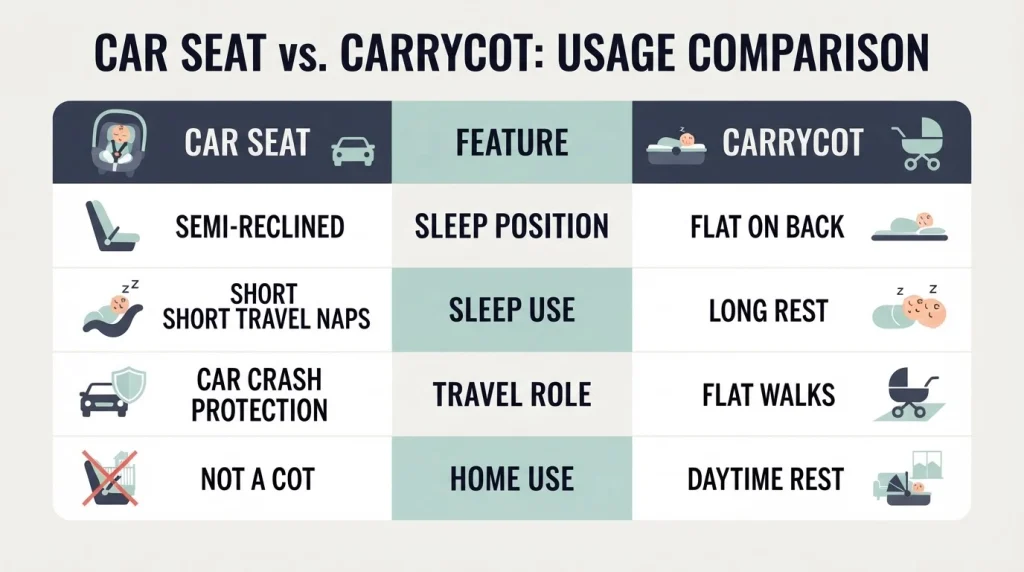
A carrycot is safer for sleep, because it lets your baby lie flat on a firm surface. A car seat is safer for travel, because it holds your baby in a crash.
That sounds simple, yet it answers the real question behind this keyword. Parents do not just want to know if a swap works; they want to know if their baby can sleep safely in it.
In a carrycot, your baby lies on their back with no straps pressing on their chest. Their head stays in line with their body, and air moves freely.
In a car seat, the semi-reclined angle can let a newborn’s head fall forward. That chin-to-chest position can make breathing harder, and it is the main sleep risk with long car seat naps.
Short naps in a car seat during a drive are normal, and most babies doze off in the car. The risk grows when that nap stretches on after you park, with no one watching.
Never let your baby sleep overnight in a car seat, and never use it as a cot at home. Move them to a cot, a carrycot, or another flat sleep surface as soon as you can.
Pro tip: Check the latest safe sleep guidance from your national health authority and your seat manual, and ask your paediatrician if your baby was born early or has a breathing condition.
The U.S. National Highway Traffic Safety Administration publishes child passenger safety guidance, and it stresses the right seat, the right fit, and the right use for every trip.
Visit NHTSA for its child passenger safety pages.
Head position matters most in the first months, so check it every time you buckle your baby in. Learn how to position a newborn’s head safely in a car seat and keep the chin off the chest.
| Feature | Car Seat | Carrycot |
|---|---|---|
| Sleep position | Semi-reclined, harnessed | Fully flat, on the back |
| Best for sleep | Short naps during travel | Long naps and daytime rest |
| Best for travel | Car journeys, crash protection | Walks, not car travel |
| Time limit | Keep short, two hours at most | No car seat style limit, follow age guidance |
| Age range | Birth to the seat limit, often about 12 months | Birth until baby can sit up or push up |
| Use at home | No, not as a bed or cot | Yes, as a daytime rest spot |
Section takeaway: For sleep, a carrycot wins, and for car travel, a car seat wins, so use each one for the job it was made to do.
When a Car Seat Works Better Than a Carrycot
A car seat wins when the car is part of the trip. A carrycot cannot go in a car, and it offers no crash protection at all.
Quick errands are the clearest win for the seat. You drive, you click, you shop, and you drive home, all without moving a sleeping baby.
Bad weather is another win. A car seat with a rain cover or canopy shields your baby fast, and you can lift the whole seat indoors in one move.
Public transport and taxis also favour the seat. A carrycot is wide and awkward on a bus, while a carrier with a handle moves through tight spaces with ease.
Use the seat when you need to move fast, keep your baby asleep, or fit your kit into a tight space. Those are travel problems, and the seat was built to solve them.
Fit matters as much as speed, though, so do not rush the install to save a minute. Learn how to install an infant car seat correctly before you rely on a quick click-and-go routine.
Section takeaway: A car seat works better for car trips, quick errands, bad weather, and tight spaces, where speed and crash protection matter most.
When a Carrycot Is the Better Choice
A carrycot wins when rest is the main job of the trip. Long walks, long visits, and long naps all point to the flat option.
Newborns benefit most, because they sleep a lot and they need that flat position. A carrycot gives them room to stretch, and it keeps their breathing easy.
Long days out are a clear carrycot day. Take the pram with the bassinet, plan a feed and a change, and let your baby sleep flat while you walk.
Edmunds covers family car and travel gear in its parenting and car seat guides, and its family advice often stresses comfort on long days out. Visit Edmunds for its family car and car seat resources.
Stop using the carrycot once your baby can sit up, roll over, or push up on hands and knees. At that point, move to a reclined pram seat that suits their stage.
Section takeaway: A carrycot is the better choice for long walks, long naps, warm days, and any day when rest matters more than speed.
How to Use a Car Seat on a Pram Safely
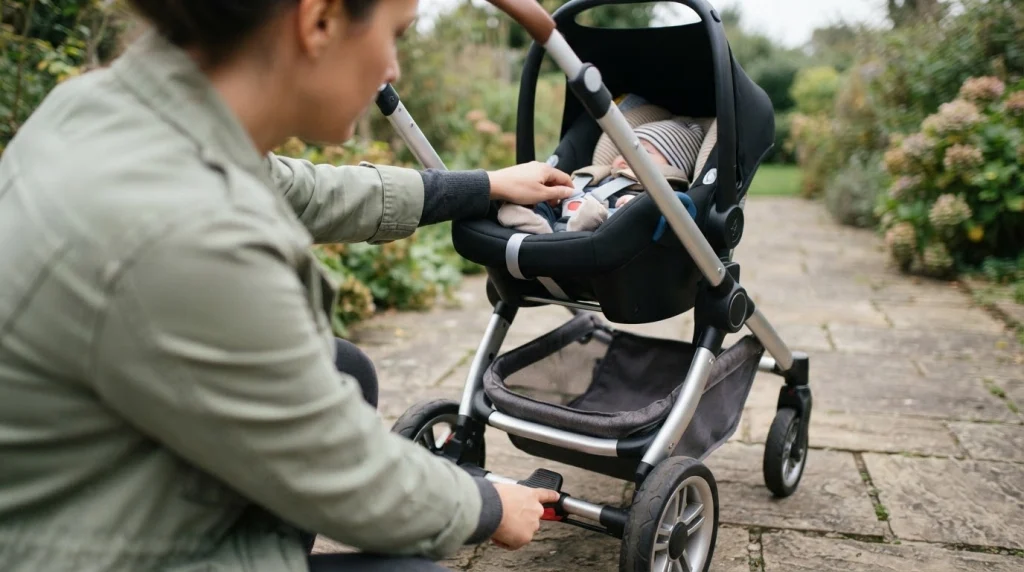
Use only the adapters made for your exact seat and pram frame. A close fit is not a safe fit, and a wrong adapter can fail without warning.
Click the seat in, then lift it by the handle to check the lock. If it moves, rocks, or clicks twice, take it off and start again.
Keep the handle in the position your manual shows for pram use. Some brands want it up as a roll bar, and others want it down, so follow your manual, not a guess.
Use the brake every time you stop, even on flat ground. A pram with a seat on top has a higher centre of gravity, so it rolls more easily than it looks.
- Check adapters: Match the brand, model, and year, not just the brand name.
- Check the lock: Lift, tug, and listen for a firm click before you walk.
- Check the harness: Snug straps, chest clip at armpit level, no slack.
- Check the head: Chin off the chest, face clear, breathing easy.
- Check the time: Note when you started, and plan a flat break.
Choose a seat that fits your car, your pram, and your baby, not just the one with the best looks. Learn how to choose a car seat for a newborn and check fit, limits, and travel system options first.
Pro tip: Keep both manuals in the car for the first month, and check the fit again after you wash the covers or move the seat to another car.
Section takeaway: Use the right adapters, lock the seat in, check the harness and head position, and keep car seat time short.
Frequently Asked Questions
Can a newborn sleep in a car seat on a pram?
Yes, for a short nap during a trip, with the head in a safe position and an adult nearby. Move your baby to a flat carrycot or cot for a long sleep, and do not leave them in the seat after you get home.
Can I use a car seat as a carrycot at home?
No, a car seat is not a carrycot and it is not a bed. Use a carrycot, a cot, or another flat sleep surface at home, and keep the car seat for travel only.
Do I need both a car seat and a carrycot?
Most newborn parents find both useful, because each one covers a different job. A car seat covers car travel, and a carrycot covers flat rest and long walks.
Can a baby travel in a carrycot in a car?
No, a standard carrycot is not a car seat and it offers no crash protection. Some brands sell a car-approved carrycot with a special fit, so check your manual and local rules before you use one in a car.
When should I stop using a carrycot?
Stop once your baby can sit up unaided, roll over, or push up on hands and knees. Move to a pram seat that reclines, and follow the weight and height limits in your pram manual.
Is a travel system worth it?
Yes, for many parents, because it lets you move a sleeping baby from car to pram without waking them. Check that your seat and pram take the same adapters, and check the boot space first.
So, can you use a car seat instead of a carrycot? Yes, for short trips, and no, for long sleep or a full day out.
Use the seat for travel, use the carrycot for rest, and your baby gets the best of both.
Check your manuals, watch the clock, and move your baby flat when the nap turns long. That habit keeps travel easy and sleep safe, as of 2026.

Daniel Brooks is an automotive writer and product researcher focused on car accessories, car tech, maintenance, and practical driving guides. At Plug-in Car World, he helps drivers make smarter automotive decisions through honest reviews and research-driven content.