Can You Feed a Baby in a Car Seat? Stop First, Feed Upright, Then Drive On
Quick Answer
No, do not feed a baby in a car seat while the car is moving — pull over, take your baby out of the seat, feed them upright, burp them, then refit the harness and drive on. Check how long a newborn can stay in a car seat before you plan your stops.
The safe feed in short
- Stop the car first: Feeding belongs at a stop, never on the move.
- Take baby out: Hold your baby upright in your arms, away from the straps.
- Feed, then burp: Give the feed time, burp midway and at the end, and watch for spit-up.
- Refit the harness: Check the chest clip, strap snugness, and recline before you drive.
- Plan feeds into stops: Babies feed every 2 to 3 hours, so let feeds set the schedule.
One rule to remember
- If your baby coughs, chokes, or goes limp while feeding, stop the feed, sit them upright, and call your pediatrician if breathing stays troubled.
I’ve sat in a parked car with a hungry baby and a bottle going cold, and I’ve also watched a parent try to feed on the move. This guide gives the honest version: why the seat is the wrong place for a feed, how to feed safely at a stop, and how to plan a trip so hunger never forces a bad call.
Can you feed a baby in a car seat? Yes, in a parked car with the baby out of the seat, and no, never while driving.
In This Guide
- Can you feed a baby in a car seat while driving?
- Why is feeding in a moving car seat unsafe?
- What is the safest way to feed a baby on a road trip?
- Bottle feeding vs breastfeeding in the car: what changes?
- How do you feed a baby in a parked car safely?
- How often should you stop to feed a baby on a long drive?
- What should you pack for feeding on the road?
- Frequently asked questions
Can you feed a baby in a car seat while driving?
No, you should not feed a baby in a car seat while the car is moving. The seat holds a baby semi-upright and strapped in, and that pose is wrong for swallowing safely.
A car seat is a travel seat built to hold a baby in a crash, not a feeding chair. Feeding needs an upright baby, a free head, and an adult watching every swallow.
I learned this the slow way, fitting an infant carrier into a Honda CR-V for a niece at 4 months old. The carrier recline looked gentle in the driveway, yet her chin dropped toward her chest the moment she dozed off.
That chin drop is the heart of the problem. A baby who slumps forward cannot swallow cleanly, and a baby who cannot swallow cleanly can choke.
What does safe feeding look like, in plain words?
Safe feeding means the baby sits upright in your arms, with the head free to turn and the mouth free to pause. You watch the face, you hear the swallow, and you stop when the baby pulls away.
A passenger cannot fix it either, not in a moving car. A back-seat adult can hold a bottle, but a sudden stop can throw that bottle, and a choking baby still needs to come out of the straps first.
Pro tip: check your car seat for recalls on the NHTSA site before a long trip, and ask your pediatrician about feeding and seat time if your baby was born early or has reflux or breathing trouble.
Section takeaway: Feeding belongs at a stop, with the baby out of the seat and upright in your arms, because a moving car seat blocks the head, the swallow, and your view all at once.
Why is feeding in a moving car seat unsafe?
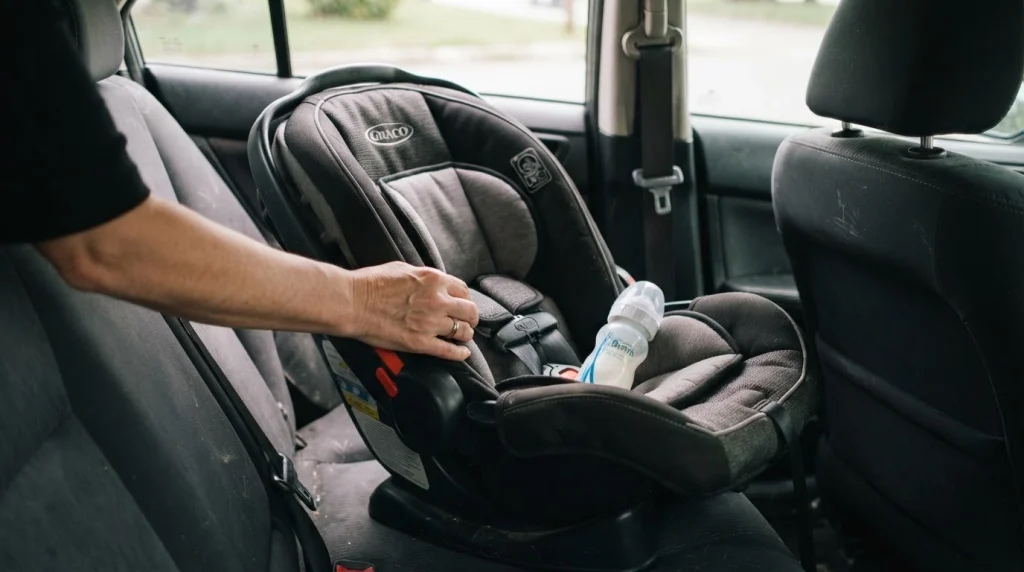
Feeding in a moving car seat is unsafe for three linked reasons: choking, the recline, and the crash. Each one alone is enough to stop the car, and together they leave no safe middle ground.
Start with choking, because it is the most direct risk. Milk flows fast from a bottle, and a reclined baby cannot cough it clear as well as an upright baby can.
How does the car seat recline make feeding harder?
An infant seat reclines so the head stays back and the airway stays open during travel. That recline helps a sleeping baby breathe, yet it works against a feeding baby.
Feeding needs the head slightly raised and the chin free. The seat pushes the head the other way, back and down, and the straps hold the body still.
Read why a newborn slumps in a car seat if your baby’s head keeps dropping forward. A slumped head narrows the airway, and a feed on top of that slump adds risk you cannot see from the front seat.
What happens to a bottle in a crash or a hard stop?
A bottle becomes a loose object in a crash. It can strike the baby, fly into the front seat, or spill hot milk across the baby’s face.
Your hands tell the same story. A driver holding a bottle has one hand off the wheel, and a passenger leaning across the seat is out of their own belt.
Section takeaway: A moving car seat makes choking more likely, keeps the baby too reclined to swallow well, and turns the bottle into a loose object, so the only safe answer is to stop.
What is the safest way to feed a baby on a road trip?
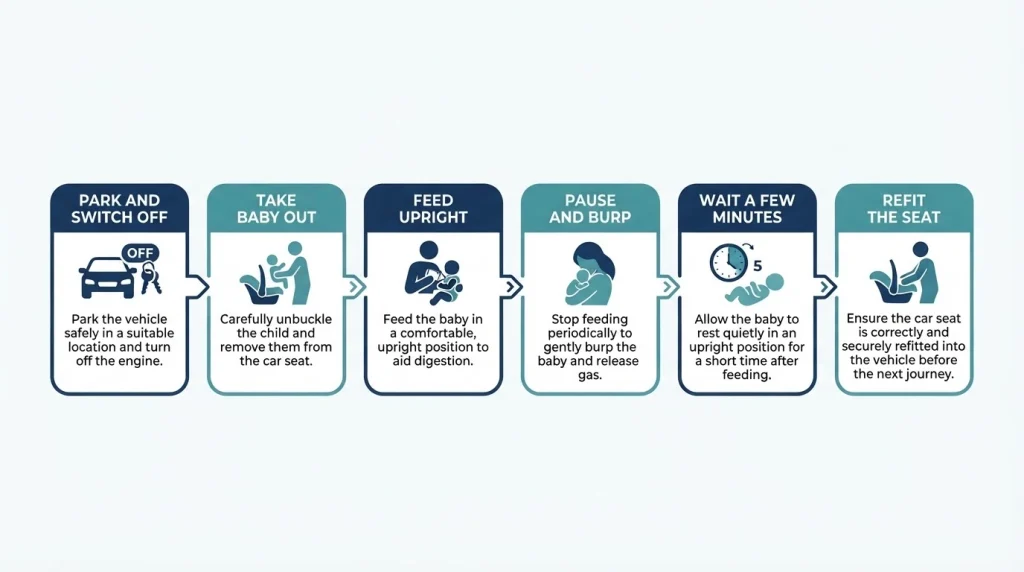
The safest way is a simple loop: drive, stop, take the baby out, feed upright, burp, refit, drive on. Repeat that loop at every feed, and the trip stays calm.
Service stations work well, and so do parks and rest areas with picnic tables. A quiet side street works in a pinch, as long as you park fully off the road and lock the doors.
How do you feed at a stop, step by step?
- Park and switch off: Choose a safe spot, switch the engine off, and take the keys with you.
- Take baby out: Unbuckle the harness, lift the baby out, and let them stretch in your arms.
- Feed upright: Hold the baby at a 45-degree angle or higher, with the head free and the chin clear of the chest.
- Pause and burp: Stop midway for a burp, then finish the feed at the baby’s pace.
- Wait a few minutes: Hold the baby upright for a short while after the feed, so spit-up settles.
- Refit the seat: Check the recline, the chest clip at armpit level, and straps snug with no slack.
How do you keep the baby’s head safe during the feed?
Support the head and neck with your hand or forearm, and keep the chin off the chest. The baby should look slightly up toward you, not down toward their own chest.
Read how to position a newborn’s head safely in a car seat before the trip, because the same head rule applies in the seat and in your arms. A free chin keeps the airway open in both places.
Section takeaway: Stop, lift the baby out, feed upright, burp, wait a few minutes, then refit the harness, and that short loop is the whole safe method.
Bottle feeding vs breastfeeding in the car: what changes?
Bottle feeding and breastfeeding share the same core rule: stop the car and take the baby out. What changes is the prep, the privacy, and the pace.
A bottle needs warm milk, a clean nipple, and a place to sit. Breastfeeding needs privacy, a good latch, and a seat that lets you sit upright.
| Situation | Bottle feeding | Breastfeeding |
|---|---|---|
| While driving | Not safe, even with a passenger holding the bottle. | Not safe, and not possible with the baby strapped in. |
| At a stop | Feed in your arms, upright, with pauses to burp. | Feed in your arms or on a bench, upright, with a cover if you want one. |
| Prep needed | Warm milk, spare bottles, and a cool bag for formula or pumped milk. | A nursing cover, a pillow for your arm, and water for you. |
| Choking risk | Higher if the bottle flows fast or the baby feeds lying back. | Lower when the latch is good, but still unsafe on the move. |
| Time at a stop | About 20 to 30 minutes, with burping and a nappy change. | About 20 to 40 minutes, with burping and a nappy change. |
Can you bottle feed in the back seat while someone else drives?
No, the driver changes nothing about the baby’s risk. The baby is still reclined, still strapped in, and still hard to reach in a choke.
What about breastfeeding in a parked car?
Yes, breastfeeding in a parked car is fine, with the baby out of the seat and in your arms. Sit in the back seat with the doors locked, or on a bench outside, and take your time.
Use a cover only if you want one. The cover is for your comfort, not for the baby’s safety, so keep the baby’s face clear and watch the latch.
Pro tip: Consumer Reports covers car seat fit and safety checks in plain language, and their guides are a good second check on recline and harness fit before a long trip.
Section takeaway: Bottle and breast feeds share one rule, stop and take the baby out, and the only real difference is what you pack and how long the stop runs.
How do you feed a baby in a parked car safely?
A parked car can be a fine feeding spot, if you treat it like a room, not a shortcut. Park safely, switch off, and give the feed the same care you would give it at home.
Pick shade in warm weather, because a parked car heats fast. Crack a window for air, keep the baby out of direct sun, and check the seat fabric with your hand before you sit down.
Where should you sit to feed in a parked car?
Sit in the back seat with the baby in your arms, or sit on a bench outside if the weather allows. The back seat gives you room to sit upright, and the doors lock around you.
Can a baby sleep in the car seat after a feed?
A baby can doze in the seat during the drive after a feed, if the recline and harness are right. Move the baby to a flat sleep surface as soon as you arrive, and never use the seat as a crib at home.
Read can a baby sleep in a car seat for the full sleep rules, because feeding and sleep overlap on every road trip. A fed baby often falls asleep fast, and a sleeping baby still needs a clear airway.
Watch the head after a feed, too. A full, sleepy baby slumps more, so check the chin before you pull away.
What should you never do at a feeding stop?
- Never prop a bottle: A propped bottle can flow too fast, and no one is watching the swallow.
- Never feed in the seat: Straps hold the baby still, and still is the wrong pose for a feed.
- Never leave baby alone: A parked car is not a nursery, even for a minute.
- Never rush the burp: A missed burp becomes spit-up, and spit-up in a reclined seat is a hazard.
Section takeaway: A parked car works for a feed when you sit in the back, keep the baby out of the seat and upright, and treat the stop with the same care as a feed at home.
How often should you stop to feed a baby on a long drive?
Stop every 2 to 3 hours for a feed, and at least every 2 hours to take the baby out of the seat. For a newborn, plan shorter legs of 60 to 90 minutes between stops.
Those two clocks line up well. A baby who feeds every 2 to 3 hours needs a stop at the same rhythm, so feeds and breaks can share one schedule.
Build the trip around that rhythm. A 6-hour drive becomes an 8-hour day, and a calm 8-hour day beats a rushed 6-hour one.
What does a feeding stop schedule look like?
Feed before you leave, then drive one leg, stop to feed, and repeat. Change the nappy at the same stop, so each break covers food, comfort, and a stretch.
Keep each stop to 30 to 45 minutes. That window fits a feed, a burp, a change, and a short walk in your arms.
What if there is nowhere safe to stop?
Plan your route around towns and service stations, not around empty stretches. A baby’s feed clock does not pause for a long gap between exits.
Read how to travel with a child car seat without your own car if your trip mixes cars, taxis, or rideshares. The same stop-and-feed rule applies in every vehicle, not just your own.
Pro tip: Edmunds covers family road trip planning and car seat fit, and their checklists help to map stops before you leave, so feeds never land on an empty stretch of road.
Section takeaway: Stop every 2 to 3 hours for a feed, and every 2 hours at most for a break out of the seat, and let the baby’s clock set the trip, not the map.
What should you pack for feeding on the road?
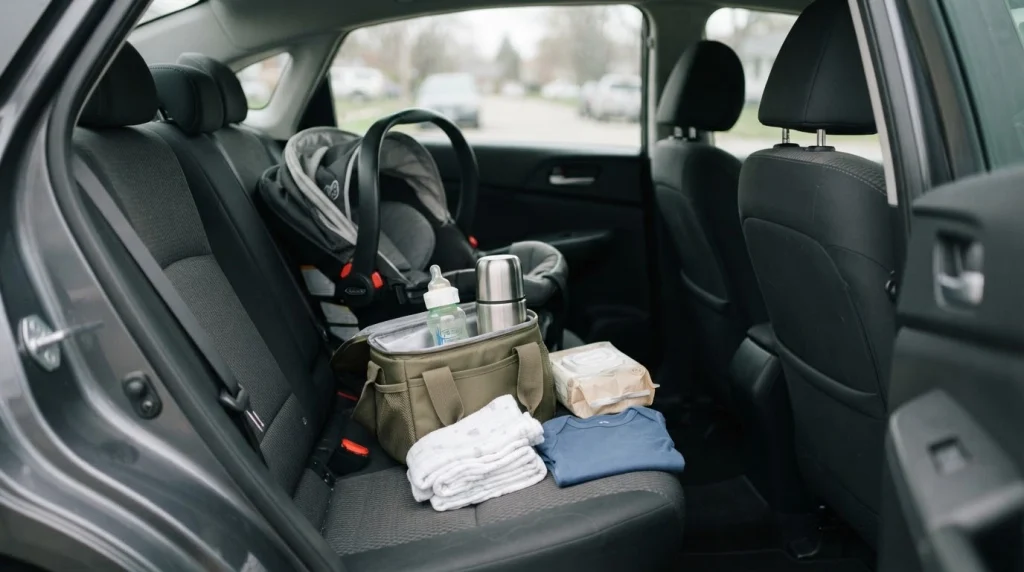
Pack for the feed, the spill, and the stop after the feed. A small bag done well beats a large bag you cannot find things in.
Keep the feeding bag within reach of the back seat, not buried in the boot. You need milk, bottles, and wipes fast at a stop, not after a 10-minute unpack.
- Milk and bottles: Pre-measured formula or pumped milk in a cool bag, plus one spare bottle.
- Warmth: A flask of warm water or a bottle warmer that works from the car at a stop.
- Burp cloths: Two or three cloths, because one always ends up damp.
- Nappies and wipes: Enough for the trip plus two extra changes, in the same bag as the bottles.
- A change for you: A spare top for the adult feeding, because spit-up finds shirts fast.
- Water for you: A bottle of water for the feeding adult, plus a snack for the drive.
Read how to choose a car seat for a newborn if your seat still feels wrong on short trips. A seat that fits well makes every stop easier, because the harness goes back on right the first time.
Section takeaway: Pack milk, bottles, warmth, burp cloths, and nappies in one reachable bag, and check the gear at home before the trip, not at a service station.
Frequently asked questions
Can I bottle feed my baby while driving?
No, do not bottle feed a baby while driving, even if a passenger holds the bottle. The baby stays reclined and strapped in, so pull over and feed out of the seat.
Can I breastfeed in a moving car?
No, you cannot breastfeed safely in a moving car. Stop, take the baby out, and feed upright in the back seat or outside.
Can I feed a baby in a car seat while parked?
Yes, you can feed in a parked car, with the baby out of the seat and upright in your arms. Sit in the back seat, lock the doors, and never leave a baby alone in a parked car.
How long can a baby go without a feed on a road trip?
Most babies feed every 2 to 3 hours, and newborns may feed more often. Plan a stop at that rhythm, and feed before you leave so the first leg starts calm.
Can I prop a bottle in a car seat?
No, never prop a bottle in a car seat. A propped bottle can flow too fast, and no one watches the swallow.
What if my baby cries for food and there is nowhere to stop?
Take the next safe exit, even if it adds time to the trip. Pull into a side street or a car park, switch off, and feed out of the seat.
Stop first, feed upright, and let the trip fit the baby. A calm feed at a stop is worth more than any time saved on the road.
Plan your next trip around feeds and breaks, and the drive will feel easier for everyone in the car.

Daniel Brooks is an automotive writer and product researcher focused on car accessories, car tech, maintenance, and practical driving guides. At Plug-in Car World, he helps drivers make smarter automotive decisions through honest reviews and research-driven content.