Can Car Seat Foam or Styrofoam Get Wet? What Water Really Does to It
Quick Answer
Yes, car seat foam can get wet, but it should not stay wet. The hard white foam inside most child car seats is EPS, a form of polystyrene like Styrofoam, and it does not soak up water like a sponge. Water still causes trouble when it sits in cracks, behind the foam, or in the soft comfort padding around it. Learn how to clean a car seat safely before you wash any part of it.
The short version
- Hard foam resists water: EPS beads hold their shape when splashed, yet cracks and gaps can trap water.
- Soft foam soaks it up: Comfort padding and fabric can hold water, smell, and mould.
- Never soak the seat: Do not submerge the shell, the foam, or the harness straps.
- Dry it fully: Air-dry in moving air until every layer feels dry.
- Check before reuse: Look for cracks, soft spots, smell, and loose foam before the next trip.
One rule to remember
- If the foam is cracked, crumbling, or still damp after a full day of air-drying, stop and ask the seat maker before you use the seat again.
I first saw the white foam inside a car seat when a neighbour brought me an infant carrier after a roof leak. The cover was soaked, the shell was damp, and she wanted to know if the seat was ruined.
Can car seat foam or Styrofoam get wet? Yes, it can, and a splash will not ruin it on its own. The risk comes from water that stays hidden, not from water that touches the surface.
In This Guide
What is the foam inside a car seat?
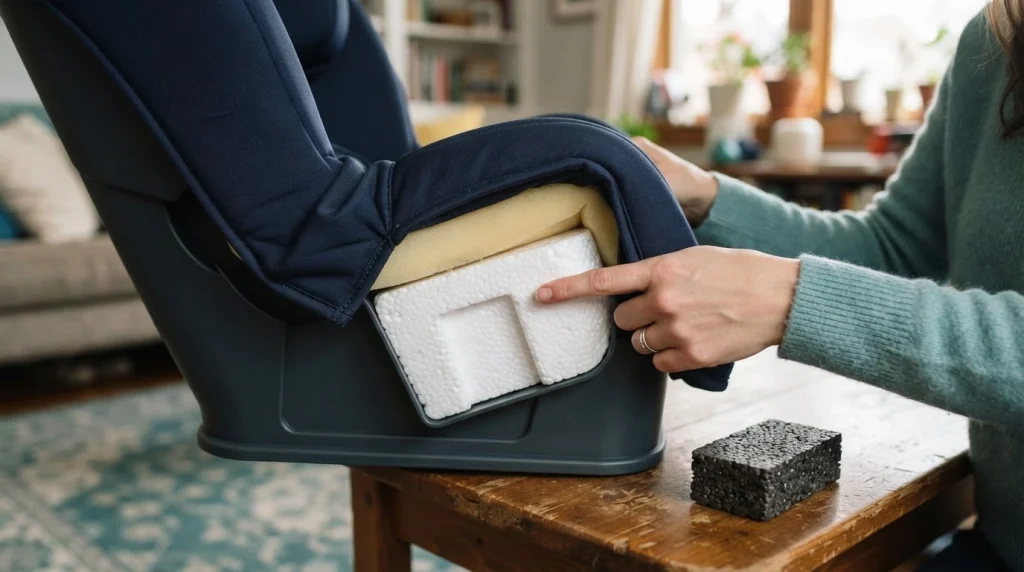
The foam inside a child car seat is not one material. Most seats use two kinds of foam, and they behave very differently when they get wet.
Definition: Car seat foam is the energy-absorbing padding inside a child restraint. The hard white layer is usually EPS, expanded polystyrene, and the soft layer under the cover is comfort foam, usually polyurethane.
EPS is the foam most parents call Styrofoam. Styrofoam is a brand name for polystyrene foam, and EPS is the expanded form used in car seats, helmets, and packing. The beads fuse into a firm block that crushes slowly in a crash.
That crush is the point. The foam spreads crash force across a wider area, so less force reaches the child. A seat without its foam layer is not the same seat.
Some newer seats use EPP, expanded polypropylene, instead of EPS. EPP looks similar, yet it springs back after a light hit and resists water a little better. Your manual names the material, or the foam itself carries a moulded label.
Comfort foam sits in a different role. It pads the cover, fills the head wings, and softens the seat edges. It is open-cell foam, which means air and water can move through it. That softness is why it dries slowly.
Pro tip: read your car seat manual before you remove a cover or touch the foam, and check the Consumer Reports car seat guidance if you want an independent view on how different seats are built.
Section takeaway: A car seat holds hard EPS foam for crash protection and soft comfort foam for padding, and only the hard foam resists water well.
Can car seat foam get wet?
Yes, car seat foam can get wet from rain, a spill, a leak, or a wash. The question is not whether water can touch it, but where the water goes and how long it stays.
EPS foam is made of closed cells. Each bead holds air inside a thin plastic skin, so water beads on the surface instead of soaking through. A splash on clean EPS will run off or sit in drops.
That closed-cell build is why a quick spill rarely ruins the hard foam. Wipe the drops away, let the surface dry, and the foam keeps its shape. As of 2026, that simple fact still guides most seat makers.
Water still finds a way in through the weak points. A crack in the foam opens the bead structure, and water can sit inside that crack. Gaps between the foam and the plastic shell hold water too.
Comfort foam has no such defence. Its open cells pull water in like a sponge, and the cover on top slows drying. A wet comfort pad can stay damp for hours after the shell looks dry.
Rain is the most common cause I see. A carrier left by an open door, a stroller frame caught in a shower, or a seat stored in a damp garage all bring water to the foam. Spills come next, then car washes and roof leaks.
Do not judge wet foam by touch alone. The cover can feel dry while the foam beneath it is still damp, and the shell can look dry while water sits behind the foam liner.
Section takeaway: Hard EPS foam can get wet without soaking through, yet water trapped in cracks, gaps, or soft comfort foam is the real problem.
What happens when Styrofoam gets wet?
Styrofoam gets wet on the surface, yet it does not swell like wood or cloth. The beads stay firm, the block keeps its shape, and the water has nowhere deep to go.
That sounds reassuring, and for a clean, intact block it mostly is. The trouble starts when water stays in place for a long time, or when the foam already has damage.
Standing water can work into the seams between foam pieces. It can sit against the shell, soften glue or tape, and loosen a foam liner from its seat. A loose liner can shift in a crash, and that shift changes how the seat protects a child.
Wet foam also hides damage. A crack filled with water looks darker than a dry crack, and a damp liner can feel soft even when the foam beneath it is sound. You cannot judge the foam until it is fully dry.
Mould is the slower risk. Mould needs moisture, warmth, and a food source, and a damp car seat gives it all three. The foam itself is not food, yet dust, milk, and skin oils on the foam are.
| Foam type | What water does | What to do |
|---|---|---|
| EPS, hard white foam | Beads on the surface, can sit in cracks and gaps | Wipe dry, air-dry fully, check for cracks |
| EPP, springy foam | Resists water a little better, dries faster | Wipe dry, air-dry, check the fit to the shell |
| Comfort foam, soft padding | Soaks water in, holds smell and mould | Remove the cover if the manual allows, air-dry fully |
| Memory foam cover pad | Soaks slowly, dries very slowly | Do not use it wet, follow the cover label |
Freezing adds another risk in cold weather. Water trapped in a crack can freeze, expand, and widen that crack. A foam block that looked fine in autumn can show a split after a cold snap.
Read how to remove stains from a car seat if the wet foam also has a spill stain. A stain cleaner that soaks the foam will make a wet-foam problem worse, not better.
Section takeaway: Wet Styrofoam keeps its shape, yet trapped water can loosen the liner, hide cracks, grow mould, and widen damage in cold weather.
How do you dry wet car seat foam safely?
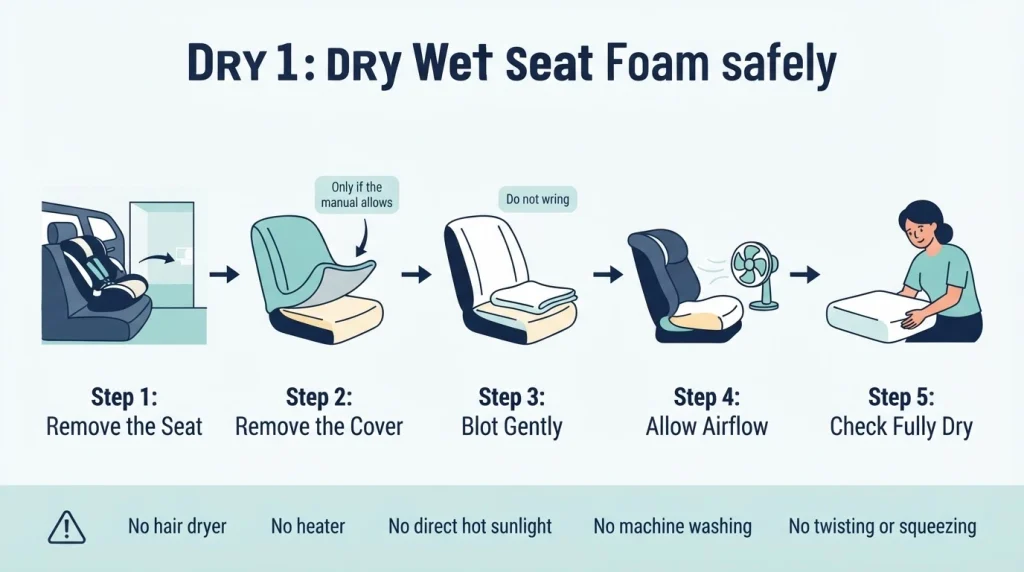
Dry wet car seat foam with air, time, and patience. Heat and force will damage the foam faster than water will.
Start by taking the seat out of the car. A seat left in a closed car dries slowly, and a damp car holds the moisture in the air. Bring the seat indoors, into a dry room with moving air.
Remove the cover only if your manual says you can. Many covers unclip or unzip, and that step lets air reach the foam. Do not pull the foam out of the shell unless the manual tells you how.
Blot the foam with a clean, dry towel. Press gently, lift, and move to a dry part of the towel. Do not wring the foam, twist it, or press it hard, because that can crack EPS or tear comfort foam.
Set the seat on its side so air can reach both faces of the foam. A fan on low, a few feet away, helps a lot. Open a window when the air outside is dry, and turn the seat over after a few hours.
Do not use a hair dryer, a heater, or direct sun on a hot day. High heat can warp EPS, shrink a cover, and dry the surface while the inside stays wet. A warm room with moving air is safer than a hot blast.
Check the foam by touch and by smell. It should feel dry through the full thickness, not just on the surface, and it should smell like clean foam, not damp cloth. If it still smells damp, give it more air time.
Read how to clean car seat straps correctly while the seat dries. Straps need the same gentle, air-dry approach, and they must never go in a washing machine.
Section takeaway: Take the seat indoors, blot gently, and air-dry it with moving air until the foam feels dry right through, with no heat and no wringing.
Can you wash car seat foam?
No, you should not wash car seat foam in a machine or a tub. Washing means soaking, and soaking is the one thing EPS and comfort foam handle badly.
Spot-clean the foam instead. Use a lightly damp cloth with clean water, wipe the dirty area, and blot it dry right away. That cleans the surface without pushing water deep into the foam.
Mild soap is allowed only when your manual says so. Some seat makers allow a drop of mild soap on a cloth for the shell or the cover, yet the same soap can weaken foam glue or leave a film on EPS. When the manual is silent, use water only.
Never use bleach, solvents, or harsh disinfectants on foam. They can break down the bead bonds in EPS, stiffen comfort foam, and leave fumes in a seat a child will breathe near. A clean smell is not worth a damaged seat.
Read how to clean vomit from a car seat if the foam is wet from sickness. That guide covers the strap and buckle area too, and it warns against soaking the parts that must stay dry.
Do not put foam in a washing machine, a dishwasher, or a bucket of soapy water. The spin, the heat, and the soak can crack EPS, tear comfort foam, and wash away the glue that holds a liner in place.
Pro tip: check your car seat manual for the exact cleaning rules for your model, and use the NHTSA site to check for recalls before you clean or refit a seat after water damage.
Section takeaway: Spot-clean foam with a damp cloth and water only, never soak or machine-wash it, and use soap only when your manual allows it.
When is wet foam a safety problem?
Wet foam becomes a safety problem when the foam itself is damaged, or when you cannot prove it is fully dry. A damp seat is a comfort problem, while a cracked seat is a safety problem.
Check the foam after it dries, in good light. Look for cracks, dents that do not spring back, crumbling edges, and pieces that flake off when you touch them. Any of those signs means the foam may not crush the way it should in a crash.
Smell the seat too. A sour or musty smell after full drying points to mould inside the foam or the cover. Mould can irritate a child’s breathing, and you cannot wash it out of foam by wiping the surface.
Check the fit of the foam to the shell. A liner that has come loose, curled at the edges, or shifted out of its channel will not sit in the right place. Push it gently back only if the manual shows how it fits.
Stop using the seat and call the seat maker when you find any of these signs. Ask whether the foam can be replaced, whether the seat needs a new liner, or whether the whole seat must be replaced. Do not glue a cracked foam block back together.
A flood-soaked seat needs the same call. Flood water carries dirt, fuel, and sewage, and no amount of wiping makes that foam safe to trust. Most seat makers say to replace a seat that sat in flood water.
Section takeaway: Wet foam is a safety problem when it cracks, crumbles, smells of mould after drying, or comes loose from the shell, and then the seat maker must decide, not you.
How do you keep car seat foam dry?
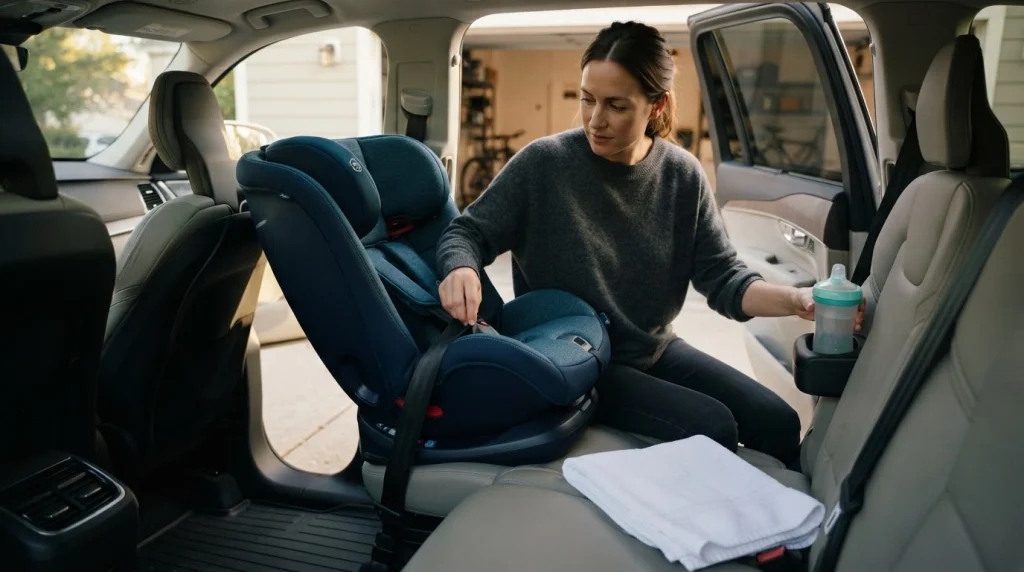
Keep car seat foam dry by stopping water before it reaches the foam. A dry seat starts outside the car, not inside it.
Use the cover as your first shield. A clean, dry cover keeps spills off the foam, and a cover you can remove and wash is easier to dry than foam. Wash the cover by its label, never with the foam inside it.
Read how to clean car seat covers before you wash one. The cover label rules the wash, and a hot wash can shrink a cover so it no longer fits the foam beneath it.
Keep drinks and milk in sealed cups on the road. A spill on the cover is a quick wipe, while a spill through the cover is a wet foam pad. I keep a spare towel in the boot for that first blot.
Store the seat indoors when you are not using it. A seat left in a damp garage, a wet boot, or an open car in rain will pick up moisture even with the cover on. A dry room is the safest store.
Read how to wash a car seat cover without damaging it if your cover is due a wash. Air-dry the cover fully before you refit it, or you will trap dampness against the foam you just dried.
Pro tip: look at Edmunds car seat and family car guides when you plan long trips, so the seat, the car, and the storage plan fit together before you load up.
Section takeaway: A dry cover, sealed drinks, indoor storage, and a quick check after rain keep water off the foam in the first place.
Frequently asked questions
Can Styrofoam in a car seat get wet in the rain?
Yes, rain can wet the foam if water gets past the cover and into the seat. Wipe the surface, take the seat indoors, and air-dry it fully before the next trip.
Does wet EPS foam lose its crash protection?
Clean EPS that dries fully and shows no cracks keeps its shape and strength. Cracked, crumbling, or flood-soaked foam may not protect the same way, so ask the seat maker.
Can I use a hair dryer to dry car seat foam?
No, do not ever use a hair dryer, a heater, or a clothes dryer on foam. High heat can warp EPS and dry the surface while the inside stays wet.
How long does car seat foam take to dry?
It depends on the foam, the air flow, and the humidity in the room. Hard EPS can dry in hours, while soft comfort foam can need a full day of moving air.
Can I wash the foam with soap and water?
No, do not soak foam in soapy water or in a tub. Spot-clean with a damp cloth and water only, and use mild soap only when your manual allows it.
What should I do if the foam smells of mould?
Stop using the seat until the smell is gone and the foam is fully dry. If the smell stays after drying, call the seat maker, because mould can live deep in foam.
Bottom line: Car seat foam can get wet, and a splash will not ruin it. Wipe it, air-dry it fully, check it for cracks and smell, and call the seat maker when anything looks wrong.

Daniel Brooks is an automotive writer and product researcher focused on car accessories, car tech, maintenance, and practical driving guides. At Plug-in Car World, he helps drivers make smarter automotive decisions through honest reviews and research-driven content.