
How to Clean Vomit From a Car Seat: A Safe Step-by-Step Guide
Quick Answer
To clean vomit from a car seat, remove the solid mess, blot the remaining moisture, and clean the affected fabric with a manufacturer-approved cleaner. For a child’s safety seat, follow the specific cleaning instructions in its manual, consistent with NHTSA car seat safety guidance.
Quick Cleaning Steps
- Remove solids: Wear gloves and lift away vomit with paper towels without spreading it.
- Blot moisture: Press clean towels onto the affected area without scrubbing.
- Check instructions: Identify whether the removable seat cover can be machine washed.
- Clean gently: Use mild soap or an approved upholstery cleaner suited to the material.
- Dry completely: Improve airflow and keep the seat out of use until its parts are dry.
- Check safety parts: Never soak child-seat harness webbing or apply harsh chemicals to buckles.
Important Safety Reminder
- Cleaning is not disinfection: If an infectious stomach illness caused the vomiting, extra precautions may be necessary, but child-seat safety instructions still apply.
A vomiting accident can turn a normal drive into a serious cleaning job. Whether you’re dealing with a child’s car seat, a removable seat cover, or the vehicle’s upholstery, the right cleaning method matters.
I’ve always considered one rule essential when dealing with automotive interiors: clean the mess without damaging what’s underneath. This guide explains how to remove vomit, control odors, protect safety components, and decide when cleaning isn’t enough.
In This Guide
- What Should You Do Immediately After Someone Vomits?
- What Supplies Do You Need to Clean Vomit?
- How Do You Clean Vomit From a Removable Car Seat Cover?
- How Do You Clean Vomit From Cloth and Leather Car Seats?
- How Do You Clean Child Car Seat Straps and Buckles Safely?
- How Do You Remove Vomit Smell and Reduce Germs?
- Frequently Asked Questions
What Should You Do Immediately After Someone Vomits?
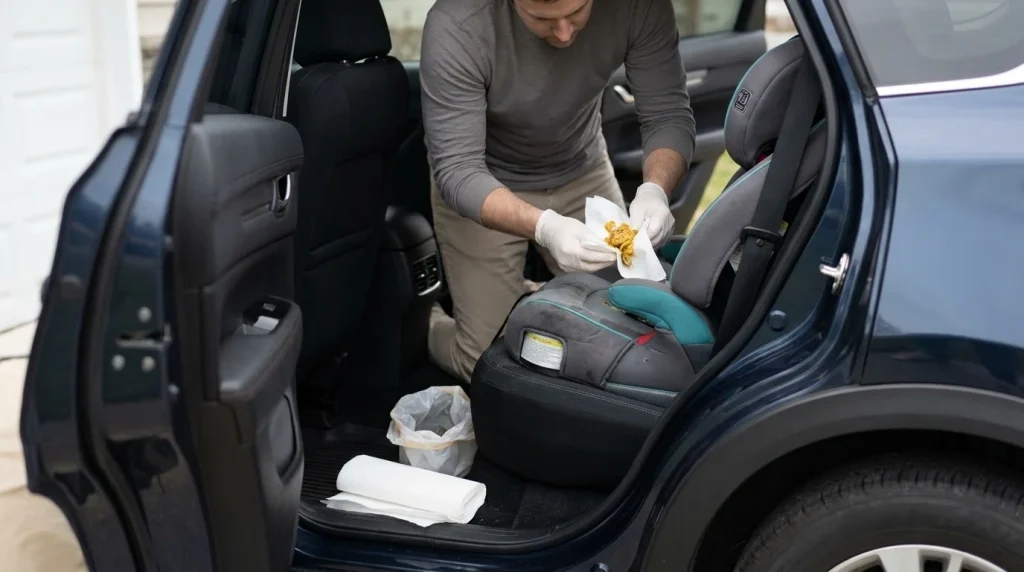
Remove visible vomit promptly, then blot the liquid before it travels deeper into the seat. Your first goal is containment, not aggressive stain removal.
Stop the Mess From Spreading
Park safely and move the passenger away from the soiled area. Open the doors or windows when practical to improve ventilation.
- Put on disposable gloves. Avoid touching contaminated surfaces with bare hands.
- Remove solid material. Use paper towels or a disposable plastic scraper without pressing into the upholstery.
- Blot the wet area. Use absorbent white towels, replacing them as they become saturated.
- Inspect nearby surfaces. Check seams, seat belt areas, cup holders, floor mats, and the gap behind the cushion.
- Bag contaminated waste. Seal used towels and gloves in a trash bag.
A small spill can hide a surprisingly large amount of liquid around seat seams. In a car interior, I would check those narrow gaps before treating the visible stain.
What Should You Avoid Right Away?
Don’t rub vomit into the fabric or immediately pour water across the seat. Excess liquid can carry contamination into foam padding that is harder to clean and dry.
- Avoid stiff brushes that damage upholstery fibers.
- Don’t use bleach on child-seat straps or vehicle seat belts.
- Never spray cleaning products into seat belt buckles or electrical controls.
- Avoid strong heat, especially around child-restraint components.
Section Takeaway: Fast cleanup helps control the mess, but gentle removal matters more than forceful scrubbing.
What Supplies Do You Need to Clean Vomit?
Most vomit-cleaning jobs need simple tools rather than aggressive chemicals. Match your supplies to the material and follow the seat manufacturer’s instructions.
Basic Cleaning Supplies
- Disposable gloves: Protect your hands during contaminated-material cleanup.
- Paper towels: Lift solid waste and absorb the first layer of moisture.
- White microfiber cloths: Blot upholstery without transferring colored dye.
- Soft-bristled brush: Loosen dry debris from suitable vehicle upholstery.
- Mild soap and water: Clean compatible child-seat surfaces and washable fabrics.
- Approved upholstery cleaner: Treat nonremovable vehicle fabric when permitted.
- Vacuum with crevice attachment: Remove dry particles from seat seams and nearby gaps.
- Fan: Improve drying without exposing materials to excessive heat.
Why Does the Type of Seat Matter?
A car seat cover is a removable fabric or protective layer fitted over a vehicle seat or child restraint. Some covers can be washed separately, while others must be cleaned in place.
Child safety seats also contain crash-protection components that need special treatment. The following comparison helps you choose the appropriate method.
| Seat Component | Recommended Approach | Avoid |
|---|---|---|
| Removable child-seat pad | Wash according to its care label | Unapproved heat or chemicals |
| Child-seat harness | Manufacturer-approved surface cleaning | Soaking or machine washing |
| Child-seat buckle | Model-specific warm-water cleaning | Soap or lubricants inside the mechanism |
| Vehicle cloth upholstery | Approved fabric cleaner and careful blotting | Overwetting the foam |
| Leather or vinyl upholstery | Material-safe cleaner on a soft cloth | Abrasive cleaners and harsh solvents |
These are general cleaning categories, not universal instructions. Your owner’s manual and product care labels determine what each specific seat can tolerate.
How Do You Clean Vomit From a Removable Car Seat Cover?
Remove a washable cover carefully, pretreat the contaminated area, and follow its washing instructions. For child safety seats, document the original assembly before removing anything.
Step 1: Check Whether the Cover Can Be Removed
Look for the manufacturer’s washing label and removal instructions. Some covers attach with elastic loops, clips, tabs, or openings around the harness.
Before disassembly, take pictures of the original layout. This helps prevent mistakes when fitting the padding back onto the seat.
Do not remove child-seat harness hardware unless the manual specifically explains how. Never alter a child-restraint structure simply to reach a stain.
Step 2: Pretreat the Dirty Fabric
Lift off remaining solids and blot excess moisture. If allowed by the care label, gently spot-clean with diluted mild detergent before washing.
- Work from the outside of the stain toward its center.
- Use a soft cloth rather than a hard scrubbing brush.
- Keep incompatible cleaners away from straps and buckles.
- Avoid leaving detergent residue in the fabric.
Step 3: Wash According to the Care Label
Many removable child-seat pads allow a cold, delicate machine wash. However, washing instructions differ across manufacturers and models.
For example, Graco’s child car seat cleaning guidance describes gentle washing for many removable pads and warns against bleach and inappropriate drying methods.
A separate aftermarket vehicle seat cover may have different instructions. Some allow machine washing, while others require hand washing or surface cleaning.
Step 4: Air Dry and Reassemble
Place the washed cover in a clean, ventilated area and follow its specified drying method. Don’t assume a child-seat pad can go in a tumble dryer.
Drying may take several hours or longer, depending on padding thickness and humidity. Never reinstall a damp cover and immediately put a child into the seat.
When reassembling, verify that the pad fits correctly and doesn’t obstruct the harness. Use the manufacturer’s instructions to confirm proper strap routing.
Section Takeaway: A removable cover makes cleanup easier, but safe washing and correct reassembly matter more than speed.
How Do You Clean Vomit From Cloth and Leather Car Seats?
For vehicle upholstery, remove debris first and clean with a product approved for that material. Cloth absorbs liquids more readily, while coated leather and vinyl generally require less moisture.
Cleaning Vomit From Cloth Car Seats
Fabric upholstery can hold contamination beneath its visible surface. Start with gentle cleaning rather than saturating the cushion.
- Remove debris: Lift visible material and carefully clean around seams.
- Blot: Absorb as much liquid as possible with dry white towels.
- Spot-test: Check the approved cleaner on a hidden section.
- Apply sparingly: Put cleaner on a cloth or follow the product’s upholstery directions.
- Blot repeatedly: Lift dissolved residue without grinding it into the fabric.
- Remove cleaner residue: Follow the product’s rinsing or wiping instructions.
- Dry thoroughly: Use ventilation and check for remaining dampness.
Some vehicle upholstery can tolerate controlled extraction cleaning. Only use an extractor when the manufacturer permits it, and avoid soaking the foam.
Cleaning Vomit From Leather or Vinyl Seats
Use a cleaner specifically approved for your leather or vinyl finish. Apply it to a soft cloth rather than pouring liquid directly onto the upholstery.
Wipe carefully around stitching, perforations, and trim. Those openings can allow moisture to reach hidden layers.
- Remove the residue before it dries onto the finish.
- Test your cleaner on an inconspicuous area.
- Use light pressure with a microfiber cloth.
- Wipe away remaining cleaner as directed.
- Apply a compatible leather conditioner only when recommended by the manufacturer.
Perforated leather deserves extra caution, especially on heated or ventilated seats. Don’t force liquid into the small openings.
What About Seats With Side Airbags?
Many modern vehicles contain side airbags inside the seat structure. Strong solvents, excessive liquid, and unauthorized cover modifications may create safety concerns.
Follow the vehicle manual when cleaning around side seams or airbag deployment areas. If contamination reaches electrical components or internal padding, consult a qualified professional.
Pro tip: Check the vehicle owner’s manual before applying upholstery chemicals near airbags, heating elements, or seat belt components.
How Do You Clean Child Car Seat Straps and Buckles Safely?
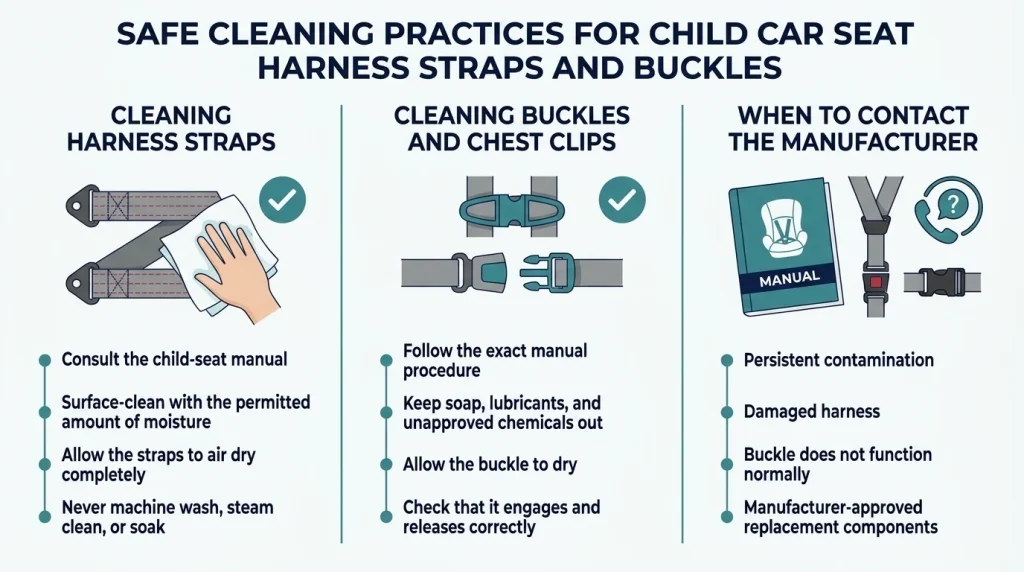
Clean child-seat harness straps and buckles only as the manufacturer directs. These components help restrain a child during a crash, so ordinary upholstery-cleaning methods may be unsafe.
Cleaning Harness Straps
Harness webbing may become contaminated when vomit runs down the child’s chest or shoulders. Treat it as a safety component, not washable clothing.
- Consult the child-seat manual for approved cleaners.
- Remove visible contamination with a soft cloth.
- Surface-clean with the permitted amount of moisture.
- Allow the straps to air dry completely.
- Inspect the webbing for damage or persistent contamination.
Never machine wash, steam clean, or soak harness webbing unless its manufacturer explicitly permits that method. Do not apply bleach, vinegar, enzyme cleaner, or disinfecting sprays without approval.
If vomit has soaked deeply into the webbing, contact the manufacturer. A replacement harness or complete restraint may be necessary.
Cleaning Buckles and Chest Clips
Vomit particles can interfere with a child-seat buckle’s operation. However, buckle-cleaning procedures vary by design.
Some manufacturers permit rinsing the buckle mechanism in warm water while keeping its strap dry. Others specify a different cleaning method.
- Follow the exact manual procedure for the buckle.
- Keep soap, lubricants, and unapproved chemicals out of the mechanism.
- Allow the buckle to dry before use.
- Check that it engages and releases correctly.
- Stop using the seat if the buckle does not function normally.
Can You Replace a Contaminated Harness?
Some manufacturers provide replacement components for eligible models. Others require a different repair or replacement approach.
Never substitute generic straps or modify the original attachment points. Contact the manufacturer with the model number and manufacturing date.
Pro tip: Follow the original child-restraint manual and consult the manufacturer whenever contamination reaches harness adjusters, buckles, or lower-anchor straps.
How Do You Remove Vomit Smell and Reduce Germs?
Persistent vomit odor often means residue remains in the fabric, seams, or padding. Removing the source and drying the area thoroughly are more effective than covering the smell with fragrance.
How Do You Get the Vomit Smell Out?
For compatible vehicle upholstery, a manufacturer-approved enzyme cleaner may help break down organic residue. Check its suitability for the fabric, leather coating, and surrounding components.
Do not automatically apply enzyme cleaners to child-seat padding or harnesses. Their cleaning instructions may prohibit those products.
If the odor remains, check the following areas:
- Seat seams and cushion gaps
- Under removable upholstery covers
- Floor mats and carpeting
- Seat belt webbing and buckle surroundings
- Removable cup holders and plastic trim
Does Cleaning Vomit Also Disinfect the Seat?
No. Cleaning removes visible soil and some contamination, while disinfection aims to inactivate specific germs using an appropriate product and procedure.
The CDC’s norovirus prevention guidance recommends careful cleanup, gloves, handwashing, and appropriate disinfection after vomiting incidents.
However, the CDC’s general disinfecting procedures are not automatically suitable for child car seats. Bleach and strong disinfectants may damage restraint components.
For suitable vehicle surfaces, consult the EPA’s list of disinfectants effective against norovirus and verify that the product label permits use on that exact material.
If a child restraint cannot be adequately cleaned using approved methods, contact its manufacturer. Don’t assume a deodorized seat is safe from infectious contamination.
How Long Should a Car Seat Dry?
Drying time depends on the materials, cleaning method, temperature, and humidity. Thick upholstery padding can remain damp after the outer fabric feels dry.
Use fans and ventilation to encourage drying. Avoid high-heat dryers, heaters, and direct heat on child-restraint components.
Before returning a child seat to service, confirm that every component is dry and correctly installed. Check harness positioning, buckle engagement, recline angle, and installation tightness according to its manual.
When Is Professional Cleaning or Replacement Necessary?
Some accidents reach areas that household cleaning cannot safely access. Knowing when to stop can prevent additional damage.
- Persistent odor: Vehicle foam may need professional assessment and cleaning.
- Electrical contamination: Consult a qualified technician if liquid reaches powered seat components.
- Damaged harness: Contact the child-seat manufacturer about replacement.
- Uncleanable child restraint: Ask the manufacturer whether continued use is appropriate.
- Recurring moisture: Inspect for trapped liquid before mildew develops.
Section Takeaway: Odor removal and disinfection are different goals. Always protect restraint components while addressing both.
Frequently Asked Questions
Can I use baking soda to remove vomit smell from a car seat?
Baking soda may absorb some odors on compatible vehicle upholstery, but it doesn’t replace cleaning or disinfection. Check the material’s instructions first, and avoid applying loose powder to child-seat harnesses, buckles, or internal parts unless the manufacturer approves.
Can I use vinegar to clean vomit from a child’s car seat?
Don’t use vinegar on a child safety seat unless its manufacturer specifically permits it. Vinegar isn’t a substitute for approved disinfection, and manufacturers may prohibit homemade cleaning solutions on sensitive restraint components.
Can I put a car seat cover in the washing machine?
Some removable child-seat pads and aftermarket vehicle seat covers are machine washable. Check the care label for water temperature, wash cycle, detergent, and drying requirements, and never machine wash child-restraint harness straps unless explicitly authorized.
Will an upholstery cleaner remove vomit stains completely?
An appropriate upholstery cleaner can remove many fresh vomit stains, but results depend on the fabric and how deeply liquid penetrated. Older stains or contamination inside seat foam may require professional assessment and additional cleaning.
Is steam cleaning safe for car seats?
Steam cleaning is generally unsuitable for child-restraint harnesses and other components unless specifically approved. Some vehicle upholstery may tolerate professional steam treatment, but heat, moisture, airbags, and electronics make manufacturer guidance essential.
What should I do if vomit gets inside a car seat buckle?
Consult the exact child-seat manual before cleaning the buckle mechanism. Follow the manufacturer’s approved procedure, let the mechanism dry, and test its function. If it sticks, fails to latch, or behaves abnormally, stop using the seat and contact the manufacturer.
Can I use the car seat immediately after cleaning?
Only when the seat is fully dry, correctly assembled, and safe to use. For a child restraint, confirm that the harness and buckle work correctly and the seat remains properly installed. Never use it with damaged or improperly cleaned safety components.
Final Takeaway: Cleaning vomit from a car seat starts with removing the mess, choosing the correct cleaner, and drying every affected part thoroughly. For child safety seats, manufacturer instructions always take priority over household cleaning shortcuts.
Keep your seat’s care instructions accessible before the next trip. A few minutes spent checking the right cleaning method can help protect both the upholstery and the people riding in it.

Daniel Brooks is an automotive writer and product researcher focused on car accessories, car tech, maintenance, and practical driving guides. At Plug-in Car World, he helps drivers make smarter automotive decisions through honest reviews and research-driven content.
