
Why Does a Baby’s Head Fall Forward in a Car Seat? What Parents Must Know
Quick Answer
A baby’s head falls forward in a car seat because the neck muscles are still weak, sleep relaxes them further, and the seat angle lets gravity pull the heavy head down. In most cases a slight forward tilt is normal, but a chin pressed hard onto the chest can narrow the airway. Check the recline angle first, then the harness fit, and learn how to position a newborn’s head safely before your next drive.
Most likely causes
- Weak neck muscles: A newborn cannot hold a heavy head up for long, and sleep makes that control weaker still.
- Seat too upright: A rear-facing seat that sits too upright lets the head tip forward instead of resting back.
- Loose harness: Slack in the straps lets the whole body slide down, and the head follows.
- Deep sleep: Muscle tone drops in deep sleep, so the head flop often shows up mid-journey.
- Wrong insert fit: A bulky insert or a missing newborn insert can push the head forward.
Do this first
- Pull over in a safe place if the chin is hard on the chest, breathing looks laboured, or the skin looks pale or blue.
- Lift the baby out, let the head come back to a neutral line, and re-check the recline indicator before you drive on.
I’ve seen that small forward flop in the rear-view mirror more times than I can count, and it still makes my stomach tighten. You glance back at a quiet baby, and the head has tipped right down onto the chest.
That moment is scary because it looks wrong, yet it is also one of the most common things parents ask me about after fitting a new infant seat. This guide goes deeper than a quick reassurance, so you can tell a harmless sleep tilt from a real airway risk, fix the angle, and know when to stop.
In This Guide
- What Does a Baby’s Head Falling Forward Mean?
- Why Does a Baby’s Head Fall Forward in a Car Seat?
- Is It Dangerous When a Baby’s Head Falls Forward?
- How Can You Tell Normal Head Flop From an Unsafe Position?
- How Do You Fix a Baby’s Head Falling Forward?
- What Should You Not Do When a Baby’s Head Falls Forward?
- When Should You Stop the Car and Get Help?
- Frequently Asked Questions
What Does a Baby’s Head Falling Forward Mean?
A baby’s head falling forward means the chin drops toward the chest while the baby sits in the car seat. The head tips down and forward, instead of resting back against the seat shell.
Parents often call it head flop, and it shows up most when a baby falls asleep in a rear-facing seat. The body relaxes, the neck gives way, and gravity does the rest.
A small tilt is not the same as a full chin-to-chest fold. In a slight tilt, you can still see a gap between chin and chest, and the baby breathes in a steady, quiet rhythm.
In a deep fold, the chin presses onto the chest and the neck bends sharply. That shape can squeeze the airway, and that is the part parents need to watch for.
Head flop is not a sign that your baby hates the seat. It is a sign that the head is heavy, the neck is still building strength, and the seat angle or harness fit needs a closer look.
Section Takeaway: A slight forward tilt in sleep is common, but a chin pressed hard onto the chest is a warning sign, not a sleep pose to ignore.
Why Does a Baby’s Head Fall Forward in a Car Seat?
A baby’s head falls forward because the head is large and heavy compared with the neck that holds it up. Newborn neck muscles tire fast, and sleep removes the small amount of control that was left.
That is the core cause, yet it rarely works alone. Five other factors often turn a small tilt into a deep flop.
- Weak neck control: A newborn has little head control in the first months, so the head follows gravity once sleep sets in.
- Seat angle too upright: A rear-facing seat needs a reclined angle so the head rests back. If the base sits too upright, the head has nowhere to go but forward.
- Vehicle seat slope: Some back seats slope down toward the front, and that slope can push a rear-facing base more upright than the indicator suggests.
- Loose harness straps: Slack lets the shoulders and hips slide down in the seat. The body drops, the head drops with it, and the chin meets the chest.
- Thick clothing or inserts: A puffy coat or a bulky insert changes how the baby sits in the shell. It can push the shoulders forward and leave the head unsupported.
- Growth spurt or wrong insert stage: A baby who has outgrown the newborn insert may sit too low, while a baby still in it may sit too high. Both change the head line.
I learned this on a family hatchback with a steeply sloped back seat. The recline bubble looked fine on flat ground, then the head tipped forward ten minutes into the drive, so I re-seated the base and tightened the harness.
Sleep plays a part too, and it explains why the flop often starts mid-journey. A baby who looked fine at the start can drift into deep sleep, lose muscle tone, and tip forward without a sound.
Section Takeaway: Head flop is rarely one fault, so check neck strength, seat angle, vehicle slope, harness slack, and insert fit together.
Is It Dangerous When a Baby’s Head Falls Forward?
Yes, it can be dangerous when the chin presses hard onto the chest. That position is called chin-to-chest, and it can narrow the airway in a small baby.
A newborn airway is soft and narrow, so it needs less pressure to fold shut than an adult airway. A deep chin-to-chest bend can make breathing noisy, laboured, or shallow.
The risk is highest for premature babies and for babies under four months old. Their neck control is weakest, and their airways are smallest, so a small change in head line matters more.
A slight tilt is a different story. If the chin stays clear of the chest and breathing stays quiet and even, the position is usually safe for the drive.
Watch the breathing, not just the head angle. Noisy breathing, fast breathing, pauses, or a change in skin colour are the signs that matter most.
For clear safety guidance, check the NHTSA car seat safety guidance and your seat manual together. The manual sets the recline range for your exact seat, and that range is the rule to follow.
Section Takeaway: Chin-to-chest is the danger line, so judge the flop by breathing and chin clearance, not by how far the head has tipped.
How Can You Tell Normal Head Flop From an Unsafe Position?

Normal head flop leaves a clear gap between chin and chest. You can fit two fingers in that gap without forcing them, and the baby’s breathing stays quiet.
Unsafe head flop closes that gap. The chin touches the chest, the neck folds, and you cannot see daylight between chin and chest.
Use the mirror check at a safe stop, not while you drive. Park, turn, and look at the head line from the side.
- Safe signs: Chin clear of chest, head tilted to one side, breathing quiet and even, skin colour normal.
- Warning signs: Chin hard on chest, breathing noisy or fast, chest pulling in with each breath, skin pale or blue around the lips.
- Stop now signs: Pauses in breathing, weak cry or no response, limp body, or blue lips. Lift the baby out at once and seek urgent help.
A baby who slumps to one side is often safer than a baby who folds straight forward. Side tilt keeps the airway more open, while a straight forward fold bends it shut.
That difference is why a newborn who slumps in a car seat needs a different check from a baby whose head drops forward. Slump is about the whole body sliding down, while head flop is about the neck angle alone.
Section Takeaway: Two fingers of chin clearance and quiet breathing mean a normal tilt, while chin-on-chest and noisy breathing mean stop and reset.
How Do You Fix a Baby’s Head Falling Forward?
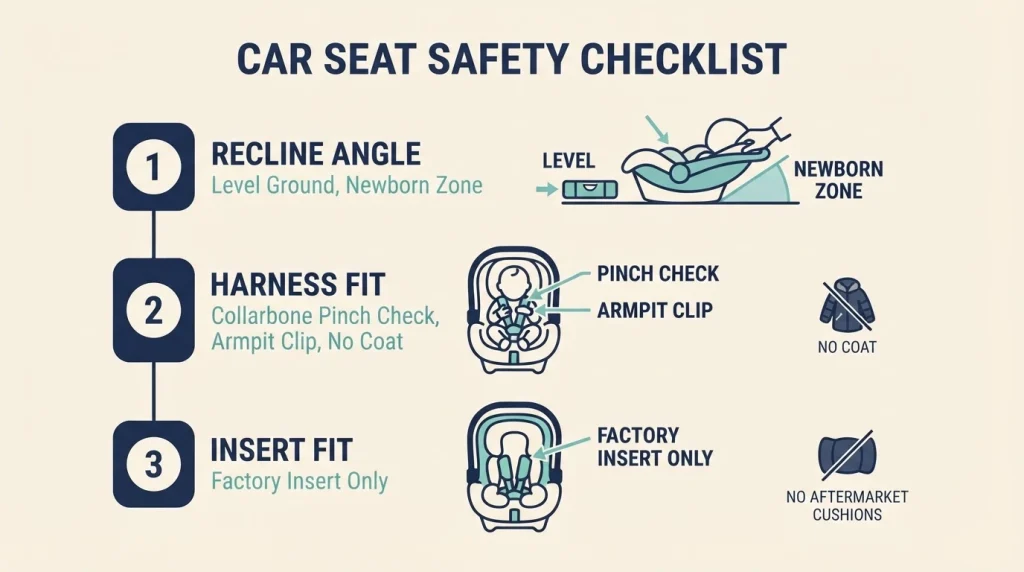
Fix a baby’s head falling forward by fixing the recline angle first, then the harness, then the insert. Work in that order, and check the head line after each change.
Start on level ground with the car parked. A slope in your driveway can fool the recline indicator, so move to flat ground before you judge the angle.
Read the recline indicator on the base or the seat shell. Most rear-facing seats show a line, bubble, or colour zone for newborns, and the baby must sit inside that zone.
If the seat is too upright, loosen the base and let it recline a step further. Some bases have a recline foot or a dial, while others need the base re-seated on the vehicle cushion.
Check the harness next, and do it without a thick coat in the way. The straps should sit at or just below the shoulders for a rear-facing baby, and the chest clip should sit at armpit level.
Do the pinch check at the collarbone. If you can pinch a fold of strap, it is too loose, so pull the adjuster until the strap lies flat and snug.
For the full angle check, follow the steps in how to check the correct car seat installation angle. That check covers the indicator, the vehicle slope, and the base fit in one pass.
| Cause | Quick check | Fix |
|---|---|---|
| Seat too upright | Recline indicator outside the newborn zone | Recline the base one step and re-check on level ground |
| Loose harness | Strap pinches at the collarbone | Tighten until flat, chest clip at armpit level |
| Wrong insert stage | Baby sits too low or too high in the shell | Use only the insert that came with the seat, for the right weight range |
| Thick clothing | Harness feels snug over the coat but loose underneath | Remove the coat, buckle, then add a blanket over the harness |
| Deep sleep slide | Head fine at start, tipped forward after a stop | Stop, lift the baby out, reset the position, and shorten the next leg |
Guidance from Edmunds on vehicle fit is a useful starting point, but the seat manual and the recline indicator are the final word for your car.
Section Takeaway: Recline first, harness second, insert third, and re-check the head line after each fix.
What Should You Not Do When a Baby’s Head Falls Forward?
Do not push the head back with your hand while you drive. Reaching back takes your eyes off the road, and a hand on the head does not fix the angle that caused the flop.
Do not add a rolled blanket, a neck pillow, or a towel behind the head. Those items can push the head forward even further, and they were not part of the seat’s crash design.
Do not use a head support insert that did not come with your seat. Aftermarket inserts can change the harness fit and the head line, and many seat makers warn against them.
Check whether car seat head support inserts are safe to use before you buy one. The short answer is to use only the insert your seat maker supplied, and only for the weight range it lists.
Do not loosen the harness to give the baby more room. Loose straps let the body slide down, and that slide makes the head flop worse, not better.
Do not let the baby keep sleeping in the seat once you reach home. Lift the baby out, move them to a flat sleep surface, and let the seat cool down for the next trip.
Consumer Reports guidance on car seat fit, covered on Consumer Reports, makes the same point in a different way. A seat works as a system, so one extra pad or strap change can undo the fit you worked hard to get right.
Pro tip: check the seat manual and the NHTSA recall lookup before you add any accessory, and ask a certified child passenger safety technician if the manual leaves you unsure.
Section Takeaway: Never fix head flop with extra padding, a hand from the front seat, or a looser harness, because each one makes the real cause harder to see.
When Should You Stop the Car and Get Help?

Stop the car as soon as it is safe to do so if the chin is hard on the chest. Do not wait for the next planned stop, and do not try to fix the head line while you drive.
Pull into a car park or a lay-by, switch the engine off, and lift the baby out of the seat. Let the head return to a neutral line, watch the breathing settle, and then re-check the recline and harness.
Seek urgent help if breathing stays noisy or fast after you lift the baby out. Seek urgent help too if the lips look blue, the body feels limp, or the baby does not respond as usual.
Book a car seat check if the flop keeps coming back on short drives. A certified technician can spot a base fit or angle fault in minutes, and that check is worth more than a dozen guesses at home.
Ask your paediatrician too if your baby was born early or has a breathing or muscle-tone condition. Those babies need a closer fit check, and some need a car seat test before their first long drive.
For long trips, plan stops and keep each leg short. Guidance on whether a baby can sleep in a car seat covers the same limit, and it is a useful reminder that a seat is for travel, not for long sleep.
Learn the basics of car seat head support safety before your next long drive. A correct head line, a snug harness, and a recline inside the newborn zone are the three checks that matter most.
Section Takeaway: Stop for chin-on-chest, seek urgent help for breathing or colour changes, and get a professional check if the flop keeps returning.
Frequently Asked Questions
Is it normal for a baby’s head to fall forward in a car seat?
Yes, a slight forward tilt in sleep is normal for a newborn with weak neck control. It becomes a concern only when the chin presses hard onto the chest or breathing turns noisy.
Why does my newborn’s head fall forward when sleeping in the car seat?
Sleep relaxes the neck muscles, so gravity pulls the heavy head down. A seat that sits too upright, a loose harness, or a wrong insert stage can make that tilt much deeper.
Can a baby’s head falling forward block their airway?
Yes, a deep chin-to-chest fold can narrow a small airway. Watch for noisy or fast breathing, pauses, or pale or blue skin, and lift the baby out at once if you see those signs.
How do I stop my baby’s head from falling forward in the car seat?
Recline the rear-facing seat into the newborn zone on level ground, tighten the harness until it passes the pinch check, and use only the insert that came with the seat. Re-check the head line after each change.
Are head support inserts safe for a baby whose head falls forward?
Only the insert supplied with your seat is safe, and only for the weight range it lists. Aftermarket inserts can push the head forward and change the harness fit, so check the manual first.
When should I worry about my baby’s head falling forward?
Worry when the chin stays on the chest, breathing looks laboured, or the flop returns on every short drive. Stop the car, reset the position, and get a professional seat check if it keeps happening.
Head flop looks alarming, and that alarm is useful. It tells you to check the angle, the harness, and the breathing, and to stop when any of those checks fail.

Daniel Brooks is an automotive writer and product researcher focused on car accessories, car tech, maintenance, and practical driving guides. At Plug-in Car World, he helps drivers make smarter automotive decisions through honest reviews and research-driven content.