What Cleaner Is Safe for a Baby Car Seat? Complete Guide
Quick Answer
Plain water on a damp cloth is the safest starting point for a baby car seat, and mild soap is safe only when your seat manual says so for that exact part. Covers, straps, buckles, and the plastic shell do not share one safe cleaner. Check the manual first, then match the cleaner to the part you are cleaning, as explained in how to clean a car seat safely.
Safe by part, in short
- Harness straps: Damp cloth and water first, mild soap only if the manual permits it for the straps.
- Removable cover: Cold water and a small amount of mild detergent, only if the care label allows it.
- Plastic shell: Damp cloth and water, or mild soap solution, then wipe dry.
- Buckle: Wipe the outside only, keep liquid out of the mechanism, and check the lock after.
- Foam padding: Spot-clean only, never soak it.
Never use on a baby car seat
- Bleach, solvents, harsh disinfectants, vinegar, baking soda, and enzyme cleaners on straps.
- Machine washing or soaking straps, unless the maker expressly says so.
- Upholstery shampoo or household stain remover on straps without maker approval.
I have cleaned milk, spit-up, and mystery stains out of more car seats than I can count. The mistake I see most often is simple.
Parents pick one strong cleaner and use it on every part. That cleaner may suit the cover and still harm the straps.
This guide goes part by part, as of 2026. You will learn what is safe for straps, covers, the shell, the buckle, and foam, and what to avoid.
In This Guide
- What cleaner is safe for a baby car seat?
- Why is one cleaner not safe for every part?
- What is safe for the harness straps?
- What is safe for the cover and fabric?
- What is safe for the plastic shell, buckle, and foam?
- Which cleaners should you never use?
- How do you test a cleaner and clean step by step?
- Frequently asked questions
What cleaner is safe for a baby car seat?
Water is the safest cleaner for a baby car seat. A lightly damp, soft cloth and plain water will lift most fresh marks.
Mild soap is the next step, but only when the manual allows it. The manual is the rule for your exact seat and your exact part.
A baby car seat is not one surface. It is fabric, webbing, plastic, metal, and foam joined together.
Each part reacts in a different way to soap, heat, and soaking. A cleaner that is gentle on fabric can still weaken webbing.
That is why the short answer is always water first. Then check the manual before you add anything else.
What does “safe” mean here?
Safe means the cleaner removes dirt without weakening the part. It also means no residue that can irritate a baby’s skin or lungs.
A cleaner can look safe and still leave a film. That film can make straps stiff or make a buckle stick.
Safe also means the seat still works after cleaning. The harness must stay strong, the buckle must lock, and the adjuster must move.
Section takeaway: Water first, manual second, and a different cleaner for each part is the safe route.
Why is one cleaner not safe for every part?
The parts of a baby car seat do very different jobs. The cover keeps a baby comfortable, while the straps hold a baby in a crash.
Cover fabric can be washed, rinsed, and dried. Harness webbing cannot be treated the same way.
Webbing is woven to stay strong under sudden force. Soaking, heat, and harsh chemicals can change how that weave behaves.
The plastic shell is hard and smooth. It can take a damp wipe, but a solvent can dull or crack it over time.
Foam sits under the cover and gives shape. Once foam soaks up water or cleaner, it dries slowly and can hold odour.
- Cover: Made to come off, wash, and dry.
- Straps: Made to stay strong, not to soak.
- Buckle: Made to lock and release, not to fill with liquid.
- Shell: Made to hold shape, not to meet solvents.
- Foam: Made to cushion, not to absorb cleaner.
I learned this the hard way on an old infant seat in my garage. I used the same upholstery cleaner on the cover and the straps.
The cover looked fresh. The straps felt stiff and dry after they dried, and I did not trust them again.
That seat went out of use. The lesson stayed with me, and it shapes every clean I do now.
Pro tip: Check your seat manual and the NHTSA car seat guidance before you use a new cleaner, especially on straps or buckles.
When a cleaner claim sounds too strong, I check it against independent guidance from Consumer Reports and Edmunds. Both point back to the same rule: follow the seat maker, not the bottle.
Section takeaway: One cleaner for every part is the fastest way to damage the part that matters most.
What is safe for the harness straps?
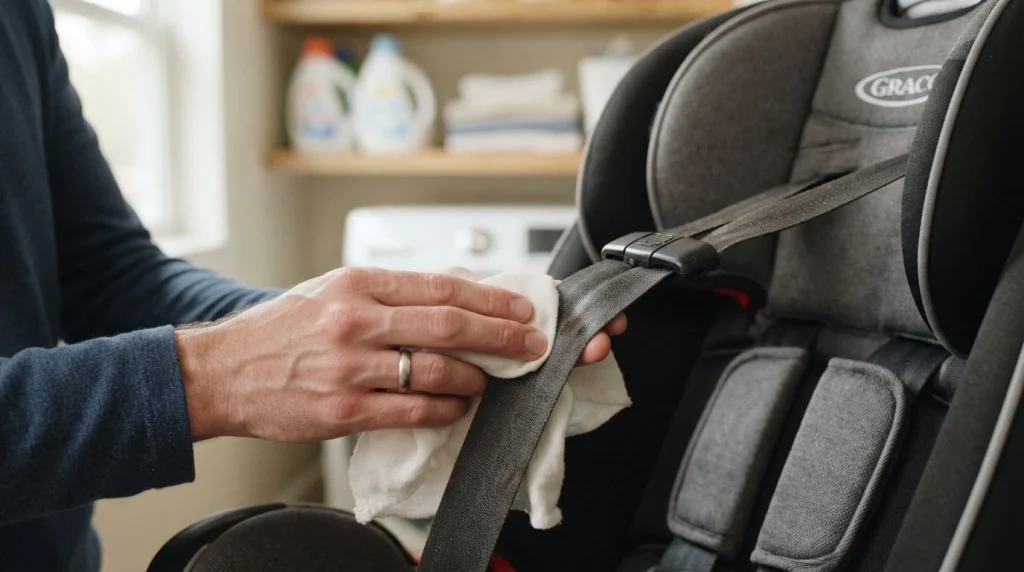
A lightly damp soft cloth and plain water is the safest way to clean harness straps. Start there, and stop there if the mark lifts.
Mild soap is safe only if your exact seat maker permits it for the straps. Some makers allow it, and some do not.
Do not assume dish soap is safe. Dish soap can contain additives that your maker has not approved for webbing.
Baby wipes are also model-dependent. Use them only if they are free of alcohol, disinfectants, and fragrance additives, and only if your maker approves them.
Lower-anchor straps may need water only. The adjuster strap may have different rules from the shoulder straps.
Some makers allow mild soap on harness webbing but ban it on the adjuster strap. Read both parts of the manual, not just one page.
How do you clean straps without soaking them?
- Damp, not wet: Wring the cloth until it barely drips.
- Blot first: Lift the mark, do not scrub it in.
- Work in short passes: Wipe one section, then check it.
- Air-dry fully: Leave the straps open to air until they feel dry through.
- Inspect after: Look for cuts, fraying, stiffness, or twists.
If straps were soaked, frayed, or badly stained, stop using the seat. Contact the maker for advice before you use it again.
A washable cover does not mean the harness can be washed the same way. Treat the cover and the straps as two separate jobs.
For the full strap routine, read how to clean car seat straps correctly.
Section takeaway: Water and a damp cloth are safe for straps, and anything stronger needs maker approval for that exact strap.
What is safe for the cover and fabric?
The removable cover is the most forgiving part of a baby car seat. Most covers can be washed if the care label allows it.
Cold water and a small amount of mild detergent is the usual safe wash. Use a gentle cycle or hand wash, as the label directs.
Vacuum the cover first. That step lifts crumbs and grit that would turn into mud once wet.
Spot-treat stains by blotting, not rubbing. Test the cleaner on a hidden area first, then wait and check for colour change.
Rinse well after washing. Leftover soap can irritate skin and can leave a stiff feel on fabric.
Air-dry the cover fully before you refit it. A damp cover can hold mildew and odour, and it can feel cold on a baby.
What changes with the cover material?
| Part | Safe cleaner | Avoid |
|---|---|---|
| Harness straps | Damp cloth and water; mild soap only if the manual permits it | Soaking, machine wash, bleach, vinegar, baking soda, enzyme cleaner |
| Removable cover | Cold water and mild detergent, if the care label allows it | Bleach, hot water, high dryer heat, unless the label allows them |
| Plastic shell | Damp cloth and water, or mild soap solution | Solvents, acetone, strong degreasers, scouring pads |
| Buckle | Wipe the outside with a damp cloth only | Liquid inside the mechanism, soaking, lubricants |
| Foam padding | Damp cloth spot-clean only | Soaking, steam, harsh cleaners |
Leather and vinyl covers need a different touch. Wipe them with a damp cloth and a cleaner made for that material, then wipe dry.
Neoprene covers need hand washing in cold to lukewarm water. Air-dry them flat and keep them out of high heat.
For the cover washing routine, read how to clean car seat covers.
Section takeaway: The cover can take mild detergent and cold water, but only when its own care label says so.
What is safe for the plastic shell, buckle, and foam?
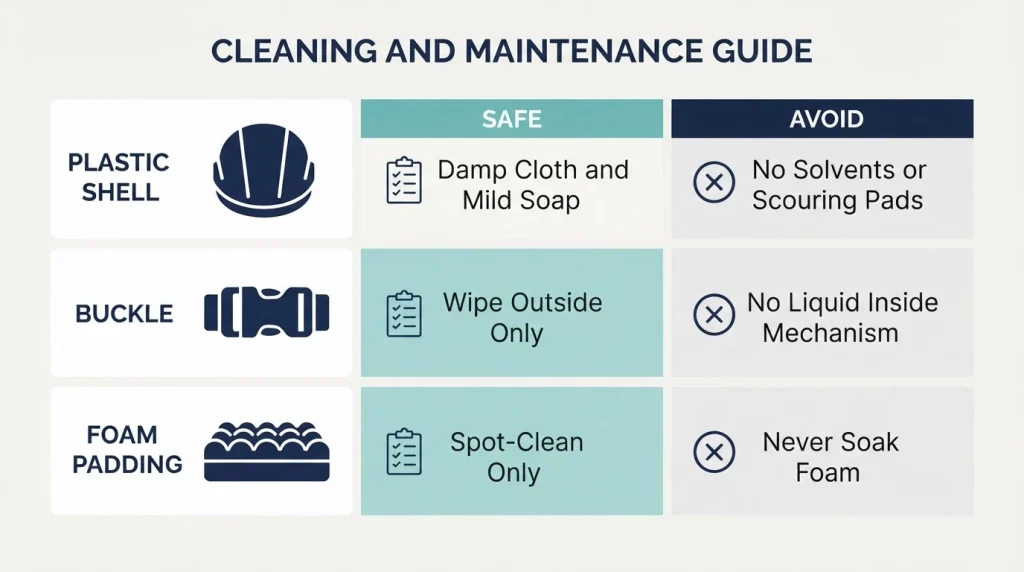
The plastic shell is the easiest part to clean. A damp cloth and water will handle most dust and light marks.
A mild soap solution can help with sticky marks. Wipe it off well, then wipe the shell dry so no film stays behind.
Do not use solvents or acetone on the shell. Those cleaners can dull the plastic and can weaken it over time.
Do not use stiff brushes or scouring pads. They leave scratches that hold dirt and make the next clean harder.
The buckle needs a gentler hand. Wipe the outside with a damp cloth and keep liquid out of the mechanism.
Do not force water or cleaner into the buckle. Liquid inside can stop the tongues from locking or releasing as they should.
After you wipe the buckle, check it. The tongues should lock with a firm click, release cleanly, and the adjuster should move freely.
Foam padding needs spot-cleaning only. Use a damp cloth, blot the mark, and let the foam air-dry fully.
Never soak foam. Soaked foam dries slowly, and it can hold odour long after the surface looks clean.
Section takeaway: Shell, buckle, and foam all take a damp cloth, but none of them should be soaked or filled with cleaner.
Which cleaners should you never use?
Some cleaners are unsafe on a baby car seat, even if they work well around the house. The risk is not just a stain, it is a weaker strap or a sticky buckle.
Bleach is the clearest no. It can damage webbing and fabric, and its fumes are harsh near a baby.
Solvents and acetone are also out. They can attack plastic and can break down the fibres in straps.
Harsh disinfectants and strong degreasers are out for the same reason. They are made for hard surfaces, not for safety webbing.
Vinegar and baking soda are common home tips, but they are not safe for straps. They are also not approved for harness webbing unless the maker says so.
Enzyme cleaners can help on a removable cover, but they are not safe for straps. Do not move a cover cleaner onto the harness.
Upholstery shampoo and household stain removers are not automatically safe for straps. They may suit car fabric, but that does not mean they suit webbing.
- Bleach: Damages webbing and fabric, harsh fumes.
- Solvents and acetone: Can attack plastic and fibres.
- Harsh disinfectants: Made for hard surfaces, not straps.
- Vinegar and baking soda: Not safe for straps without maker approval.
- Enzyme cleaners: For covers only, never for straps.
- Steam and high heat: Can warp plastic and stiffen webbing.
Fragrance sprays and deodorisers are also a poor choice. They mask odour, they do not clean, and they can leave residue near a baby’s face.
If a cleaner label does not name your seat material, do not use it. A hidden test will not fix a cleaner that was wrong for the part.
For stain-specific help, read how to remove stains from a car seat.
Section takeaway: If a cleaner is strong, scented, or made for another surface, keep it away from straps and buckles.
How do you test a cleaner and clean step by step?
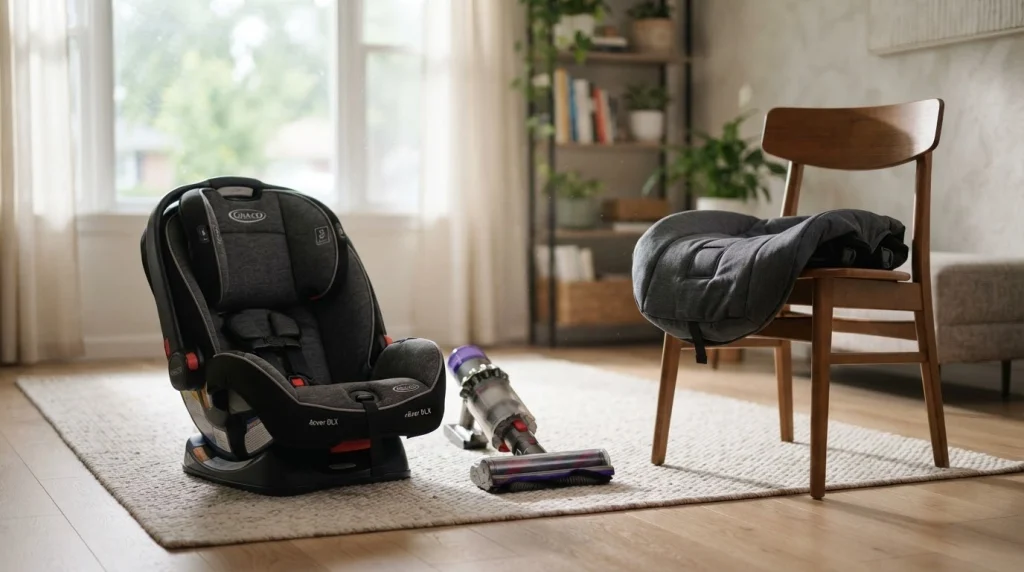
Start with the manual, not the bottle. Find the cleaning page for your exact model and read it for each part.
Vacuum the seat first. Loose crumbs and grit can scratch fabric and can turn into paste once wet.
Test every new cleaner on a hidden spot. Use a small amount, wait, and check for colour change, stiffness, or residue.
Work from the gentlest cleaner upward. Water first, then mild soap if the manual allows it, and stop once the mark lifts.
Clean one part at a time. Do the cover, then the shell, then the straps, and keep the cleaner for each part separate.
- Remove the cover: Take it off as the manual shows, and keep the straps in place.
- Vacuum the shell: Lift crumbs from creases and from under the foam.
- Wipe the shell: Use a damp cloth, then wipe dry.
- Clean the cover: Wash it only as the care label allows, then air-dry it fully.
- Blot the straps: Use a damp cloth and water, and air-dry them fully.
- Wipe the buckle: Clean the outside only, then check the lock and release.
- Refit and check: Put the cover back, check the harness fit, and check the buckle again.
Air-dry every part fully before you refit it. A damp seat can smell, and a damp strap can feel stiff.
If vomit or mould is the problem, clean the cover and shell as above, and treat the straps with water only. For the vomit routine, read how to clean vomit from a car seat.
Use the essential car seat safety checklist for parents after a deep clean. It helps you check fit, harness, and buckle before the next trip.
Section takeaway: Manual first, vacuum first, test first, and air-dry fully before you refit anything.
Frequently asked questions
Can I use dish soap on a baby car seat?
Only if your manual permits mild soap for that exact part. Dish soap is not automatically approved, because additives can vary by brand.
Can I use baby wipes on car seat straps?
Only if your maker approves them for straps. Wipes must be free of alcohol, disinfectants, and fragrance additives unless approved.
Is vinegar safe for a baby car seat?
No, not for straps. Vinegar can be used on some removable covers only, and only after a test, but keep it away from harness webbing.
Can I use baking soda to remove odour?
Baking soda can help light odour on some fabric covers, but do not use it on straps. Vacuum it off fully and air-dry the cover.
What cleaner is safe for the plastic shell?
A damp cloth and water is safe, and a mild soap solution can help sticky marks. Wipe dry and avoid solvents, acetone, and scouring pads.
How do I know if a cleaner damaged the straps?
Look for stiffness, fraying, cuts, or a change in feel after drying. If you see damage, or if straps were soaked, stop using the seat and contact the maker.
A clean seat should feel fresh and work as it did before. If the harness feels different, trust that feeling and check it before you drive.
Start with water, match the cleaner to the part, and let the manual decide. That simple rule keeps a baby car seat clean and safe, as of 2026.

Daniel Brooks is an automotive writer and product researcher focused on car accessories, car tech, maintenance, and practical driving guides. At Plug-in Car World, he helps drivers make smarter automotive decisions through honest reviews and research-driven content.