How Do You Choose the Correct Car Seat Adapter? 7 Checks That Prevent a Wrong Fit
Quick Answer
To choose the correct car seat adapter, match the exact car seat model, stroller model, and model year to the adapter maker’s fit list. A correct adapter clicks in firm, locks with no wobble, and lets you check whether a car seat will fit in your car before you buy it.
Check These 5 Things First
- Exact model names: Use the full car seat and stroller names, not just the brand.
- Model year matters: A 2024 carrier often needs a different adapter than a 2026 version.
- One adapter, one job: Stroller adapters, base adapters, and belt adapters are not interchangeable.
- Lock test: It must click, lock, and stay tight when you lift and wiggle it.
- Manual wins: If the manual does not list your pair, do not guess.
If It Does Not Fit
- Stop and return it, even if it looks close.
- A near fit is still a wrong fit for a baby.
I’ve stood in a driveway with a brand-new adapter that looked right and would not lock. It took ten minutes, a scraped knuckle, and a quick check of the model label to learn my lesson.
This guide goes deeper than a fit chart. You’ll learn how to choose the correct car seat adapter for your exact seat, stroller, and car, plus the mistakes I see parents make most.
In This Guide
- What Is a Car Seat Adapter — And Which Type Do You Need?
- How Do You Choose the Correct Car Seat Adapter in 5 Steps?
- Will It Fit Your Car Seat? How to Check Compatibility Before You Buy
- Brand-Specific vs Universal Adapters: Which Is Safer?
- How Do You Match an Adapter to Your Stroller, Car, and Base?
- What Should You Check Before You Click or Install It?
- Common Adapter Mistakes That Cause a Wobbly or Unsafe Fit
- How Much Should a Car Seat Adapter Cost — And When Is It Worth It?
- Frequently Asked Questions
What Is a Car Seat Adapter — And Which Type Do You Need?
Definition: A car seat adapter is a small frame or set of clips that lets an infant car seat lock onto a stroller, a car seat base, or another frame it was not built to fit directly.
It bridges two products. Without it, the seat may sit on top but never lock.
Most parents mean a stroller adapter when they ask this question. That is the adapter that turns an infant carrier into a travel system.
Other adapters solve a different problem. Know which one you need before you shop.
What are the 3 main types of car seat adapters?
The three main types are stroller adapters, base adapters, and seat-belt or ISOFIX adapters. Each one fits a different gap.
- Stroller adapter: Clicks an infant carrier onto a stroller frame so you can move a sleeping baby without waking them.
- Base adapter: Helps a carrier lock onto a base from the same brand family, often for a second car or a newer base.
- Seat-belt / ISOFIX adapter: Helps install a seat in a car without ISOFIX or LATCH anchors, or in an older vehicle.
I learned this the hard way with a used stroller. The seller said “it fits most seats.”
It fit none of mine. The clips were for a different brand, and the shape was close enough to fool me at first glance.
Is a car seat adapter the same as a car seat base?
No, an adapter is not a base. A base stays in the car and holds the carrier with LATCH or a seat belt.
An adapter is a connector. It does not replace the base, the harness, or the seat itself.
Think of it like this. The base is the dock, and the adapter is the plug that lets two brands talk to each other.
Section takeaway: Name your job first — stroller, base, or car install — because the wrong type will never fit right, no matter how close it looks.
How Do You Choose the Correct Car Seat Adapter in 5 Steps?
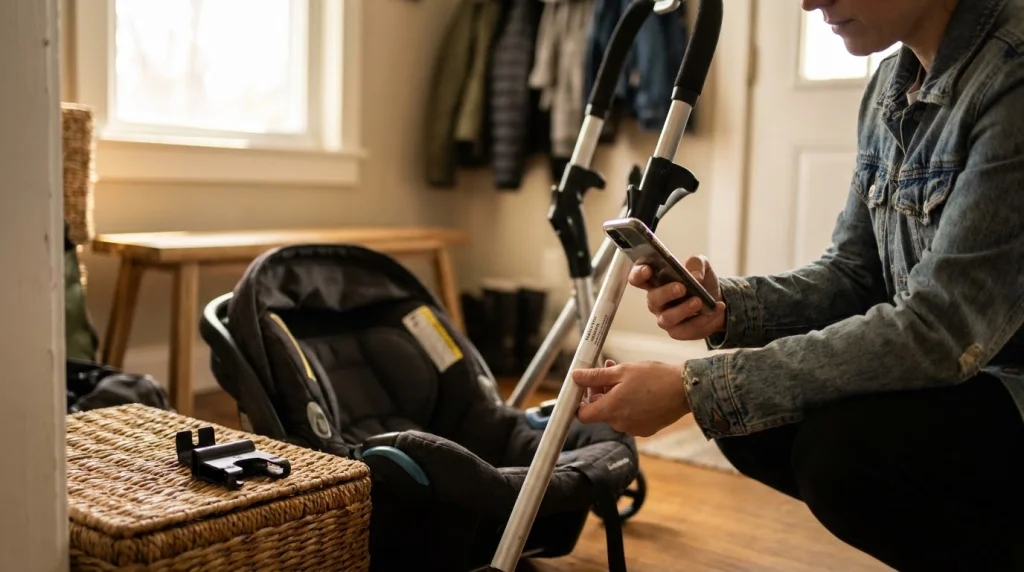
You can choose the correct car seat adapter in five steps: write down both exact models, check the maker’s fit list, confirm the year, check the weight limit, and test the lock in person if you can.
Skip one step and you risk a return. Skip the lock test and you risk a wobble.
- Write down both models: Copy the full name from the label under the carrier and on the stroller frame.
- Check the fit list: Search the adapter maker’s official compatibility chart for that exact pair.
- Confirm the year: Check the manufacture date, not just the purchase date.
- Check the weight limit: Make sure the adapter limit covers your baby plus the carrier weight.
- Test the lock: Click it in, lift it, and wiggle it side to side before you drive or walk away.
That label matters more than the box. I once bought an adapter for a Graco SnugRide, only to find my seat was a SnugRide 35 Lite with a different clip shape.
The names sounded the same. The clips were not.
What information do you need before you shop?
You need the car seat brand, model, and manufacture date. You also need the stroller brand, model, and year.
Take photos of both labels. Store them on your phone for the shop or for a return.
- Car seat label: Found under the carrier, near the handle or on the side shell.
- Stroller label: Found on the rear leg, under the seat, or inside the basket area.
- Adapter part number: Found on the adapter box and on the adapter itself.
Keep those photos until the adapter is tested. They save a second trip.
Safety note: Never force an adapter to lock. If it needs force, it is the wrong adapter. Check your owner’s manual and stop if you are unsure.
Section takeaway: Exact model plus exact year plus a firm lock test beats a “fits most” claim every time.
Will It Fit Your Car Seat? How to Check Compatibility Before You Buy
Check compatibility by matching the adapter’s part number to your car seat model on the manufacturer’s fit list. If your exact model is not listed, treat it as not compatible.
A store listing is not proof. A maker’s chart is.
Start with the brand that made the adapter. Most adapters are made by the stroller brand or the car seat brand, not by a third party.
How do you read a compatibility chart?
Find your car seat in the left column, then find your stroller across the top. The box where they meet tells you the part number you need.
Some charts list by year. Others list by carrier family, like KeyFit or Pipa.
- Green or a check mark: Listed as compatible with that part number.
- Blank: Not tested or not compatible — do not assume it works.
- Note or footnote: May need a second clip, a different base, or a weight limit.
Read the footnote. I missed one once, and it said the adapter only worked with the stroller’s 2023 frame, not the older one I owned.
What if your seat is not on the list?
Do not buy a “close” adapter and hope. Contact the maker with your model and date, or choose a different stroller or seat.
Universal adapters can help in some cases. They still need a listed fit for your pair.
When you are choosing a new seat, fit comes before colour or fabric. Our guide to what to look for in an infant car seat covers shell size, base fit, and harness checks that affect adapter choice too.
Section takeaway: If your exact model is missing from the official fit list, it is not a fit — it is a guess.
Brand-Specific vs Universal Adapters: Which Is Safer?
A brand-specific adapter is usually safer because it was tested with one seat and one stroller. A universal adapter can work, but only when it lists your exact pair and passes the same lock test.
Brand-specific means one maker tested that pair. Universal means one adapter tries to fit many pairs.
That difference shows up in the click. Brand-specific adapters tend to lock with a clear, firm sound. Universal ones can feel tight in one spot and loose in another.
| Adapter type | Best for | Fit | Main risk |
|---|---|---|---|
| Brand-specific | Same-brand seat + stroller | Tight, tested lock | Wrong year can still fail |
| Universal | Mixed brands, listed pairs only | Adjustable, needs careful test | Wobble if not listed |
| Aftermarket copy | Low-cost replacement | Varies by maker | No crash testing, weak clips |
Price is not the test. A cheap copy can look identical and use thinner plastic.
Check the material and the lock. Good adapters use firm plastic or metal clips, clear release buttons, and no flex when loaded.
Are universal car seat adapters safe?
Yes, some universal adapters are safe when the maker lists your seat and stroller and the adapter passes a firm lock test. Safety comes from that listed test, not from the word “universal.”
Look for a clear fit list, a weight limit, and instructions in plain language. Avoid adapters with no brand, no part number, and no manual.
For broader safety checks, the NHTSA car seat safety guidance is a good place to confirm install basics before you use any adapter on the road.
Section takeaway: Choose brand-specific first, use a listed universal adapter second, and skip an unbranded copy altogether.
How Do You Match an Adapter to Your Stroller, Car, and Base?
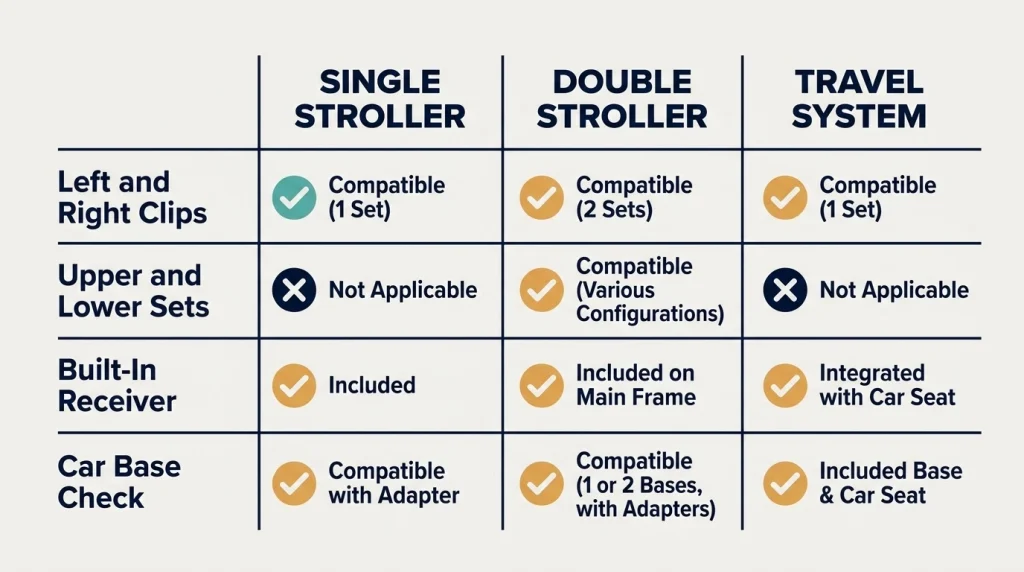
Match the adapter to all three parts: the carrier, the stroller frame, and the car base if you use one. A fit for two parts is not a fit for the system.
Parents often check the stroller and forget the car. Then the carrier clicks onto the stroller fine and will not lock onto the base.
How do you match a stroller adapter?
Start with the stroller frame. Some strollers need one adapter set, while others need a different set for a double frame or a bassinet mode.
- Single stroller: One adapter set, usually left and right clips.
- Double stroller: May need two sets, or a different upper and lower set.
- Travel system: The adapter may already be built in — check before you buy a second one.
Test it with the stroller open and locked. A frame that is not fully open can hide a bad fit.
If you plan to use the carrier on a pram frame instead of a bassinet, read our guide on using a car seat instead of a carrycot first, because sleep time limits still apply.
How do you match a base adapter?
Check the base model and the carrier model together. Some bases accept two carrier generations, while others accept only one.
Look for the base label and the carrier label side by side. The dates should fall in the same family range.
When you buy for a second car, a second base is often safer than moving one base back and forth. That choice also affects which adapter you need.
Does your car change the adapter you need?
Yes, your car can change the base and install method, which can change the adapter. A small back seat, a sloped bench, or missing LATCH anchors can force a seat-belt install.
Measure the back seat width and check the LATCH anchors before you order. A tight car can make a wide carrier plus adapter hard to load.
For help with that wider decision, see what to look for when buying a car seat, including vehicle fit, seat size, and install type.
Section takeaway: A true match covers carrier, stroller, and car — check all three before you pay.
What Should You Check Before You Click or Install It?
Before you install it, check the adapter for cracks, bent clips, missing screws, and a clear lock sound. Then check the carrier, the harness, and the base install.
A five-minute check beats a roadside fix. I do it every time I swap a seat between cars.
- Visual check: Look for cracks, white stress marks, or bent metal.
- Clip check: Press each release button and make sure it springs back.
- Lock check: Click the carrier in, lift the handle, and try to pull it straight up.
- Wobble check: Push side to side — it should move less than an inch at the belt path.
- Recline check: Make sure the carrier sits level and the baby’s head does not flop forward.
That one-inch test is a useful rule from install guides. It is not a guess, and it works for bases too.
How do you test a stroller adapter at home?
Set the stroller on flat ground and lock its brakes. Click the carrier in and listen for the lock.
Then lift the carrier by the handle. It should lift the stroller slightly, not come free.
Push the stroller over a curb cut or a small bump in your driveway. Listen for rattles and watch for shift.
Our guide on how car seats are installed explains the same LATCH and seat-belt checks that apply to a base, so use it as a second check.
Safety note: Do a final check with the baby out of the seat first. Never test a new adapter with your baby in it until the lock is firm and repeatable.
Section takeaway: If it clicks, lifts, and stays tight on a bump test, it is ready — if any step fails, stop and recheck the model.
Common Adapter Mistakes That Cause a Wobbly or Unsafe Fit
The most common mistake is buying by brand alone. The second is using an adapter from a different year, and the third is skipping the lock test.
All three feel small. All three cause a wobble.
What mistakes should you avoid?
Avoid these five mistakes. I have made two of them myself.
- Brand-only buying: “Graco” is not a model — check the full name and year.
- Mixing generations: A new carrier on an old adapter often looks right and locks wrong.
- Using a used adapter blind: Check for recalls, cracks, and missing parts before you use it.
- Forcing the click: Force hides a mismatch and can crack a clip.
- Skipping the manual: The manual lists the exact pair and the weight limit.
Used adapters need extra care. Ask for the part number, the original box, and the reason for sale.
If the seller cannot name the models it fits, walk away. A free adapter is not free if it fails.
Can you use an adapter after a crash or a drop?
No, do not reuse an adapter after a crash. Replace it, even if it looks fine, and follow the car seat maker’s crash guidance.
A hard drop on concrete can also crack hidden plastic. When in doubt, replace it.
Removing the carrier the right way also protects the clips. See how to remove a car seat from its base so you do not yank the adapter or bend a release tab.
For independent safety advice, Consumer Reports and AAA car care guidance both stress checking fit, recalls, and install before regular use.
Section takeaway: Most wobbles come from a wrong model, a wrong year, or a skipped test — not from a bad stroller.
How Much Should a Car Seat Adapter Cost — And When Is It Worth It?
Most brand-specific adapters cost $30 to $80 as of 2026, while universal sets often cost $40 to $100. Price varies by brand, material, and whether you need one set or two.
Check the maker’s site for the current price. Do not trust a single marketplace listing.
A $30 adapter that fits is worth more than a $90 set that does not. Fit is the value.
When is an adapter worth buying?
An adapter is worth it when you already own a good carrier and a good stroller that were made to work together with that part. It saves you from buying a whole new travel system.
It is not worth it when you need to force a fit, buy two adapters to make it work, or replace the stroller soon anyway.
- Worth it: Listed pair, firm lock, daily use for months.
- Not worth it: Unlisted pair, wobble, or only for one short trip.
- Better option: A travel system bundle, or a second base for a second car.
Budget for a second set if you have twins or two strollers. That cost adds up fast.
What about warranty and returns?
Keep the receipt and the box until you test the fit. Most makers allow returns for a wrong fit, but only within a short window.
Check the warranty length before you buy. A one-year warranty is common for brand adapters, while unbranded copies often have none.
Register the adapter if the maker allows it. That helps with recall notices.
The Car Care Council also reminds owners to keep manuals and receipts for safety parts, which helps if you need a warranty claim later.
Section takeaway: Pay for a listed, tested fit — not for the lowest price or the broadest “fits most” claim.
Frequently Asked Questions
Are car seat adapters universal?
No, most car seat adapters are not truly universal. Some are made for a wide range of listed pairs, but they still need your exact seat and stroller on the fit list to work safely.
Can I use a car seat adapter from a different brand?
Yes, you can use a different-brand adapter only if the maker lists your car seat and stroller as compatible. If that pair is not listed, do not use it, even if the clips look similar.
How do I know if my car seat needs an adapter?
Your car seat needs an adapter if it does not click directly onto your stroller frame. Check the stroller manual for a built-in receiver, then check the adapter fit list for your carrier model.
Do I need a different adapter for each car?
No, you usually need one stroller adapter, not one per car. You may need a second base for a second car, and that base may need its own check, but the stroller adapter stays with the stroller.
Can I use a used car seat adapter?
Yes, you can use a used adapter if it has no cracks, no missing parts, no recall, and it locks firmly with your exact models. Check the part number and test it without your baby first.
What should I do if my adapter wobbles?
Stop using it and recheck the model, year, and lock. A wobble often means a wrong adapter, a bent clip, or a frame that is not fully open. Replace it if the wobble stays after a correct install.
Do car seat adapters expire?
Adapters do not have a set expiry date like car seats, but plastic ages and clips wear. Replace an adapter after a crash, after visible damage, or when the lock no longer feels firm.
Choosing the correct car seat adapter comes down to one rule I now follow every time: match the exact models, trust the maker’s list, and test the lock before your baby rides in it.
Do that, and the adapter disappears into the background — which is exactly what a good adapter should do.

Daniel Brooks is an automotive writer and product researcher focused on car accessories, car tech, maintenance, and practical driving guides. At Plug-in Car World, he helps drivers make smarter automotive decisions through honest reviews and research-driven content.