Do Carseat Naps Count as Naps? What Counts, What Does Not, and How to Log It
Quick Answer
Yes, a carseat nap counts as a nap when your baby truly falls asleep in the seat during a drive. It counts toward daytime sleep, but it does not count as a full crib nap. The sleep is often shorter, lighter, and broken by stops, light, and road noise. Learn can a baby sleep in a car seat safely before you plan a long day around it.
The short version
- Count the sleep: If your baby sleeps for 10 minutes or more, log it as sleep.
- Count it as partial: A short car ride nap rarely replaces a full nap at home.
- Move on arrival: Transfer your baby to a flat, firm sleep surface when you reach home.
Safety first
- Never leave a baby alone in a car seat in a parked car.
- Never use a car seat as a routine nap spot at home.
- Check breathing, chin position, and harness fit before every drive.
I have driven plenty of sleepy babies home from family visits, and I know the hope that kicks in when those little eyes close.
This guide answers those questions in plain language. It covers what counts as a nap, how long a carseat nap needs to be, why carseat sleep feels different from crib sleep, and how to log it without wrecking the rest of the day.
In This Guide
- What Counts as a Nap?
- Do Carseat Naps Count as Naps?
- How Long Does a Carseat Nap Need to Be to Count?
- Why Is Carseat Sleep Not the Same as Crib Sleep?
- How Do You Count a Carseat Nap in Your Baby’s Schedule?
- When Should a Carseat Nap Not Count?
- How Can You Help Your Baby Nap Better After a Carseat Nap?
- Frequently Asked Questions
What Counts as a Nap?
A nap is a period of daytime sleep. It does not need a crib, a dark room, or a perfect routine to count.
What matters is sleep itself. If your baby falls asleep and stays asleep for a clear stretch, that time is sleep.
A carseat nap is daytime sleep that happens in a car seat during a drive. The seat is a travel tool, not a sleep device.
What is a carseat nap?
A carseat nap is sleep that starts while your baby rides in a car seat. It often starts fast, because the motion, hum, and warmth soothe many babies.
It can last 10 minutes on a school run, or close to an hour on a motorway trip. Both are real sleep, but they do very different jobs for the day.
What do parents usually mean by “count”?
Most parents ask this question for one of three reasons. They want to know if the nap counts toward total daytime sleep, if it resets the wake window, or if it replaces the next planned nap.
Those are three different questions, and they have three different answers.
- Total daytime sleep: Yes, count the minutes your baby slept.
- Wake window: Yes, start the next window from the wake-up time.
- Next planned nap: Not always. A short carseat nap often leaves your baby still tired.
Section takeaway: A carseat nap counts as sleep, but it rarely counts as a full nap. Log the minutes, then judge the next nap by how rested your baby looks.
Do Carseat Naps Count as Naps?
Yes, carseat naps count as naps in the simple sense. Your baby slept, so the time counts toward daytime sleep.
No, they do not count as equal to a crib nap. The sleep is lighter, shorter, and easier to break.
When does a carseat nap count fully?
A carseat nap counts most when it is long, settled, and uninterrupted. A baby who sleeps for 45 minutes or more on a smooth drive, with a clear airway and a relaxed body, has had a useful nap.
That nap can replace a planned nap for many babies, mainly older babies and toddlers. It still may not feel as restful as the same length of sleep in a crib.
When does it count only partly?
Most carseat naps fall into this group. The nap is short, broken by a stop, or cut short by arrival.
Your baby may doze for 12 minutes, wake at a traffic light, doze again, then wake when you park. That is still sleep, but it is fragmented sleep.
- Count it: Log the total minutes slept, even if they came in two short bursts.
- Do not count it as done: Plan for another nap sooner than you would after a full crib nap.
- Watch for tired signs: Rubbing eyes, yawning, and fussing mean the bucket is still half empty.
What about newborns?
Newborns sleep in short bursts all day, and a carseat nap fits that pattern. It counts toward their total sleep, just as a short crib nap would.
Newborns also need more care in a car seat. Their heads are heavy, their necks are weak, and their airways can narrow if the chin drops to the chest.
Pro tip: Check your car seat manual and the NHTSA guidance for your seat model before a long trip, and ask your pediatrician if your baby was born early or has breathing or reflux issues.
Section takeaway: Count the sleep your baby had, but do not assume a carseat nap did the same job as a crib nap. The length and the quality both matter.
How Long Does a Carseat Nap Need to Be to Count?
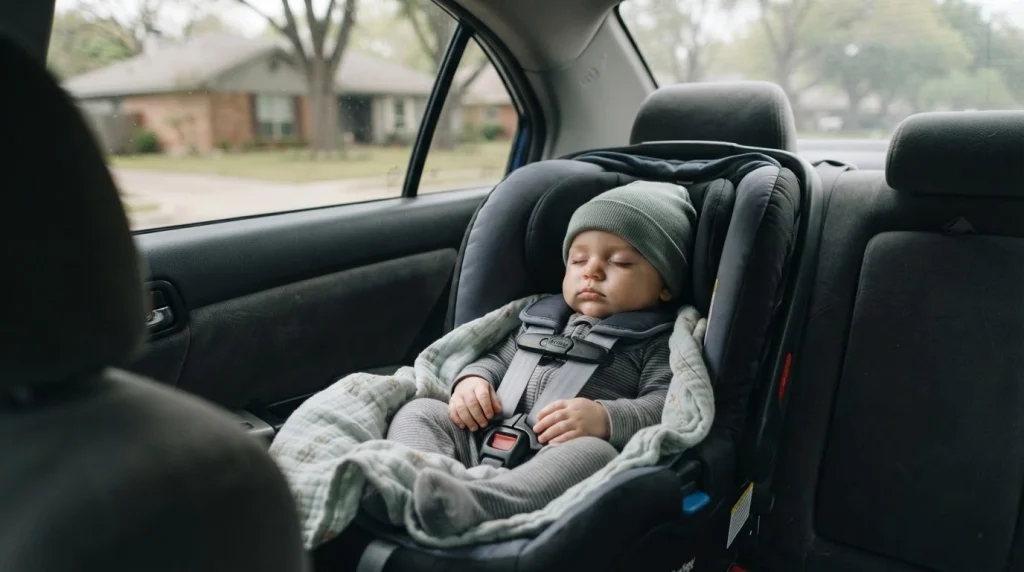
There is no magic minute mark that turns sleep into a nap. Sleep counts from the moment your baby falls asleep.
Length still changes what the nap can do. A 10-minute doze calms a tired baby for a short while. A 45-minute stretch gives far more rest.
Does a 10-minute carseat nap count?
Yes, a 10-minute carseat nap counts as sleep. It counts toward total daytime sleep, and it can take the edge off tiredness.
It does not count as a full nap. Most babies wake from a 10-minute nap still tired, and they need another nap soon after.
What about 20 to 30 minutes?
A 20 to 30-minute nap is the most common carseat nap. It often covers one light sleep cycle, or part of one.
Count it as a short nap. Plan the next nap earlier than usual, and keep the room dark and calm when you get home.
What about 45 minutes or more?
A nap of 45 minutes or more counts as a solid nap for most babies. It often includes deeper sleep, and it can carry your baby through a longer wake window.
It can replace a planned nap, mainly if your baby wakes calm and stays alert. It still may not match a crib nap of the same length.
Long carseat naps also raise a safety question. How long should a baby stay in a seat without a break? Read how long a newborn can stay in a car seat before a long trip, and plan stops into the drive.
Section takeaway: Every minute of sleep counts, but length sets the value. Short naps count as short naps, and long naps count as real rest.
Why Is Carseat Sleep Not the Same as Crib Sleep?
A crib gives your baby a flat, firm, still surface. A car seat gives a reclined, curved, moving surface.
That difference changes the sleep. It changes the depth, the length, and how rested your baby feels after waking.
What makes carseat sleep lighter?
Motion helps many babies fall asleep, but it can also keep sleep light. Braking, turning, and road noise can pull a baby back toward waking.
Light through the window, a change in temperature, and a stop at a shop can do the same. Your baby may stay in light sleep for most of the ride.
Why does position matter?
A baby sleeps flat on the back in a crib, with the head free to turn. A baby sleeps reclined in a car seat, with the head held by the seat shape and straps.
That reclined position can let the head tip forward, mainly in a newborn. A tipped head can narrow the airway and disturb sleep.
Check the head often in the mirror, and stop if the chin stays pressed to the chest. Learn why a newborn slumps in a car seat so you can spot the early signs.
Fit also matters here. A snug harness, the right recline, and no bulky coat help the head stay in a safer line. Read how to position a newborn’s head safely in a car seat before you adjust anything.
Does carseat sleep affect head shape or comfort?
Mix up the day. Give your baby flat sleep at home, supervised tummy time when awake, and time out of the seat after a drive.
For more on safe sleep surfaces and routine sleep advice, see the guidance from Consumer Reports and your pediatrician.
Section takeaway: Carseat sleep is lighter and more broken than crib sleep, mainly because of motion, light, and position. Count it, but do not treat it as equal.
How Do You Count a Carseat Nap in Your Baby’s Schedule?
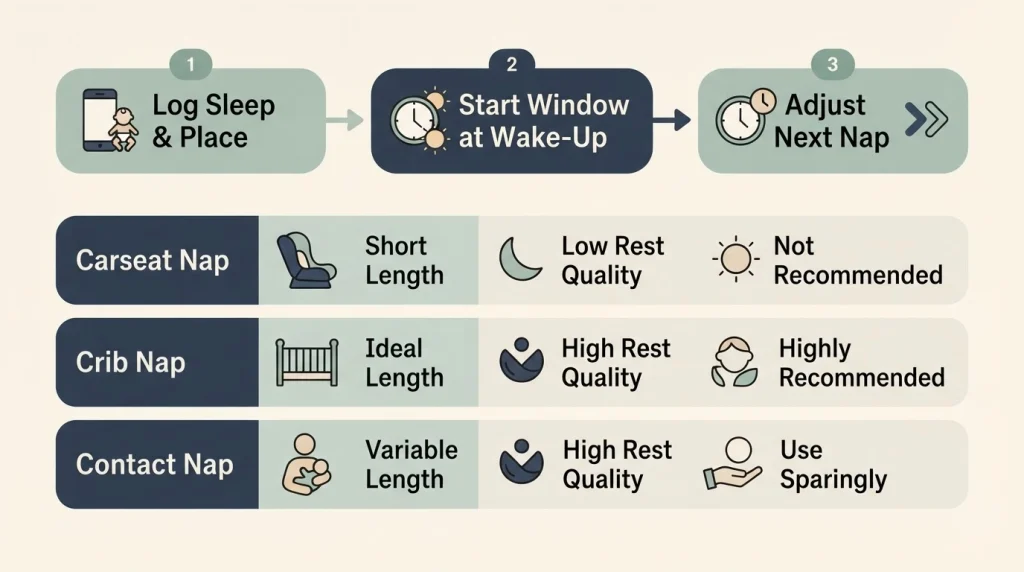
Counting a carseat nap is simple once you split the job into three steps. Log the sleep, reset the clock, and judge the next nap by your baby.
Start with the wake-up time. That is the anchor for everything that follows.
How do you log a carseat nap?
Note the time your baby fell asleep and the time your baby woke. Use the total minutes, even if sleep came in two short bursts.
Note the place too. Write “car, 25 min” rather than just “nap, 25 min”. That note helps you see the pattern later.
How do you reset the wake window?
A wake window is the time your baby can stay awake happily between sleeps. It starts when your baby wakes, and it ends at the next sleep.
Start the next window from the carseat wake-up time, not from the end of the drive. If your baby woke at 10:30, the next window starts at 10:30.
Shorten that window after a short carseat nap. A baby who had 15 minutes in the car often needs sleep again sooner than a baby who had an hour in a crib.
Carseat nap vs crib nap: a simple comparison
| Nap type | Typical length | Sleep quality | How to count it |
|---|---|---|---|
| Carseat nap | 10 to 45 minutes | Lighter, often broken by stops and noise | Count the minutes, treat it as partial |
| Crib nap | 45 to 90 minutes | Deeper, still, easier to finish a cycle | Count it as a full nap |
| Contact nap | 30 to 90 minutes | Often deep, but ends when you move | Count it as a full nap if it lasts |
A simple example day
Your baby wakes at 7:00, then sleeps in the car from 9:00 to 9:25. Log 25 minutes of car sleep.
Do not wait for the usual next nap time. Offer the next nap around 11:00, or sooner if tired signs show.
Section takeaway: Log the minutes, start the next wake window from the wake-up time, and bring the next nap forward after a short car nap.
When Should a Carseat Nap Not Count?
Most carseat naps count as sleep. A few should not count at all, because the sleep was not safe sleep.
If the nap happened in a parked car, at home in a seat on the floor, or with a slumped head, treat it differently.
What if the car was parked?
A nap in a parked car does not count as a safe nap. A parked car heats fast, cools fast, and leaves a baby alone with no driver watching.
Never leave a baby to finish a nap in a parked car, even for a few minutes. Take your baby out, and move to a flat sleep surface.
What if the head slumped forward?
A nap with a slumped head should not count as good sleep. The airway may narrow, and the sleep may stay light and broken.
Stop the car in a safe place if you see the chin pressed to the chest. Fix the recline, check the harness, and let your baby breathe freely before you drive on.
Aftermarket head supports can make this worse if they push the head forward. Check car seat head support safety before you add any insert or pillow.
What if the nap ran very long without a break?
Plan a break at least every two hours on a long trip. Take your baby out, hold them upright, and let them move before you buckle them in again.
For official car seat and travel safety guidance, see NHTSA. Your seat manual also lists the recline and fit limits for your model.
Section takeaway: Count sleep that happened safely in a moving car. Do not count sleep in a parked car, at home in a seat, or with a slumped head.
How Can You Help Your Baby Nap Better After a Carseat Nap?
A carseat nap often leaves a baby half rested. The next nap is your chance to top up the bucket.
Do not try to force a long nap right away. Offer a calm wind-down, a dark room, and a familiar routine.
Should you transfer your baby to a crib?
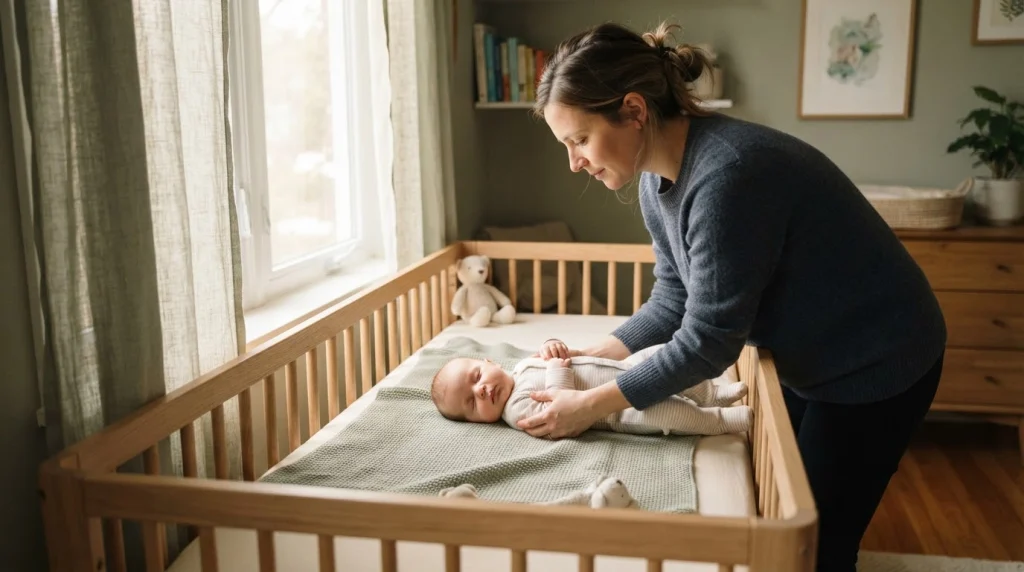
Yes, transfer your baby to a crib, bassinet, or play yard when you get home. A flat, firm surface is the safest place for routine sleep.
Move slowly and keep a hand on your baby. Some babies stay asleep through the move, and some wake and need a short settle.
How do you plan the next nap?
Offer the next nap sooner than usual after a short car nap. Offer it at the usual time after a long, settled car nap.
Use tired signs as your guide. Eye rubbing, yawning, and a glazed look mean the window is closing.
Keep the room dark, the noise low, and the routine short. A familiar song or a brief cuddle can help a car-tired baby settle.
Will carseat naps ruin night sleep?
A single carseat nap rarely ruins night sleep. A day full of short, broken naps can push bedtime earlier, though.
Run a quick check before the next drive, too. Use the essential car seat safety checklist for parents to confirm fit, straps, and recline. For car and travel context, see Edmunds.
Section takeaway: Transfer to a flat surface, bring the next nap forward after a short car nap, and let an earlier bedtime catch up a broken day.
Frequently Asked Questions
Does a 10-minute carseat nap count?
Yes, it counts as 10 minutes of daytime sleep. It does not count as a full nap, so plan the next nap sooner and watch for tired signs after the drive.
Does a carseat nap reset the wake window?
Yes, start the next wake window from when your baby wakes in the car. Shorten that window after a short nap, and lengthen it after a long, settled nap that day.
Should I wake my baby after two hours in a car seat?
Yes, take a break at least every two hours on a long trip. Take your baby out, hold them upright, feed or change them, then buckle them in again on the trip.
Can my baby nap in a car seat at home?
No, a car seat is not a routine nap spot at home. Move your baby to a crib, bassinet, or play yard with a flat, firm surface for sleep at home.
Do carseat naps count for newborns?
Yes, they count toward a newborn’s total daytime sleep. Newborns sleep in short bursts, so log the minutes and keep drives short with careful head and harness checks during the drive.
Will a carseat nap make bedtime harder?
A single carseat nap rarely makes bedtime harder. A day of short, broken naps can make your baby overtired, so offer an earlier, calm bedtime that night after a long car day.
If a carseat nap helped today, log it and move on. The goal is not a perfect schedule, but a baby who sleeps safely and wakes rested.

Daniel Brooks is an automotive writer and product researcher focused on car accessories, car tech, maintenance, and practical driving guides. At Plug-in Car World, he helps drivers make smarter automotive decisions through honest reviews and research-driven content.