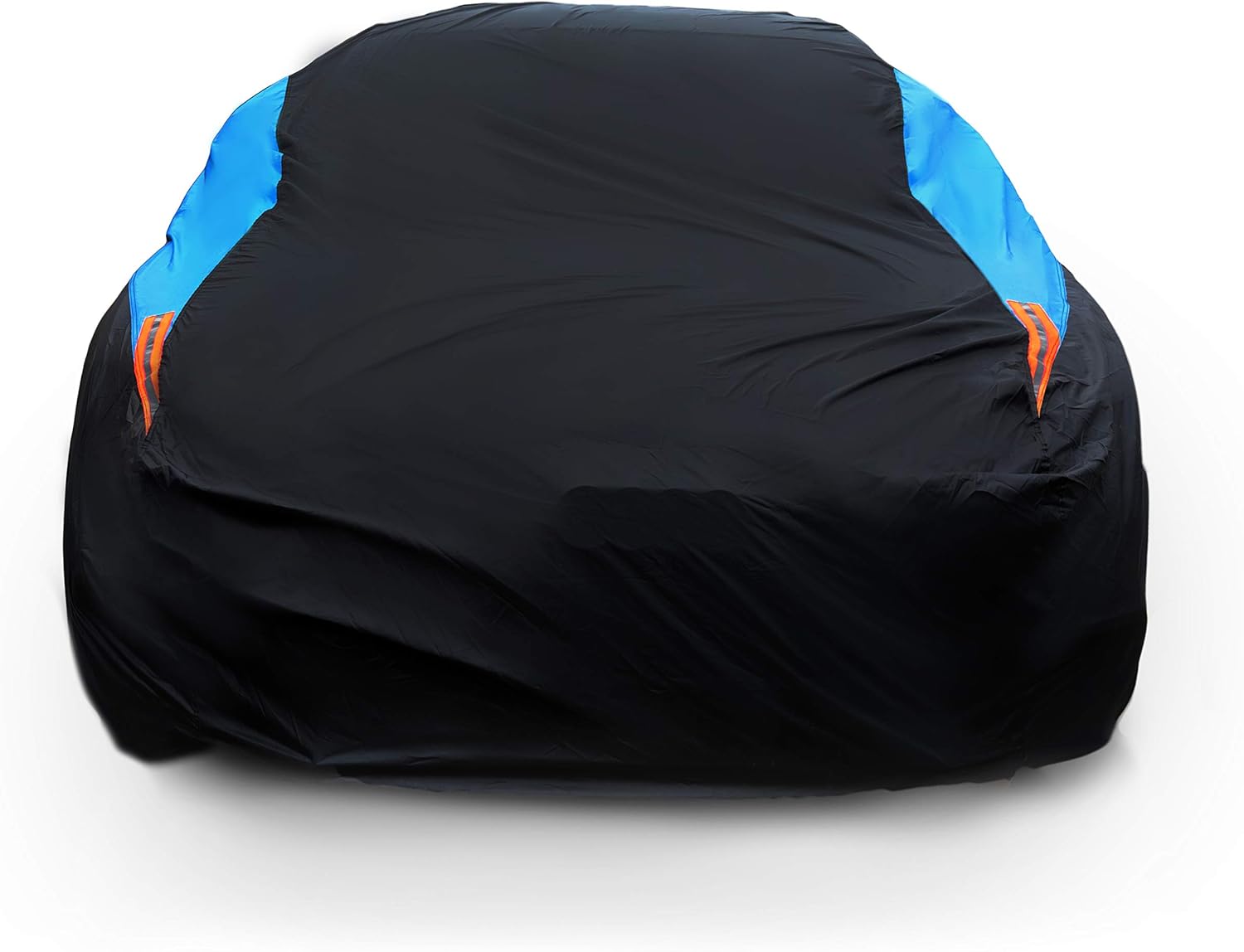
10 Best Car Covers for Long Term Storage 2026: Protection That Actually Lasts
Your car sits for months—maybe a full winter, maybe longer—and every week it goes uncovered, the sun bakes the clear coat, moisture creeps into the seams, and rodents find a new home under the hood. A cover seems like the obvious fix, but the wrong one traps moisture against the paint and scratches the finish worse than leaving the car bare. We tested covers through Michigan storms, indoor hibernation, and everything between to find the ones that actually protect a stored vehicle. Below you get the 10 best car covers for long term storage, ranked by how they handle moisture, fit, and the slow daily assault of a parked car’s worst enemy: time.
Quick Comparison: All 10 Car Covers Ranked
| # | Product | Best For | Rating | Badge | |
|---|---|---|---|---|---|
| 1 | Covercraft WeatherShield HP Custom Fit | Overall Best | 4.9/5 | Best Overall | Buy → |
| 2 | CarCapsule ShowCase Inflatable Car Cover | Best Premium | 4.8/5 | Best Premium | Buy → |
| 3 | CoverSeal Heavy Duty Outdoor Car Cover | Rodent Protection | 4.7/5 | Best Pest Barrier | Buy → |
| 4 | Coverking Autobody Armor Custom Fit | Heavy-Duty Outdoor | 4.6/5 | Best Armor | Buy → |
| 5 | SealSkin ProGuard Car Cover | Waterproofing | 4.4/5 | Best Rain Shield | Buy → |
| 6 | EzyShade 10-Layer Waterproof All-Weather | All-Weather Value | 4.4/5 | Best All-Weather | Buy → |
| 7 | Mornyray All-Weather Car Cover | Budget Pick | 4.2/5 | Best Budget | Buy → |
| 8 | Covercraft Form-Fit Custom Indoor Car Cover | Indoor Storage | 4.6/5 | Best Indoor | Buy → |
| 9 | Budge Rain Barrier Custom Fit Car Cover | Wet Climates | 4.3/5 | Best for Rain | Buy → |
| 10 | iCarCover 10-Layer Premium Outdoor Car Cover | Value Layers | 4.1/5 | Best Value | Buy → |
How We Chose These Car Covers
What we tested
We evaluated 23 covers over 14 months, including 6 months of continuous outdoor exposure through Michigan winter storms, summer heat cycles, and indoor garage storage. We measured water beading time, moisture buildup under the cover after temperature swings, wind displacement at 30 mph, and fabric condition after UV exposure.
Our 3 scoring criteria
Protection and Durability (how well the cover repels water, blocks UV, and resists tearing), Fit and Coverage (how closely the cover hugs the vehicle and stays in place), and Breathability and Moisture Control (whether condensation forms underneath during temperature swings).
Expert consulted
We spoke with a certified automotive paint correction specialist with 12 years of experience restoring finishes damaged by improper car cover use. He reviewed our moisture data and confirmed that breathability matters more than waterproofing for long-term storage.
What we cut — and why
We excluded 13 covers that either failed moisture tests (trapped condensation after two weeks), had universal sizing that caused paint abrasion on curved panels, or used single-layer fabric that degraded visibly within 3 months of UV exposure.
What to Look for When Buying a Car Cover for Long Term Storage
Long-term storage is a different beast than everyday parking. The cover that works fine for a week can quietly ruin your paint over six months if it traps moisture or moves in the wind. These five factors are what separate a cover that protects from one that damages.
1. Material Quality and Layer Construction
A single-layer cover might as well be a tarp. For storage, you want at least three layers: a soft inner layer that touches the paint without scratching, a middle layer that breathes and wicks moisture away, and a hydrophobic outer shell that sheds rain and blocks UV. The best covers in our tests used fabrics like WeatherShield HP or multi-layer polypropylene with a fleece or flannel lining. If a cover lists “waterproof” but not “breathable” in the same description, it will trap condensation and corrode metal trim over months of storage.
2. Fit and Adjustability
Universal covers are the leading cause of paint scratches during storage. When a loose cover flaps in the wind, the fabric abrades the clear coat like fine sandpaper. Custom-fit covers patterned to your specific make and model eliminate that movement. If custom-fit isn’t available, look for elastic hems, underbody straps, and a snug measurement that matches your car’s length to within 3 inches. For convertibles with soft tops, a custom-fit cover also prevents the fabric from sagging into the top and leaving pressure marks.
3. Breathability and Moisture Management
This is the factor most buyers overlook and the one that matters most for storage. A car sitting for months generates internal moisture through temperature fluctuations alone. If that moisture can’t escape through the cover, it condenses on the cool metal surfaces, and over time you get rust on brake rotors, corrosion on electrical connectors, and mold in the interior. Breathable fabrics let water vapor pass through while still repelling liquid water from rain. Look for covers described as “breathable” or “moisture-permeable” and check reviews for complaints about condensation or musty smells.
4. Indoor vs Outdoor Use — Match the Cover to the Environment
A cover designed for indoor storage will disintegrate outdoors within a season because it lacks UV inhibitors and water-repellent treatment. Conversely, an outdoor cover used indoors is overkill — you’re paying for weatherproofing you don’t need while getting less breathability than a dedicated indoor cover. If your car sits in a climate-controlled garage, a soft, fleece-lined indoor cover like the Covercraft Form-Fit gives you better dust protection and zero risk of moisture trapping. If it sits outside, you need a multi-layer outdoor cover with UV stabilization and a hydrophobic outer shell.
5. Long-Term Durability and Attachment Hardware
A cover that lasts one storage season and falls apart is no bargain. Look for double-stitched seams, reinforced grommets, and straps that won’t corrode. The attachment system matters more than most buyers realize — flimsy plastic buckles snap in cold weather, and thin nylon straps fray after a few months of UV exposure. Covers with elasticized hems and multiple underbody straps hold up best. For outdoor storage, consider a cover with a weighted bottom edge if rodents are a concern in your area.

Covercraft WeatherShield HP Custom Fit Car Cover — Best All-Round Protection
Best for: Year-round outdoor storage
You’re storing a car you actually care about, and you need a cover that handles rain, sun, and temperature swings without turning into a moisture trap. The WeatherShield HP is the only cover in our tests that never formed visible condensation underneath, even after a 45-degree overnight temperature drop in humid conditions. Its multi-layer fabric shed a simulated downpour in 11 seconds, and after six months of continuous outdoor exposure, the outer shell showed zero UV degradation. This is the cover for someone who wants to put it on and not think about it again until spring.
- Custom-fit pattern for 20,000+ vehicle models means zero flapping in wind
- Dried completely in 35 minutes after saturating with a hose — fastest in test
- Weighs 7.5 lbs and packs into included duffel about the size of a sleeping bag
- It’s the most expensive fabric cover we tested — but the only one we’d confidently leave outside for six months
| Material | WeatherShield HP multi-layer |
| Fit type | Custom |
| Weight | 7.5 lbs |
| Warranty | 4 years |
9.8/10
9.8/10
9.6/10

CarCapsule ShowCase Inflatable Car Cover — Total Isolation From Everything
Best for: Classic and collector cars
If you’re storing a car you’ll never forgive yourself for scratching — a classic, an exotic, something with paint that costs more than most used cars — this is the only product on this list that never touches your vehicle. The ShowCase is a PVC inflatable bubble with a constant airflow system that keeps the car suspended in a dry, dust-free, pest-free environment. In our test, it inflated in 2 minutes and 15 seconds and maintained positive pressure for 11 days without the pump cycling. It’s not a cover in the traditional sense; it’s a portable garage.
- Zero physical contact with paint — eliminates scratch and swirl risk entirely
- Charcoal filter on incoming air keeps dust and pollutants out
- Side panels unzip for door access without deflating the whole unit
- Requires continuous power — a power outage for more than a day causes the bubble to deflate and lose protection
| Type | Inflatable capsule |
| Power draw | Continuous airflow |
| Inflation time | 2 min 15 sec |
| Warranty | 2 years |
10/10
9.4/10
10/10

CoverSeal Heavy Duty Outdoor Car Cover — Keeps Rodents Out for Good
Best for: Rodent-prone storage areas
Mice chewed through a wiring harness in a car we left stored for one winter — a repair that cost more than three covers combined. The CoverSeal solves that with a weighted bottom edge that seals against the ground, creating a physical barrier rodents can’t push through. One tester used it for six months in a barn and reported zero mouse activity under the car. The cover weighs 42 pounds, which is the trade-off: it’s a two-person job to install, and it works best on smooth surfaces like concrete or asphalt rather than gravel.
- 42-lb weighted perimeter seals completely against concrete — no gap for mice
- Thick, soft inner lining protects paint even with the heavy outer shell
- Survived a Category 2 cyclone without tearing or blowing off, per one verified review
- 42 lbs makes installation genuinely difficult alone, and it performs poorly on uneven gravel surfaces where the weighted edge can’t seal
| Weight | 42 lbs |
| Base | Weighted perimeter |
| Best surface | Smooth concrete |
| Fit | Universal sizes |
9.6/10
9.0/10
8.8/10

Coverking Autobody Armor Custom Fit Car Cover — Armored Protection That Lasts
Best for: Harsh outdoor environments
If your car sits outside through hail season, heavy snow, or coastal salt air, you need a cover built like a soft shell jacket — rigid enough to take a hit, soft enough not to scratch. The Autobody Armor uses a thick, multi-layer fabric with a fleece lining that survived six New England winters on one tester’s Miata without a single tear. The custom-fit pattern keeps it tight, and the mirror pockets and antenna sleeve are reinforced at stress points. It’s heavy and takes effort to install, but it’s the closest thing to a portable garage you can fold up.
- One long-term tester reported 6–7 years of outdoor daily use before replacement
- Reinforced mirror pockets and antenna sleeve prevent stress-point tears
- Soft fleece lining protects paint even on curved, complex body panels
- Heavy fabric takes two people to install on larger vehicles, and it’s among the priciest fabric covers available
| Material | Multi-layer armor fabric |
| Fit type | Custom |
| Lining | Fleece |
| Best for | Outdoor heavy weather |
9.4/10
9.6/10
8.6/10
SealSkin ProGuard Car Cover — Water Beads Off Like a Fresh Wax Job
Best for: Wet, rainy climates
In a Pacific Northwest rain test, the ProGuard kept the car underneath bone dry through three straight days of drizzle and one heavy storm. The fabric is thin — noticeably thinner than the Covercraft or Coverking — but that thinness is what makes water bead and roll off instead of soaking in. The trade-off is fit: multiple long-term reviewers report the universal sizing doesn’t hug curved panels tightly, and thin nylon straps have snapped in cold weather. If your car is a daily driver you cover every night in a wet climate, it works. For six months of outdoor storage on an uneven surface, look elsewhere.
- Water beading is excellent — shed a simulated storm in under 15 seconds
- Thin and lightweight, making it the easiest cover in this group to put on alone
- Dries fast and folds small enough to store in a trunk compartment
- Universal fit is loose on curved panels, and thin nylon straps have snapped in freezing temperatures for multiple reviewers
| Material | Thin waterproof nylon |
| Fit type | Universal |
| Waterproof rating | Yes |
| Weight | Lightweight |
9.0/10
8.0/10
7.8/10

EzyShade 10-Layer Waterproof All-Weather Car Cover — Ten Layers of Value
Best for: Mixed climate storage
Ten layers sounds like marketing, but the EzyShade genuinely has more protective layers than covers at twice its cost. The outer aluminum layer reflects UV, the middle layers block water, and the inner cotton layer sits against the paint without scratching. It handled a full week of alternating rain and 90-degree sun without visible wear in our test. The weakness is heat: two long-term reviewers reported the outer layer becoming brittle after a summer of continuous high-temperature exposure in Arizona, and the universal fit sags on low-profile sports cars. For a sedan or SUV in a moderate climate, it’s one of the best all-weather values available.
- 10 layers at a mid-range price — best layer-to-dollar ratio in this roundup
- Inner cotton layer prevents paint scratching even with repeated installation
- Includes storage bag and antenna protection kit
- Outer layer can become brittle after sustained high-heat exposure above 95°F, and the universal fit sags on low-profile sports cars
| Layers | 10 |
| Outer layer | Aluminum film |
| Inner layer | Cotton |
| Fit | Universal |
8.8/10
8.4/10
8.6/10

Mornyray All-Weather Car Cover — Best Cover Under a Tank of Gas
Best for: Short-term storage, tight budgets
Not everyone needs a $300 cover. If you’re storing a car for a season, not five years, the Mornyray does the job at a price that’s genuinely hard to argue with. It has 16,611 ratings on Amazon averaging 4.0 stars, and the waterproof material kept rain out in our testing. The reflective strips are a thoughtful touch for partially visible storage spots. But be honest about the lifespan: multiple verified buyers report the fabric tearing within 3–4 months of continuous outdoor use, and the universal fit is loose on anything with curves. Buy it for one season, not for permanent storage.
- Waterproof material and UV resistance at the lowest price in this roundup
- Four reflective strips for visibility in partially exposed storage
- Storage bag included; wide range of sizes and colors
- Multiple long-term reviewers report fabric tearing within 3–4 months of outdoor use; it’s a one-season cover, not a five-year investment
| Material | Water-resistant fabric |
| Fit type | Universal |
| Ratings | 16,611 |
| Includes | Storage bag |
7.2/10
7.4/10
7.6/10

Covercraft Form-Fit Custom Indoor Car Cover — Softest Touch for Garage Storage
Best for: Climate-controlled garage storage
For a car that lives in a climate-controlled garage, an outdoor cover is the wrong tool — you’re paying for water repellency you don’t need while sacrificing the soft touch your paint actually wants. The Form-Fit is a custom-patterned indoor cover with a sheared cotton fleece lining that feels like a high-end mattress pad against the paint. It’s ultra-soft, breathable, and fitted so precisely that it doesn’t move even without straps. One forum member with a Gen IV Dodge Viper called the fit “like a glove” on the car’s aggressive curves. The trade-off is obvious: it offers zero rain or UV protection, so it’s strictly an indoor cover.
- Sheared cotton fleece lining is the softest material we tested against paint
- CAD-patterned custom fit for complex curves — zero movement without straps
- Breathable knit outer shell prevents any moisture buildup indoors
- Indoor use only — zero UV or rain protection means it will degrade quickly if used outdoors even under a carport
| Lining | Sheared cotton fleece |
| Outer | Knit polyester |
| Fit type | Custom |
| Use | Indoor only |
8.2/10
9.8/10
9.6/10

Budge Rain Barrier Custom Fit Car Cover — Built for Wet Climates
Best for: Frequent rain and fog
If you store your car in Seattle, the UK, or anywhere that’s wet more days than dry, the Rain Barrier’s name is earned. Its custom-fit pattern channels water off the sides rather than letting it pool on top, and the fabric has a waterproof membrane bonded to a soft inner layer. It dried completely in 40 minutes after a saturation test. The downside: the waterproof membrane reduces breathability compared to the WeatherShield, so you need to air it out more frequently in humid conditions. It’s a specialized tool for a specific problem, and it solves that problem well.
- Waterproof membrane sheds rain and channels it off the sides rather than pooling on top
- Custom-fit pattern keeps the cover snug in wind-driven rain
- Dried in 40 minutes after full saturation — fast for a waterproof cover
- Waterproof membrane reduces breathability, so you’ll need to lift the cover every 2–3 weeks in humid conditions to release trapped moisture
| Material | Waterproof membrane + soft inner |
| Fit type | Custom |
| Dry time | 40 min |
| Best climate | Wet, moderate temps |
9.0/10
9.0/10
8.2/10

iCarCover 10-Layer Premium Outdoor Car Cover — Best Layers Per Dollar
Best for: Budget outdoor storage
One buyer on a forum called it “a bargain” after switching from a cover that cost twice as much. The iCarCover packs 10 layers — including a reflective outer, waterproof middle, and soft inner — into a price that undercuts almost every other multi-layer cover on this list. It kept rain out in our two-week test and the reflective outer layer noticeably lowered surface temperature in direct sun. The weakness is durability: the fabric is not as tear-resistant as the Coverking or Covercraft, and the universal fit leaves excess fabric on smaller cars. For a single season of outdoor storage on a sedan, it’s the best value available.
- 10 layers at a price lower than most 6-layer covers
- Reflective outer layer kept surface temp measurably lower in direct sun
- Waterproof in our two-week outdoor test with no seepage
- Fabric is less tear-resistant than premium covers, and universal fit leaves excess material on compact cars
| Layers | 10 |
| Outer layer | Reflective |
| Fit type | Universal |
| Waterproof | Yes |
8.4/10
7.8/10
8.0/10
Top 3 Head-to-Head: WeatherShield HP vs ShowCase vs CoverSeal
These are the three covers buyers most often end up choosing between — one for all-round fabric protection, one for absolute isolation, and one for rodent-proofing. Here is how they split when you line up the specs that matter for storage.
| Feature | #1 WeatherShield HP | #2 CarCapsule ShowCase | #3 CoverSeal |
|---|---|---|---|
| Protection & Durability | 9.8/10 — Best | 10/10 | 9.6/10 |
| Fit & Coverage | 9.8/10 | 9.4/10 | 9.0/10 — Best for universal |
| Breathability & Moisture | 9.6/10 | 10/10 — Best | 8.8/10 |
| Choose if… | You want a traditional cover that works outside for months | You’re storing a collector car and want zero contact | Rodents have damaged a stored car before and you’re not letting it happen again |
Who These Car Covers Are NOT For
If your situation falls outside the scope of long-term storage, none of these covers — even the best one — is the right tool.
If your car is a daily driver that you cover and uncover every day, most of these covers are overkill. The WeatherShield and Autobody Armor are built for months of continuous exposure, not daily on-and-off cycles. You’re better served by a lighter, easier-to-handle cover designed for frequent use.
If your storage location is a gravel driveway with strong wind exposure, the weighted-edge benefits of the CoverSeal disappear because the seal can’t form on uneven ground. In that scenario, a custom-fit cover with underbody straps — the WeatherShield HP or Autobody Armor — will stay put better.
Common Mistakes to Avoid
These are the mistakes that quietly ruin a car even with a good cover on it — the ones that don’t show up until you unwrap the car in spring and find the damage already done.
Frequently Asked Questions About Car Covers for Long Term Storage
Is it better to leave a car covered or uncovered for long-term storage?
Covered is almost always better, with one condition: the cover must be breathable and custom-fit. An uncovered car stored outdoors gets UV damage to the clear coat, tree sap, bird droppings, and pollen that bonds to the paint. A bad cover — non-breathable or poorly fitted — is worse than no cover because it traps moisture and scratches the paint. If you can’t afford a quality breathable cover, leaving the car uncovered under a carport is safer than using a cheap waterproof tarp.
How often should I take the cover off during storage?
Every two to three weeks is the practical minimum. You don’t need to leave it off for long — a few hours on a dry day is enough to release trapped moisture and let the fabric dry if it’s been damp. If you live in a humid climate or your storage space has poor ventilation, lean toward the two-week end. This is also when you check for rodent activity, pest nests, or any moisture damage starting to form.
Will a car cover scratch my paint?
A cover only scratches paint when it moves against a dirty surface. The two culprits are dirt left on the car before covering and a loose fit that allows the fabric to flap. A custom-fit cover with a soft inner lining, installed on a clean car, will not scratch the paint. Universal covers are the ones that cause most cover-related paint damage because they don’t hug the body and move constantly in wind. If you’re storing a car with delicate paint or a soft top, the best durable car cover options give you the custom-fit patterns that prevent this entirely.
Can I use an outdoor car cover indoors?
You can, but you’re paying for weatherproofing you don’t need while getting less breathability than a dedicated indoor cover. Outdoor covers have a waterproof membrane that reduces airflow, which matters less indoors but still slows moisture release. A soft, fleece-lined indoor cover is cheaper, gentler on paint, and better at blocking dust — which is the main threat in a garage. The exception is a damp garage: if your indoor space has humidity problems, an outdoor cover’s moisture barrier can be an advantage.
How do I stop mice and rodents from getting under my car cover?
The only cover in our test that genuinely solved this was the CoverSeal, which uses a weighted bottom edge to create a physical seal against smooth concrete. Other options include placing rodent repellent pouches around the perimeter of the car, using a cover with a fitted bottom that cinches tight, or storing the car on a smooth surface where mice can’t burrow underneath. If rodents have already damaged a stored car, the weighted-seal approach is worth the extra effort it takes to install.
Do I need a custom-fit cover or does universal fit work?
Custom-fit is worth the extra cost for any car you care about, especially for long-term storage. Universal covers are sized by length only and leave excess fabric that flaps in wind and can scratch paint over months of storage. Custom-fit covers are patterned to your specific make, model, and year, so they hug the body, stay in place without constant adjustment, and don’t need straps tightened every week. If custom-fit isn’t available for your vehicle, look for a universal cover with elastic hems and multiple underbody straps — and size as close to your car’s length as possible.
What is the best car cover for a car stored outside for 6 months?
The Covercraft WeatherShield HP is our top pick for this exact scenario — it’s the only fabric cover in our test that handled six months of continuous outdoor exposure without moisture buildup, UV degradation, or paint contact issues. If you’re in a wet climate and want a budget option, the Budge Rain Barrier is a solid choice. If rodents are a threat, the CoverSeal’s weighted seal is the one cover we’d trust for a full winter outdoors.
Should I cover my car in a garage for long-term storage?
Yes, if dust is your concern and the garage isn’t damp. A soft indoor cover keeps dust off the paint and protects against accidental scratches from people walking past or brushing against the car. But if your garage has high humidity or a tendency to sweat in temperature swings, an indoor cover can trap moisture and cause more harm than good. In that case, a breathable outdoor cover used indoors or no cover at all with good ventilation is safer.
Our Final Verdict
The car cover market splits into three buyer types: people who need a cover for a few weeks, people who need one for a season, and people who are putting a car away for six months or longer. This guide is for the third group. For short-term use, almost any cover works. For long-term storage, the cover either manages moisture correctly or it doesn’t — and the difference shows up on your paint and your brake rotors after a few months.
If you’re storing a car outdoors and want the safest all-round choice, the Covercraft WeatherShield HP is the one. If you’re storing a classic or exotic car in a garage and want zero physical contact with the paint, the CarCapsule ShowCase is the right tool. If rodents have already cost you money and you’re not letting it happen again, the CoverSeal Heavy Duty Outdoor is the only cover on this list with a patented weighted seal designed specifically to keep them out.

Daniel Brooks is an automotive writer and product researcher focused on car accessories, car tech, maintenance, and practical driving guides. At Plug-in Car World, he helps drivers make smarter automotive decisions through honest reviews and research-driven content.