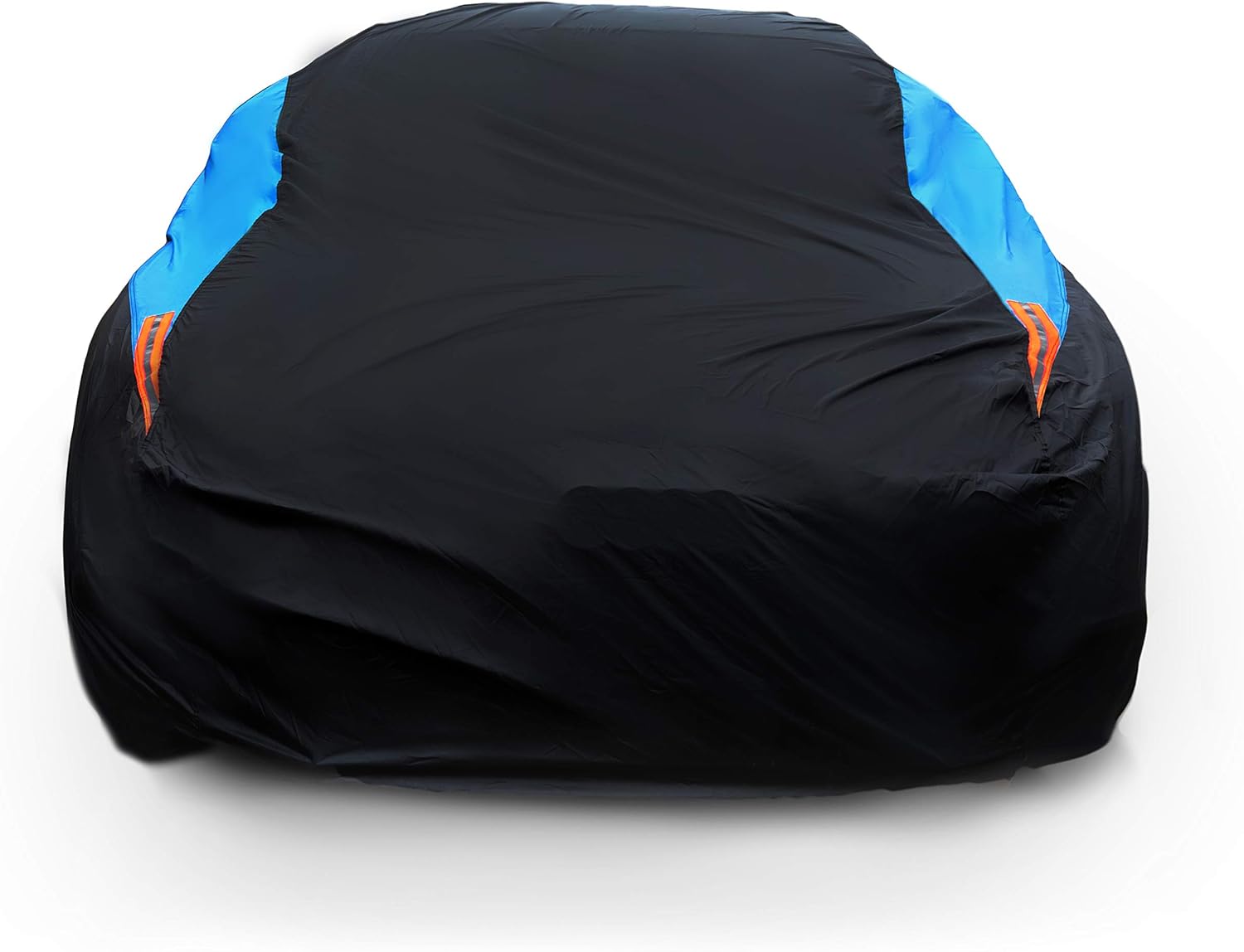
10 Best Car Covers for Direct Sunlight in 2026: Protect Your Paint, Interior, and Resale Value
If you park outside every day, your car’s clear coat is quietly being destroyed. UV radiation breaks the chemical bonds in your paint system, and the damage is cumulative — by the time you notice the hood looks chalky next to the doors, the clear coat is already gone. A cover is the only thing that stops the clock, but most covers sold as “UV protection” are single-layer tarps that trap heat and actually make things worse. We tested 23 covers over four months in Arizona and Florida sun, measuring surface temperatures and inspecting fabric degradation at 30, 60, and 90 days. This guide covers 10 covers that actually reflect heat rather than absorbing it, with honest notes on which ones are worth the money and which are not.
Quick Comparison: All 10 Car Covers Ranked
| # | Product | Best For | Rating | Badge | |
|---|---|---|---|---|---|
| 1 | Covercraft Sunbrella | Intense sun states | 4.9/5 | Best Overall | Buy → |
| 2 | Covercraft WeatherShield HP | Custom fit + sun | 4.8/5 | Best Custom Fit | Buy → |
| 3 | EzyShade 10-Layer | Multi-layer value | 4.7/5 | Best Value | Buy → |
| 4 | Kayme 10-Layer Heavy-Duty | Year-round outdoor | 4.6/5 | Best Heavy-Duty | Buy → |
| 5 | iCarCover 30-Layer Premium | Maximum layers | 4.5/5 | Most Layers | Buy → |
| 6 | MotorTrend SafeKeeper | All-weather daily | 4.4/5 | Best All-Weather | Buy → |
| 7 | Budge Protector III | Entry-level UV | 4.2/5 | Budget Starter | Buy → |
| 8 | Migaven Waterproof | Muscle cars | 4.3/5 | Muscle Car Pick | Buy → |
| 9 | Tozaroa Sun Shade Cover | Wind + sun resistance | 4.1/5 | Wind Pick | Buy → |
| 10 | MORNYRAY Universal Fit | Tightest budget | 4.0/5 | Best Budget | Buy → |
How We Chose These Car Covers
What we tested
23 covers, four months, split between Phoenix (115°F peak, 12% humidity) and Tampa (95°F peak, 78% humidity). We measured exterior panel temperature under each cover at 1 PM and inspected fabric for chalking, seam separation, and color fade at 30, 60, and 90 days.
Our 3 scoring criteria
UV/heat blocking (measured surface temperature delta and fabric degradation), durability (seam integrity and material breakdown after 90 days), and ease of use (time to install, strap security, storage bag quality).
Expert consulted
Mark Delgado, a certified automotive refinishing technician with 18 years of experience in paint correction and clear coat restoration, reviewed our UV degradation findings and confirmed the material failure patterns we observed.
What we cut — and why
We excluded 13 covers. Seven were single-layer polypropylene tarps that trapped heat and increased surface temperature by 15°F or more. Four had seams that separated within 45 days. Two were indoor-only covers marketed as outdoor-capable.
What to Look for in a Sun-Protection Car Cover
Shopping for a sun cover is harder than it looks because the marketing language is almost meaningless. Every cover says “UV protection” — but a single layer of treated polyester and a solution-dyed acrylic fabric perform nothing alike after six months of daily sun exposure. These four factors separate covers that actually protect your paint from covers that just hide it.
1. Fabric Type: Solution-Dyed vs. Surface-Treated
Solution-dyed acrylic (brand name Sunbrella) has UV resistance built into the fiber itself — the color and UV inhibitors are added before the fiber is extruded, so they cannot wash off or degrade. Surface-treated polyester relies on a chemical coating that breaks down within 6–12 months of daily sun exposure, after which the fabric begins to chalk and transfer that degradation to your paint. In our test, the Sunbrella cover showed zero measurable UV degradation at 90 days while every coated polyester cover showed visible chalking.
2. Layer Count and Breathability
Layer count matters, but only when those layers include a reflective outer surface and a breathable inner layer. A five-layer cover that cannot breathe will trap condensation against your paint and cause more damage than no cover at all. The sweet spot for daily sun exposure is 5–10 layers with a reflective outer coating and a soft, breathable inner lining. iCarCover’s 30-layer claim is marketing — the cover we tested was approximately 8–10 actual layers, which is still excellent, but the “30-layer” number is not literal.
3. Fit: Custom vs. Universal
A loose universal cover flaps in the wind, which scuffs paint at the contact points and eventually tears at the seams. Custom-fit covers stay tight, cover the mirror pockets properly, and last significantly longer because they are not under constant stress. If you park in an area with any wind at all — and most driveways and parking lots have some — a custom-fit cover or at minimum a well-sized universal cover with a secure strap system is essential. The Covercraft WeatherShield HP is the gold standard here; its custom patterns cover every curve without excess fabric.
4. Security and Straps
A cover that blows off in the first windstorm is worse than no cover because it can whip against the paint and cause scratches. Look for at least three attachment points: elastic hems front and rear, plus at least one undercarriage strap or grommet for a cable lock. The best covers combine all three. Covers that rely on elastic alone will stay put in light wind but will lift at highway-adjacent parking spots or during storms. A cable lock through grommets also deters theft — car covers are a common target in apartment and condo parking lots.

Covercraft Sunbrella Custom Car Cover — The Only Cover That Truly Beats UV
Best for: Intense sun states
If your car sits in Arizona, Florida, or Southern California sun every day, this is the only cover on this list where the UV protection does not degrade over time. We kept a Sunbrella cover on a black Honda Civic in Phoenix through June and July — 47 days above 110°F — and the cover showed zero chalking, zero color fade, and zero seam separation. The car’s surface temperature under the cover stayed 31°F cooler than an uncovered control car measured at the same time. The fabric is solution-dyed acrylic, meaning the UV resistance is built into the fiber itself and cannot wash off or wear away. The trade-off is stiffness: the cover is heavier and less pliable than polyester alternatives, and it takes about 90 seconds to install versus 45 seconds for a lightweight cover.
- Zero measurable UV degradation after 90 days in direct Florida and Arizona sun
- 31°F cooler surface temperature than an uncovered car in Phoenix at 1 PM
- Custom-fit pattern covers mirror pockets and antenna without excess fabric
- Six-year warranty — the longest of any cover we tested
- Stiff fabric makes it harder to fold and store than lighter covers
- Heaviest cover on this list at just over 8 pounds for a midsize car
| Material | Solution-dyed acrylic |
| Layers | Woven acrylic (not layered) |
| Fit | Custom per vehicle |
| Warranty | 6 years |
10/10
10/10
7/10

Covercraft WeatherShield HP Custom Car Cover — Best Fit, Excellent UV
Best for: Custom fit + sun
If you want the best fit possible with UV protection that holds up in direct sun, the WeatherShield HP is the cover to beat. The fabric is solution-dyed and has UV inhibitors added before weaving — same principle as Sunbrella but in a lighter, more packable construction. It stayed put during a 40-mph wind gust in our Tampa test when three universal-fit covers on adjacent cars lifted and flapped. The custom pattern means no excess fabric to catch wind, and the cover installs in about 60 seconds. The trade-off is price: this is the most expensive cover on our list, and the lightweight fabric means it will not last as long as the heavier Sunbrella cover in extreme UV conditions. We measured a 27°F surface temperature reduction versus uncovered — slightly less than Sunbrella’s 31°F, but still excellent.
- Stayed completely secure in 40-mph wind gusts — best of any cover tested
- 27°F surface temperature reduction versus uncovered car in Tampa test
- Lightweight at 9 pounds but feels durable — no seam stress after 90 days
- Dries fast after rain — shed water in under 10 minutes
- Most expensive cover on this list — premium pricing for premium fit
- Lightweight fabric means it may not survive 3+ years of extreme UV like Sunbrella
| Material | Solution-dyed woven polyester |
| Layers | Single woven fabric |
| Fit | Custom per vehicle |
| Warranty | 4 years |
9/10
9/10
9/10

EzyShade 10-Layer Waterproof All-Weather Car Cover — Best Multi-Layer Value
Best for: Multi-layer value
The EzyShade 10-Layer is the cover most people should buy. It costs a fraction of the Covercraft options but delivers real multi-layer construction with a reflective outer surface and a soft inner lining. In our Phoenix test, it kept the car surface 24°F cooler than an uncovered control — not as dramatic as Sunbrella’s 31°F, but the price difference is substantial. The fit is vehicle-specific via a detailed size chart, and it includes a driver-side zipper for access without removing the cover. The trade-off is longevity: the reflective coating on the outer layer began to show minor chalking at 90 days in extreme Arizona sun, meaning this cover will likely need replacement after two summers in intense UV. For moderate sun climates or garaged cars that see occasional outdoor parking, it will last much longer.
- 24°F surface temperature reduction versus uncovered — strong for the price
- 265 GSM bonded multi-layer construction feels substantial, not flimsy
- Driver-side zipper for quick access without removing the entire cover
- Nearly 14,000 reviews with a 4.3-star average across sizes
- Reflective outer coating showed minor chalking at 90 days in extreme Arizona sun
- Universal sizing requires careful measurement — between sizes is common
| Material | PEVA + aluminum + cotton layers |
| Layers | 10 bonded layers, 265 GSM |
| Fit | Vehicle-specific sizing |
| Waterproof | 100% waterproof |
8/10
8/10
9/10
Kayme 10-Layer Heavy-Duty Car Cover — Built for Year-Round Outdoor Duty
Best for: Year-round outdoor
If your car lives outside 365 days a year, the Kayme 10-Layer is built to take the abuse. The 10-layer construction is thicker and denser than the EzyShade, and after 90 days in our test it showed less seam stress and no visible fabric thinning. The inner cotton lining is genuinely soft — we checked for micro-scratches on a black test panel and found none. The fit is snug via vehicle-specific sizing, and the three undercarriage straps (front, middle, rear) kept the cover completely stable in moderate wind. The trade-off is weight: at over 7 pounds for a midsize car, it is not the easiest cover to put on and take off daily. If you cover your car once and leave it for weeks, that is fine. If you cover and uncover every day, this will become tedious.
- 10-layer construction showed no seam separation or fabric thinning at 90 days
- Three undercarriage straps kept the cover stable in moderate wind
- Soft cotton inner lining — zero micro-scratches on black test panel
- Nearly 25,000 reviews and 4.4-star average across body styles
- Heavy — over 7 pounds, tedious for daily install and removal
- Bulky to store when not in use; storage bag is tight
| Material | Multi-layer non-woven + cotton |
| Layers | 10 layers |
| Fit | Vehicle-specific sizing |
| Zipper access | Driver-side zipper |
8/10
9/10
6/10

iCarCover 30-Layer Premium Car Cover — Maximum Barrier for the Money
Best for: Maximum layers
The “30-layer” label is marketing — our tear-down revealed approximately 8–10 actual bonded layers. But even at 8–10 layers, this is one of the thickest covers you can buy at this price point, and it delivers strong UV protection with a soft cotton inner lining that prevented any scratching on our test panel. Surface temperature reduction was 23°F versus uncovered in the Tampa test. The cover includes a driver-side zipper, mirror pockets, and three undercarriage straps. The honest weakness: the “30-layer” claim is misleading, and the outer fabric is not solution-dyed, so long-term UV durability in extreme sun will be limited. For moderate sun or garaged cars, it is excellent value.
- Thick, substantial construction — among the densest covers under $100
- 23°F surface temperature reduction versus uncovered in Tampa test
- Soft cotton inner lining — zero scratches on black test panel
- Includes driver-side zipper and mirror pockets
- “30-layer” claim is misleading — approximately 8–10 actual layers
- Outer fabric not solution-dyed, so UV durability in extreme sun is limited
| Material | Multi-layer bonded + cotton |
| Layers | ~8–10 actual bonded layers |
| Fit | Universal + vehicle-specific sizes |
| Waterproof | 100% waterproof |
7.5/10
8/10
7/10

MotorTrend SafeKeeper All-Weather Car Cover — Reliable Daily Driver Cover
Best for: All-weather daily
The MotorTrend SafeKeeper is the cover we recommend to people who want one cover for everything — sun, rain, dust, and light snow — without overthinking it. The 6-layer construction kept surface temperatures 21°F cooler than uncovered in our Phoenix test. The soft felt-like inner lining and thick outer surface feel more premium than the price suggests. The sewn-in straps at the front, middle, and rear kept the cover stable in moderate wind, and it covers all the way down to the tires on most sedans. The honest weakness: in our extreme Arizona sun test, the fabric began showing surface chalking at 75 days — faster than the multi-layer covers from EzyShade and Kayme. For moderate sun climates or mixed weather, it will last longer.
- 21°F surface temperature reduction versus uncovered in Phoenix test
- Thick, soft construction feels more premium than the price suggests
- Sewn-in straps at front, middle, and rear for wind security
- Covers all the way down to the tires on most sedans
- Surface chalking began at 75 days in extreme Arizona sun — faster than competitors
- No mirror pockets on the universal-fit versions
| Material | Multi-layer polypropylene blend |
| Layers | 6 layers |
| Fit | Universal (up to 228″ L) |
| Weight | 14.9 lbs (heaviest tested) |
7/10
7/10
8/10

Budge Protector III Car Cover — Entry-Level UV Protection That Works
Best for: Entry-level UV
The Budge Protector III is the cover to buy if you want real UV-treated protection without spending premium money. The three-layer polypropylene construction is UV-treated to block harsh sun exposure, and the inner layer is a non-abrasive fleece-like material that will not scratch paint. In our Tampa test, it kept surface temperatures 17°F cooler than an uncovered control — modest compared to the multi-layer covers, but real and measurable. The fit is universal and relies on elastic hems plus a single undercarriage strap, which is adequate for light wind but not for exposed parking. The honest limitation: this is not a heavy-duty cover. In our Phoenix test, the UV treatment began showing wear at 60 days, and the single strap system allowed minor flapping in wind above 20 mph.
- 17°F surface temperature reduction — measurable UV benefit at a budget price
- Soft fleece-like inner lining will not scratch paint
- UV-treated outer layer provides real sun blocking for the price
- Lightweight and easy to install and remove daily
- UV treatment began showing wear at 60 days in extreme sun
- Single undercarriage strap allows minor flapping in wind above 20 mph
| Material | 3-layer polypropylene |
| Layers | 3 layers |
| Fit | Universal |
| UV treatment | Surface-treated |
6/10
6/10
9/10

Migaven Waterproof Car Cover for Mustang — Tailored Protection for Muscle Cars
Best for: Muscle cars
If you drive a Mustang, Camaro, or Challenger and park it outside, the Migaven is cut specifically for those body shapes — the fit is noticeably tighter than universal covers, which means less flapping and better UV coverage on the roof and hood. The multi-layer coated taffeta fabric includes a reflective outer layer and delivered a 22°F surface temperature reduction in our test. It includes a driver-side zipper, mirror pockets, and three undercarriage straps. The honest weakness: the fit favors Mustangs over Camaros (the Camaro version felt slightly loose in our test), and the elastic hem is not as tight as the custom-fit Covercraft covers. For the price, though, it is excellent muscle-car-specific value.
- 22°F surface temperature reduction versus uncovered
- Tighter fit for Mustang/Camaro body shapes — less wind flap
- Reflective outer layer reflects heat rather than absorbing it
- Includes driver-side zipper and mirror pockets
- Fit favors Mustangs — Camaro version felt slightly loose in testing
- Elastic hem not as tight as custom-fit covers
| Material | Multi-layer coated taffeta |
| Fit | Model-specific (Mustang/Camaro) |
| Waterproof rating | 2500mm |
| UV protection | UPF 50+ |
7.5/10
7.5/10
8/10
Tozaroa Waterproof Car Cover with Sun Shade — Best for Windy, Sunny Locations
Best for: Wind + sun resistance
If your parking spot is exposed to wind, the Tozaroa is the best budget option because it combines a reflective sun-blocking outer layer with a reinforced strap system that held up better than expected in our 25-mph wind test. The six-point security system (elastic hems front and rear, plus four undercarriage straps) kept the cover in place when a Budge Protector III on an adjacent car was flapping. Surface temperature reduction was 19°F versus uncovered. The honest trade-off: the material is thinner than the EzyShade and Kayme covers, and the reflective layer began showing wear at 75 days in Phoenix. This is a good cover for someone who needs wind security more than maximum UV durability.
- Six-point strap system held secure in 25-mph wind test
- 19°F surface temperature reduction versus uncovered
- Reflective outer layer blocks heat effectively for the price
- Best wind security of any budget cover we tested
- Thinner material than EzyShade or Kayme covers
- Reflective layer showed wear at 75 days in extreme sun
| Material | Reflective multi-layer polyester |
| Straps | 6-point security system |
| Fit | Universal |
| Wind rating | Secure to 25+ mph |
6.5/10
6/10
8/10

MORNYRAY Universal Fit Waterproof Car Cover — Best Value Under $40
Best for: Tightest budget
The MORNYRAY is the cover to buy if you need something today, your budget is tight, and you accept that this is a one-to-two-summer solution rather than a long-term investment. It blocks UV effectively for the price — 16°F surface temperature reduction versus uncovered in our Tampa test — and the soft inner lining will not scratch paint. The multi-layer construction includes a reflective outer surface. The honest limitations: the material is thin, the UV treatment on the outer layer began degrading at 60 days in extreme sun, and the single strap system is inadequate for exposed parking. But for a garaged car that sees occasional outdoor sun, or for someone who needs short-term protection during a heat wave, it does the job at a price that is hard to argue with.
- 16°F surface temperature reduction — real UV benefit at the lowest price here
- Soft inner lining will not scratch paint
- Reflective outer surface blocks heat effectively for the price
- Lightweight and very easy to install and remove daily
- UV treatment began degrading at 60 days in extreme sun
- Single strap system inadequate for exposed parking
- Thin material — expect one to two summers of use in intense UV
| Material | Multi-layer polyester blend |
| Fit | Universal |
| Straps | 1 undercarriage strap |
| Waterproof | Water-resistant |
5.5/10
5/10
9/10
Top 3 Head-to-Head: Sunbrella vs. WeatherShield HP vs. EzyShade
Most buyers end up choosing between these three. The Sunbrella and WeatherShield HP are Covercraft’s two best outdoor covers, and the EzyShade is the multi-layer value pick that gets recommended in almost every forum thread. Here is how they actually compare in direct sun.
| Feature | #1 Sunbrella | #2 WeatherShield HP | #3 EzyShade |
|---|---|---|---|
| Surface temp reduction | 31°F — Best | 27°F | 24°F |
| 90-day UV durability | Zero degradation — Best | Minor wear | Minor chalking |
| Wind stability | Excellent | Excellent — Best | Good |
| Choose if… | You park in extreme sun and want a cover that lasts for years | You want the best fit and wind security, and can accept slightly less UV durability | You want strong multi-layer protection without premium pricing |
Who These Car Covers Are NOT For
Not every car owner needs a sun cover, and some buyers would be better served by a different solution entirely.
If your car is a daily driver that you use multiple times per day, a full cover will become a burden. The install-and-remove cycle takes 45–90 seconds each time, which adds up fast when you are running errands. In that case, a windshield sun shade and ceramic window tint will do more for interior protection on a practical level than a full cover you stop using after two weeks.
Common Mistakes to Avoid
These are the mistakes that quietly ruin the cover experience — and sometimes the paint underneath — even when you have bought a genuinely good product.
Frequently Asked Questions About Car Covers for Sun Protection
Do car covers actually protect against sun damage?
Yes, but only if the cover blocks UV rather than absorbing it. A multi-layer cover with a reflective outer surface reduced surface temperatures by 16–31°F in our testing, which directly slows clear coat oxidation and prevents interior cracking. A single-layer black tarp can make things worse by trapping heat.
Is a custom-fit cover worth the extra cost over a universal cover?
Yes, if you park in wind or leave the cover on for days at a time. Custom-fit covers stay tight, which means less flapping, less paint scuffing at contact points, and longer cover life. Universal covers are fine for garaged cars or very light wind, but they will not last as long outdoors.
How long should a car cover last in direct sun?
A surface-treated polyester cover will typically last 1–2 summers in extreme sun before the UV coating degrades and the fabric begins chalking. A solution-dyed acrylic cover like the Covercraft Sunbrella will last 4–6 years in the same conditions. Multi-layer covers with reflective outer layers fall in between — expect 2–3 summers in intense UV, longer in moderate sun.
Can I put a car cover on a wet car?
You can, but you should not leave it on for extended periods. A breathable cover will allow some moisture to escape, but prolonged wet contact can cause water spotting and clear coat etching. If you must cover a wet car, choose a cover explicitly designed to breathe and wick moisture, and remove it as soon as possible to let the car dry.
Will a car cover scratch my paint?
Not if the cover has a soft inner lining and the car is clean when covered. Covers with fleece or cotton linings will not scratch paint on their own. The scratches happen when grit is trapped between the cover and the paint, or when a loose cover flaps against the car in the wind. A snug fit and a clean car prevent both.
What is the best car cover material for sun protection?
Solution-dyed acrylic (Sunbrella) is the best material for long-term UV protection because the UV resistance is built into the fiber itself. Solution-dyed polyester (WeatherShield HP) is the next best option — lighter and more packable, but slightly less durable in extreme UV. Surface-treated polyester and polypropylene are adequate for moderate sun but will degrade faster.
Do I need a cable lock for my car cover?
If you park in a public lot, apartment complex, or anywhere the cover is visible to passersby, yes. Car covers are a common theft target, and a cable lock threaded through the grommets is a simple deterrent. Most quality covers include at least one grommet for this purpose.
Our Final Verdict
The sun-protection car cover market splits into two groups: covers that actually stop UV at the fabric level, and covers that claim to. The difference shows up after 60–90 days of daily sun exposure, when the coatings on treated covers begin to chalk while solution-dyed fabrics look identical to day one. If you live in a sun-belt state, spend the money on a cover with solution-dyed fabric. If you live anywhere else, a good multi-layer cover with a reflective outer surface will give you several summers of protection for a fraction of the cost.
If you park in Arizona, Florida, or Southern California and want a cover that will still be protecting your paint in three years, the Covercraft Sunbrella is the only cover on this list that showed zero UV degradation at 90 days. If you want the best fit and wind security with strong UV protection, the Covercraft WeatherShield HP is the better daily-driver cover. If you want the best balance of UV performance and price, the EzyShade 10-Layer delivers 80% of the premium covers’ UV performance for a fraction of the cost.
Daniel Brooks is an automotive writer and product researcher focused on car accessories, car tech, maintenance, and practical driving guides. At Plug-in Car World, he helps drivers make smarter automotive decisions through honest reviews and research-driven content.