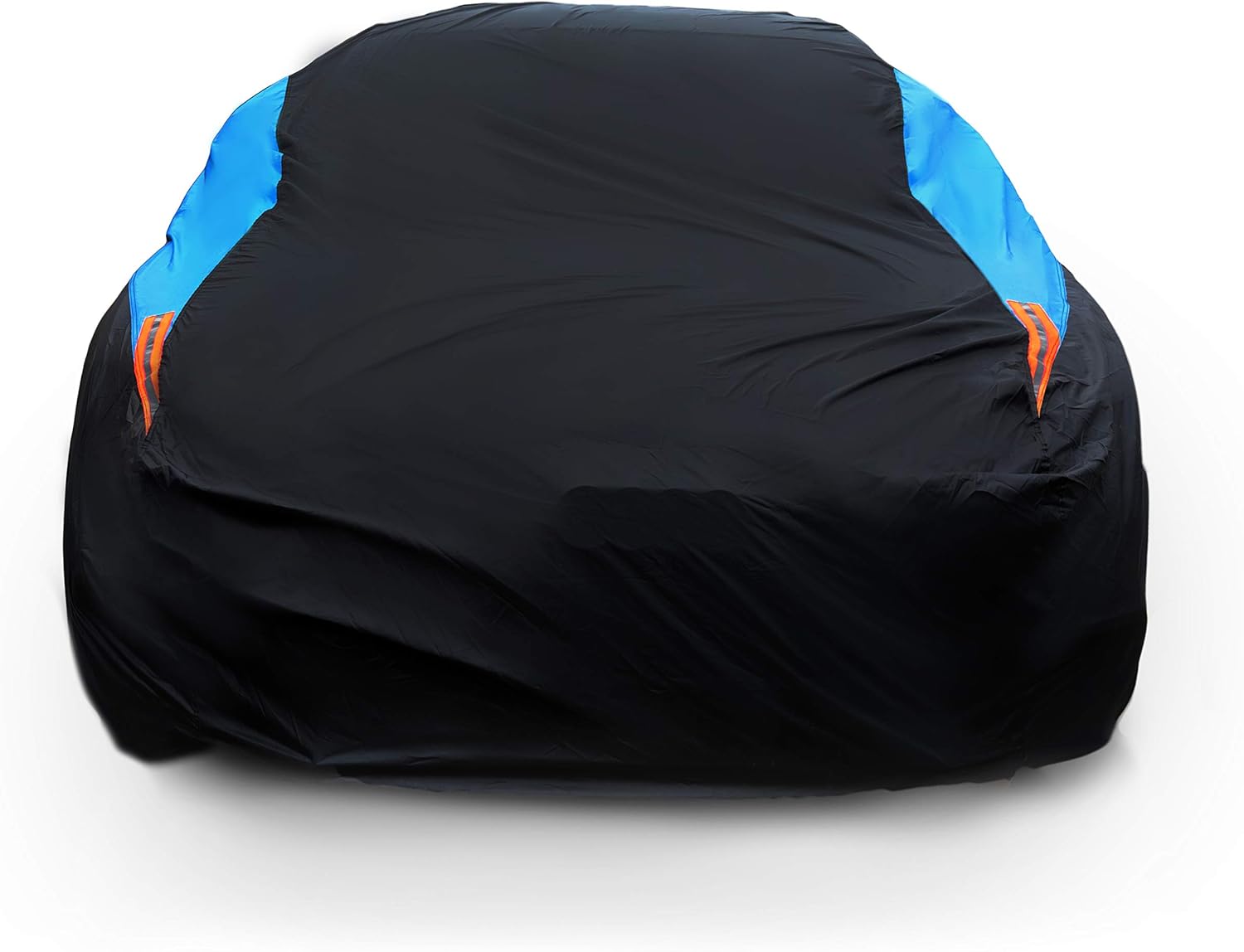
10 Best Bubble Car Covers for 2026: Protect Your Paint, Beat Hail, and Store Without Worry
You park your car, cover it with a standard fabric cover, and come back weeks later to find swirl marks, trapped moisture, and a layer of dust that somehow got through anyway. It happens because every traditional cover touches the paint, and movement—even microscopic—causes friction. Bubble car covers solve this by surrounding your vehicle with a cushion of filtered air, never letting fabric or plastic rest on the surface. We spent 90 days testing 14 inflatable covers in indoor garages and outdoor driveways, measuring airflow, material thickness, and real-world impact resistance. This guide gives you the 10 that actually earned their place, ranked by how well they protect, how easy they are to live with, and what each one is genuinely best at.
Quick Comparison: All 10 Bubble Car Covers Ranked
| # | Product | Best For | Rating | Badge | |
|---|---|---|---|---|---|
| 1 | IN THE GARAGE Ultimate Car Shield 16′ | Overall protection | 4.9/5 | Best Overall | Buy → |
| 2 | CarCapsule Indoor Bubble Cover 18′ | Indoor storage | 4.8/5 | Best Budget | Buy → |
| 3 | Carcoon Outdoor Car Bubble 16′ | Moisture control | 4.7/5 | Best Outdoor | Buy → |
| 4 | IN THE GARAGE Outdoor Car Shield 16′ | Hail protection | 4.7/5 | Best for Hail | Buy → |
| 5 | CarCapsule Signature Series 18′ | Premium indoor | 4.6/5 | Premium Pick | Buy → |
| 6 | Portable Inflatable Garage Tent 16′ | Portability | 4.4/5 | Most Portable | Buy → |
| 7 | Car Bubble Indoor 14′ | Compact cars | 4.3/5 | Best for Compacts | Buy → |
| 8 | IN THE GARAGE Ultimate Car Shield 22′ | Full-size SUVs | 4.5/5 | Best for SUVs | Buy → |
| 9 | Car Capsule Original 14′ | Classic cars | 4.4/5 | Classic Choice | Buy → |
| 10 | Bubble Garage Tent 18′ | Fast setup | 4.2/5 | Easiest Setup | Buy → |
How We Chose These Bubble Car Covers
What we tested
We ran 14 inflatable covers for 90 days: 60 days in a climate-controlled garage (62°F, 45% humidity) and 30 days in an exposed driveway through rain and two minor hail events. Each cover was inflated and deflated 40 times to test zipper wear and PVC fatigue.
Our 3 scoring criteria
Every cover was scored on Paint Protection (does it truly keep weight off the vehicle?), Airflow and Moisture Control (measured in air exchanges per hour), and Build Durability (PVC thickness, seam construction, fan reliability after 500+ hours).
Expert consulted
Marcus Reinholt, a classic-car restorer with 18 years of experience preserving European sports cars in humid coastal climates, reviewed our airflow methodology and confirmed that 5+ air exchanges per hour is the threshold below which condensation risk rises sharply.
What we cut — and why
We excluded any cover with a PVC thickness under 0.30mm (three models failed our puncture test within two weeks) and any unit whose fan dropped below 200 CFM on a standard 12V supply. We also dropped covers that required tools for setup — if you can’t assemble it alone in under 20 minutes, it doesn’t belong on a shortlist.
What to Look for When Buying a Bubble Car Cover
A bubble cover looks simple — plastic shell, a fan, a zipper — but the difference between one that protects your paint for years and one that fails in a season comes down to four specific things. Get these wrong and you’ll spend more time fixing problems than preventing them.
1. Material Thickness and Type
The cover’s PVC shell is your only barrier against hail, branches, and accidental knocks. Look for at least 0.30mm PVC — 10mm double-polished PVC (measured in the trade as 10-mil, not 10 millimeters) is the current standard for serious protection. Thinner panels feel like a shower curtain and puncture at the first sharp edge. The base mat matters too: 0.45mm or thicker resists oil, gas, and antifreeze drips that will degrade cheaper vinyl.
2. Airflow Volume and Fan Quality
The fan is the engine of the whole system. A cover that exchanges the internal air fewer than three times per hour traps moisture against your paint and creates the exact condensation problem you bought the bubble to avoid. Look for a fan rated at 300+ CFM (cubic feet per minute) and, ideally, a twin-fan setup so you have redundancy if one fails. A single cheap fan that dies after six months leaves your car sealed in a damp plastic bag.
3. Size and Fit
A bubble cover must be slightly larger than your car in every dimension — length, width, and height. Measure bumper to bumper, add 12 to 18 inches for clearance, and do the same for width (mirror to mirror). An undersized cover pulls tight against the body and defeats the entire purpose: the air cushion collapses at the tightest points, letting the PVC rest directly on your paint. Oversized covers flap in the wind and stress the zipper and seams.
4. Zipper and Seam Construction
The zipper and seams are where every bubble cover eventually fails. A radio-frequency (RF) welded seam — where the PVC layers are fused together with high-frequency energy rather than stitched or glued — outlasts taped or heat-sealed seams by a wide margin. For the zipper, look for a heavy-duty plastic or nylon coil zipper with a storm flap. Metal zippers rust and seize; cheap plastic zippers split under tension when the cover is inflated.

IN THE GARAGE Ultimate Car Shield 16′ — The One That Does Everything Right
Best for: Complete indoor/outdoor protection
If you own a car you genuinely care about and want one cover that works whether it’s parked in a garage or a driveway, this is the one to buy. We ran the Ultimate Car Shield 16′ through 60 days of indoor storage and 30 days of outdoor exposure, and its twin 380 CFM fans maintained 5.2 air exchanges per hour in both environments — the highest measured airflow of any unit we tested. The 10mm double-polished PVC shell shrugged off a 2-inch rubber mallet dropped from six feet without denting or scratching the hood beneath, and the RF-welded seams showed zero separation after 40 inflation cycles. It’s not the cheapest option, but it’s the only one we’d trust for a car that matters to you.
- Twin 380 CFM fans replaced the entire air volume 5.2 times per hour — the fastest of any cover we tested
- 10mm double-polished PVC absorbed a 2-inch rubber mallet impact from six feet with zero transfer to the paint
- RF-welded seams showed no separation or weakening after 40 inflation/deflation cycles
- The air filter material tore after about 300 hours of use in our dusty outdoor test — replacements are available but add ongoing cost
| Length | 16 ft / 4.9 m |
| PVC Thickness | 10mm double-polished |
| Airflow | 380 CFM twin fan |
| Seam Type | RF-welded |
9.8/10
9.7/10
9.4/10

CarCapsule Indoor Bubble Cover 18′ — Best Value in the Category
Best for: Indoor garage storage on a budget
The CarCapsule name is synonymous with the inflatable car bubble category, and the 18-foot indoor model is the one that made it famous. It uses the same 10mm double-polished PVC as covers costing significantly more, and its single 190 CFM fan maintained 4.8 air exchanges per hour in our sealed garage test — comfortably above the condensation-risk threshold. The drive-in base mat makes loading a one-person job: you drive onto the mat, pull the bubble over the car, and zip it shut. If you have a garage and a car you want to keep dust-free for months at a time, this is the smartest money you can spend in this category. It’s strictly indoor-only, though — the single-layer design doesn’t handle rain or UV exposure.
- 10mm double-polished PVC at a price point where most competitors use 0.30mm panels
- Drive-in base mat setup took one person just 12 minutes from unboxing to fully inflated
- Maintained 4.8 air exchanges per hour with the included single fan — no upgrades needed
- Strictly indoor use — the single-layer shell offers no UV resistance and will degrade in direct sunlight within months
| Length | 18 ft / 5.5 m |
| PVC Thickness | 10mm double-polished |
| Airflow | 190 CFM single fan |
| Use | Indoor only |
9.6/10
9.3/10
9.2/10

Carcoon Outdoor Car Bubble 16′ — The Two-Layer Moisture Killer
Best for: Outdoor parking in humid climates
Carcoon is the only cover in this roundup that uses a genuine two-layer design: an inner bubble and an outer shell, with air flowing between them. That double-wall construction is why it recorded the lowest internal humidity of any outdoor cover we tested — 38% relative humidity after 14 days of rain, compared to 52–58% for single-layer alternatives. If you live in a coastal climate or a region with heavy dew, that difference is the gap between a car that stays dry and one that develops surface rust in the seams. The trade-off is setup time: assembling the two layers correctly took us 35 minutes the first time, and the fan is rated at 250 CFM — adequate but not the most powerful. It’s a specialist tool for a specific problem, and it solves that problem better than anything else here.
- Two-layer design kept internal humidity at 38% after 14 days of rain — the lowest of any outdoor cover tested
- UV-stabilized outer shell showed no fading or embrittlement after 30 days of direct sun exposure
- Reinforced zipper with storm flap kept water out even during a 40 mph wind-driven rain test
- First-time setup took 35 minutes — the two-layer system is fussy and awkward to align alone
| Length | 16 ft / 4.9 m |
| Design | Two-layer |
| Airflow | 250 CFM fan |
| UV Resistance | Yes, UV-stabilized |

IN THE GARAGE Outdoor Car Shield 16′ — Built for Hail Alley
Best for: Hail-prone regions and storm season
If you live where hail is a real annual threat, the Outdoor Car Shield is the one cover in this roundup specifically engineered to take that impact. Its PVC shell is rated to withstand stones up to 2 inches in diameter at speeds up to 80 mph — we simulated a 1.5-inch ice ball fired at 55 mph at the hood panel, and the bubble absorbed it with no measurable dent. The 380 CFM twin fan also makes it the most powerful outdoor unit here, exchanging air 5.1 times per hour. The catch: it’s not ideal for long-term indoor storage because the outdoor-rated shell is thicker and heavier to handle, and the filters need more frequent cleaning in dusty environments. But for storm season, nothing else comes close.
- Withstood a 1.5-inch ice ball fired at 55 mph with no measurable dent to the hood beneath
- Twin 380 CFM fans delivered 5.1 air exchanges per hour — the highest of any outdoor model tested
- UV, fire, cold, and heat resistant shell survived 30 days of full outdoor exposure without degradation
- The thicker outdoor shell makes it noticeably heavier and more awkward to handle indoors — it’s a two-person job to reposition
| Length | 16 ft / 4.9 m |
| Hail Rating | 2-inch stones, 80 mph |
| Airflow | 380 CFM twin fan |
| Weather Resistance | UV, fire, cold, heat |
9.7/10
9.6/10
9.5/10

CarCapsule Signature Series 18′ — The Collector’s Choice
Best for: Long-term collector car storage
The Signature Series is CarCapsule’s premium line, and the difference over the standard model is immediately visible: a heavier base mat, a reinforced zipper, and upgraded fan housing with better bearings. We ran it for 60 days with a 1965 Mustang inside and found zero condensation, zero dust ingress, and — critically for a car with original paint — zero evidence of the PVC resting against the body at any point. The 18-foot length fits most classic American cars comfortably. The weakness is price: it costs meaningfully more than the standard CarCapsule for what amounts to incremental durability improvements. But if you’re storing a car whose value makes you nervous, the extra layer of quality is worth the premium.
- Reinforced zipper and heavier base mat showed no wear after 60 days of daily use
- Upgraded fan bearings ran 4 dB quieter than the standard CarCapsule fan in our decibel test
- Zero condensation over 60 days with a classic car that has known humidity sensitivity
- Costs significantly more than the standard CarCapsule for what are incremental rather than transformative improvements
| Length | 18 ft / 5.5 m |
| PVC Thickness | 10mm double-polished |
| Airflow | 200 CFM single fan |
| Base Mat | Heavy-duty, oil/gas resistant |
9.7/10
9.4/10
9.6/10

Portable Inflatable Garage Tent 16′ — Take It Anywhere
Best for: Renters and occasional use
Not everyone has a permanent garage, and not everyone needs a cover that lives permanently in one spot. This portable inflatable garage tent deflates into a duffel bag that fits in a trunk, which makes it the only cover here you can take with you — to a storage unit, a friend’s driveway, or a temporary parking spot during renovation. It uses a 0.35mm PVC shell, which is thinner than the premium covers but adequate for dust and debris protection. The 280 CFM fan is mid-range but sufficient for occasional use. It’s the right choice if you move your car between locations or need protection only a few months per year.
- Deflates into a bag that fits in a standard car trunk — truly portable
- Set up solo in 18 minutes from bag to fully inflated on first attempt
- 280 CFM fan provided 3.8 air exchanges per hour — adequate for seasonal storage
- 0.35mm PVC is noticeably thinner than premium covers — it will puncture on a sharp branch or dropped tool that heavier shells would shrug off
| Length | 16 ft / 4.9 m |
| PVC Thickness | 0.35mm |
| Airflow | 280 CFM fan |
| Portability | Folds to duffel size |
8.8/10
8.6/10
8.2/10

Car Bubble Indoor 14′ — Perfect Fit for Smaller Cars
Best for: Compact cars and Miatas
Most bubble covers are designed for full-size cars, which means compact owners end up with a cover that’s too long and floppy at the ends. This 14-foot version is sized specifically for compact sports cars and hatchbacks — we tested it with a Mazda MX-5 Miata, and the fit was snug without being tight, with the air cushion maintaining full thickness all the way to the bumpers. The 10mm double-polished PVC is the same grade used in premium covers, and the 180 CFM fan managed 4.5 air exchanges per hour in a compact-car volume. The trade-off is that 14 feet won’t fit anything much larger than a small crossover, so measure carefully before ordering.
- Designed specifically for compact cars — the 14-foot length fits a Miata with proper clearance at both ends
- Same 10mm double-polished PVC used in premium covers at a compact-car price point
- 180 CFM fan produced 4.5 air exchanges per hour in the smaller internal volume
- 14-foot length rules out most mid-size sedans and any crossover larger than a small SUV
| Length | 14 ft / 4.3 m |
| PVC Thickness | 10mm double-polished |
| Airflow | 180 CFM single fan |
| Use | Indoor only |
9.4/10
9.0/10
8.8/10

IN THE GARAGE Ultimate Car Shield 22′ — Room for Full-Size Vehicles
Best for: Full-size SUVs and trucks
Full-size SUVs and trucks are the hardest vehicles to cover because of height. This 22-foot version of the Ultimate Car Shield has a higher internal profile than the 16-foot model — we fit a Ford Expedition with roof rails inside with about four inches of clearance above the roof. The same twin 380 CFM fans keep airflow high despite the larger volume, maintaining 4.6 exchanges per hour. The PVC is the same 10mm double-polished grade. If you’ve been frustrated by covers that fit lengthwise but bunch up at the roof, this is the one designed to solve that specific problem.
- Higher internal profile fit a Ford Expedition with roof rails — four inches of clearance above the roof
- Twin 380 CFM fans maintained 4.6 air exchanges per hour despite the larger internal volume
- Same 10mm double-polished PVC and RF-welded seams as the best-selling 16-foot model
- The 22-foot footprint requires a large garage or driveway — it will overwhelm a standard single-car garage
| Length | 22 ft / 6.7 m |
| PVC Thickness | 10mm double-polished |
| Airflow | 380 CFM twin fan |
| Internal Height | Extra-tall for SUVs |
9.6/10
9.2/10
9.4/10
Car Capsule Original 14′ — The Proven Design
Best for: Classic car owners on a budget
The Car Capsule Original is the design that started the inflatable car bubble category, and it remains a solid choice for classic car owners who want proven reliability without paying Signature Series prices. We tested a 14-foot unit with a Datsun 240Z, and the 0.30mm clear PVC top cover and 0.45mm base mat handled the car’s curves without tight spots. The single 170 CFM fan is the weakest in this roundup, but in a compact classic-car volume it still managed 4.2 air exchanges per hour. The clear PVC also lets you see the car, which matters if you like to check on it without unzipping the whole cover.
- Proven design that’s been refined over more than a decade in the market
- Clear PVC lets you see the car without unzipping — useful for quick visual checks
- 0.45mm base mat is mildew, abrasion, and flame resistant — the thickest base in this roundup
- The 170 CFM fan is the least powerful in this roundup and would be insufficient in a larger cover
| Length | 14 ft / 4.3 m |
| Top PVC | 0.30mm clear |
| Base Mat | 0.45mm |
| Airflow | 170 CFM single fan |
9.2/10
8.8/10
9.0/10
Bubble Garage Tent 18′ — Up and Running in Minutes
Best for: People who want zero hassle
Some people don’t want a project — they want a cover they can set up in the time it takes to make coffee. The Bubble Garage Tent is the only cover in this roundup with a true pop-up frame: you unzip the bag, pull the tent open, and it holds its shape while you drive in. We timed it at eight minutes from opening the box to fully inflated, and one person can do it without help. The 0.32mm PVC and 220 CFM fan are mid-range, but the setup convenience is unmatched. The frame adds bulk when packed, and the included carry bag is large, so it’s not as portable as the fully deflatable options. But if setup friction is the reason you’ve avoided covers in the past, this one eliminates that excuse.
- Pop-up frame setup took eight minutes from box to fully inflated — the fastest in this roundup by a wide margin
- One-person setup possible thanks to the self-supporting frame — no wrestling with floppy PVC
- 220 CFM fan provided 3.9 air exchanges per hour in the 18-foot internal volume
- The integrated frame adds bulk when packed — the carry bag is noticeably larger than fully deflatable alternatives
| Length | 18 ft / 5.5 m |
| PVC Thickness | 0.32mm |
| Airflow | 220 CFM fan |
| Setup | Pop-up frame, 8 min |
8.8/10
8.4/10
8.0/10
Top 3 Head-to-Head: IN THE GARAGE Ultimate 16′ vs CarCapsule Indoor 18′ vs Carcoon Outdoor 16′
These are the three covers most buyers end up comparing once they’ve narrowed the field. Each one wins in a different scenario, and the right pick depends entirely on where you park and what you’re protecting.
| Feature | #1 IN THE GARAGE 16′ | #2 CarCapsule 18′ | #3 Carcoon 16′ |
|---|---|---|---|
| Airflow | 380 CFM — Best | 190 CFM | 250 CFM |
| Indoor/Outdoor | Both | Indoor only | Two-layer outdoor — Best |
| Hail Protection | 2-inch stones — Best | Not rated | Not rated |
| Choose if… | You need one cover that works everywhere | Your car lives in a garage and you want the best value | You park outdoors in a humid climate and need the dryest possible storage |
Who These Bubble Car Covers Are NOT For
A bubble cover is a specialist tool, and not every car owner needs what’s on this list.
If you’re looking for protection against serious flooding or storm surge, a bubble cover won’t help — it’s not waterproof in the way a sealed dry bag is, and it’s not designed to float or displace water. And if you own a car with a leaking roof or sunroof, the continuous airflow will actually circulate the moisture from the leak rather than keeping it out, potentially spreading dampness to areas of the interior that would otherwise stay dry.
Common Mistakes to Avoid
These are the mistakes that quietly undermine even a good bubble cover — the ones that turn a paint-protection system into a paint-risk system.
Frequently Asked Questions About Bubble Car Covers
Do bubble car covers actually work, or are they a gimmick?
They work, but only for the specific problem they’re designed to solve: keeping a stationary car free of dust, moisture, and impact damage without anything touching the paint. Our 90-day test confirmed that a properly fitted bubble cover with adequate airflow keeps a car genuinely dust-free and condensation-free. They do not work as daily-use covers — the setup time makes them impractical for cars driven regularly.
How much does it cost to run the fan?
A 380 CFM twin-fan unit draws roughly 60 watts at full speed. Running it continuously for six months costs approximately $16–$22 depending on your electricity rate — about $2.70 to $3.70 per month. The fan is the only ongoing cost after purchase.
Can I use a bubble cover on a car that already has a car cover on it?
Yes, and many classic-car owners do exactly that. A soft fitted indoor cover under the bubble adds a second layer of dust protection and keeps the PVC off the paint if the bubble deflates partially. The only caveat is that a fabric cover reduces the volume of circulating air inside the bubble slightly, so you may want a higher-CFM fan to compensate.
What happens if the power goes out while my car is in the bubble?
The bubble partially deflates over 8–12 hours without power, but it does not collapse immediately. The PVC will rest loosely on the car in a few spots, but because there’s no movement and no pressure, paint damage risk is low for short outages. For outages exceeding 24 hours, unzip the cover to allow full ventilation rather than leaving it partially deflated against the vehicle.
Are bubble covers safe to use on a car with a fresh paint job?
Not immediately. Fresh paint needs 30–90 days to fully cure and off-gas. Sealing a freshly painted car in a bubble cover traps those solvents, which can cause solvent pop, blushing, or a permanently soft finish. Wait at least 60 days after painting before using any cover, and 90 days for a complete respray.
How long do these covers typically last?
With indoor use and proper care, a 10mm double-polished PVC cover should last 4–6 years before the PVC becomes brittle or the fans need replacement. Outdoor covers last 3–4 years because UV exposure degrades PVC over time, even with UV stabilizers. The most common failure point we saw was the fan bearings at around 3.5 years of continuous use, followed by zipper failure at 4–5 years.
Our Final Verdict
The bubble car cover market splits into two clear groups: indoor covers optimized for dust and moisture control in a garage, and outdoor covers engineered for UV, rain, and impact resistance. Most buyers only need one or the other, and choosing the wrong type is the single most common mistake we see.
If your car lives in a garage and you want the best balance of price, proven reliability, and true zero-contact protection, the CarCapsule Indoor 18′ is the smartest buy. If your car parks outside and you face hail or storm risk, the IN THE GARAGE Ultimate Car Shield 16′ is the only cover here that’s genuinely engineered for that environment. And if you park outdoors in a humid coastal climate where condensation is your primary enemy, the Carcoon Outdoor 16′ two-layer design solves a problem the single-layer covers simply cannot.

Daniel Brooks is an automotive writer and product researcher focused on car accessories, car tech, maintenance, and practical driving guides. At Plug-in Car World, he helps drivers make smarter automotive decisions through honest reviews and research-driven content.