
When Should You Replace Your Steering Wheel Cover?
Quick Answer
Replace your steering wheel cover as soon as it becomes loose, slippery, cracked, torn, heavily worn, or difficult to grip securely. A well-maintained cover may last several years, but its condition matters more than its age or mileage. If it shifts during steering or interferes with the wheel’s controls or airbag area, stop using it and replace it with a compatible cover.
Signs It’s Time for a Replacement
- Loose fit: The cover rotates, slips, or bunches up when you turn the wheel.
- Surface damage: Cracks, peeling layers, torn seams, or exposed inner material appear.
- Reduced grip: The surface feels slick, greasy, uneven, or difficult to hold securely.
- Persistent odor: An unpleasant smell remains after cleaning and drying the material properly.
- Material breakdown: Rubber, synthetic leather, suede, or fabric deteriorates beyond practical cleaning or repair.
- Fitment problems: The cover obstructs controls, catches your hands, or crowds the steering wheel’s airbag module.
What to Do Next
- Check the cover before driving and whenever you notice a change in grip or fit.
- Choose a replacement that matches your steering wheel’s diameter, rim thickness, and vehicle requirements.
A steering wheel cover protects the original wheel and changes how it feels in your hands, but it won’t last forever. Knowing when to replace your steering wheel cover helps you maintain a secure grip without spending money on a new one prematurely.
When checking car interiors, I pay attention to more than appearance. A cover can look acceptable while its inner grip has weakened, its seams are stretching, or its material has become slippery from heat and hand oils.
This guide explains the warning signs, typical lifespan, differences between materials, and practical replacement decisions for everyday drivers and DIY enthusiasts. It also covers fitment and airbag-related precautions that are easy to overlook.
In This Guide
- What are the signs that a steering wheel cover needs replacing?
- How long should a steering wheel cover last?
- Which steering wheel cover materials last longest?
- Should you clean, repair, or replace your steering wheel cover?
- How do you choose the right replacement cover?
- What should you know about replacement costs and safety?
- Steering wheel cover replacement FAQs
What Are the Signs That a Steering Wheel Cover Needs Replacing?

Replace a steering wheel cover when damage, looseness, or material deterioration affects your ability to hold and turn the wheel securely. You don’t need to wait until the cover falls apart completely.
A steering wheel cover is a removable or fitted layer that sits over the steering wheel’s outer rim. It may use genuine leather, synthetic leather, rubber, silicone, fabric, suede, or a combination of materials.
1. The cover slips or rotates
A properly fitted cover should stay firmly in place during normal steering. If it twists independently of the wheel, it can interfere with precise steering inputs.
Check the fit while the vehicle is parked and switched off. If the cover has visible gaps, bunching, or movement around the rim, replace it rather than relying on extra adhesive or improvised fastening.
This is a priority safety issue. Don’t continue driving with a cover that shifts unexpectedly, particularly during tight turns or emergency maneuvers.
2. The surface becomes smooth, greasy, or slippery
Frequent contact with hands, skin oils, lotions, sweat, and cleaning products can change a cover’s surface. Some materials become polished and slick even when they have no obvious tears.
Clean the cover according to its manufacturer’s instructions and allow it to dry fully. If the grip remains poor afterward, replacement is the sensible choice.
3. Cracks, peeling, or torn seams appear
Cracks and peeling often indicate that the material’s outer layer has started breaking down. Frayed stitching, split seams, and exposed backing can also create rough edges that catch your fingers.
Inspect the entire circumference, including the sections hidden behind the steering wheel spokes. Damage often starts in high-contact areas before spreading around the rim.
4. The cover develops a persistent odor
Heat, sweat, spilled drinks, and trapped moisture can leave a cover smelling unpleasant. Cleaning may solve mild contamination, but deeply embedded odors can remain in porous fabric or deteriorating foam.
Replace the cover if the smell persists after appropriate cleaning and thorough drying. If you suspect mold or material breakdown, avoid masking the odor with fragrances.
5. The cover becomes misshapen or uncomfortable
Compressed padding, hardened rubber, uneven thickness, and peeling layers can make the wheel uncomfortable to hold. These changes can also create inconsistent grip around the rim.
A cover that feels comfortable at the top but lumpy near the bottom may have worn unevenly. If the deformation cannot be corrected without compromising its fit, replace it.
Quick inspection: Look for movement, surface damage, peeling, unusual odors, and distorted padding. If any defect affects your grip or steering control, don’t postpone replacement simply because the cover is relatively new.
How Long Should a Steering Wheel Cover Last?
A steering wheel cover can last from less than a year to several years, depending on its construction, exposure to heat and sunlight, frequency of use, and maintenance. There is no universal replacement interval that applies to every cover.
As of 2026, a condition-based inspection remains more useful than treating a particular age or mileage as a mandatory replacement point. Follow any lifespan or care guidance supplied by the cover’s manufacturer.
Typical lifespan by use and exposure
The following figures are practical planning estimates, not guaranteed service-life ratings or results from controlled product testing.
- Heavy daily use: A low-cost cover may show noticeable wear within 6–18 months.
- Moderate daily use: A reasonably constructed cover may remain serviceable for around 1–3 years.
- Careful use and good maintenance: A durable cover may last 3–5 years or longer.
- Harsh heat and direct sunlight: Material breakdown may happen sooner, even with relatively light driving.
These ranges overlap because materials and manufacturing quality vary widely. A premium cover exposed to intense heat every day may deteriorate sooner than a basic cover kept clean and protected.
Why mileage doesn’t tell the whole story
Two drivers can cover the same distance and experience very different cover wear. Frequent parking maneuvers, stop-and-go traffic, sweaty hands, and repeated contact with jewelry can accelerate damage.
Consider two everyday scenarios:
- Commuter car: Repeated turns, frequent entry and exit, and prolonged sun exposure can wear the cover quickly.
- Occasional-use car: Lower mileage may slow friction-related wear, but a vehicle parked outdoors can still experience heat-related deterioration.
In hot climates, the steering wheel and interior can become extremely warm when parked in direct sunlight. That repeated heat exposure can contribute to drying, fading, adhesive failure, or cracking in susceptible materials.
How often should you inspect your cover?
A quick check every month is a practical habit, especially if you drive daily or park outside. Inspect it sooner after spills, unusually hot weather, or any sudden change in grip.
- Check for movement and gaps around the rim.
- Run your hand over the surface to identify slick or rough areas.
- Inspect seams, stitching, and exposed edges.
- Look for fading, cracking, peeling, or compressed padding.
Don’t wait for your next scheduled service if the cover starts slipping or interfering with steering. Address those defects immediately.
Section Takeaway: Use age as a reminder to inspect, not as the sole reason to replace. A cover’s grip, fit, and structural condition should determine when it comes off.
Which Steering Wheel Cover Materials Last Longest?
Material choice affects durability, comfort, grip, and maintenance, but no material is automatically the best for every driver. Construction quality, fit, and environmental exposure also matter.
Leather, synthetic leather, rubber, silicone, and suede-style materials each wear differently. Choose based on your driving conditions and the type of maintenance you’re willing to perform.
| Material | Durability considerations | Maintenance | Best suited for |
|---|---|---|---|
| Genuine leather | Can age well, but may dry, crack, or discolor | Gentle cleaning and compatible leather care | Drivers seeking a traditional feel |
| PU or synthetic leather | Outer coating can peel or crack | Wipe with an approved cleaner | Drivers wanting a leather-like finish |
| Rubber | May harden, become tacky, or deteriorate with age | Clean according to product instructions | Drivers who prefer a textured grip |
| Silicone | Can remain flexible, but fit and surface condition vary | Usually straightforward cleaning | Drivers seeking an easy-care surface |
| Suede or microfiber | May flatten, stain, or absorb oils | Careful cleaning and drying | Drivers prioritizing a soft, textured feel |
Leather vs. synthetic leather
Genuine leather can develop a natural patina, but it still needs suitable care and may crack under repeated heat and neglect. Synthetic leather often costs less, though its surface coating can peel as the material ages.
Neither option guarantees a longer service life. Check the stitching, backing, construction quality, and manufacturer’s care instructions before buying.
Rubber and silicone vs. fabric-based covers
Rubber and silicone covers are often easy to wipe clean, making them practical for drivers who frequently handle the wheel with sweaty hands. However, a tacky or deteriorating surface can become uncomfortable and should not be treated as normal grip.
Suede-style and microfiber covers may feel pleasant initially, but they can hold oils and show flattened patches. They suit drivers willing to clean them carefully and replace them when the texture deteriorates.
Section Takeaway: Buy for reliable fit and lasting grip rather than material labels alone. Inspect the surface regularly, because every material can become unsuitable when it deteriorates.
Should You Clean, Repair, or Replace Your Steering Wheel Cover?
Clean a cover when dirt or surface oils cause the problem, but replace it when the material or fit has deteriorated. Repair is reasonable only when the fix restores a secure fit without creating new hazards.
Before buying another cover, identify what’s wrong with the existing one. That simple check can save money and prevent you from replacing a cover that only needs proper cleaning.
When cleaning is enough
Cleaning makes sense when the cover remains firmly attached and structurally sound. Follow the product’s care instructions instead of applying a strong household cleaner that could damage its finish.
- Use a compatible cleaner and a soft cloth.
- Remove surface dirt without soaking the cover.
- Wipe away residue according to the cleaner’s directions.
- Allow the surface to dry completely before driving.
Avoid oily dressings or slippery interior-detailing products on the steering wheel. A shiny finish isn’t an improvement if it reduces your grip.
When a repair may work
Minor cosmetic damage may be repairable if the manufacturer supports the repair method. A small area of surface discoloration, for example, doesn’t automatically make an otherwise sound cover unusable.
However, don’t assume loose stitching or a split seam can be safely fixed with ordinary glue. Adhesives may soften in heat, create hard spots, or fail to restore the original fit.
If the cover moves, has substantial tears, or has lost its shape, replacement is usually the better option. Never rely on tape, cable ties, or improvised fasteners to secure a slipping cover.
When replacement is the only sensible choice
Choose a new cover when damage affects grip, stability, or the ability to turn the wheel comfortably. Replacing a worn cover is generally simpler than trying to restore badly degraded material.
Also replace a cover that remains contaminated or unpleasant after appropriate cleaning. There’s little value in keeping a cover that no longer feels clean or secure.
Decision Guide
Match the solution to the problem
- Dirty but firmly fitted: clean it.
- Minor cosmetic damage with secure construction: check whether an approved repair is possible.
- Loose, slippery, cracked, torn, or misshapen: replace it.
- Interference with controls or the airbag module: stop using the cover and resolve the fitment issue.
How Do You Choose the Right Replacement Cover?
Choose a replacement that fits your steering wheel securely, provides dependable grip, and suits your vehicle’s controls and safety requirements. Don’t buy based on appearance or a universal-fit label alone.
A well-fitting cover should remain stable around the entire rim without excessive movement, bunching, or gaps. The correct fit also helps maintain a consistent steering-wheel thickness and feel.
Measure the steering wheel correctly
Most standard passenger-car steering wheels fall within a diameter range of roughly 14–17 inches (about 36–43 cm), but you should measure your actual wheel rather than assume it fits that range.
Use these checks before ordering:
- Outside diameter: Measure straight across the wheel from one outer rim edge to the opposite edge through the center.
- Rim thickness: Check the circumference or thickness where your hands normally grip.
- Fitment range: Compare both measurements with the cover manufacturer’s specifications.
- Wheel shape: Check for a flat-bottom design, unusual contours, or a nonstandard rim.
A cover that’s too small can be difficult to install and may strain its material or seams. One that’s too large may move during steering.
Choose material for your driving conditions
For a car parked outdoors in a hot climate, prioritize materials with clear care guidance and suitable heat resistance. A breathable fabric or microfiber cover may feel different from rubber or synthetic leather, so consider how it performs with your hands and typical driving conditions.
If easy cleaning is important, a smooth, compatible surface may be more practical than a porous material. If comfort is your priority, inspect the padding and texture as well as the outer material.
Check compatibility with vehicle features
Modern steering wheels may contain an airbag module, horn, cruise-control buttons, audio controls, heating elements, and driver-assistance controls. A replacement cover must not obstruct any of these features.
Be especially careful with heated steering wheels. An incompatible cover may affect heat transfer or conflict with the vehicle manufacturer’s guidance, so check both the vehicle manual and the cover instructions.
Pro tip: If the cover’s fit could affect an airbag module or built-in controls, consult your vehicle owner’s manual or a qualified technician before installation.
Inspect quality before installation
Examine the cover’s inner surface, seams, edges, and any elastic or gripping features. Avoid products with uneven stitching, loose sections, strong persistent chemical odors, or unclear sizing information.
Once installed according to the manufacturer’s directions, check that the cover sits evenly and doesn’t rotate independently of the wheel. Verify that your hands can move around the rim naturally.
Section Takeaway: The best replacement is one that fits the exact wheel, preserves comfortable control, and suits your environment. Correct fit matters more than a premium appearance or a particular material label.
What Should You Know About Replacement Costs and Safety?
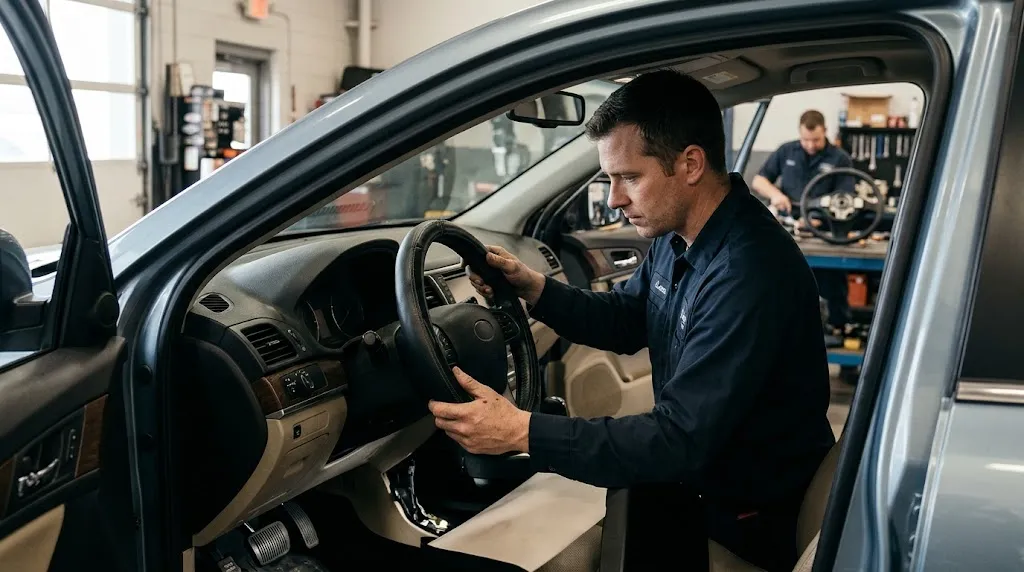
Replacing a removable steering wheel cover is usually a straightforward DIY task, and many basic covers cost less than a full steering wheel replacement. The actual price depends on the material, construction, brand, and vehicle-specific fitment.
As a broad shopping estimate, inexpensive universal covers may cost around $10–$20, midrange options around $20–$40, and premium or specialty covers $40 or more. These are illustrative U.S. retail ranges, not verified live prices or guarantees of quality.
DIY replacement vs. professional help
| Task | Typical approach | When to get help |
|---|---|---|
| Removing a removable cover | Follow the cover manufacturer’s instructions | If it is bonded, stuck, or requires force near controls |
| Installing a replacement | Fit the correctly sized cover evenly | If the cover won’t seat securely or blocks controls |
| Reupholstering the original wheel | Use a vehicle-compatible repair kit or specialist | For complex stitching, heating elements, or damaged components |
| Replacing the steering wheel itself | Follow vehicle-specific service procedures | When airbag, clock spring, wiring, or steering alignment is involved |
A removable cover normally does not require you to remove the steering wheel or disconnect the battery. Don’t dismantle the steering wheel just to replace a slip-on cover.
Replacing the steering wheel itself is a different job. It can involve the supplemental restraint system (SRS), which includes airbags and related components, as well as electrical connectors and the clock spring that maintains electrical connections while the wheel turns.
Pro tip: Before any steering-wheel removal, follow the exact factory service procedure for your vehicle, including its battery-disconnection and airbag precautions. If you’re unfamiliar with SRS work, use a qualified technician.
Why airbag compatibility matters
The driver’s frontal airbag is housed in or around the steering wheel’s central module on many vehicles. A rim cover must not obstruct the module, its deployment path, or any manufacturer-designated clearance.
Never stretch a rim cover over the central airbag pad or use an accessory that conceals the airbag seams. If the product instructions don’t clearly establish compatibility with your wheel, choose another product.
The National Highway Traffic Safety Administration’s airbag guidance explains the role of airbags in crash protection and why correct operation matters. Avoid modifications that could interfere with your vehicle’s safety systems.
Section Takeaway: Replacing a removable cover is different from replacing a steering wheel. Choose a compatible cover and seek professional assistance if fitment, wiring, heating, or airbag safety is uncertain.
Steering Wheel Cover Replacement FAQs
How often should I replace my steering wheel cover?
There is no fixed replacement schedule for every steering wheel cover. Inspect it monthly and replace it whenever it becomes loose, slippery, cracked, torn, or misshapen, regardless of age or mileage.
Can a steering wheel cover last five years?
Yes, a well-made cover may last five years or longer with suitable care and limited damaging exposure. However, heat, sunlight, frequent use, poor fit, and material quality can shorten its lifespan considerably.
Is a peeling steering wheel cover dangerous?
Peeling can expose rough backing, weaken seams, and create an uneven grip. If the damage affects your hand placement or allows the cover to move, stop using it and replace it before driving again.
Can I replace a steering wheel cover without removing the wheel?
Yes, most removable slip-on covers can be replaced without removing the steering wheel. Follow the cover’s fitting instructions and avoid forcing tools or fasteners near the airbag module, electrical controls, or steering-wheel trim.
Should I replace a cover that smells bad?
Not necessarily if the odor comes from removable dirt or surface contamination. Clean it with an appropriate product and let it dry fully; replace it if the odor persists or the material shows signs of deterioration.
Does a more expensive steering wheel cover last longer?
Not always. Higher prices may reflect better materials, stitching, or fitment, but they don’t guarantee a longer lifespan. Check the construction, sizing specifications, care instructions, and warranty rather than relying on price alone.
Can a steering wheel cover affect an airbag?
A correctly fitted cover designed for the steering wheel’s rim should not obstruct the central airbag module. Never cover the airbag pad or interfere with its deployment area, and follow the vehicle manufacturer’s instructions for compatible accessories.
Final Takeaway: Replace Your Cover When Its Condition Changes
The right time to replace a steering wheel cover is when it no longer provides a secure, comfortable, and reliable grip. A calendar date or mileage figure cannot tell you as much as a careful inspection.
Check the fit, surface, seams, and material regularly. Clean minor dirt when appropriate, but don’t try to rescue a cover that slips, peels, or has deteriorated beyond safe use.
When buying a replacement, measure your steering wheel, compare material options, and verify compatibility with your vehicle’s controls and safety features. A properly fitted cover should make driving more comfortable without compromising control.
Ready to replace yours? Inspect your current cover today, confirm your wheel’s measurements, and choose a well-fitting replacement that meets your needs. If anything about the fit or airbag clearance is uncertain, consult your vehicle manual or a qualified technician before installation.

Daniel Brooks is an automotive writer and product researcher focused on car accessories, car tech, maintenance, and practical driving guides. At Plug-in Car World, he helps drivers make smarter automotive decisions through honest reviews and research-driven content.
