
Why a Car Seat’s Crash History Matters: A Complete Safety Guide
Quick Answer
A car seat’s crash history matters because a collision can place stress on its protective components, even when the seat looks undamaged. A child safety seat involved in a moderate or severe crash must be replaced. After a minor crash, continued use depends on the manufacturer’s instructions and the NHTSA car seat replacement guidelines. Never rely on appearance alone to judge a used seat’s safety.
Five important safety considerations
- Hidden component stress: Crash forces may affect the shell, harness, or other restraint components without obvious visible damage.
- Crash severity: Moderate and severe collisions require replacement, regardless of whether the seat looks normal.
- Manufacturer instructions: Some brands require replacement after any crash, including a minor collision.
- Unknown seat history: A secondhand seat with an unverifiable crash history should be avoided.
- Replacement covers: Fresh upholstery cannot restore a crash-damaged seat or prove that its structure is safe.
What should you do?
- Check before reuse: Confirm the collision details, inspect the seat, read its manual, and contact the manufacturer whenever replacement requirements are unclear.
Why a car seat’s crash history matters becomes clear when you consider what happens during a collision. A child restraint may look perfectly clean while its previous use raises serious safety questions.
When evaluating a used car seat, I would check its history before considering price, fabric condition, or convenience. This guide explains crash damage, replacement rules, secondhand-seat checks, and the role of car seat covers.
In This Guide
What Does a Car Seat’s Crash History Mean?
A car seat’s crash history describes whether a child restraint has been involved in a vehicle collision and what happened during that event. It helps determine whether the seat can continue providing appropriate protection.
This history matters for infant seats, convertible car seats, combination seats, and booster seats. Each uses structural components or restraint systems to help protect children during travel.
What information belongs in a crash history?
A useful history records more than a simple yes-or-no answer about previous accidents.
- Previous collisions: Whether the seat was inside a vehicle during any crash.
- Crash circumstances: Whether occupants were injured, airbags deployed, or the vehicle needed towing.
- Nearby vehicle damage: Whether the door closest to the car seat was damaged.
- Seat condition: Any visible cracks, deformation, broken parts, or harness damage.
- Manufacturer guidance: Whether the company required replacement after the incident.
- Previous replacement: Whether the original seat was retired and another restraint was installed.
Why does the history matter more than appearance?
Appearance tells you something about cleanliness and obvious wear. It cannot establish everything that happened to a restraint during a collision.
Imagine two identical convertible car seats sitting beside each other. Both have clean covers, intact buckles, and no visible cracks.
One has never been in an accident. The other was installed in a vehicle during a serious collision.
Those seats should not be treated as equally suitable for continued use. The second seat’s crash history establishes a reason to replace it.
This distinction becomes especially important when buying secondhand equipment. You cannot reliably reconstruct a previous collision by examining fabric alone.
Does crash history apply to an empty car seat?
Yes. A car seat can experience collision forces even when no child occupies it.
The restraint may still be attached through a seat belt or the lower-anchor system. Those connections transfer forces during a crash.
When deciding whether replacement is necessary, consider the collision itself rather than whether a child was sitting in the restraint.
Why Can a Crash Affect Car Seat Safety?
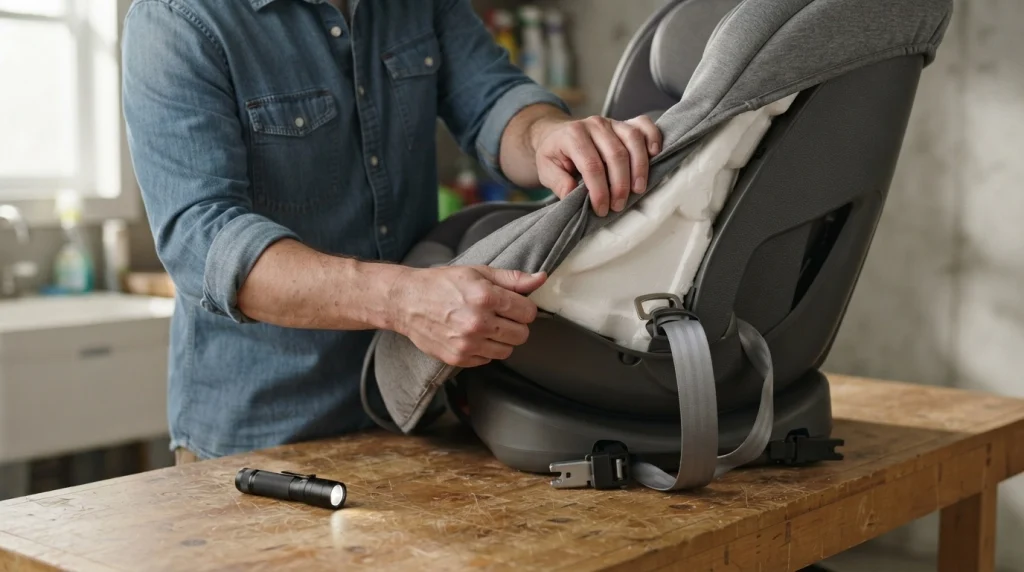
A collision can load parts of a child restraint in ways that ordinary driving does not. Depending on the crash, the seat’s protective components may experience significant stress.
Child car seats are designed to manage crash forces and help control a child’s movement. Their protection depends on multiple parts working together correctly.
Which car seat components may be affected?
Several components deserve attention after a collision.
- Plastic shell: The structural body may crack, deform, or experience stress that is difficult to recognize visually.
- Energy-absorbing foam: Foam components may compress or become damaged during an impact.
- Harness webbing: Straps and their attachment points may experience significant loading.
- Harness adjuster: Damage or malfunction could affect the ability to achieve a secure fit.
- Buckles and clips: Broken or distorted components can interfere with correct restraint use.
- Base and connectors: Infant-seat bases, lower-anchor connectors, and attachment hardware may require replacement under the manufacturer’s rules.
Not every collision damages every component. However, a visual inspection cannot establish that all safety-critical parts remain suitable for another crash.
Can internal damage exist without visible cracks?
Yes, damage may not always be apparent during a routine inspection. That is one reason replacement decisions must consider the crash circumstances and manufacturer instructions.
A clean-looking shell should not be treated as proof of structural integrity. Likewise, a working buckle cannot confirm that every restraint component remains unaffected.
There is an important distinction here. A minor collision does not automatically make every car seat unsafe.
Research informing federal guidance supports allowing some restraints to remain in use after qualifying minor crashes. This is why NHTSA distinguishes minor collisions from more serious events.
How does crash protection depend on the whole seat?
A child restraint works as an integrated safety system. The shell, harness, padding, attachment points, and vehicle installation all contribute to its performance.
For a forward-facing harness seat, the harness and top tether help manage the child’s movement. A rear-facing restraint supports the child’s body differently during a frontal collision.
If an important component is damaged, correct installation alone may not address that problem. The seat must also remain suitable for continued service.
As of 2026, there is no reliable household test that proves an unknown-history car seat is crashworthy. A visual examination cannot substitute for its documented history and manufacturer requirements.
Section Takeaway: A car seat’s safety depends on more than its visible condition. Its collision history helps determine whether the restraint should remain in use.
Does Every Crash Require Car Seat Replacement?
No. Not every minor collision automatically requires replacement under NHTSA guidance.
However, car seats involved in moderate or severe crashes must be replaced. The manufacturer may also require replacement after a minor crash.
What are NHTSA’s five minor-crash criteria?
NHTSA considers a crash minor only when all five conditions below are satisfied.
- The vehicle remained drivable. It could be driven away from the crash scene.
- The nearest door was undamaged. The vehicle door closest to the child restraint sustained no damage.
- No occupants were injured. Nobody inside the vehicle suffered an injury during the crash.
- No airbags deployed. The vehicle’s airbags did not deploy during the collision.
- The car seat has no visible damage. Inspection reveals no observable damage to the restraint.
All five conditions must apply. If one condition is not satisfied, the crash does not qualify as minor under these criteria.
Minor vs. moderate or severe crashes
| Crash situation | Safety assessment | Recommended action |
|---|---|---|
| Minor collision meeting all five criteria | May qualify for continued use | Follow the car seat manufacturer’s instructions. |
| Collision involving airbag deployment | Fails the minor-crash criteria | Replace the car seat. |
| Collision involving occupant injury | Fails the minor-crash criteria | Replace the car seat. |
| Moderate or severe collision | Not suitable for continued use | Replace the car seat. |
| Unknown previous collision history | Safety history cannot be established | Avoid using the secondhand seat. |
Does a low-speed accident count as a minor crash?
Not automatically. Vehicle speed alone does not determine whether a collision meets NHTSA’s minor-crash definition.
For example, a relatively low-speed collision that deploys an airbag fails the minor-crash criteria. A small-looking dent also cannot establish that every required condition was satisfied.
Consider the complete circumstances rather than guessing from repair costs or vehicle appearance.
What if the manufacturer requires replacement after any crash?
Follow the manufacturer’s instructions. Some car seat makers recommend replacement after any collision, even when all five NHTSA minor-crash conditions are met.
The requirements may differ between brands and models. Check the exact instruction manual rather than relying on advice for a similar-looking seat.
Pro tip: When crash severity or replacement requirements are uncertain, contact the car seat manufacturer directly. Use your seat’s original model number to request model-specific guidance.
Section Takeaway: Moderate and severe crashes require replacement. Minor-crash eligibility does not override stricter manufacturer instructions.
How Can You Check a Used Car Seat’s History?
Start by asking the previous owner about the seat’s crash history. If that history cannot be established reliably, avoid using the restraint.
A secondhand car seat can offer financial savings, but an attractive price cannot compensate for missing safety information.
What should you ask the previous owner?
I would begin with direct questions before examining the seat’s fabric or accessories.
- Has this car seat ever been installed in a vehicle involved in a collision?
- Was the restraint present during any accident, even when unoccupied?
- Has the manufacturer ever advised that the seat should be replaced?
- Have the harness, buckle, shell, base, or other components been replaced?
- Have any original parts been removed, substituted, or modified?
- How was the seat cleaned and stored?
- Is the original instruction manual available?
Pay attention to uncertain answers. Statements such as “it probably wasn’t damaged” do not establish a complete crash history.
A seat from a trusted relative may offer better history information than an anonymous marketplace listing. Even then, the same safety checks remain necessary.
What should you inspect on a secondhand car seat?
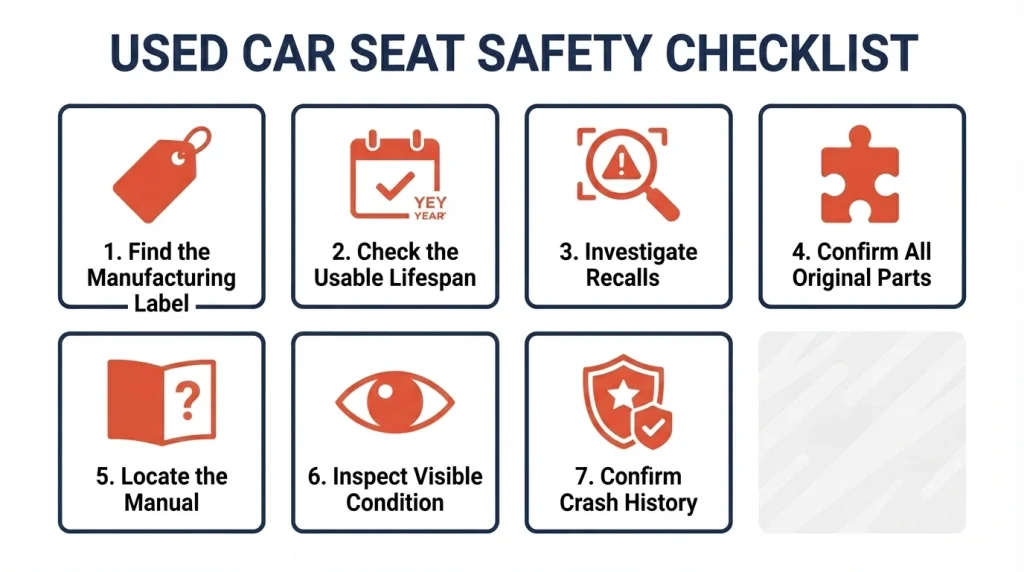
The NHTSA used car seat safety checklist identifies essential conditions for considering a secondhand restraint.
Use the following checks before accepting one.
- Find the manufacturing label. Confirm the brand, model number, and manufacturing date.
- Check the usable lifespan. Consult the manufacturer for the seat’s expiration date or service-life limit.
- Investigate recalls. Search using the specific model information and confirm whether required remedies were completed.
- Confirm all original parts. Check the shell, harness, buckle, base, and other components applicable to that model.
- Locate the manual. Obtain an official copy from the manufacturer if the original is missing.
- Inspect visible condition. Look for cracks, deformation, damaged straps, loose hardware, or other warning signs.
- Confirm crash history. Establish whether the seat has experienced a collision and whether continued use was permitted.
Can a used car seat be safe if it has never been in an accident?
Potentially, yes. A known crash-free history is important, but it does not automatically establish that the seat is suitable.
The restraint must also be within its manufacturer-defined lifespan, complete, undamaged, and free of unresolved safety recalls. It must fit the child and vehicle correctly.
Some seats have manufacturer-specified usable lifespans measured in years from manufacture. Do not assume that every car seat shares the same expiration period.
The American Academy of Pediatrics car seat guidance also advises families to avoid used restraints when their history is unknown.
Section Takeaway: A used car seat needs a trustworthy history, correct identification, complete components, and appropriate condition. Missing information is a reason to choose another seat.
Can Car Seat Covers Hide Crash Damage?
Yes. Replacement upholstery can conceal visible wear or damage beneath the fabric. However, a new cover cannot establish that the underlying child restraint remains safe.
Car seat covers deserve particular attention because they are often replaced for cleanliness or appearance.
What is a car seat cover?
A car seat cover is a fabric or protective layer designed to cover a seat’s surface. For a child restraint, the original cover is part of the manufacturer’s intended configuration.
Some covers are specifically designed for a particular child car seat model. Others are universal aftermarket accessories sold separately.
These products should not be treated as interchangeable.
Why can a new cover create a misleading impression?
Fresh upholstery may make an older car seat appear lightly used. The underlying shell, hardware, and harness could still have a history that requires investigation.
Consider a secondhand infant seat advertised with a new replacement cover. The clean material may look reassuring, but it reveals nothing about previous crash forces.
A proper inspection should consider the following:
- Underlying shell: Examine accessible areas for cracks or deformation according to the manufacturer’s instructions.
- Harness openings: Check for correct routing and visible wear.
- Original identification: Confirm that the manufacturer’s labels remain present and readable.
- Cover compatibility: Verify that the cover is supplied or explicitly approved for the exact car seat model.
- Complete history: Confirm that the restraint has not been involved in a crash requiring replacement.
Are aftermarket child car seat covers safe?
Not every separately sold cover is suitable for every child restraint. Unapproved accessories can interfere with harness fit or alter the configuration the manufacturer intended.
Extra padding may compress during a crash, potentially creating unwanted harness slack. A replacement cover can also interfere with correct strap routing or access to restraint components.
Transport Canada’s aftermarket restraint safety guidance warns about accessories that interfere with harness positioning and other protective features.
The same caution applies to protective mats placed between a child restraint and a vehicle seat. Use them only when the child car seat manufacturer permits their use.
Pro tip: If a child car seat’s original fabric is worn, ask the manufacturer about an approved replacement cover. Never use upholstery changes to justify reusing a seat that requires replacement after a crash.
What Should You Do With a Car Seat After an Accident?
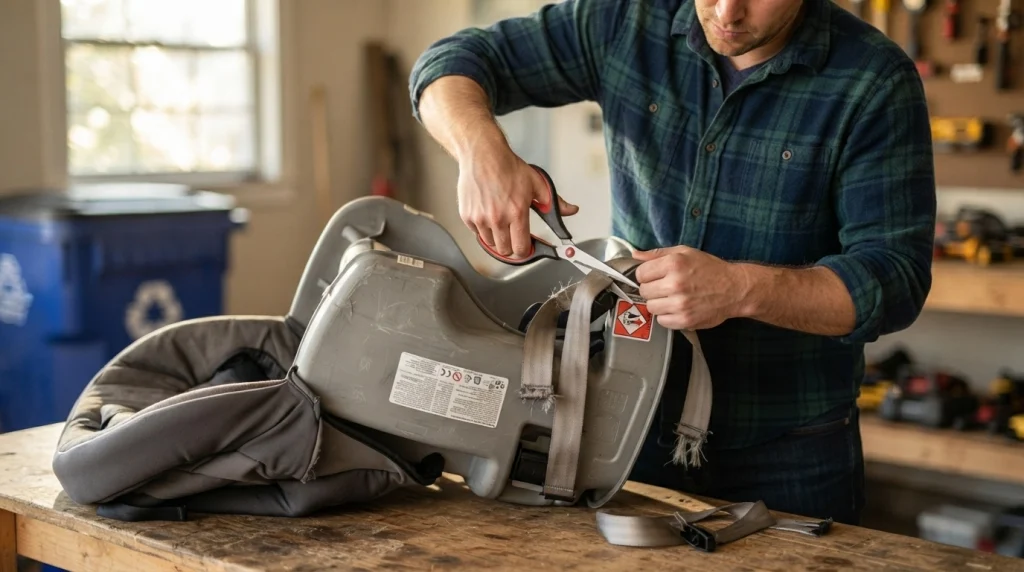
After a collision, determine whether the car seat must be replaced before allowing it to carry a child again. The decision should follow official safety guidance and the manufacturer’s requirements.
Do not assume that an empty seat or an undamaged-looking cover makes continued use acceptable.
Step 1: Document the collision
Once everyone is safe, collect relevant details about the crash.
- Record the accident date and location.
- Photograph vehicle damage when safe.
- Record whether airbags deployed.
- Document whether occupants suffered injuries.
- Note the condition of the door nearest the car seat.
- Record whether the vehicle could be driven afterward.
- Keep photographs of the installed restraint if available.
These details may help the manufacturer assess the circumstances. They can also support an insurance claim.
Step 2: Contact the car seat manufacturer
Use the manufacturer contact details on the restraint label, manual, or official website. Provide the exact model and a factual description of the collision.
Ask whether the seat or any separate base requires replacement. Keep any written guidance for your records.
Step 3: Check insurance replacement coverage
An auto insurance policy may cover replacement of a child restraint following an accident. Coverage depends on the policy, insurer, jurisdiction, and circumstances.
Contact your insurer before disposing of a seat involved in a claim. Ask which photographs, receipts, or other records they require.
Consumer Reports discusses these considerations in its car seat replacement after a crash guide.
Step 4: Retire a seat that requires replacement
Do not donate, sell, or pass along a car seat that must be retired because of its crash history. Another family could otherwise unknowingly use an unsuitable restraint.
Follow the manufacturer’s disposal recommendations and applicable local recycling rules. Depending on those instructions, disposal preparation may include:
- Removing detachable fabric or padding.
- Disabling the harness to prevent reuse.
- Clearly marking the shell as unsuitable for use.
- Checking whether a local recycling program accepts the materials.
Complete any insurance inspection or evidence requirements before making permanent alterations.
Step 5: Install the replacement correctly
Choose a replacement restraint appropriate for the child’s height, weight, and developmental needs. Confirm that it can be installed correctly in the vehicle.
Read both manuals before installation. For a harnessed car seat, check the approved belt path, installation method, recline requirements, and harness adjustment.
The restraint generally should not move more than one inch side to side or front to back when checked at the belt path. Follow model-specific instructions for the final installation check.
A certified child passenger safety technician can help evaluate correct installation. This does not replace manufacturer guidance about the crashworthiness of a previously damaged seat.
Section Takeaway: Document the crash, confirm replacement requirements, ask about insurance, and retire any seat that must be replaced. Correctly installing a suitable replacement completes the process.
Frequently Asked Questions About Car Seat Crash History
1. Can you reuse a car seat after a minor accident?
Possibly. NHTSA states that seats do not automatically require replacement after a minor crash meeting all five specified conditions. However, the car seat manufacturer may require replacement after any collision. Check the exact model’s instructions before continuing to use it.
2. Is a car seat safe if it has no visible crash damage?
Appearance alone cannot establish safety after a collision. Crash forces may affect components without obvious visible changes. If the seat was involved in a moderate or severe crash, replace it regardless of appearance. For minor collisions, follow the manufacturer’s guidance.
3. Should you buy a used car seat with an unknown crash history?
No. An unknown collision history makes it difficult to determine whether a secondhand restraint meets replacement guidelines. Choose a seat with a trustworthy history, identifiable model information, all required parts, and no unresolved recalls or other disqualifying conditions.
4. Does a car seat need replacement if the child was not inside during the crash?
The child’s absence does not automatically exempt the seat from replacement requirements. An installed restraint may experience collision forces while empty. Apply the same crash-severity assessment and manufacturer instructions whether the seat was occupied or unoccupied during the accident.
5. Can replacing the fabric cover make a crashed car seat safe again?
No. Replacing upholstery does not repair structural damage or reverse crash-related stress. If the manufacturer or crash circumstances require replacement, the complete restraint must be retired. Use only manufacturer-approved replacement covers on seats that remain suitable for continued use.
6. How do you know whether an older car seat has expired?
Check its manufacturing date, expiration marking, and instruction manual. Manufacturers establish model-specific service-life limits, so there is no single expiration period that applies to every car seat. Contact the manufacturer if the labeling is unclear or the model’s lifespan cannot be confirmed.
7. Will insurance pay for a new car seat after an accident?
Insurance may cover a replacement, but reimbursement is not guaranteed. Coverage varies with the policy, local rules, and claim circumstances. Contact the insurer, document the restraint’s involvement, and retain relevant photographs and receipts before disposing of the old seat.
Final Takeaway: A child car seat’s crash history is an essential part of its safety assessment. A clean cover, working buckle, or attractive secondhand price cannot establish that a previously crashed restraint is suitable for use.
Before choosing or reusing a child car seat, confirm its history, check the manufacturer’s requirements, and replace it whenever the circumstances call for replacement. Protecting the child matters far more than preserving the seat.

Daniel Brooks is an automotive writer and product researcher focused on car accessories, car tech, maintenance, and practical driving guides. At Plug-in Car World, he helps drivers make smarter automotive decisions through honest reviews and research-driven content.
