
How to Find the Expiration Date on a Car Seat: Complete Guide
Quick Answer
To find the expiration date on a car seat, check the manufacturer’s label on the bottom, back, or side of the seat’s plastic shell. Look for an expiration date, a “Do not use after” statement, or the date of manufacture. If only the manufacture date appears, use the manufacturer’s specified lifespan to calculate expiration. The NHTSA car seat safety checklist also explains why identifying labels matter.
Five quick steps to find the date
- Check underneath: Examine the bottom of the car seat’s plastic shell for a printed sticker or molded date.
- Inspect the back: Look around the rear shell, side panels, and areas identified in the manual.
- Read the label: Find the expiration date, manufacture date, model number, or useful-life statement.
- Check the manual: Confirm how many years the manufacturer allows that particular model to remain in service.
- Verify the result: Contact the manufacturer if the date is missing, damaged, or difficult to interpret.
Important safety reminder
- Do not guess: Car seats have different expiration periods, and the date you purchased yours usually does not determine its lifespan.
Wondering how to find the expiration date on a car seat without spending an hour searching for a tiny sticker? You’re not alone, especially when the label hides behind a base, under the shell, or near the harness hardware.
My approach is to check the identification label first, then verify the manufacturer’s instructions. I’ll walk you through the locations, date calculations, common brands, and safety checks that matter.
In This Guide
- Where Is the Expiration Date Located on a Car Seat?
- How Do You Read and Calculate a Car Seat Expiration Date?
- How Long Do Car Seats Last Before They Expire?
- What If You Cannot Find the Car Seat Expiration Date?
- Is a Car Seat Safe to Use If It Has Not Expired?
- Frequently Asked Questions
- Final Takeaway: Check Before Your Next Drive
Where Is the Expiration Date Located on a Car Seat?
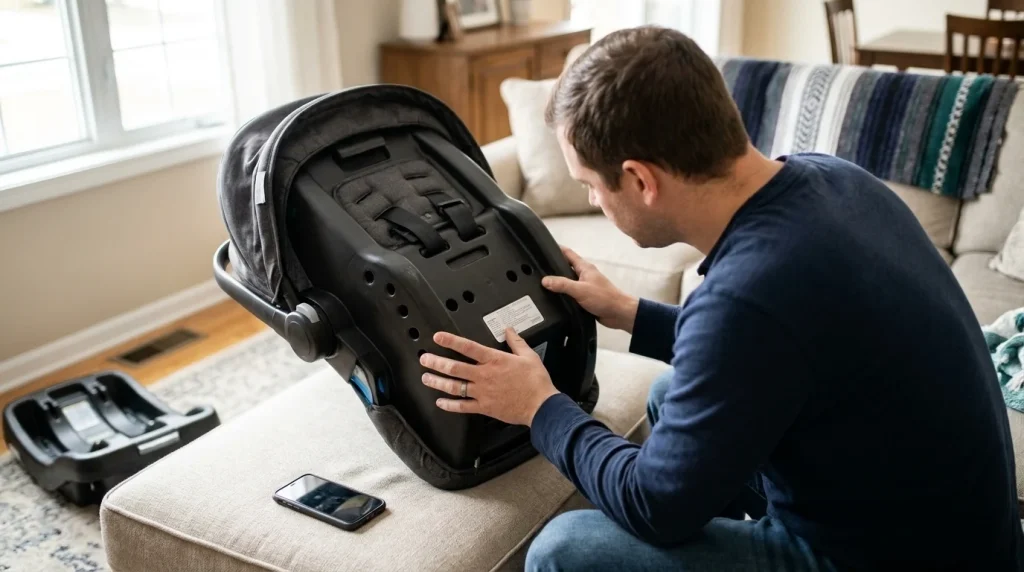
The expiration date is usually printed on a manufacturer label or molded into the car seat’s plastic shell. Common locations include the underside, back, side, and occasionally a covered area identified in the manual.
Manufacturers don’t use one universal label position. Even two seats from the same brand may have different locations.
Car seat expiration date: The date after which the manufacturer says a child restraint should no longer be used. It reflects the manufacturer’s specified service life, not necessarily the seat’s visible condition.
Where is the expiration date on an infant car seat?
Infant car seats often have identification labels underneath the carrier or along the rear shell. You may need to detach the carrier from its base to inspect it.
Use the manufacturer’s normal release procedure. Never dismantle the seat, loosen structural hardware, or modify its safety components to find a label.
Check these areas:
- Underside of the carrier: Look for a white or silver sticker containing production details.
- Rear plastic shell: Inspect around the harness adjustment areas and manufacturer markings.
- Side of the carrier: Some models display safety and manufacturing information here.
- Separate base: Check the bottom or manufacturer-specified compartment for its own identification information.
Remember that an infant carrier and its detachable base can have separate dates. Verify both components rather than assuming one date covers the entire system.
Where is the expiration date on a convertible car seat?
Convertible seats typically have labels on the back, side, or bottom of the shell. The exact location depends on the brand and model.
Large rear-facing and forward-facing seats can make the label difficult to see while installed. A flashlight and your phone camera can help.
- Park your vehicle safely before inspecting the seat.
- Check any accessible side or rear labels.
- Consult the manual’s label-location diagram.
- If necessary, uninstall the seat following the manufacturer’s instructions.
- Photograph the label before reinstalling the seat correctly.
I prefer taking a clear picture of the complete identification label rather than copying a single date. That photo also preserves the model number and other information needed for recalls.
Where is the expiration date on a booster seat?
Booster seats also have manufacturer-defined useful lives. Look underneath the seating area, along the rear shell, or beneath an approved removable cover.
Backless boosters may carry their identification markings on the underside. High-back boosters may have additional markings on the rear structure.
Only remove fabric components when the instructions permit it. A cover that comes off for washing does not mean every underlying part should be removed.
Section takeaway: Start with the underside and back of the seat, but trust your model’s manual for the exact label location. Check detachable bases separately.
How Do You Read and Calculate a Car Seat Expiration Date?
First, determine whether your label shows an actual expiration date or only the date of manufacture. These are different pieces of information.
Some manufacturers print the final use date directly. Others tell you how long the seat remains usable after manufacturing.
What does the date of manufacture mean?
The date of manufacture is when the car seat was produced. It is not the date you purchased, registered, or first installed the seat.
For example, a seat purchased in September 2023 might have been manufactured in April 2022. Its age generally begins with the manufacturing date if that is what the manufacturer specifies.
Look for wording such as:
- Date of manufacture: Identifies the production date.
- Manufactured on: Usually followed by a month, day, and year.
- Expiration date: Identifies the manufacturer’s stated last date of use.
- Do not use after: Gives a date or an age limit for continued use.
- Serial or model number: Helps identify the exact seat but does not automatically represent its expiration date.
How do you calculate expiration from the manufacturing date?
If the manual states that the seat expires a certain number of years after manufacture, add those years to the manufacturing date. Use the lifespan specified for your model.
Here’s a simple hypothetical example:
| Information | Example |
|---|---|
| Manufacture date | April 15, 2021 |
| Manufacturer-specified lifespan | 7 years |
| Calculated expiration date | April 15, 2028 |
| Calculation | 2021 + 7 years = 2028 |
This example illustrates the calculation, not the lifespan of every car seat. A different model could have a different expiration period.
What if the label only shows a month and year?
Do not assume the seat remains usable through the final day of that month. The manufacturer’s wording determines how to interpret a month-only expiration marking.
For an unclear date, contact the manufacturer before continuing to use the seat. Give the representative the model number, manufacture date, and exact wording.
Are molded date stamps the same as expiration dates?
Not necessarily. Some plastic components display molded date wheels or markings that identify when individual parts were produced.
Those markings may differ from the completed seat’s manufacture date. Use the designated product identification label and manual instead of guessing from a molded symbol.
Section takeaway: A manufacture date tells you when the seat was made. To determine expiration, you also need the correct model-specific useful life or a directly printed expiration date.
How Long Do Car Seats Last Before They Expire?
Many child car seats have manufacturer-specified lifespans around 6 to 10 years, although some models have different limits. There is no single expiration period that applies to every brand.
As of 2026, leading manufacturers continue to provide model-specific expiration guidance. Older versions of a product may follow different rules than newly manufactured seats.
Car seat expiration periods by manufacturer
The following examples come from manufacturer guidance. They are starting points, not substitutes for the information printed on your particular seat.
| Brand | Published lifespan examples | Where to verify |
|---|---|---|
| Graco | 7 years for certain plastic-reinforced belt-path seats; 10 years for specified steel-reinforced models and belt-positioning boosters. | Graco expiration guidance |
| Britax | 6 years for specified infant models, 9 years for listed harness-to-booster models, and 10 years for several convertible and all-in-one models. | Britax expiration guide |
| Evenflo | 10 years for its current car seats and boosters; models made before January 2025 may have different expiration periods. | Evenflo expiration information |
Notice how even one manufacturer can specify multiple lifespans. That’s why I never recommend choosing an expiration date from a generic brand chart alone.
The product label, official instructions, and manufacturer support should settle the question. If they appear to disagree, ask the manufacturer to clarify.
Does the type of car seat affect its expiration date?
Yes, but the product category alone cannot establish the exact expiration date. Infant seats, convertible seats, all-in-one seats, and boosters may have different useful lives.
A convertible seat designed for several growth stages does not automatically last longer than an infant seat. The manufacturer determines its service-life limit.
Does the expiration period start when you buy the car seat?
Usually, no. Many manufacturers calculate expiration from the manufacture date rather than the purchase date.
However, don’t assume every manufacturer uses that method. Check the instructions for your exact product, especially when reviewing older models or seats sold outside the United States.
Imagine purchasing a car seat in 2024 that was manufactured in 2022. If its stated lifespan is seven years from manufacture, it would expire in 2029, not 2031.
Keeping your receipt can still help with warranty questions. It does not automatically extend the car seat’s useful life.
Why do car seats have expiration dates?
Car seat manufacturers account for aging materials, changing safety requirements, and the expected service life of their products. Years of handling and vehicle temperature changes can contribute to wear.
Important considerations include:
- Plastic components: Materials may age or deteriorate over extended periods.
- Harness systems: Straps, adjusters, and buckles experience repeated handling.
- Foam and padding: Protective materials must remain in the condition required by the manufacturer.
- Design changes: Child restraint technology and safety requirements can evolve.
- Replacement parts: Older models may no longer have compatible parts available.
Expiration does not mean every seat suddenly breaks on a particular day. It means the manufacturer no longer recommends use beyond that specified limit.
Section takeaway: Brand averages are useful for research, but the exact model determines the lifespan. Always verify the date against official instructions.
What If You Cannot Find the Car Seat Expiration Date?
If the expiration label is missing or unreadable, identify the car seat’s exact model before making any decision. Do not estimate its age using appearance, purchase memories, or the child’s age.
There are several reliable ways to investigate a missing date. Start with the least invasive option.
Step 1: Look for other manufacturer information
Inspect the areas specified in the manual for a model number, serial number, and manufacturing label. Photograph any readable information without altering the seat.
A model number can help the manufacturer identify the correct instructions. A serial number alone should not be treated as an expiration date.
Step 2: Find the original instruction manual
Search the manufacturer’s official support resources using the exact model number. Many brands provide downloadable replacement manuals.
Look under sections such as:
- Safety warnings and precautions
- Product information and identification labels
- Expiration or useful-life instructions
- Maintenance and replacement requirements
The manual may also show exactly where the identification sticker should appear. This helps when a seat has several different labels.
Step 3: Contact the manufacturer
If the manual doesn’t resolve the issue, contact customer support. Ask them to confirm the seat’s expiration date and the correct way to identify it.
Have this information ready:
- Brand and model name
- Model number and available serial number
- Any visible manufacturing details
- Photographs of the seat and labels
- Relevant purchase information, if available
If the manufacturer cannot reliably establish the seat’s age or identity, replace it rather than guessing. A seat with missing identification information also creates recall-checking problems.
What if you bought the car seat secondhand?
Secondhand seats deserve additional attention because expiration is only one safety concern. You also need a trustworthy account of the seat’s history.
Ask the previous owner about crashes, recalls, replacement parts, and cleaning methods. If you cannot verify important safety details, avoid using that seat.
Don’t assume fresh-looking fabric means the seat is nearly new. Covers can be cleaned or replaced while the underlying plastic shell remains years old.
Similarly, an unfamiliar seat without its original identification label may be difficult to authenticate. Contact the manufacturer instead of relying on a seller’s estimate.
Section takeaway: When the date is missing, use the manufacturer’s identification process. If the expiration and safety history cannot be established, choose a replacement.
Is a Car Seat Safe to Use If It Has Not Expired?
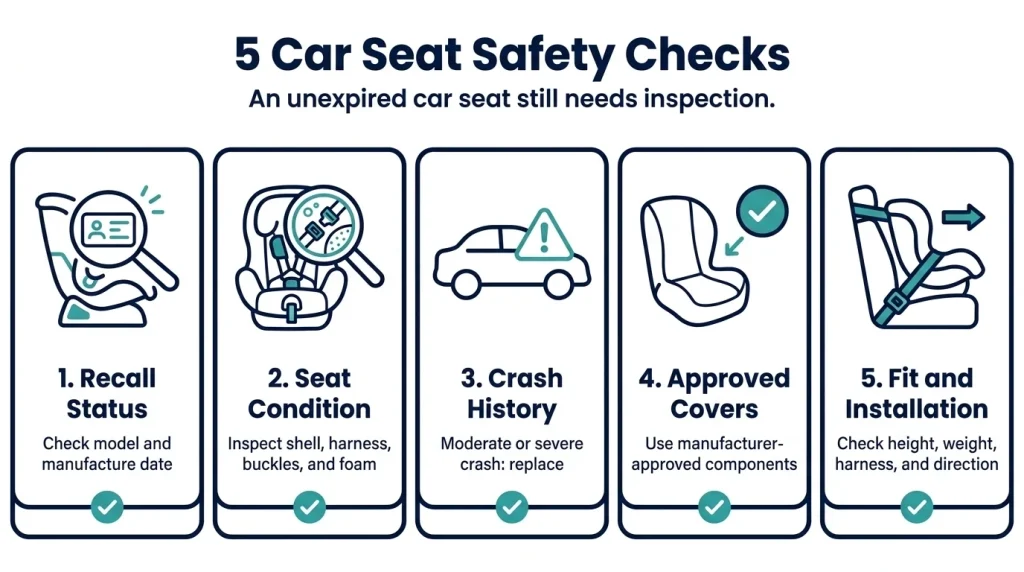
An unexpired car seat is not automatically safe. Its condition, crash history, recall status, completeness, and correct installation also matter.
When I review a seat, I treat the expiration date as the first checkpoint. The remaining safety checks are just as important.
Check for product recalls
A recall is different from an expiration date. A seat may have an active recall even when it is only a few months old.
Use the model number and manufacture date to check the NHTSA recall database for applicable U.S. products. Follow the manufacturer’s official remedy instructions if you find a recall.
Not every recall requires replacing the entire car seat. Some manufacturers provide approved corrective parts or other remedies.
Pro tip: Register your car seat with the manufacturer so you can receive applicable safety recall notifications.
Inspect the shell and safety components
Visible damage can make a seat unsuitable before its expiration date. Inspect the product according to its manual.
Pay attention to these areas:
- Plastic shell: Look for visible cracks, deformation, or broken sections.
- Harness webbing: Check for fraying, cuts, or damage.
- Buckles and adjusters: Confirm they work as the manufacturer describes.
- Foam components: Look for missing or damaged protective pieces.
- Installation hardware: Check for missing or damaged parts.
- Labels: Confirm the model and manufacture information remain identifiable.
Do not glue cracked plastic or substitute generic hardware. Contact the manufacturer about approved replacement parts and whether continued use is permitted.
Consider whether the seat has been in a crash
Crash history can override the expiration date. NHTSA recommends replacing child car seats after moderate or severe crashes.
After a minor crash, replacement may not always be necessary. The crash must meet all of NHTSA’s minor-crash criteria, and the manufacturer’s instructions still control.
Those criteria include:
- The vehicle could be driven away from the crash.
- The door nearest the car seat was not damaged.
- No occupant suffered an injury.
- The airbags did not deploy.
- The car seat has no visible damage.
If the crash does not meet every criterion, do not classify it as minor. When uncertain, stop using the seat and contact its manufacturer.
Pro tip: Always consult the car seat manufacturer’s crash-replacement instructions, even when the seat appears undamaged.
Do car seat covers affect the expiration date?
Replacing the fabric cover does not reset the car seat’s expiration date. The service-life limit applies to the child restraint, not just its upholstery.
Use only replacement covers and accessories approved for that specific model. Unapproved padding or covers can interfere with the harness or change how the restraint fits.
Cleaning also matters. Follow the manufacturer’s instructions for washing fabric, wiping the shell, and caring for harness components.
Never soak harness straps or apply cleaning chemicals unless the instructions expressly permit that method. If a component was cleaned incorrectly, ask the manufacturer whether it needs replacement.
Check the child’s fit and installation
A car seat can be unexpired yet unsuitable for your child. Confirm that the child falls within the manufacturer’s permitted height and weight limits.
Check the required seating direction, harness positioning, and vehicle installation instructions. Do not switch to a different restraint stage based only on the child’s birthday.
For U.S. car seats, a certified child passenger safety technician can help you check installation and fit. The car seat and vehicle manuals remain essential references.
Section takeaway: A valid expiration date is only one part of car seat safety. Recalls, crashes, damage, approved components, and proper installation must also be considered.
Frequently Asked Questions
1. How do I find the expiration date on a Graco car seat?
Find the manufacture date on the car seat’s identification label. Then check the seat’s manual or molded useful-life statement for the correct expiration period. Graco specifies different lifespans for certain seat constructions, so calculate from the exact model’s instructions rather than using one universal number.
2. Where is the expiration date on a Britax car seat?
Britax directs owners to the product’s serial label, although its location varies by model. Many newer seats display the expiration date alongside the manufacture date. If yours shows only the manufacture date, check the manual’s safety information and use the stated lifespan.
3. Can I find my car seat’s expiration date using its serial number?
Sometimes the manufacturer can use serial information to help identify your product. However, a serial number is not automatically an encoded expiration date. Contact the manufacturer with the complete label details and model number if you cannot determine the expiration yourself.
4. Do car seats expire exactly six years after manufacture?
No. Six years is the specified lifespan for some models, not every child restraint. Other models may have seven, eight, nine, ten, or different service-life limits. Always follow the actual expiration date or calculation method provided by the manufacturer.
5. Can I still use a car seat if it expired last month?
You should stop using the seat once it reaches the manufacturer’s expiration limit. Its appearance cannot reliably establish continued crash protection. Replace the expired seat with an appropriate restraint that fits your child and vehicle, following the applicable instructions.
6. Does a car seat base expire separately from the carrier?
Some infant car seat bases have their own manufacture dates, expiration information, or useful-life requirements. Check the base’s label and instructions separately. Do not assume the carrier and base share the same expiration date, especially if they were manufactured or purchased at different times.
7. What should I do with an expired car seat?
Stop using it and check for an appropriate local recycling or disposal program. Before disposal, follow the manufacturer’s retirement guidance, which may include cutting the harness and marking the shell as expired. Do not donate or resell an expired seat for child passenger use.
Final Takeaway: Check Before Your Next Drive
Learning how to find the expiration date on a car seat is a straightforward but important safety task. The challenge is knowing where your particular manufacturer placed the label.
Start with the bottom and back of the shell, identify the manufacture or expiration date, and check the manual. If anything remains unclear, contact the manufacturer instead of estimating.
Before your next drive, take these simple actions:
- Photograph your car seat’s identification label.
- Record the verified expiration date somewhere accessible.
- Check the infant carrier and detachable base separately, if applicable.
- Review the seat’s recall status and overall condition.
- Plan to replace the restraint before its useful life ends.
My final advice is simple: a clean cover and sturdy-looking shell cannot tell you a seat’s age. The manufacturer’s information can.
Check the label today, confirm the date, and make sure your child’s car seat is ready for the road.

Daniel Brooks is an automotive writer and product researcher focused on car accessories, car tech, maintenance, and practical driving guides. At Plug-in Car World, he helps drivers make smarter automotive decisions through honest reviews and research-driven content.
