How Do You Keep a Baby Cool in a Car Seat During Summer? Pre-Cool, Shade, and Check Often
Quick Answer
Yes, you can keep a baby cool in a car seat during summer by pre-cooling the car, shading the window, dressing your baby in one light layer, and checking them often. Start the air conditioning before you buckle your baby in, and plan a stop about every two hours — check how long a newborn can stay in a car seat before you set your break times.
The cool-baby routine in short
- Pre-cool first: Run the air conditioning for 5 to 10 minutes before your baby gets in.
- Shade the sun: Use a window shade on the sunny side, never a blanket over the seat.
- Dress light: One thin, breathable layer beats a thick outfit in a warm seat.
- Touch and check: Feel the back of the neck and chest at every stop for sweat or heat.
One rule to remember
- Never leave a baby alone in a parked car, even for a minute, even with the windows down.
I’ve opened a car door on a July afternoon and felt the heat roll out like an oven. The buckles were hot to the touch, and the seat fabric felt like it had been sitting in the sun all day.
How do you keep a baby cool in a car seat during summer? You cool the car first, block the sun, dress light, keep air moving, and check your baby often. This guide walks through each step, so a hot day never catches you out.
In This Guide
- Why Do Babies Overheat in a Car Seat So Fast?
- How Do You Pre-Cool the Car Before the Drive?
- What Is the Best Way to Cool a Baby During the Drive?
- What Should a Baby Wear in a Car Seat in Summer?
- Do Car Seat Cooling Products Actually Work?
- What Are the Signs Your Baby Is Overheating?
- What Should You Never Do to Cool a Baby in a Car Seat?
- Frequently Asked Questions
Why Do Babies Overheat in a Car Seat So Fast?
Babies overheat faster than adults in a car seat. Their bodies are small, they sweat less well, and they cannot move away from the heat.
A car seat adds to the problem. The padding holds body heat, the harness holds your baby close to that padding, and the seat faces away from the airflow in most cars.
On a 15-minute school run with the air conditioning on low, my nephew still came out with a damp back and pink cheeks.
Why does the back seat stay hotter than the front?
Cool air drops as it moves through the cabin. Front vents cool the driver first, and the back seat gets what is left.
Sun through the rear window adds heat right where your baby sits, and a rear-facing seat blocks airflow around the body.
Why are newborns at higher risk in the heat?
Newborns have less control over their body temperature. They cannot kick off a blanket, shift position, or tell you they feel hot.
Premature babies and babies with a fever or breathing issue need extra care in heat, so ask your pediatrician about travel plans when your baby is unwell.
- Small body, fast change: A baby heats up and cools down faster than an adult.
- Less sweating: Young babies do not sweat as well, so they lose heat slowly.
- Trapped heat: Padding, harness straps, and a reclined seat hold warmth against the body.
- No escape: A strapped-in baby cannot move to a cooler spot or shed a layer.
Section Takeaway: Your baby feels the heat in the back seat before you feel it up front, so check the seat and your baby, not just the dashboard temperature.
How Do You Pre-Cool the Car Before the Drive?
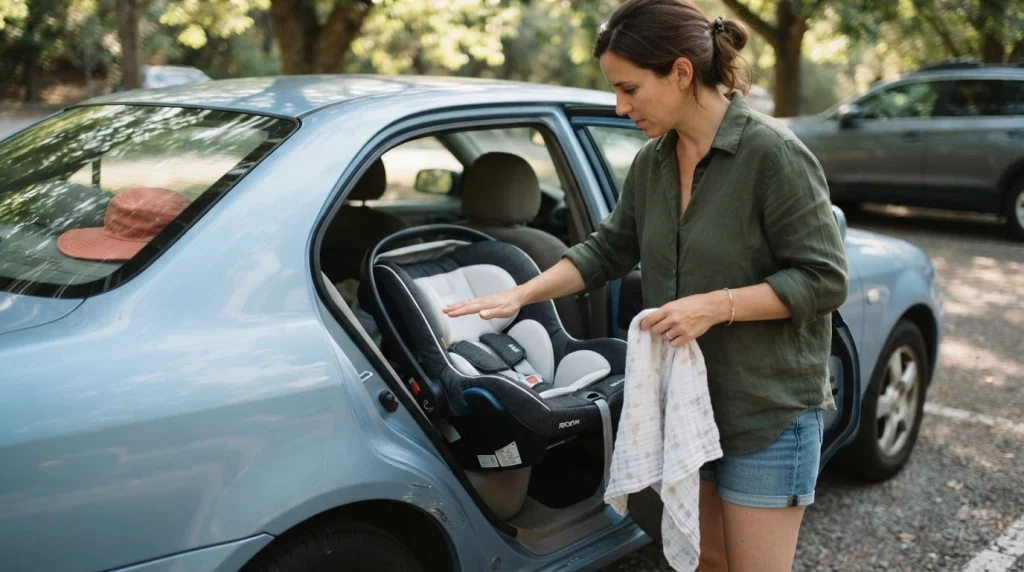
Pre-cooling is the single best step for a summer drive. A cool car at the start buys you comfort for the whole trip.
Start the car, turn the air conditioning to its coldest setting, and let it run for 5 to 10 minutes, opening the doors for the first minute to let trapped hot air out.
Touch the seat, the buckles, and the harness before your baby gets in. If a buckle burns your hand, it will hurt your baby too.
I drape a light towel over the seat when I park in the sun, then lift it off before I pre-cool the car, and I never leave it in the seat while my baby is buckled in. Hot weather car seat safety tips cover the same pre-cool habit, and it is worth building into every summer trip.
Where should you park on a hot day?
Shade beats any gadget. Park under a tree, in a covered car park, or with the rear of the car facing away from the sun.
A sunshade helps the front, but a shade on your baby’s side window does more for the back seat.
How long should you pre-cool the car?
Five minutes is enough for a short trip, and ten minutes is better when the car has sat in full sun for hours.
Watch the air from the rear vents, not just the front ones, and never pre-cool with your baby buckled in while the car idles in a closed garage.
Pro tip: Check your vehicle owner’s manual for air conditioning and rear vent controls, and check Edmunds for your model’s rear air features before a long summer trip.
Section Takeaway: Cool the car before your baby gets in, touch the buckles and fabric first, and never skip the pre-cool on a sunny day.
What Is the Best Way to Cool a Baby During the Drive?
Keep the air moving through the back seat. Point a rear vent toward the seat, or angle a front vent so air flows back, and keep the fan on a steady medium setting.
Direct cold air on your baby’s face is not the goal — gentle, moving air around the seat is.
On a long drive, I stop about every two hours, even when my baby looks happy. I unbuckle, lift them out, and let them cool in the shade for a few minutes.
That break lets me check their skin and the harness fit before we drive on. Can a baby sleep in a car seat explains why those breaks matter for sleep safety too, and the same stop-and-check habit helps in the heat.
Should you use the windows or the air conditioning?
Air conditioning wins on a hot day, because open windows pull in hot air and dust without cooling well.
Open windows can help for a minute when you first get in, to push hot air out, then close them once the air conditioning is on.
How do window shades help?
A shade on your baby’s side window blocks direct sun on their skin and the seat. It cuts the heat load without blocking your view of your baby.
Choose a shade that sticks to the window and stays put, and never hang a blanket over the seat to block the sun — it traps heat and blocks airflow.
- Rear vents on: Aim cool air toward the back seat, not at the dashboard.
- Fan on medium: Steady airflow beats a blast of cold air followed by still air.
- Shade on the sunny side: Move the shade if the sun moves across the car.
- Stop every two hours: Unbuckle, cool down in the shade, and check skin and harness.
- Watch the sun: A seat that was shaded at the start can sit in full sun by midday.
Section Takeaway: Keep air moving through the back seat, shade the sun without covering the seat, and stop on a schedule instead of waiting for fussiness.
What Should a Baby Wear in a Car Seat in Summer?
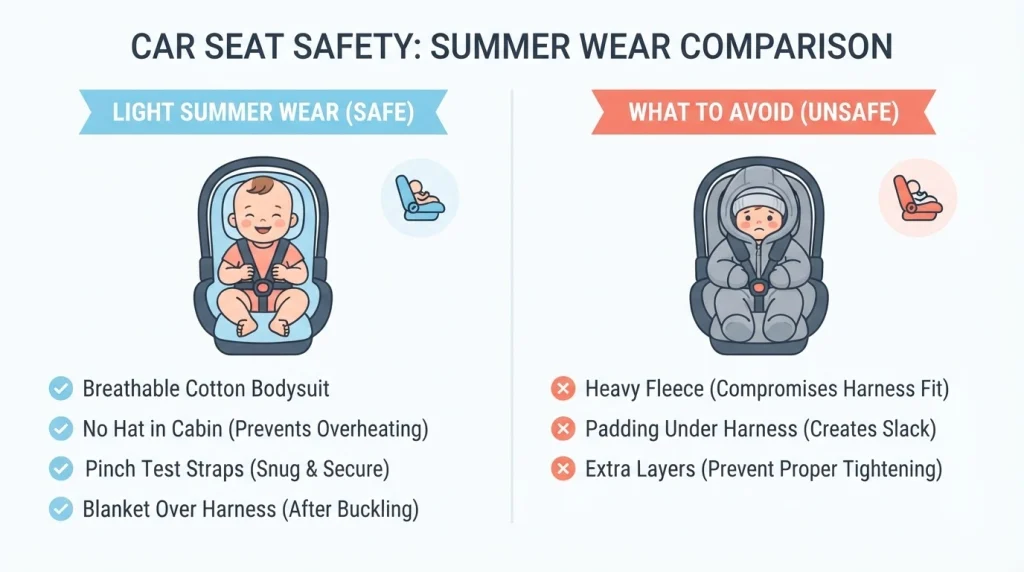
Dress your baby in one light layer in summer. A thin cotton bodysuit or a light onesie is usually enough in a cooled car.
Thick clothes trap heat and change how the harness fits, because the straps need to sit close to your baby’s body.
Check the fit with the pinch test: tighten the harness, then try to pinch the strap at your baby’s shoulder. If you can pinch a fold, it is too loose.
I dress my baby in the car the way I would dress them in a cool room. One light layer, no hat indoors, and a thin blanket over the buckled harness if the air conditioning feels cold.
A blanket over the harness warms without loosening the straps. A blanket under the harness does the opposite, so keep padding out from behind your baby. How to position a newborn’s head safely in a car seat shows the same rule for head supports: nothing extra behind the head or body unless the seat maker allows it.
What fabrics work best in the heat?
Light cotton and bamboo blends breathe well and let sweat dry instead of trapping it against the body.
Avoid heavy fleece and padded outfits, and choose light colours, which absorb less sun near a window.
Should a baby wear a hat in the car?
No hat is needed in a cooled car. A hat traps heat on the head, and the head is where a baby loses heat fastest.
Use a hat outside in the sun, take it off in the car, and check warmth by touching bare feet or socks.
Section Takeaway: One light, breathable layer, a snug harness, and a blanket over the straps — not under them — keep your baby cool and safe.
Do Car Seat Cooling Products Actually Work?
Some cooling products help, and some create new risks. The test is simple: does it change the harness fit, block airflow, or add heat?
Mesh seat covers can help when the seat maker allows them. A breathable mesh layer lets air move under your baby instead of trapping sweat against the padding.
Cooling pads with gel or fans need more care. A thick pad changes the seat shape, lifts your baby up, and can loosen the harness without you noticing.
Use only products the car seat maker allows in the manual. If the manual says no, the product stays out, no matter how well it sells.
I tried a mesh cover on a long summer drive once. It helped on the back, where sweat had pooled before, and the harness still passed the pinch test.
I skipped a fan pad on the same trip — it was thick, needed a cable across the seat, and lifted my baby so the straps sat wrong. Best baby car seat covers for summer lists mesh and breathable options, and it is a good place to compare covers before you buy one.
| Cooling option | How it helps | What to watch |
|---|---|---|
| Breathable mesh cover | Lets air move under your baby. | Must be maker-approved and must not loosen the harness. |
| Window shade | Blocks direct sun on skin and seat. | Must stay fixed and must not block the driver’s view. |
| Thin blanket over harness | Adds warmth only if the air conditioning feels cold. | Never place it under the harness or over the face. |
| Fan or gel cooling pad | Can move air or feel cool to the touch at first. | Thick pads change harness fit, and cables are a hazard. |
| Damp cloth on the neck | Cools fast at a stop. | Use only at a stop, never while driving, and keep it off the face. |
Check Consumer Reports for independent notes on car seat accessories before you buy a cooling add-on. A product that cools well but breaks the harness fit is not a safe buy.
Section Takeaway: A thin, maker-approved mesh cover or a window shade can help, but a thick cooling pad that changes the harness fit is not worth the risk.
What Are the Signs Your Baby Is Overheating?
Check your baby at every stop, and glance back when you can. Early signs are easy to miss when you are focused on the road.
Flushed, red cheeks are a common first sign. Damp hair, a sweaty neck, and a warm chest are next, and fussiness often follows.
Feel the back of the neck and the chest, not the hands or feet, which run cool even when the body is warm.
Fast breathing, a fast heartbeat, and unusual sleepiness are later signs. A baby who feels limp, will not wake, or will not feed needs help right away.
Both need fast action: move your baby to shade, remove extra layers, and cool them with a damp cloth on the neck, armpits, and groin.
What should you do if your baby feels too hot?
Pull over somewhere safe first. Never try to cool your baby while you are still driving.
Take your baby out of the seat, move to shade, remove extra clothes, and offer a feed if one is due. Call your pediatrician if your baby stays hot or seems limp, and call emergency services if your baby will not wake.
- Flushed skin: Red cheeks or a red chest after a short drive.
- Sweat: Damp hair, a wet neck, or a sweaty back in the seat.
- Fussiness: Crying that does not settle, or a baby who seems restless and hot.
- Fast breathing: Breathing quicker than usual at rest.
- Limp or sleepy: A baby who is hard to wake needs urgent help.
Section Takeaway: Feel the neck and chest at every stop, act on the first sign of heat, and get medical help fast if your baby stays hot, limp, or hard to wake.
What Should You Never Do to Cool a Baby in a Car Seat?
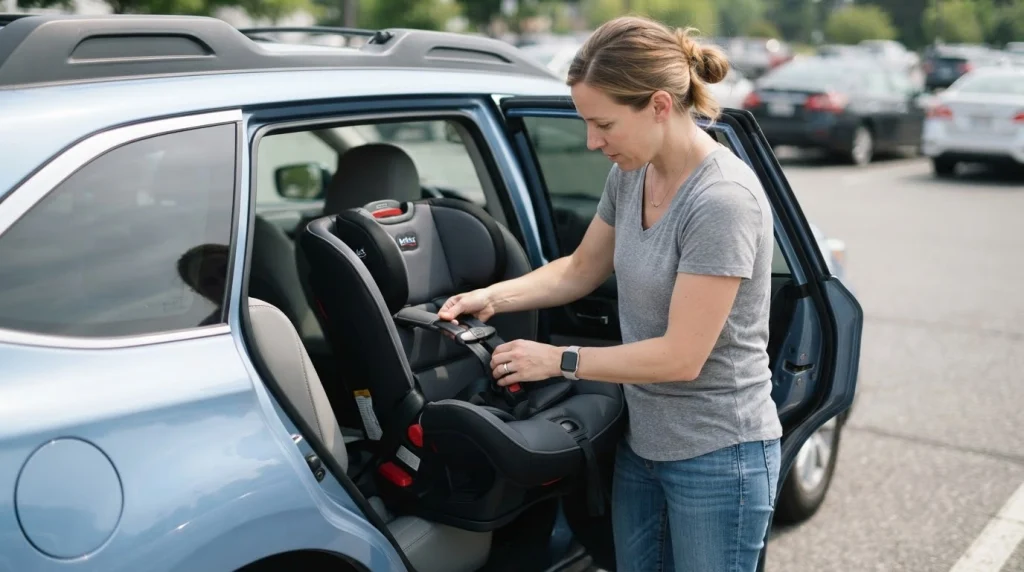
Never leave a baby alone in a parked car. A parked car heats up fast, even on a mild day, and cracking a window does not keep it safe.
Never drape a blanket, towel, or muslin over the car seat to block the sun. It traps heat inside the seat, cuts airflow, and can cover your baby’s face.
Never put ice packs, frozen bottles, or a cold gel pack inside the seat. They can cause cold burns, shift under the harness, and chill one spot while the rest stays hot.
Never loosen the harness to cool your baby down. A loose harness is a crash risk, and it does not cool your baby in any real way.
Never use an unapproved insert or pad to lift your baby off hot fabric, and never rely on a fan alone in a parked car — it only moves hot air around.
Pro tip: Check the NHTSA heatstroke prevention guidance and your car seat manual before summer travel, and use the essential car seat safety checklist for parents as a pre-trip check for harness, recline, and fit.
Section Takeaway: No shortcut is worth a loose harness, a covered seat, or a baby left alone in a parked car — cool the car, not the seat, and stop to check.
Frequently Asked Questions
1. Can I put a fan in front of my baby’s car seat?
Yes, but keep it out of reach and never point it straight at your baby’s face. Air conditioning and a window shade do more than a fan alone.
2. Is it safe to use a cooling pad in a baby car seat?
Only if the car seat maker allows it and the harness still passes the pinch test. Thick pads can lift your baby, change the seat shape, and loosen the harness, so check the manual first.
3. How often should I stop on a hot day?
Stop about every two hours, and sooner if your baby looks hot or fussy. Unbuckle, move to shade, and check the neck and chest before you drive on.
4. Can a baby overheat in a car seat in the shade?
Yes, a shaded car can still feel warm inside, and the seat padding holds body heat. Pre-cool the car, keep air moving, and check your baby even when you park in shade.
5. What temperature is too hot for a baby in a car seat?
There is no single safe number, because sun, humidity, and clothing all change the risk. If the seat feels hot to your hand, or your baby feels hot and sweaty, the car is too warm.
6. Should I wake a sleeping baby to check if they are too hot?
Yes, check at your planned stops without fully waking them if you can. Feel the neck and chest, look for flushed skin, and move them to shade if they feel hot.
Pre-cool the car, shade the window, dress light, and check often. A cool baby is a calm baby, and a calm drive starts before you buckle in.

Daniel Brooks is an automotive writer and product researcher focused on car accessories, car tech, maintenance, and practical driving guides. At Plug-in Car World, he helps drivers make smarter automotive decisions through honest reviews and research-driven content.