How Can You Make a Car Seat More Comfortable for a Baby? 7 Safe Fixes That Actually Help
Quick Answer
You make a car seat more comfortable for a baby by fixing the fit first, then the recline, the harness, and the temperature. A snug harness, the right recline, a breathable cover, and a break every 2 hours do more than any extra padding, and can a baby sleep in a car seat safely once those basics are right.
The fixes that help most
- Fit first: Use the infant insert only while your baby is in its weight range, and remove it when the manual says to.
- Recline right: Set the newborn recline mark, so the chin stays off the chest and the head stays back.
- Harness snug: Pull the straps snug at the shoulders, with no pinchable slack and the chest clip at armpit level.
- Stay cool: Dress your baby in one light layer, shade the window, and keep the cabin near 68 to 72 degrees Fahrenheit.
- Stop often: Take your baby out every 2 hours at most, hold them flat, and let them stretch and cool down.
One rule to remember
- If a comfort add-on goes behind your baby, under the harness, or over the face, skip it unless your car seat manual allows it.
I’ve fitted infant seats in a Honda Civic, a Toyota RAV4, and a cramped sedan with a tall driver up front, and the same lesson kept showing up. Comfort starts with fit, not with shopping.
How can you make a car seat more comfortable for a baby? Start with the fit, the recline, and the harness, then fix heat and fussiness in that order.
In This Guide
What does comfortable mean in a car seat?
A comfortable car seat is a seat that holds your baby in a safe, relaxed pose without pressure, heat, or slump. It does not mean soft like a bed, and it does not mean loose like a lounge chair.
Fit comes first, then recline, then temperature, then calm. If the fit is wrong, no blanket or toy will fix it.
Why do babies cry in a car seat even when the seat is new?
Most car seat crying comes from one of five causes: a loose harness, a wrong recline, heat, hunger, or a wet diaper. A new seat does not rule out any of them.
I once spent 20 minutes in a driveway with a friend, sure the seat was the problem. The harness was the problem, and one snug pull changed the whole ride.
Check the simple causes first, in the same order every time. That habit saves you from buying a fix for a problem you do not have.
- Harness: Loose straps let a baby slide and slump, and slump feels awful.
- Recline: A seat that sits too upright lets the head fall forward.
- Heat: A hot cabin makes a baby sweaty, red, and restless in minutes.
- Hunger: A hungry baby will cry in the best seat in the world.
- Diaper: A wet or soiled diaper rubs with every bump in the road.
How do you tell comfort crying from pain or fear?
Comfort crying often eases when you fix one thing, such as the harness, the heat, or the diaper. Pain crying stays sharp, and fear crying often eases when you hold your baby close.
Section takeaway: Comfort in a car seat means a safe, relaxed pose with no pressure, heat, or slump, and crying is your baby’s way of pointing at fit, recline, heat, hunger, or a wet diaper.
How do you fix the fit first?
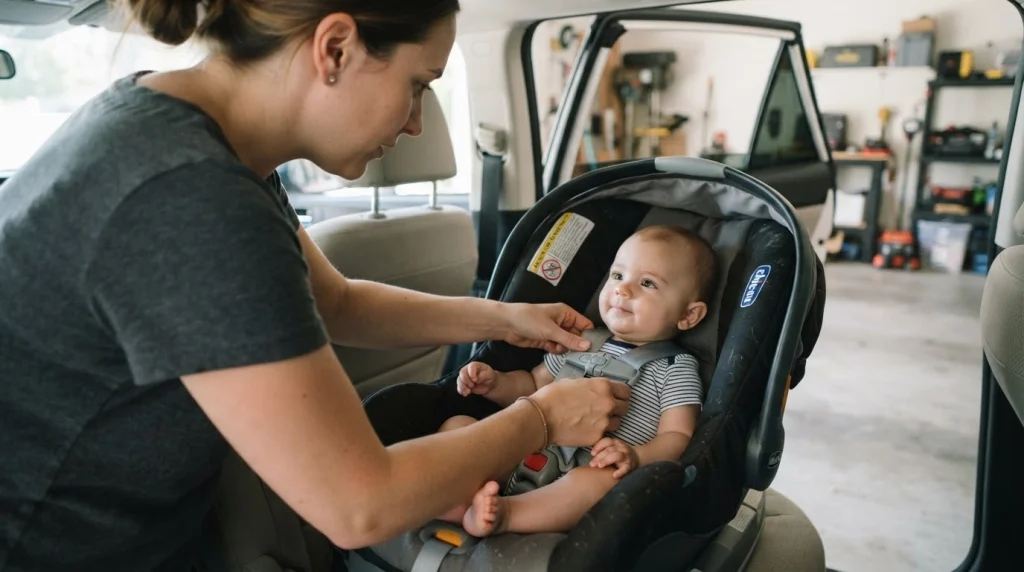
Fix the fit first, because every other comfort change sits on top of it. A seat that fits well holds your baby still, spreads pressure evenly, and keeps the harness where it belongs.
Run through the full safety list before you change anything else. The essential car seat safety checklist for parents covers install, harness, and recline in one pass, and it is worth the 10 minutes.
When should you use the infant insert, and when should you remove it?
Use the infant insert only while your baby is inside the weight and height range printed in your manual. The insert fills the gap around a small newborn, so the harness sits at the right height.
Remove the insert when your baby passes that range, even if the seat looks roomier without it. A baby who has outgrown the insert will sit too high and too far forward with it still in place.
How do you get the harness snug without pinching?
Place the straps flat on the shoulders, with no twists, and pull until you cannot pinch any slack at the collarbone. The chest clip goes at armpit level, not on the belly or up near the neck.
Thick coats and snowsuits hide slack, so dress your baby in a thin layer for the seat. Put the coat on over the harness, or use a blanket on top, once the straps are snug.
- Straps flat: No twists, no folds, and no strap bunched under the arm.
- Pinch check: Try to pinch the strap at the shoulder, and tighten until you cannot grab any slack.
- Chest clip: Level with the armpits, centred on the chest, and closed with a clear click.
- Harness height: At or below the shoulders for rear-facing, and re-check after a growth spurt.
- Seat tightness: The seat should move less than 1 inch side to side at the belt path.
Pro tip: check your car seat for recalls and fit guidance on the NHTSA site, and follow your seat manual first when the two disagree on a model-specific detail.
Section takeaway: Use the infant insert only in its stated range, keep the harness flat and snug with the chest clip at armpit level, and dress your baby thin under the straps.
How do you set recline and head support?
Set the recline to the newborn mark in your manual, and check it again after the base settles. A seat that looks right in the driveway can shift a little after the first few miles.
Recline decides where the head goes, and head position decides how well your baby breathes. That link is why recline matters more than extra padding.
Why does a baby’s head fall forward in a car seat?
A baby’s head falls forward when the seat sits too upright, the harness is loose, or the baby has outgrown the insert. A small baby also has weak neck muscles, so gravity wins fast.
The fix is the recline, not a pillow behind the head. Move the recline to the newborn setting, tighten the harness, and re-check the head after a short drive.
Are head supports safe, and which ones should you use?
Use only the head support that came with your seat, or one your seat maker names as allowed. That support was shaped for your seat, and it sits in the right place for the harness.
Aftermarket head inserts, neck pillows, and strap covers can push the head forward, hide harness slack, or change how the seat works in a crash. They feel soft in the shop, and they can still be the wrong choice in the car.
Read are car seat head support inserts safe to use before you buy one, because the safe answer depends on your exact seat and your baby’s size.
- Built-in support: Use the one that came with the seat, and keep it in the harness path as the manual shows.
- Head position: Head back, chin off the chest, and no tilt that blocks the nose or mouth.
- Aftermarket inserts: Skip them unless your seat maker allows that exact insert.
- Blankets as support: Do not roll a blanket behind the head to prop it up.
Section takeaway: Set the newborn recline, tighten the harness, and use only the head support that came with your seat, because a pillow behind the head cannot fix a wrong angle.
How do you keep your baby cool and dry?

Keep the cabin near 68 to 72 degrees Fahrenheit, shade the rear window, and dress your baby in one light layer. A baby heats up fast in a car seat, because the padding holds warmth close to the body.
Check the back of the neck, not the hands, for warmth. Hands feel cool in air conditioning even when the chest is warm and sweaty.
As of 2026, the advice has not changed: a cool cabin, a breathable seat cover, and a light layer beat a fan pointed at the face. Air flow should be gentle, not a cold blast.
What fabric and clothing help most in heat?
Choose a breathable, washable seat cover in cotton or a cotton blend when your seat allows a cover change. Dark vinyl and thick fleece hold heat, and they make a sweaty back worse.
Dress your baby in a thin cotton onesie for the seat, and add a light blanket on top if the cabin feels cool. Skip the thick fleece suit, because it adds bulk under the harness and heat on top of it.
For sun and heat on the road, read protect your child from sun exposure in a car seat before a summer trip, and plan shade for the side your baby sits on.
How do you stop sweat, rash, and damp clothes?
Change a damp onesie at the next stop, and let the skin dry before you buckle up again. A wet layer chills fast when the air conditioning kicks in, and it rubs with every bump.
- One light layer: Cotton onesie under the harness, blanket on top if needed.
- Shade first: A window shade on the baby’s side cuts glare and heat without blocking air.
- Air flow: Aim a rear vent at the cabin, not straight at the baby’s face.
- Dry change: Swap a sweaty onesie at every long stop, and keep the spare in reach.
Section takeaway: A cool cabin, a light cotton layer, shade on the baby’s side, and a dry change at each stop do more for comfort than any cooling gadget.
What should you not add to a car seat?
Do not add anything that goes behind your baby, under the harness, or over the face unless your car seat manual allows it. That rule covers most of the comfort products in the baby aisle.
The safe question is simple, and it is worth asking before every purchase. Did my seat maker allow this exact add-on, for my exact seat?
| Comfort fix | Safe choice | Risky shortcut |
|---|---|---|
| Head support | Built-in insert from your seat maker | Thick aftermarket neck pillow |
| Extra padding | Infant insert in its stated weight range | Memory foam pad behind the baby |
| Warmth | Thin layer under harness, blanket on top | Thick snowsuit under the harness |
| Sun and heat | Window shade and cool cabin air | Blanket draped over the whole seat |
| Soothing | Pacifier, soft music, a calm voice | Loose toy with hard parts in the seat |
Which aftermarket accessories are the riskiest?
Thick seat liners, strap covers, head pillows, and bunting bags that go under the harness are the riskiest adds. They change the harness fit, and you cannot see the slack they hide.
Read are aftermarket car seat accessories safe before you add anything, and keep the manual open while you read it.
What can you add safely?
You can add a pacifier, a soft toy that clips to the seat and stays out of the face, gentle music, and a window shade. Those adds do not sit under the harness, and they do not change the fit.
A thin, seat-maker-approved cover can help too, if it fits your exact model. Check the fit at home first, then re-check the harness after you fit it.
For a broader guide to car and gear choices, the Consumer Reports homepage is a useful starting point for independent guidance on baby gear and cars.
Section takeaway: Skip any add-on that sits behind your baby or under the harness unless your seat maker allows it, and soothe with a pacifier, music, and shade instead.
How do you keep a baby comfortable on long rides?

Keep a baby comfortable on a long ride by planning the day around stops, not around the map. Take your baby out every 2 hours at most, and give them a real break out of the seat.
A long ride is a series of short legs, with a feed, a change, and a flat rest at each stop. That rhythm keeps a baby cooler, drier, and calmer than any seat add-on.
What should you do at each stop?
Take your baby out, hold them flat, and let them stretch. Feed them, change them, and check the skin for redness and sweat.
Re-check the harness and recline before the next leg, because a seat can shift after a stop. A 2-minute check at a rest area beats a fussy hour on the road.
How do you soothe a fussy baby without breaking the rules?
Talk, sing, or play soft music, and offer a pacifier if your baby uses one. A calm voice from the front seat often works better than a new toy.
If the crying stays loud, pull over at the next safe place and check the basics again. Hunger, heat, a wet diaper, and a loose harness are still the most likely causes.
For the safe add-ons that can help on a long ride, read which car seat accessories are safe to use, and pack only the ones that sit outside the harness path.
For car and road-trip planning, the Edmunds homepage is a useful starting point for route, car, and gear planning.
Section takeaway: Plan stops every 2 hours, feed and change at each stop, and soothe with your voice, music, and a pacifier, never by loosening the harness in a moving car.
Frequently asked questions
Can I put a blanket under my baby in a car seat?
No, do not put a blanket, towel, or pad under your baby in a car seat unless your manual allows it. Use a thin layer under the harness and a blanket on top instead.
Can I use a car seat insert to make my baby more comfortable?
Yes, if it is the insert that came with your seat and your baby is still in its stated weight and height range. Remove it when your baby passes that range, and do not replace it with a thick aftermarket pad.
How do I keep my baby from getting too hot in a car seat?
Keep the cabin near 68 to 72 degrees Fahrenheit, shade the window on the baby’s side, and dress your baby in one light cotton layer. Check the back of the neck for warmth, and change a sweaty onesie at the next stop.
Why does my baby hate the car seat all of a sudden?
A sudden change often points to a growth spurt, a wrong harness height, an outgrown insert, heat, or a wet diaper. Re-check the fit, the recline, and the insert range first, then look at hunger and tiredness.
Can I add padding to make a car seat softer for my baby?
No, do not add memory foam, thick liners, or extra padding behind your baby unless your seat maker allows that exact product. Soft layers can compress in a crash and leave the harness loose, so fix the fit and the recline instead.
How long can a baby stay in a car seat before a break?
Take your baby out every 2 hours at most, and sooner for a newborn in the first month of life. Hold them flat, let them stretch, feed and change them, then re-check the harness before the next leg.
Start with fit, recline, and a snug harness, then keep your baby cool, dry, and out of the seat every 2 hours. A comfortable baby is a safe baby, and a safe seat is the most comfortable seat you can buy.
Check the manual, fix one thing at a time, and let the crying guide you to the cause.

Daniel Brooks is an automotive writer and product researcher focused on car accessories, car tech, maintenance, and practical driving guides. At Plug-in Car World, he helps drivers make smarter automotive decisions through honest reviews and research-driven content.