
Is a Steering Wheel Cover Better Than Replacing the Steering Wheel?
Quick Answer
A steering wheel cover is usually better than replacing the steering wheel when the original wheel is structurally sound but looks worn, feels slippery, or needs a more comfortable grip. Replacement is the better choice for a cracked, deformed, collision-damaged, or otherwise defective wheel, provided the replacement matches the vehicle’s safety systems and specifications. Before modifying a wheel equipped with an airbag, review the official airbag safety guidance.
Which option makes more sense?
- Lower cost: A correctly fitted cover generally costs less than a replacement wheel and installation.
- Cosmetic wear: A cover can hide faded surfaces and minor scuffs without removing the original wheel.
- Structural damage: A cover cannot repair cracks, deformation, or damage from a collision.
- Factory features: Replacement requires careful compatibility checks for airbags, controls, heating, and steering-column connections.
- Driving safety: Neither option is appropriate if the wheel has looseness, abnormal movement, or another unresolved steering fault.
A simple rule
- Choose a cover for comfort and appearance; choose a compatible replacement for a damaged wheel.
- If the wheel is cracked, loose, or damaged after a crash, have it inspected before driving.
If you’re deciding whether a steering wheel cover is better than replacing the steering wheel, start by identifying what’s wrong with your current one. The right choice depends on its condition, your budget, and the features built into your vehicle.
In this guide, I’ll compare costs, comfort, durability, installation, and safety considerations so you can make a sensible decision in 2026 without paying for work you don’t need.
In This Guide
1. Is a Cover or a Replacement Steering Wheel Better?
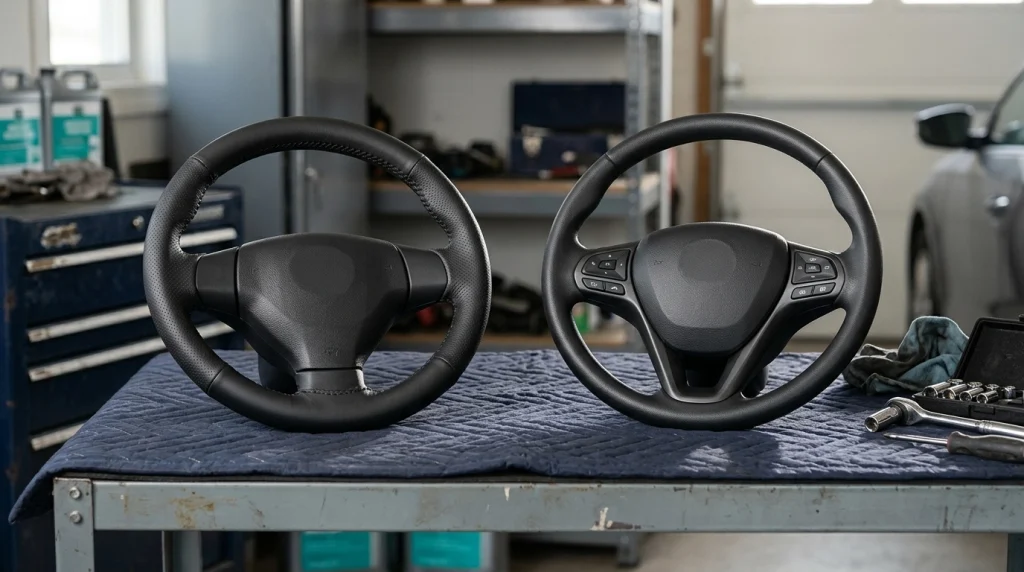
A steering wheel cover is better for minor cosmetic wear and grip improvements, while replacement is better when the original wheel is damaged or no longer suitable for safe use. Neither option is automatically superior because they solve different problems.
What is a steering wheel cover?
A steering wheel cover is a removable or fitted layer that wraps around the original wheel’s outer gripping surface. Common materials include genuine leather, synthetic leather, microfiber, suede-style fabric, and rubber-like compounds.
The cover changes the surface you hold without replacing the underlying steering wheel. A suitable model can improve grip, add cushioning, and conceal worn finish.
What does replacing the steering wheel involve?
Steering wheel replacement means removing the original wheel assembly and installing another compatible wheel. Depending on the vehicle, the job may involve the airbag module, electrical connectors, steering-wheel controls, and a clock spring, which maintains electrical connections as the wheel turns.
Replacement can restore a damaged wheel or update its appearance, but it requires much closer attention to vehicle-specific compatibility. A different-looking wheel is not necessarily a safe or suitable substitute.
| Comparison | Steering wheel cover | Replacement wheel |
|---|---|---|
| Best use | Comfort and surface wear | Damage or a complete wheel upgrade |
| Typical complexity | Low if correctly sized | Moderate to high |
| Airbag disassembly | Normally unnecessary | May be required |
| Repairs structural damage | No | Can, if the correct replacement addresses the damage |
| Preserves original wheel | Usually yes | No |
| Factory features | Generally remain in place | Must be preserved or properly supported |
For most everyday drivers, a well-fitted cover is the sensible first choice when the wheel is sound. Replacement becomes worthwhile when a cover would only hide a more serious problem.
Section takeaway: Match the solution to the fault. Improving the surface is different from repairing or replacing the steering wheel assembly.
2. How Much Does a Steering Wheel Cover or Replacement Cost?
A steering wheel cover generally costs much less than replacing a steering wheel because it requires fewer parts and usually no professional disassembly. The actual price depends on material, vehicle design, parts availability, and local labor rates.
Typical cost ranges in 2026
The following are broad planning estimates in US dollars, not live quotes or guaranteed market prices. Your vehicle’s make, model, trim, and location can change the final amount considerably.
| Option | Indicative cost | What affects the price? |
|---|---|---|
| Basic steering wheel cover | $10–$25 | Basic material and construction |
| Better-quality cover | $25–$60+ | Material, stitching, fit, and finish |
| Replacement wheel from a salvage source | $50–$200+ | Condition, rarity, and included components |
| New OEM replacement wheel | $150–$600+ | Vehicle, trim, controls, heating, and availability |
| Professional replacement labor | $100–$300+ | Labor rates, vehicle procedures, and diagnostics |
These figures are illustrative estimates for budgeting, not a verified price survey. An airbag, damaged clock spring, additional electrical work, or post-repair diagnostics may increase the total.
Which option offers better value?
If your original wheel is sound, spending $30 on a well-fitted cover may solve the problem without the expense of removing the wheel. Paying several hundred dollars for replacement makes little sense when the only issue is a worn outer finish.
However, the cheapest option is not always the best value. A poorly fitted cover can slip, while an unsuitable replacement wheel can create expensive compatibility problems.
- Choose a cover when the wheel is secure, intact, and comfortable to operate.
- Choose replacement when the wheel is structurally damaged or a verified repair assessment calls for a new assembly.
- Get a professional quote when the airbag, wiring, steering column, or electronic controls are involved.
When comparing estimates, ask whether the quoted replacement includes the necessary controls, compatible airbag components, installation, and required checks. Don’t assume that a wheel advertised as a direct fit includes everything your car needs.
Section takeaway: A cover usually wins on upfront cost. Replacement can offer better long-term value when the original wheel needs a proper repair rather than a cosmetic disguise.
3. When Is a Steering Wheel Cover Enough?
A steering wheel cover is usually enough when the original wheel remains structurally sound and the problem is limited to appearance, surface texture, or grip. It can be a practical upgrade for an older daily driver without requiring steering-wheel removal.
When the original finish is worn
Sun exposure, hand oils, cleaning products, and years of use can make a steering wheel look shiny, faded, or uneven. A cover can hide that surface wear and give the cabin a cleaner appearance.
Check the underlying material first. Peeling layers, deep cracks, exposed structural material, or damage near the airbag module deserve closer inspection rather than automatic concealment.
When you want better grip and comfort
A suitable cover can add texture or cushioning to a wheel that feels too smooth or thin. This may be useful if the factory surface has become slippery or uncomfortable during longer drives.
- Leather and synthetic leather: Offer a familiar, finished feel and are relatively easy to wipe clean.
- Microfiber or suede-style materials: Can provide a softer, more textured grip but may need more careful cleaning.
- Rubberized materials: Can add texture, although heat, surface quality, and fit vary by product.
Material alone doesn’t guarantee grip. Stitching quality, inner lining, wheel shape, and the accuracy of the fit all affect how securely the cover stays in place.
When you want a low-effort cosmetic upgrade
Many standard covers install without tools, although tight-fitting designs can require considerable effort. A typical installation may take around 10–20 minutes, depending on the cover and wheel size.
Before purchasing, measure the wheel according to the manufacturer’s instructions. Many passenger-car steering wheels are roughly 14–15 inches (about 36–38 cm) in diameter, but your vehicle may differ.
A cover that’s too loose can rotate unexpectedly, while one that’s too tight may be difficult to install or may not suit the wheel’s shape. Check the fit carefully before driving.
When a cover is the wrong solution
A cover should never be used to disguise a wheel that moves abnormally or has a suspected structural defect. Nor should it be treated as a repair for steering vibration, stiffness, or a steering wheel that sits off-center.
Those symptoms may come from tires, wheel balance, alignment, suspension parts, or steering components. Adding a cover won’t correct the cause.
Section takeaway: A cover is ideal for surface-level problems. Make sure the wheel underneath is safe and the fitted cover cannot shift during normal steering.
4. When Should You Replace the Steering Wheel?
Replace the steering wheel when it has confirmed structural damage, serious deformation, or damage that the vehicle manufacturer says requires replacement. A cover cannot restore the wheel’s original strength or repair a compromised assembly.
After a collision or airbag deployment
A collision can damage a steering wheel even when the damage isn’t obvious from the driver’s seat. If the driver airbag has deployed, the wheel may also require replacement under the vehicle manufacturer’s repair procedure.
Don’t assume a used wheel is safe simply because it looks intact. The correct repair may require inspection or replacement of related restraint-system components as well.
Pro tip: Check the manufacturer’s repair information and applicable recall status before approving steering-wheel or airbag work. NHTSA provides a vehicle recall lookup for US-market vehicles.
When the wheel is cracked, deformed, or loose
A visible crack, bent structure, or abnormal movement calls for a proper inspection. A cover might conceal the damage without correcting it.
It’s also important to distinguish a damaged steering wheel from a fault elsewhere in the steering system. Excessive play, clunks, stiffness, or unusual movement may involve the steering column, steering gear, tie rods, or suspension.
- Cracked or deformed wheel: Arrange an inspection and replace it if the manufacturer or technician determines it’s unsafe.
- Loose wheel on the steering column: Stop treating it as a cosmetic issue and have the mounting and steering system inspected.
- Steering vibration: Investigate possible tire, wheel, brake, or suspension causes instead of replacing the wheel without diagnosis.
- Airbag warning light: Have the restraint system diagnosed; a cover will not fix an SRS fault.
When factory features need restoration
Some steering wheels contain heated elements, cruise-control buttons, audio controls, driver-assistance switches, paddle shifters, or other electronic components. If the wheel assembly is damaged or a feature has failed because of the wheel itself, replacement may be appropriate.
However, confirm the fault before ordering parts. A failed switch, connector, fuse, or clock spring may be responsible, and replacing the entire wheel may not solve the underlying issue.
When an upgrade is the goal
An aftermarket steering wheel may appeal to drivers who want a different shape, material, or motorsport-inspired appearance. But a wheel that fits the shaft physically may not support the original airbag, controls, heating, or driver-assistance features.
For a road car, a compatible OEM replacement is often the simpler route when preserving factory safety equipment matters. Consider an aftermarket assembly only after checking its vehicle-specific suitability and applicable local rules.
Section takeaway: Replace a wheel to address a verified wheel-level problem. Diagnose steering symptoms and electrical faults before buying an assembly.
5. What About Airbags, Fitment, and Installation?
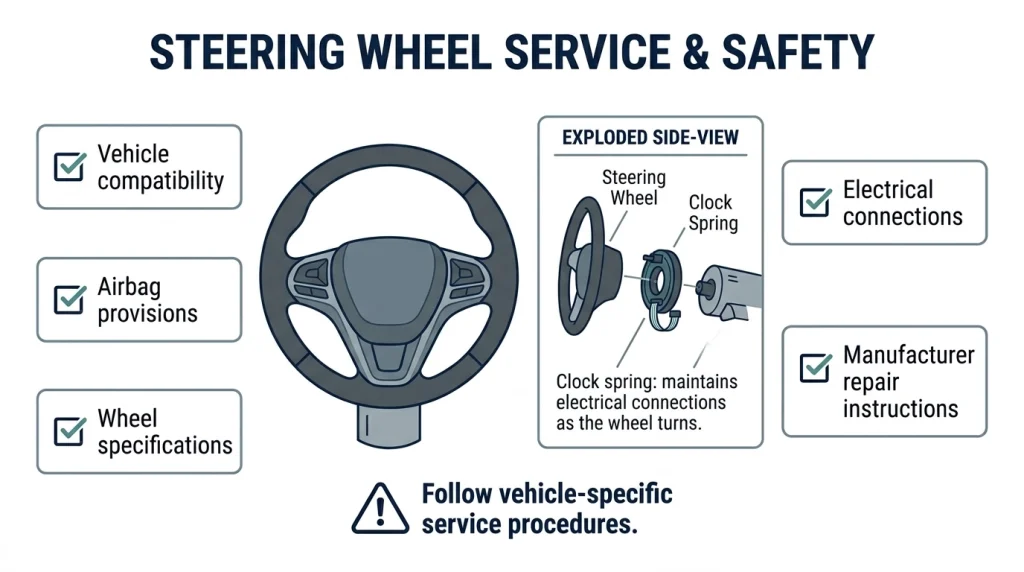
A steering wheel replacement can involve safety-critical restraint components and electrical connections, so it requires vehicle-specific procedures. A simple cover installation usually avoids that disassembly, but the cover still must fit securely and leave the wheel’s controls and safety features unobstructed.
Why airbag compatibility matters
The steering wheel airbag is part of the vehicle’s supplemental restraint system, commonly called the SRS. The wheel, airbag module, mounting points, electrical connectors, and control systems must work together as designed.
An incompatible aftermarket wheel or improperly handled airbag can compromise occupant protection. Never assume that a wheel is safe just because its bolt pattern matches.
Pro tip: Consult your owner’s manual, the factory service information, and a qualified technician before any work involving the airbag module. Never improvise airbag removal or electrical testing procedures.
Why the clock spring and controls matter
The clock spring is a coiled electrical connector that maintains connections between the fixed steering column and the rotating wheel. Depending on the vehicle, it may serve the airbag, horn, steering-wheel buttons, and other functions.
Damage to this component can cause warning lights or loss of features. Incorrect wheel installation can also affect alignment, wiring, or the operation of the steering system.
What should you check before buying a replacement?
- Vehicle compatibility: Match the exact make, model, model year, and trim where relevant.
- Airbag provisions: Confirm that the correct compatible restraint components remain in place.
- Electrical connections: Verify support for the horn, buttons, heating, and other fitted features.
- Wheel specifications: Check the mounting interface, dimensions, and any manufacturer requirements.
- Repair instructions: Confirm required fasteners, torque specifications, centering procedures, and post-installation checks.
Should you replace the wheel yourself?
Installing a slip-on cover is a reasonable DIY job for many owners. Removing a steering wheel with an airbag is a different task and shouldn’t be approached as a generic step-by-step project.
Before steering-wheel removal, follow the manufacturer’s battery-disconnection and SRS waiting procedures exactly, and use the required service information. Disconnecting a battery alone does not make every restraint-system procedure safe.
Use a qualified technician if you lack the correct tools, instructions, or experience. The cost of professional work is easier to justify than an improperly handled safety system.
After replacement, the installer should verify that the wheel is centered, the steering functions correctly, the horn and fitted controls work, and the airbag warning system behaves as specified by the manufacturer.
Section takeaway: Compatibility matters more than appearance. Preserve the original safety functions and use the vehicle-specific repair procedure for replacement work.
6. How Do You Choose the Right Option?
The best choice comes down to three things: the condition of your current wheel, the result you want, and the total cost of a safe solution. Start with the condition rather than choosing a cover or replacement based on appearance alone.
Use this decision guide
| Your situation | Best next step | Reason |
|---|---|---|
| The surface looks faded or worn | Consider a cover | Addresses appearance without removing the wheel |
| The grip feels slippery | Inspect, clean, and consider a suitable cover | May improve the gripping surface |
| The wheel is cracked or deformed | Get a professional inspection | A cover cannot restore structural integrity |
| The airbag has deployed | Follow the manufacturer’s collision-repair procedure | Related restraint components may need replacement |
| A steering-wheel button has stopped working | Diagnose the electrical fault | The switch, wiring, or clock spring may be responsible |
| You want a sportier appearance | Compare a cover with a compatible replacement | A cover may achieve the look with fewer complications |
Consider durability and maintenance
A cover adds another surface that collects sweat, dust, and oils, so it needs regular cleaning according to its material and care instructions. Heat exposure, sunlight, frequent use, and poor-quality construction can shorten its useful life.
A replacement wheel avoids a separate outer cover but still wears with use. Leather can fade or become shiny, while synthetic materials can crack, peel, or lose their texture.
Neither option has a universal lifespan. Buy according to fit, material quality, maintenance needs, and the manufacturer’s warranty rather than relying on an unsupported mileage claim.
Think about resale and original features
Keeping the original wheel and factory features intact may be preferable if you plan to sell the car. A reversible cover can be removed later, although it may leave marks if dirt or trapped moisture has affected the underlying surface.
An aftermarket replacement may appeal to a particular enthusiast, but buyers may prefer the original equipment and functioning safety features. Keep documentation for any replacement and disclose relevant repairs honestly.
Get a quote before committing
If replacement appears necessary, ask a repair shop to separate the part cost, labor, and any additional diagnostic or calibration charges. Confirm whether the quote includes the correct wheel, compatible controls, and required restraint-system work.
For general vehicle-repair guidance and ownership considerations, you can also consult Edmunds and Kelley Blue Book. Use a vehicle-specific service manual for the technical details of your own car.
Section takeaway: Inspect first, then compare total costs. A properly fitted cover is often the economical choice, but no cosmetic upgrade should take the place of a needed safety repair.
7. Frequently Asked Questions
Is a steering wheel cover safer than replacing the steering wheel?
Neither option is inherently safer in every situation. A correctly fitted cover on an undamaged wheel can be a sensible cosmetic upgrade, while a damaged wheel may need replacement. The safest choice preserves steering function, airbag compatibility, and all required factory safety features.
Can a steering wheel cover hide cracks?
A cover can conceal visible surface damage, but it cannot repair a structural crack or confirm that the wheel remains safe. If you find cracks, deformation, or signs of collision damage, have the wheel inspected before covering it or continuing to drive.
Does replacing a steering wheel affect the airbag?
It can. The replacement must support the vehicle’s intended airbag system and related electrical connections. An incompatible wheel or incorrect installation can compromise safety. Use manufacturer-approved repair information and qualified assistance whenever the job involves airbag components.
How much should I spend on a steering wheel cover?
As a broad US-dollar budget, a basic cover may cost $10–$25, while a better-quality option may cost $25–$60 or more. Fit, material, stitching, and durability matter more than price alone. Check your wheel dimensions and the cover manufacturer’s fitment guidance before buying.
Will a steering wheel cover stop steering wheel vibration?
No. A cover changes the gripping surface, not the mechanical causes of vibration. Tire imbalance, damaged tires, wheel problems, brake issues, or worn suspension and steering parts can cause vibration. Have persistent or severe vibration diagnosed rather than trying to cover up the symptom.
Can I install a replacement steering wheel at home?
Some experienced DIY owners can complete vehicle-specific replacement work with the correct tools and service information. However, wheels with airbags involve safety-critical procedures, wiring, and correct fastener specifications. If you’re unfamiliar with SRS systems, have a qualified technician perform the work.
Is an OEM steering wheel better than an aftermarket wheel?
An OEM wheel designed for your exact vehicle is often the more straightforward choice for preserving factory fit, controls, and restraint-system compatibility. An aftermarket wheel may suit a particular build, but confirm its legality, safety provisions, and compatibility before installation.
Final takeaway
If your steering wheel is intact and you want a better grip or fresher appearance, start with a quality, correctly fitted cover. If the wheel is structurally damaged or a manufacturer-approved repair requires replacement, choose the correct replacement and preserve the vehicle’s safety systems.
Before spending money, inspect the existing wheel, identify the actual problem, and compare the total cost of each suitable option. When in doubt about damage, airbag compatibility, or steering faults, get a qualified inspection rather than relying on a cover to solve the problem.

Daniel Brooks is an automotive writer and product researcher focused on car accessories, car tech, maintenance, and practical driving guides. At Plug-in Car World, he helps drivers make smarter automotive decisions through honest reviews and research-driven content.
