
Can a Loose Steering Wheel Cover Cause an Accident?
Quick Answer
Yes, a loose steering wheel cover can contribute to an accident if it slips, rotates, or interferes with your grip while driving. The cover doesn’t usually affect the steering mechanism directly, but unexpected movement can make precise steering harder when you need it most.
Why a loose cover is a safety concern
- Grip can slip: The cover may rotate beneath your hands during a sudden turn or evasive maneuver.
- Steering corrections become harder: Unexpected movement can delay or reduce the precision of your response.
- Fitment may be wrong: An oversized or stretched cover can move even when installed carefully.
- Material can deteriorate: Worn seams, damaged elastic, and stretched synthetic material can allow slipping.
- Other hazards may exist: A cover that interferes with controls or is incompatible with a heated steering wheel needs attention.
What should you do?
- If the cover slips while driving, pull over somewhere safe and stop using the vehicle until the problem is corrected.
- Remove or replace a loose cover only when the vehicle is parked safely, and verify that the replacement fits securely.
A steering wheel cover is an accessory fitted over the original steering wheel rim to change its feel, improve comfort, or protect its surface. When that cover moves independently of the wheel, it can compromise the grip you rely on to control the car.
I approach this as a driver-control issue rather than a cosmetic problem. This guide explains the risks, the warning signs, how to check the fit safely, and when replacement or professional help makes sense.
In This Guide
- How can a loose steering wheel cover cause an accident?
- What are the warning signs of an unsafe cover?
- Why do steering wheel covers become loose?
- How can you check and fix a loose steering wheel cover?
- Is the cover loose, or is the steering system faulty?
- How can you prevent steering wheel cover problems?
- Frequently asked questions
How Can a Loose Steering Wheel Cover Cause an Accident?

Yes, a loose steering wheel cover can increase accident risk by allowing your hands to move without transferring steering input as predictably as intended. The danger is greatest when you need a quick, accurate correction to avoid another vehicle, a pedestrian, or an unexpected obstacle.
1. It can slip during a sudden turn
Your hands depend on a stable connection to the steering wheel rim. If the cover rotates independently, your grip may shift before the steering wheel responds as expected.
Imagine a car pulling out in front of you on a busy road. You reach to steer around it, but the cover slides under your palm, making the movement less controlled than you anticipated.
The precise outcome depends on how far the cover moves, your speed, road conditions, and how much steering correction the situation requires. Even a brief loss of confidence in your grip can matter during an emergency maneuver.
2. It can interfere with steering precision
Small steering adjustments help you maintain your lane, follow curves, and correct the vehicle’s path. A cover that shifts or bunches up can make those adjustments feel inconsistent.
This doesn’t mean every loose cover will cause a crash. It means an avoidable source of uncertainty exists between your hands and the steering wheel.
3. It can create a false sense of security
A cover may look normal while its inner surface has stretched or its stitching has started to fail. Drivers sometimes notice the problem only after the material moves during a turn.
Don’t wait for a near miss to confirm that the cover isn’t secure. If it rotates, slides, or bunches up, stop driving until you’ve corrected the issue.
Does a loose cover affect power steering?
A loose rim cover generally doesn’t damage the power steering system directly. Power steering uses hydraulic assistance or an electric motor to reduce the effort needed to turn the wheels, while the cover affects the driver’s grip on the steering wheel.
However, a separate steering fault can occur at the same time. If the wheel feels unusually heavy, has excessive play, or produces new noises, don’t assume the cover explains everything.
Safety takeaway: A cover that moves independently of the steering wheel is not safe to ignore, even if the car otherwise seems to steer normally.
What Are the Warning Signs of an Unsafe Cover?
The clearest warning sign is movement between the cover and the original steering wheel. A secure cover should stay in position when you grip the rim and apply gentle pressure while the vehicle is parked.
Check for these problems before your next trip.
- Rotational movement: The cover turns around the rim instead of remaining firmly seated.
- Sliding: The cover shifts sideways or moves out of position when you grip it.
- Loose sections: One part fits tightly while another lifts, wrinkles, or bunches up.
- Damaged seams: Stitching splits or the material begins separating near the grip points.
- Unusual thickness: Folded or bunched material creates an uneven grip around the wheel.
- Persistent slipping: Your hands slide across the material more easily than expected, especially when your palms are damp.
Can you tell whether the cover is safe just by looking?
No. Visual inspection can reveal tears, gaps, and damaged seams, but it can’t confirm that the cover will stay in place under steering loads.
Check both the visible condition and the fit. If you can’t confidently establish that the cover is secure, remove or replace it rather than relying on appearance alone.
When should you stop driving immediately?
Stop at the first safe opportunity if the cover slips during normal driving or makes it difficult to hold and turn the wheel reliably. Don’t continue to your destination just to see whether the problem happens again.
If the steering wheel itself has excessive free play, suddenly becomes difficult to turn, or feels disconnected from the front wheels, treat that as a separate, potentially serious mechanical problem. Arrange professional inspection and towing when continued driving could be unsafe.
Pro tip: Check your vehicle owner’s manual for steering-related warnings and safety instructions. If you suspect a mechanical fault, ask a qualified technician to inspect the steering system.
Why Do Steering Wheel Covers Become Loose?
Most loose covers result from incorrect sizing, material deterioration, poor installation, or a mismatch between the cover and the steering wheel. Identifying the cause helps you choose a lasting fix instead of repeatedly pushing the cover back into place.
Common causes and their solutions
| Cause | What you may notice | Best response |
|---|---|---|
| Incorrect diameter | The cover feels loose around much of the rim. | Measure the wheel and choose the correct size. |
| Incorrect rim thickness or shape | Some sections fit while others shift. | Check compatibility with the wheel’s profile. |
| Stretched material | The cover gradually becomes easier to rotate. | Replace the worn cover. |
| Damaged stitching or lining | Seams separate or the inner surface bunches up. | Replace it if damage affects secure fitment. |
| Incorrect installation | The cover sits unevenly or isn’t fully seated. | Reinstall according to the manufacturer’s instructions, if undamaged. |
| Contamination or wear | The surface feels slippery or the fit deteriorates. | Clean as directed or replace the cover. |
Why does steering wheel size matter?
A cover must match the wheel’s outside diameter and the thickness and shape of its rim. A difference of even a small amount can affect how tightly the cover seats, depending on its construction.
Many passenger-car steering wheels measure roughly 14–16 inches (about 36–41 cm) across, but this is only a general reference, not a fitment specification. Always measure your own wheel and check the manufacturer’s size range.
Can heat or cold make a cover loose?
Temperature changes can affect some cover materials, particularly synthetic materials and elastomers. Repeated exposure to sunlight and cabin heat can also accelerate wear in susceptible products.
Material alone doesn’t determine safety. A correctly sized leather, synthetic leather, silicone, or fabric cover still needs secure fitment and must be compatible with the vehicle.
Section takeaway: Replace a cover that has stretched, torn, or lost its grip. Choosing the right size is more reliable than trying to compensate for a poor fit.
How Can You Check and Fix a Loose Steering Wheel Cover?
You can check a steering wheel cover’s fit while the vehicle is parked, switched off, and secured. You don’t need to start the engine or take the car onto the road to test whether the cover moves independently.
Step 1: Park and inspect the cover
Park on level ground, engage the parking brake, switch off the vehicle, and remove the key or follow your vehicle’s shutdown procedure. Make sure the car cannot roll before inspecting the steering wheel.
Look around the entire rim for movement, uneven seating, stretched material, and damaged seams. Pay particular attention to the sections where your hands normally grip the wheel.
Step 2: Check for movement by hand
Grip the cover gently at several points and apply light pressure to see whether it shifts relative to the original wheel. Avoid forceful twisting or any test that could damage the wheel, controls, or cover.
- Secure fit: The cover stays seated and doesn’t rotate independently.
- Loose fit: The cover slides, twists, or moves away from its intended position.
- Damaged fit: A seam separates, material bunches up, or part of the cover lifts away from the rim.
If you notice movement, don’t drive the car until you’ve corrected the problem. A simple stationary check is useful, but it cannot guarantee safe performance under every driving condition.
Step 3: Remove or reinstall the cover
If the cover is undamaged and the manufacturer’s instructions permit reinstallation, remove it carefully and check the original steering wheel surface. Clean away residue using a method approved for the wheel’s material.
Reinstall the cover according to its instructions, ensuring it sits evenly around the rim. If it remains loose, stop trying to make it fit.
Don’t use glue, tape, cable ties, or improvised fasteners to secure a cover unless the vehicle and accessory manufacturers explicitly approve that method. An improvised repair may fail unexpectedly or damage the original steering wheel.
Step 4: Replace an incompatible cover
Measure the wheel’s outside diameter and check the rim thickness against the accessory manufacturer’s specifications. Replace the cover with one designed for that size and shape.
If you have a heated steering wheel, consult both manufacturers before fitting any cover. Some accessories can reduce heat transfer or conflict with the vehicle’s operating restrictions.
Pro tip: Never remove the steering wheel, airbag module, or steering-column components to fix an ordinary rim cover. If access to safety-related components appears necessary, stop and consult a qualified technician.
When is professional help necessary?
A cover replacement is usually a straightforward accessory task, provided the cover is designed for your vehicle and installs without modifying any safety components. Professional help is appropriate if the original wheel is damaged, the steering controls malfunction, or the steering itself feels abnormal.
If the cover is secure but the wheel still has excessive play, vibration, or unusual resistance, have the steering system inspected separately. You can consult NHTSA’s vehicle safety resources for general safety information and guidance on vehicle-related concerns.
Section takeaway: Inspect, test, and correct the fit while parked. If the cover cannot stay securely in place without improvised modifications, replace it.
Is the Cover Loose, or Is the Steering System Faulty?
A loose cover and a mechanical steering problem can produce different symptoms, although both may occur at the same time. The key distinction is whether the cover moves independently or the steering wheel itself behaves abnormally.
| Symptom | Possible explanation | Recommended action |
|---|---|---|
| Cover rotates around the rim | Incorrect size, wear, or poor fit | Remove or replace the cover. |
| Steering wheel has excessive free play | Possible steering linkage, steering gear, or column problem | Arrange prompt professional inspection; don’t drive if control is compromised. |
| Wheel vibrates at certain speeds | Possible wheel balance, tire, suspension, or other mechanical issue | Have the cause diagnosed rather than blaming the cover alone. |
| Steering becomes unusually heavy | Possible power steering or mechanical fault | Stop when safe and seek assistance if control is affected. |
| Wheel makes new clunking or grinding noises | Possible steering-column, steering-gear, or suspension issue | Arrange a mechanical inspection. |
| Airbag warning light appears | Possible restraint-system fault | Follow the owner’s manual and arrange qualified diagnosis. |
Can a loose cover affect the airbag?
A cover fitted only over the outer rim generally poses a different risk from an accessory that obstructs or alters the driver’s airbag module. However, a poorly designed accessory may interfere with controls or other vehicle-specific features.
The driver’s frontal airbag is typically housed in the steering wheel’s central hub, separate from the rim. Don’t cover, modify, or attach unapproved accessories to the airbag cover or deployment area.
In its 2024 warning about aftermarket steering wheel decals, NHTSA explained that decorative decals can detach during airbag deployment and cause serious injuries. Although a rim cover is not the same product, the warning reinforces why steering-wheel accessories must never interfere with airbag safety.
Pro tip: Consult your vehicle owner’s manual for accessory restrictions and airbag precautions. Never assume an accessory is safe simply because it fits physically.
Can you keep driving if only the cover is loose?
The safest approach is to stop at the first safe opportunity and correct the problem before driving again. A loose cover may not indicate a failed steering mechanism, but it can still compromise your ability to maintain a dependable grip.
If the steering wheel itself feels loose, the vehicle pulls unexpectedly, or you notice a sudden change in steering response, treat the issue as a potential mechanical fault. Arrange professional assistance rather than attempting to diagnose it while driving.
Section takeaway: A moving cover usually calls for removal or replacement, while abnormal steering behavior calls for mechanical diagnosis. Never use a cover adjustment as a substitute for repairing a steering fault.
How Can You Prevent Steering Wheel Cover Problems?
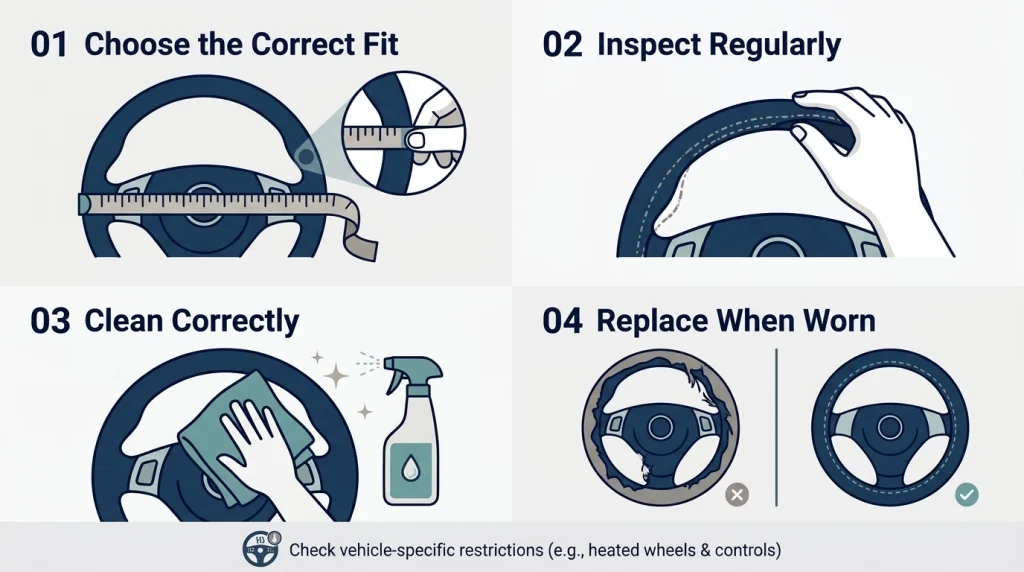
You can reduce the chance of a loose steering wheel cover by choosing the correct fit, following the installation instructions, and checking its condition regularly. A quick inspection during routine vehicle cleaning can catch wear before it becomes a driving hazard.
Choose a cover that matches your wheel
Don’t buy based on appearance or a generic label such as universal fit alone. Verify the required dimensions and confirm that the cover suits your particular steering wheel design.
Consider these factors before purchasing:
- Diameter and rim thickness: Match the manufacturer’s stated fit range.
- Material: Choose a surface that provides a consistent grip and suits your cleaning routine.
- Construction: Inspect seams, inner lining, and edges for weak points.
- Vehicle compatibility: Check restrictions for heated wheels and integrated controls.
- Installation method: Follow the supplied instructions without adding unapproved fasteners.
Inspect the cover during routine maintenance
There’s no universal replacement interval for every steering wheel cover. Inspection frequency should reflect its condition, use, and exposure to sunlight, heat, moisture, and cleaning products.
As a practical habit, check the cover during your regular interior cleaning and whenever you notice a change in grip. Replace it promptly if the material stretches, the stitching separates, or the cover starts moving.
Clean the cover correctly
Accumulated oils, dust, and cleaning-product residue can change how a steering wheel feels in your hands. Use only cleaning methods compatible with the cover material and the original wheel surface.
- Check the manufacturer’s cleaning recommendations before applying a product.
- Avoid soaking materials that may absorb water or weaken at the seams.
- Remove slippery residue completely and allow the surface to dry.
- Recheck the cover’s fit after cleaning or reinstalling it.
Don’t overlook the original steering wheel
The factory wheel should remain in good condition beneath the cover. Cracks, loose trim, damaged controls, or other defects deserve attention even if a new cover hides them.
For general vehicle safety information, NHTSA’s vehicle safety section is a useful starting point. Your owner’s manual and the vehicle manufacturer remain the primary references for model-specific equipment restrictions.
Section takeaway: Good fitment, compatible cleaning products, and regular inspections are the simplest ways to prevent cover-related grip problems.
Frequently Asked Questions
Can a loose steering wheel cover cause an accident?
Yes. If the cover slips or rotates beneath your hands, it can make steering corrections less predictable and increase the risk of losing control during an emergency maneuver. Remove or replace a cover that won’t remain securely in place.
Is it safe to drive with a slightly loose steering wheel cover?
No amount of independent movement should be dismissed as harmless. Even if the cover shifts only slightly, you cannot assume it will remain stable during sudden steering input. Stop at a safe location and correct the fit before continuing.
How do I know whether my steering wheel cover is too big?
Look for gaps, loose sections, bunching, or rotation around the rim. Measure the steering wheel’s diameter and compare it with the cover manufacturer’s fit specifications. If the cover remains loose after correct installation, choose a compatible replacement.
Can I use glue or tape to secure a loose steering wheel cover?
Avoid improvised adhesives and fasteners unless the accessory and vehicle manufacturers explicitly approve them. Glue or tape may damage the original steering wheel, create an uneven grip, or fail over time. A properly sized replacement is the safer solution.
Can a loose steering wheel cover damage the steering system?
A loose rim cover generally doesn’t damage the steering mechanism directly. Its primary concern is driver control and grip. If you also notice excessive steering play, unusual noises, vibration, or heavy steering, have the mechanical system inspected separately.
Does a steering wheel cover interfere with the airbag?
A correctly fitted cover limited to the outer rim is different from an accessory attached to the central airbag module. However, compatibility varies by vehicle and accessory. Follow the owner’s manual, keep the airbag area unobstructed, and never modify the airbag cover.
When should I replace my steering wheel cover?
Replace it when it slips, stretches, tears, develops loose seams, or no longer fits securely. There is no single replacement interval for every material and driving environment. Condition and secure fit matter more than age alone.
Final Takeaway: Don’t Ignore a Loose Steering Wheel Cover
A loose steering wheel cover might seem like a minor interior annoyance, but it can become a serious driver-control issue when you need accurate steering. The safest solution is to remove or replace it before driving again.
Choose a correctly sized cover, inspect it regularly, and avoid improvised repairs. If the steering wheel itself feels loose, heavy, or unpredictable, have the vehicle checked by a qualified technician.
Before your next trip, take a moment to confirm that the cover stays firmly seated and your hands have a reliable grip. That small precaution is worth far more than keeping an unsafe accessory on the wheel.

Daniel Brooks is an automotive writer and product researcher focused on car accessories, car tech, maintenance, and practical driving guides. At Plug-in Car World, he helps drivers make smarter automotive decisions through honest reviews and research-driven content.
