
Are Steering Wheel Covers Worth It? Pros and Cons
Quick Answer
Yes, steering wheel covers are worth it for many drivers because they can improve grip, add comfort, protect the original wheel, and refresh an aging interior. However, the benefits depend on choosing the correct size, a secure fit, and a material compatible with your vehicle. Drivers with heated steering wheels or hands-on driver-assistance sensors should check their owner’s manual before installing one.
The main pros and cons
- Better grip: Textured leather, microfiber, and rubberized materials can make the wheel more comfortable to hold.
- Surface protection: A well-fitted cover helps shield the factory rim from hand oils, everyday wear, and abrasion.
- More comfort: Extra padding can help drivers who find a thin or worn steering wheel uncomfortable.
- Low cost: A cover generally costs less than professionally rewrapping or replacing a steering wheel.
- Possible slipping: An incorrectly sized or poorly secured cover can rotate unexpectedly and compromise steering control.
- Compatibility limits: Some covers aren’t suitable for heated wheels or vehicles that use steering-wheel touch sensors.
Before buying
- Measure your steering wheel and confirm the cover’s specified diameter and rim-thickness range.
- After installation, test for movement while parked. Remove the cover if it twists, bunches, or interferes with controls.
- Never cover the airbag module or attach decorative objects to its center pad.
Steering wheel covers are among the simplest car interior accessories, but they affect something you handle every second you’re driving. The right one can improve your daily experience, while the wrong one can create an avoidable safety problem.
When weighing the pros and cons, I would focus on fit, grip, comfort, and compatibility before appearance. This guide explains what covers genuinely improve, where they fall short, and how to decide whether one makes sense for your car in 2026.
In This Guide
- What Is a Steering Wheel Cover, and What Does It Do?
- What Are the Advantages of Steering Wheel Covers?
- What Are the Disadvantages of Steering Wheel Covers?
- Which Steering Wheel Cover Material Is Best?
- Are Steering Wheel Covers Safe for Every Car?
- How Do You Choose and Maintain the Right Cover?
- Frequently Asked Questions
What Is a Steering Wheel Cover, and What Does It Do?
A steering wheel cover is a removable or fitted layer that wraps around the outer rim of a car’s steering wheel. It changes the surface your hands touch and can protect the original finish from everyday wear.
Most covers fit over the existing wheel without removing the airbag, steering wheel, or factory controls. That makes them a simpler alternative to replacing or professionally rewrapping the entire wheel.
What does a steering wheel cover actually change?
A cover changes the wheel’s texture, thickness, and feel rather than its mechanical steering system. It doesn’t repair worn steering components, correct steering-wheel vibration, or improve power steering performance.
Depending on its design, a cover may offer:
- A different grip surface: Textured or soft materials change how the rim feels in your hands.
- Extra thickness: Padding can make a narrow rim easier for some drivers to hold.
- Surface protection: The cover takes much of the contact from hands, rings, and routine handling.
- A visual refresh: A new finish can make a worn interior look tidier without replacing factory parts.
Is a steering wheel cover the same as an aftermarket steering wheel?
No. A cover fits over the existing rim, while an aftermarket steering wheel replaces the original wheel assembly. Replacement wheels can involve a hub adapter, electrical connections, steering controls, and airbag compatibility.
A conventional cover usually requires no steering-wheel disassembly. That difference makes a cover the more practical choice for drivers who want a cosmetic or comfort upgrade rather than a major modification.
Section Takeaway: A steering wheel cover changes the contact surface, not the underlying steering system. Its value comes from comfort, protection, and grip when the fit is secure.
What Are the Advantages of Steering Wheel Covers?

The main advantages are improved comfort, a more suitable grip texture, protection for the factory finish, and a relatively inexpensive interior update. These benefits matter most when the original steering wheel feels slippery, thin, worn, or uncomfortable.
1. They can improve grip and control feel
A suitable cover can provide a more comfortable, consistent contact surface, especially when the factory wheel has become smooth with age. Textured synthetic leather, microfiber, and appropriately designed rubberized surfaces offer different levels of friction and softness.
However, a cover doesn’t automatically make steering safer. The material must suit your hands, and the cover must remain firmly attached during normal steering movements.
2. They protect the original steering wheel
Hands transfer oils, sweat, sunscreen, and dirt to the rim over time. A cover can take much of that contact instead of allowing it to accumulate directly on the factory material.
This can be especially useful in a used car with an intact but aging steering wheel. Protecting the original surface may also help preserve the cabin’s appearance, although it doesn’t guarantee a higher resale value.
3. They can make long drives more comfortable
Some drivers prefer a slightly thicker rim because it feels more natural to hold during long commutes. A padded cover can also soften contact with a hard or worn surface.
The improvement is personal, though. An excessively thick cover can make the wheel awkward for smaller hands, so added padding isn’t always an advantage.
4. They refresh the interior without a major modification
Steering wheel covers come in understated black finishes, contrasting stitching, and other designs that complement different interiors. They can hide ordinary surface discoloration and make an older cabin look more coordinated.
A removable cover also allows you to return to the factory appearance later. That flexibility makes it attractive to owners who don’t want permanent interior changes.
5. They can be economical and easy to replace
Basic covers often cost roughly $10–$20, while many midrange and premium options fall around $20–$50 or more. These are broad retail estimates rather than verified prices for a particular product, and specialist fitted covers may cost more.
Installing a conventional slip-on cover often takes several minutes, although a tight fit may require more effort. Replacing a worn cover is generally simpler than arranging professional steering wheel reupholstery.
Section Takeaway: Covers offer the most value when you need better comfort, everyday surface protection, or a reversible interior refresh. Their benefits depend on proper fit and a material that suits your driving conditions.
What Are the Disadvantages of Steering Wheel Covers?
The biggest disadvantages are the risk of slipping, an altered steering feel, possible compatibility problems, and the need for regular cleaning. A cover that doesn’t fit your car properly can create more problems than it solves.
1. A loose cover can compromise steering control
A steering wheel cover should move with the wheel as one secure unit. If the cover rotates independently, your hands may move the cover without producing the steering input you intended.
That is the drawback I would take most seriously. Remove any cover that shifts, bunches up, or slides around the rim instead of trying to secure it with improvised tape or adhesive.
2. The extra thickness may feel uncomfortable
A cover increases the wheel’s overall thickness, sometimes noticeably. Drivers with smaller hands may struggle to maintain a relaxed grip if the new rim feels too bulky.
Raised seams, hard stitching, and uneven padding can also create pressure points during long trips. A slimmer, smooth cover may work better than a heavily padded design.
3. Cheap materials can deteriorate quickly
Low-quality synthetic leather may peel, crack, become sticky, or lose its original texture. Heat, sunlight, sweat, cleaning products, and frequent handling can accelerate deterioration.
A cover that looks good in its packaging might feel quite different after months of daily use. Check its stitching, surface texture, and fit rather than judging it by appearance alone.
4. Covers can trap dirt and moisture
Dust, sweat, and moisture can accumulate between the cover and the original steering wheel. If you never remove or clean the cover, trapped grime may contribute to unpleasant odors or damage the underlying finish.
Removable covers make inspection easier, but frequent removal can be inconvenient with tight-fitting designs. Regular cleaning helps prevent that problem.
5. Some covers interfere with vehicle features
Not every cover works with every steering wheel. Heated wheels, capacitive hand-detection sensors, unusual rim shapes, and manufacturer-specific restrictions can make a seemingly suitable accessory inappropriate.
Never assume that a universal-fit label guarantees compatibility. Your vehicle’s owner’s manual and the cover manufacturer’s instructions should determine whether installation is appropriate.
Section Takeaway: Poor fit is the most serious everyday drawback, while bulk, material deterioration, and maintenance are common comfort concerns. If a cover conflicts with the vehicle’s instructions or features, skip it.
Which Steering Wheel Cover Material Is Best?
The best steering wheel cover material depends on your priorities, including grip, comfort, climate, durability, and cleaning needs. Leather, synthetic leather, microfiber, and rubberized materials each have different strengths and limitations.
Steering wheel cover material comparison
| Material | Main advantage | Main drawback | Best suited for |
|---|---|---|---|
| Genuine leather | Natural feel and a premium finish | Requires suitable care and may cost more | Drivers who value a refined feel |
| PU or synthetic leather | Wide range of styles and accessible prices | Quality varies; surfaces may peel | Everyday drivers seeking value |
| Microfiber or suede-like fabric | Soft, textured contact surface | May collect dirt and need careful cleaning | Drivers who prefer a soft, textured grip |
| Rubberized or silicone-based material | Easy-care surfaces and a grippy feel | May feel sticky or bulky, depending on design | Practical, low-fuss use |
These are general material characteristics, not standardized performance ratings. Construction, surface treatment, and fit can matter as much as the material name.
Is leather better than synthetic leather?
Genuine leather is appealing if you prefer a natural texture and a more traditional interior finish. With appropriate care, a quality leather cover can remain attractive for years, although its lifespan depends on use and environmental conditions.
PU leather is often the more budget-friendly choice and offers many colors and finishes. However, lower-quality versions may crack or peel sooner than a well-made alternative.
For most everyday drivers, I would prioritize a secure fit and comfortable surface over paying extra for a particular material label.
What should you spend on a steering wheel cover?
Use the following approximate budget ranges as a starting point, not as verified market averages.
- Budget, around $10–$20: Suitable for basic protection if the sizing, stitching, and material quality are satisfactory.
- Midrange, around $20–$50: Offers more choice in textures, construction, padding, and finishes.
- Premium, $50 and above: May offer better materials or more specialized construction, but a higher price doesn’t guarantee better grip or compatibility.
Compare the cover’s dimensions, installation requirements, cleaning instructions, and return policy before spending more. A correctly fitted basic cover is preferable to an expensive one that slips.
Section Takeaway: Genuine leather suits drivers who value a natural finish, while synthetic leather and rubberized options may be more practical for everyday use. Buy for fit, texture, and construction rather than price alone.
Are Steering Wheel Covers Safe for Every Car?
Steering wheel covers are not automatically safe for every vehicle. A conventional cover can be appropriate when the vehicle manufacturer permits it, the product fits securely, and it doesn’t interfere with steering controls, sensors, or other equipment.
How do you know whether a cover fits correctly?
Start by checking your vehicle’s specifications and measuring the wheel. Most covers list a compatible steering wheel diameter and may also specify the rim thickness or shape they can accommodate.
- Measure the outside diameter across the steering wheel through its center.
- Measure the rim’s thickness or circumference where your hands normally rest.
- Compare both measurements with the cover manufacturer’s fitment guidance.
- Check the wheel’s shape, spoke layout, and any unusual contours that might affect installation.
- Install the cover according to its instructions and inspect the entire circumference.
- With the vehicle parked, grip the cover and check that it doesn’t rotate or shift independently.
Don’t stretch an unsuitable cover beyond its intended range or use improvised fasteners to make it fit. If you cannot install it securely, choose a different design.
Can a cover affect the steering wheel airbag?
A conventional rim cover is different from an accessory attached to the steering wheel’s central airbag module. However, that distinction doesn’t make every aftermarket accessory safe.
The National Highway Traffic Safety Administration’s airbag guidance explains how airbags protect occupants and why their operation matters. NHTSA has also specifically warned drivers against aftermarket decorative steering wheel decals that can detach during deployment and cause serious injuries.
Keep the airbag cover and its deployment area free from added decorations, adhesive emblems, and attachments. Never wrap material over the center pad or modify the airbag assembly to accommodate an accessory.
Pro tip: Check your vehicle owner’s manual and NHTSA’s official safety guidance before adding steering-wheel accessories. If an accessory requires airbag disassembly or changes to safety components, consult a qualified automotive technician.
Can you use a cover on a heated steering wheel?
Only when your vehicle manufacturer’s instructions permit it. A cover can insulate the heated rim, and some manufacturers prohibit covers because they may contribute to overheating or interfere with the system’s intended operation.
Don’t rely solely on a seller’s claim that a cover is compatible with heated wheels. Follow the instructions for your specific vehicle and the accessory, and choose the stricter restriction if they differ.
What about steering-wheel sensors and driver-assistance systems?
Some vehicles use steering-wheel touch sensors to detect whether the driver has their hands on the wheel during lane-centering or other driver-assistance functions. A cover may interfere with those sensors, depending on the vehicle’s design.
Check the manual for your exact model before installing a cover. If the manufacturer prohibits one or a warning appears after installation, remove the accessory and follow the vehicle’s troubleshooting instructions.
Can a steering wheel cover fix vibration or steering problems?
No. A cover cannot correct steering wheel vibration, excessive steering play, uneven tire wear, or heavy steering caused by a mechanical fault.
If the steering wheel shakes, pulls unexpectedly, feels unusually stiff, or develops abnormal play, investigate the underlying problem instead of covering it up. Depending on the symptoms, the cause may involve tires, wheel balance, alignment, suspension parts, or the power steering system.
Pro tip: If steering behavior changes suddenly or you notice a serious loss of control, stop somewhere safe and arrange professional assistance. Consult your owner’s manual and a qualified mechanic rather than treating the symptom as an accessory issue.
Section Takeaway: Correct sizing is only the first safety check. Vehicle-specific restrictions, airbag protection, heated-wheel instructions, and sensor compatibility matter just as much.
How Do You Choose and Maintain the Right Cover?
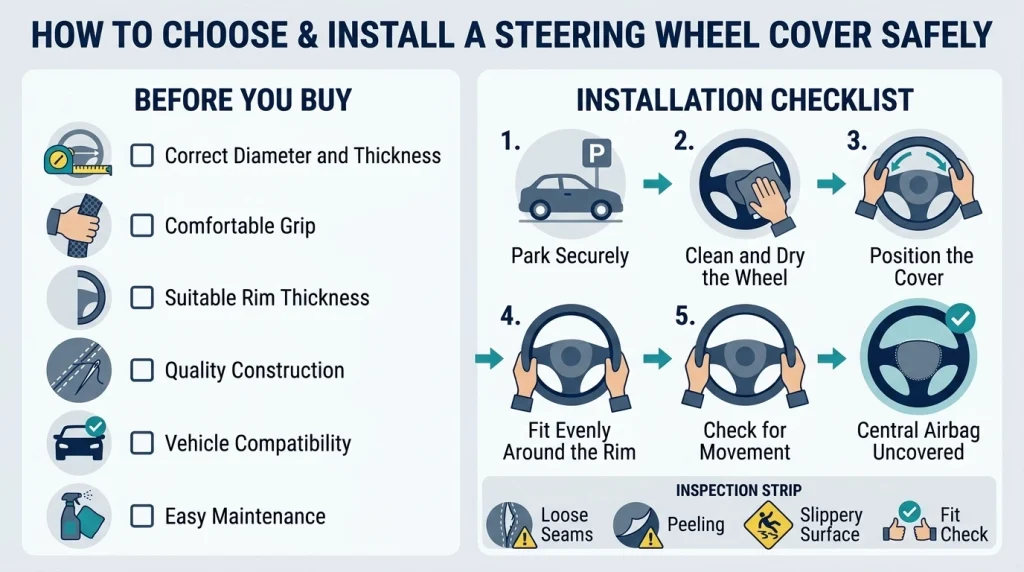
Choose a cover that fits your exact steering wheel, provides a comfortable grip, and suits your vehicle’s equipment. Good maintenance then helps preserve its texture, cleanliness, and secure fit.
What should you check before buying?
- Fitment: Confirm the wheel diameter, rim thickness, shape, and vehicle compatibility.
- Grip: Look for a surface that feels secure without being sticky or excessively rough.
- Thickness: Consider whether added padding will help or make the wheel harder to hold.
- Construction: Inspect stitching, seams, edge finishing, and the quality of the inner gripping surface.
- Climate: Consider cabin heat, direct sunlight, humidity, and the material’s cleaning requirements.
- Compatibility: Check restrictions involving heated wheels, touch sensors, and steering-wheel controls.
- Care instructions: Choose a product you can clean without damaging the surface.
How do you install a steering wheel cover properly?
A conventional rim cover generally installs without removing the steering wheel or airbag. Follow the product’s instructions, and don’t force the cover into place if its dimensions appear incorrect.
- Park the car securely, switch off the engine, and keep the vehicle stationary.
- Clean the original steering wheel with a suitable cleaner and allow it to dry completely.
- Position the cover according to the manufacturer’s installation instructions.
- Work it evenly around the rim, checking that seams and shaped sections sit where intended.
- Inspect the full circumference and test for independent movement while parked.
Don’t use glue, screws, tape, or other improvised modifications to secure a cover that doesn’t fit. A conventional cover should not require airbag removal, steering wheel removal, or access to internal wiring.
Pro tip: If installation requires removing the steering wheel or airbag module, stop and consult the factory service manual or a qualified technician. Accidental airbag deployment can cause serious injury.
How often should you clean and inspect a cover?
Inspect the cover at least monthly, and more often if you drive frequently or park in hot, dusty conditions. Regular checks help identify loose sections, worn stitching, peeling material, and changes in grip before they become significant problems.
- Routine cleaning: Use a soft cloth and a cleaner approved for the material.
- Surface inspection: Look for cracks, sticky patches, loose seams, and areas where the material has worn smooth.
- Fit inspection: Check whether the cover has stretched, shifted, or developed loose edges.
- Underlying wheel: Remove a removable cover periodically when the manufacturer’s instructions allow it, then inspect and clean the factory surface.
- Replacement: Replace a cover that becomes slippery, damaged, or unable to remain securely attached.
Avoid soaking the cover or applying oily dressings that leave the grip slick. Always follow the cleaner and maintenance instructions for the particular material.
When is it better not to use a cover?
Leaving the factory wheel uncovered is often the better choice when it already feels comfortable and remains in good condition. You also avoid adding thickness, hiding surface wear, or introducing another item that needs cleaning and inspection.
Skip a cover when your owner’s manual prohibits it, when the wheel relies on incompatible touch sensors, or when you cannot find a design that fits securely. A damaged steering wheel may need proper repair rather than a cover that conceals the underlying problem.
Section Takeaway: Measure before buying, install according to the manufacturer’s instructions, and inspect the fit regularly. If the cover compromises grip or conflicts with vehicle equipment, remove it.
Frequently Asked Questions
Are steering wheel covers worth it for older cars?
Yes, a steering wheel cover can be worthwhile in an older car if the original rim remains structurally sound but feels slippery, thin, or worn. It can refresh the interior and protect the remaining finish. However, it won’t repair cracks or other underlying damage.
Do steering wheel covers improve grip?
They can improve grip when the original wheel feels too smooth and the replacement surface offers suitable friction. Results depend on material, fit, and personal preference. A loose, slippery, or poorly sized cover can reduce control rather than improve it.
Do steering wheel covers damage the original wheel?
A properly fitted, clean cover generally protects the original surface from direct hand contact. However, trapped dirt, moisture, or friction can cause wear beneath it. Clean the wheel before installation and inspect the covered surface periodically when removal is permitted.
Are universal steering wheel covers safe?
A universal cover can be suitable if its stated size range and design match your vehicle’s steering wheel. The universal label alone doesn’t establish compatibility. Confirm the dimensions, install it correctly, and remove it if it shifts or conflicts with vehicle-specific instructions.
Can you leave a steering wheel cover on all year?
Usually, if the cover fits securely and the vehicle manufacturer permits its use. Heat, sunlight, moisture, and frequent handling can accelerate wear, so inspect it regularly. Heated steering wheels and sensor-equipped systems may have restrictions that make year-round use inappropriate.
Are expensive steering wheel covers better than cheap ones?
Not necessarily. A more expensive cover may offer better materials or construction, but price doesn’t guarantee secure fit, comfortable grip, or vehicle compatibility. Compare dimensions, stitching, material quality, care requirements, and return policies before choosing.
Should you use a steering wheel cover if the original wheel is already comfortable?
Not necessarily. If your factory wheel provides a comfortable, secure grip and remains in good condition, a cover may offer little practical benefit. Leaving it uncovered avoids extra bulk, cleaning requirements, and potential fitment problems.
Final Takeaway: Should You Buy a Steering Wheel Cover?
Steering wheel covers are worth it when they solve a real comfort, grip, or protection problem without compromising vehicle compatibility. For everyday drivers, a correctly fitted cover can be a practical and relatively inexpensive interior upgrade.
Before buying, measure the wheel, compare materials, and read your vehicle’s instructions. Don’t overlook heated-wheel restrictions, driver-assistance sensors, or the need to keep the airbag module unobstructed.
If your original wheel already feels right, there’s no need to add another layer. When a cover does offer a clear benefit, prioritize secure fit and reliable grip over appearance or price.
For more vehicle maintenance and accessory guidance, explore the relevant guides on PluginCarWorld as they become available.

Daniel Brooks is an automotive writer and product researcher focused on car accessories, car tech, maintenance, and practical driving guides. At Plug-in Car World, he helps drivers make smarter automotive decisions through honest reviews and research-driven content.
