
What Is a Car Seat Load Leg and How Does It Work?
Quick Answer
A car seat load leg is an adjustable support that extends from a child car seat or its base to the vehicle floor. During a frontal crash, it helps limit forward and downward rotation, reducing how much crash energy reaches the child. The American Academy of Pediatrics’ car seat guidance recognizes load legs as an important crash-energy management feature.
What a load leg does
- Limits forward rotation: Helps prevent the child seat from pitching excessively toward the front seats.
- Manages crash energy: Transfers some of the forces through the support leg into the vehicle floor.
- Supports the base: Creates an additional contact point between the restraint and the vehicle.
- Works with existing anchors: Supplements an approved seat belt or lower-anchor installation.
- Requires vehicle compatibility: Must contact a suitable floor location permitted by the car seat and vehicle manufacturers.
Important safety reminder
- Never improvise: Follow both instruction manuals, especially when the floor contains storage compartments or an uneven center hump.
If you’ve recently shopped for an infant car seat, you’ve probably noticed a metal support extending toward the floor. That seemingly simple part can make a meaningful difference in how the restraint behaves during a crash.
I’ve always believed that understanding a safety feature matters more than memorizing its marketing name. This guide explains how load legs work, where they help, how to install them, and when they shouldn’t be used.
In This Guide
- What Is a Car Seat Load Leg?
- How Does a Car Seat Load Leg Work in a Crash?
- Does a Load Leg Make a Car Seat Safer?
- Will a Car Seat Load Leg Work in My Vehicle?
- How Do You Install a Car Seat Load Leg Correctly?
- Load Leg vs. Anti-Rebound Bar: What’s the Difference?
- Frequently Asked Questions About Car Seat Load Legs
What Is a Car Seat Load Leg?
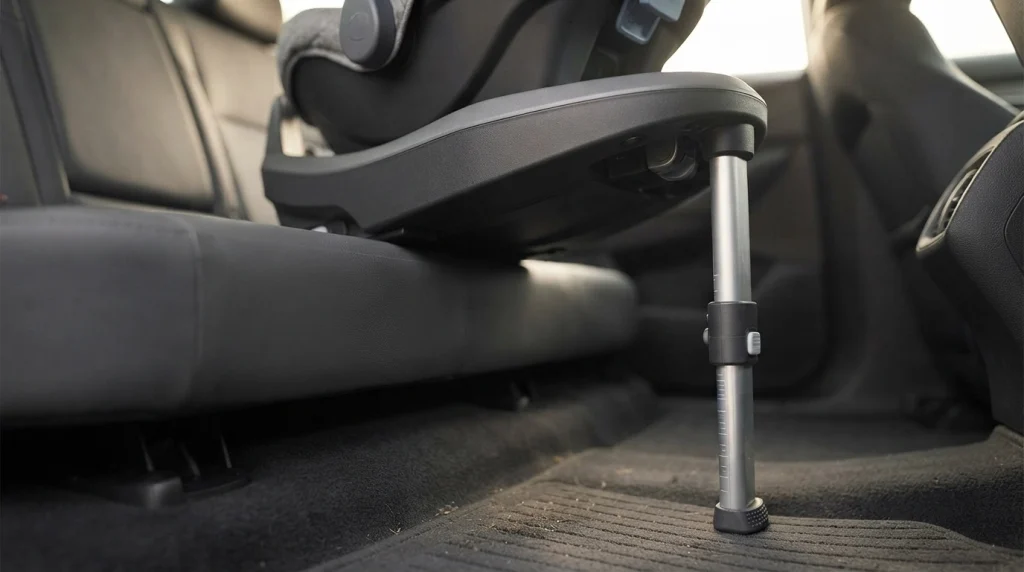
A car seat load leg is a support mechanism that connects a child restraint to the vehicle floor. Manufacturers may also call it a support leg, stability leg, or foot prop.
Most commonly, you’ll find it attached to a rear-facing infant car seat base. Certain convertible and all-in-one child restraints also incorporate this feature.
What are the main parts of a load leg?
The design varies between manufacturers, but most load-leg systems contain several recognizable components.
- Support leg: The main structure extending downward from the base.
- Height adjustment mechanism: Allows the leg to reach the vehicle floor.
- Locking mechanism: Holds the leg in an approved position.
- Floor-contact foot: The lower section that rests against the vehicle floor.
- Installation indicator: On some models, displays whether the leg has reached an acceptable position.
Many models allow the load leg to fold beneath the base when not in use. However, storage and optional-use rules depend on the particular restraint.
Is a load leg the same as a car seat anchor?
No. A load leg supports crash-energy management, while the seat belt or lower anchors secure the restraint to the vehicle.
In the United States, the lower-anchor installation system is commonly called LATCH, meaning Lower Anchors and Tethers for Children. Other markets commonly use the term ISOFIX for compatible attachment systems.
A load leg doesn’t replace either installation method. It works alongside the approved attachment system.
Pro tip: Check the child restraint’s identification label and instruction manual before using any support feature. Appearance alone doesn’t confirm that a part is compatible or correctly installed.
How Does a Car Seat Load Leg Work in a Crash?
A load leg works by limiting the rotation of the child restraint during a frontal collision. It directs part of the crash load into the vehicle floor rather than allowing the restraint to rotate as far forward.
What happens to a rear-facing car seat during a frontal crash?
When a vehicle stops suddenly, occupants and unsecured objects continue moving forward because of inertia. A properly installed rear-facing child restraint controls the child’s movement through its shell, harness, and attachment system.
However, the restraint itself can rotate relative to the vehicle seat. A load leg helps resist this motion.
- Initial impact: The vehicle decelerates rapidly, creating forces on the child restraint.
- Forward rotation begins: The restraint tends to pitch toward the front of the vehicle.
- Load leg provides support: The extended leg braces against the vehicle floor.
- Crash forces are redirected: Part of the loading travels through the support into the floor structure.
- Rotation is reduced: The restraint generally experiences less forward pitching than an otherwise comparable unsupported installation.
Think of the leg as a structural brace rather than a conventional shock absorber. Some designs also incorporate components intended to manage energy through controlled movement or deformation.
Why does reducing rotation matter?
Excessive forward rotation can increase movement of the child’s head and body. Depending on the vehicle and restraint, it may also increase the possibility of contact with the front seatback.
Reducing that motion can improve certain crash-test injury measures, including head acceleration and neck loading. The actual benefit depends on the complete child restraint system.
A load leg is therefore one part of the safety design. Harness fit, installation tightness, recline angle, and the restraint shell remain critical.
Section Takeaway: A load leg adds an important force-management path between the child seat and vehicle floor. Its principal job is controlling rotation during a crash.
Does a Load Leg Make a Car Seat Safer?
Yes, a properly used load leg can improve crash protection, particularly in frontal impacts. However, having a load leg doesn’t automatically make one car seat safer than every model without one.
Testing by Consumer Reports on load-leg crash protection found lower average modeled infant head-injury risk among tested seats equipped with load legs.
Those findings come from controlled laboratory comparisons, not guarantees about individual real-world crashes. Performance varies between child restraint designs and installation conditions.
What safety benefits should parents expect?
- Less forward rotation: Helps control how far the child restraint pitches during a frontal impact.
- Improved energy management: Allows part of the crash forces to pass into the vehicle floor.
- Potentially lower head loading: Some crash tests show reductions in head-injury measures.
- Reduced forward displacement: May lower the likelihood of the child moving toward nearby vehicle structures.
Are car seats without load legs unsafe?
No. A properly selected and installed car seat without a load leg can still provide effective crash protection.
Manufacturers use different combinations of restraint-shell design, energy-management materials, harness geometry, and attachment systems. A complete safety evaluation matters more than one feature.
For parents comparing models in 2026, I would prioritize a seat that fits the child and vehicle correctly. A compatible load leg is a worthwhile additional feature, not a substitute for correct use.
Manufacturer information, such as Graco’s explanation of infant car seat load legs, also makes clear that the primary attachment method remains necessary.
Pro tip: Compare complete crash-test performance and ease-of-use information, not just the presence of a load leg or an advertised safety percentage.
Will a Car Seat Load Leg Work in My Vehicle?
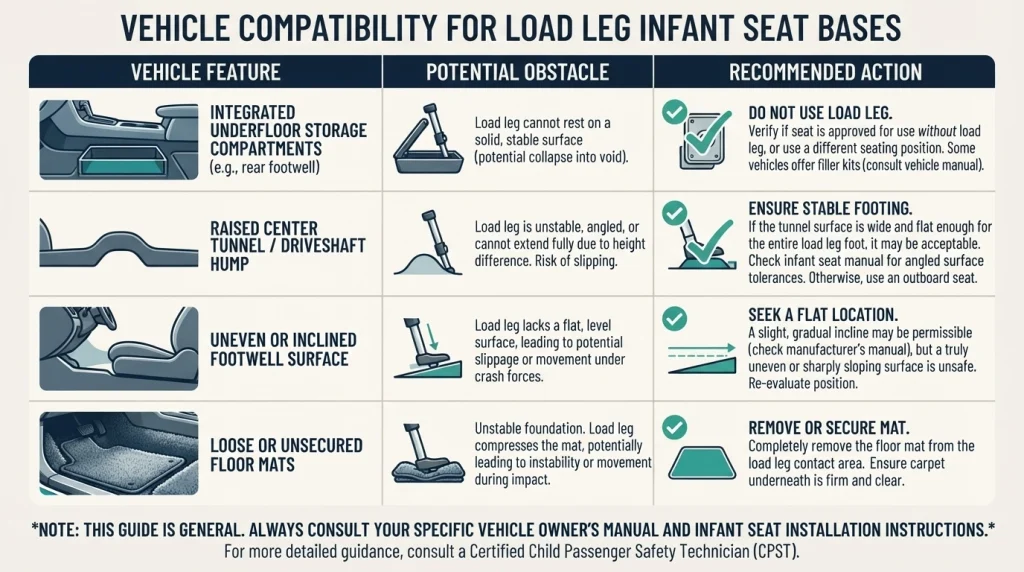
Not every vehicle or seating position can accommodate a load leg safely. Compatibility depends on the floor structure, available space, leg adjustment range, and both manufacturers’ instructions.
This is the detail I’d check before purchasing a load-leg-equipped seat. A base that fits the cushion doesn’t necessarily have a suitable landing point on the floor.
Why does the vehicle floor matter?
During a crash, the load leg applies substantial force to its contact area. That area must be capable of supporting the leg as intended.
Some vehicles contain underfloor storage compartments with removable or relatively weak covers. A compartment lid may not provide the structural support required by a particular load leg.
Never assume a storage lid is acceptable simply because it feels solid under your hand. Check the vehicle manufacturer’s instructions and any approved exceptions.
Which vehicle features can cause compatibility problems?
| Vehicle feature | Potential problem | Recommended action |
|---|---|---|
| Underfloor storage | Compartment lid may not support crash loading. | Use only a manufacturer-approved arrangement. |
| Raised center tunnel | Leg may not reach an approved position. | Check another permitted seating position. |
| Uneven footwell | Foot may not contact the floor properly. | Follow model-specific placement requirements. |
| Loose or thick floor mat | May interfere with acceptable floor contact. | Follow both manufacturers’ mat instructions. |
| Restricted legroom | Leg may interfere with interior components. | Confirm clearance and approved positioning. |
Can I use a load leg in the center rear seat?
Sometimes. The center position can be an excellent seating location, but it may have a raised floor or limited space.
If the leg cannot achieve the required position, another approved rear seating position may be preferable. The best location is one that allows a secure and compatible installation.
The Insurance Institute for Highway Safety’s child-seat guidance also emphasizes proper installation and following the restraint manufacturer’s directions.
Section Takeaway: A load leg must be compatible with the actual vehicle floor beneath its foot. Never assume that every rear seating position permits the same installation.
How Do You Install a Car Seat Load Leg Correctly?
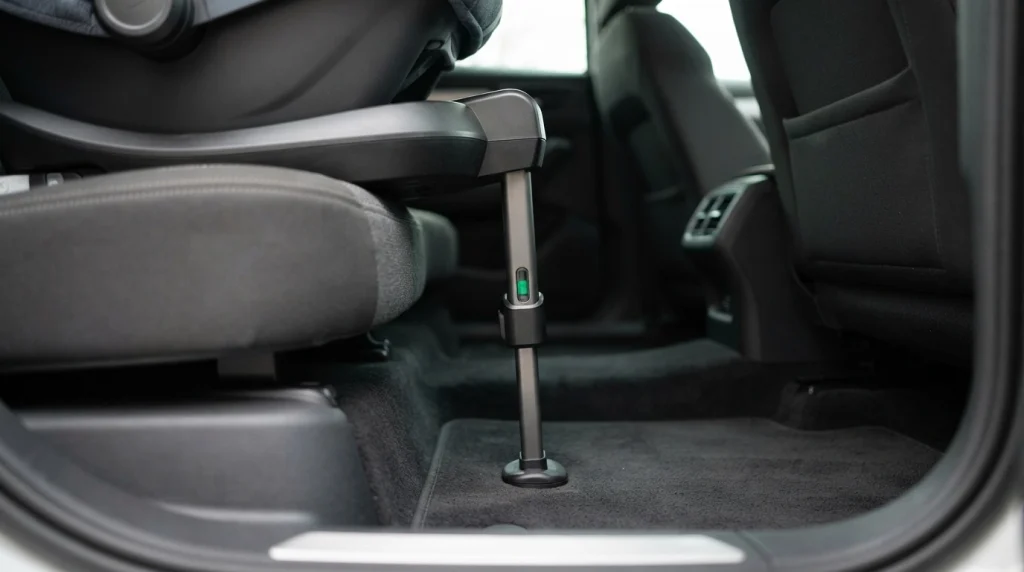
Correct installation starts with securing the car seat using its approved attachment method. The load leg is then positioned according to that model’s instructions.
The sequence can differ between products. Treat these steps as a general checklist, not a replacement for your specific instruction manual.
Step-by-step load leg installation checklist
Read both manuals.Confirm that the child restraint and vehicle permit load-leg use in your chosen position. Check for any restrictions involving floor compartments or mats.
Choose an approved seating location.Position the restraint in the rear seat according to its instructions. Check that the leg has enough room to reach the intended floor area.
Secure the car seat or base.Use the vehicle seat belt or approved lower-anchor system as directed. Don’t combine attachment methods unless both manufacturers explicitly permit that configuration.
Check installation tightness.Hold the restraint at its belt path and test side-to-side and front-to-back movement. It should move no more than 1 inch (2.5 cm) at that location.
Extend the load leg.Release and adjust the leg as the manual directs. Ensure the foot reaches its approved floor-contact position.
Confirm correct positioning.Check the leg’s locking mechanism, contact, angle, and any indicators. Don’t force it downward to change the car seat’s recline.
Complete the final checks.Verify the required recline angle and secure any removable infant carrier to its base. Check the child’s harness fit before driving.
The National Highway Traffic Safety Administration’s installation tips explain the one-inch movement test and proper restraint setup.
How much pressure should the load leg apply?
The correct amount depends on the restraint’s design and adjustment mechanism. Many systems require firm floor contact without lifting the base or changing its approved recline angle.
Don’t use improvised blocks, towels, or spacers beneath the leg. These can change how the restraint behaves in a crash.
What are the most common installation mistakes?
- Leaving the leg unlocked: A leg that appears extended may not be secured in its required adjustment position.
- Using the wrong floor location: Storage lids, uneven surfaces, or vehicle restrictions may prevent acceptable support.
- Changing the recline with the leg: The load leg is not a substitute for the seat’s approved recline adjustment.
- Ignoring the belt path: A load leg cannot compensate for a loose seat belt or lower-anchor installation.
- Assuming every design is identical: Different models have different leg angles, adjustment mechanisms, and use requirements.
One check I recommend is looking directly at the leg’s foot from floor level. It’s much easier to spot a misplaced contact point than when viewing the setup from above.
Pro tip: If you cannot confirm a correct installation, have a certified Child Passenger Safety Technician inspect it. Never guess about floor compatibility or modify the support leg yourself.
Section Takeaway: A properly installed load leg supports an already secure child restraint. Correct floor contact, locking, recline, and manufacturer approval are essential.
Load Leg vs. Anti-Rebound Bar: What’s the Difference?
A load leg and an anti-rebound bar are different car seat safety features. Both help control restraint motion, but they generally act during different phases of a crash.
The load leg mainly reduces initial forward rotation. An anti-rebound bar helps control the rear-facing restraint’s rebound movement after the initial forward motion.
How do the main anti-rotation features compare?
| Safety feature | Primary function | Typical application |
|---|---|---|
| Load leg | Limits forward rotation using vehicle-floor support. | Rear-facing infant and certain other child restraints. |
| Anti-rebound bar | Helps limit rearward rotation during rebound. | Certain rear-facing restraints. |
| Top tether | Limits forward movement of a forward-facing restraint. | Forward-facing harnessed seats and certain model-specific configurations. |
Can a car seat have both a load leg and an anti-rebound bar?
Yes. Some child restraints combine both features to help control movement through multiple phases of a collision.
However, more features don’t automatically guarantee a better outcome. Overall crash performance and correct installation still determine how well the complete system functions.
What should I look for when buying a load-leg car seat?
I’d compare the complete restraint and its compatibility with the vehicle before focusing on individual features.
- Child fit: Confirm approved height, weight, and harness requirements.
- Vehicle compatibility: Check whether your floor and seating position allow the load leg.
- Ease of installation: Look for clear locking instructions, readable recline indicators, and accessible adjustments.
- Crash-test performance: Review independent testing where available.
- Everyday practicality: Consider vehicle changes, travel, cleaning requirements, and whether the restraint permits baseless installation.
- Manufacturer support: Check for accessible manuals, replacement parts, and recall information.
Since car seat covers are often purchased alongside infant seats, avoid adding unapproved padding or replacement fabric beneath the harness. Use only covers and accessories specifically approved by the restraint manufacturer for that model.
Pro tip: Register the child restraint with its manufacturer and check official recall information. Never install an aftermarket load leg or alter the restraint’s original structure.
Frequently Asked Questions About Car Seat Load Legs
1. Do all infant car seats have load legs?
No. Many infant car seats use other restraint and energy-management designs without a load leg. Some include one on their detachable base, while others offer different safety features. Compare overall performance, proper fit, and vehicle compatibility rather than assuming every seat requires a leg.
2. Can I use a car seat without its load leg?
It depends on the specific model and installation instructions. Some restraints permit the leg to remain stowed, while others require it during particular installation modes. Never leave a required load leg unused, and don’t assume another manufacturer’s instructions apply to your seat.
3. Does a load leg replace the car seat belt or LATCH system?
No. A load leg is a supporting safety feature, not the primary attachment system. The car seat or base must still be secured using an approved seat belt or lower-anchor installation. The load leg helps manage movement during a crash after the restraint is properly attached.
4. Can a load leg be used on an SUV’s third-row seat?
Possibly, but compatibility must be confirmed for that exact vehicle and seating position. Third-row floors can have unusual shapes, storage structures, or limited clearance. Check the vehicle manual, car seat manual, and manufacturer’s compatibility guidance before attempting the installation.
5. Does a load leg need to touch the car floor?
Yes, when deployed for use, the load leg must reach the approved floor-contact position described by its manufacturer. The correct angle and pressure vary by model. If the leg cannot reach an acceptable position, don’t improvise an extension or place objects beneath it.
6. Can I use a load-leg infant car seat without its base?
Some infant carriers allow baseless installation using the vehicle seat belt. However, a load leg attached to the detachable base will not provide its benefit when the carrier is installed without that base. Always confirm whether your particular carrier permits baseless installation.
7. Are load legs worth considering when buying a car seat?
Yes. A load leg can offer meaningful additional crash protection when compatible and used correctly. Still, the safest practical choice is a restraint that fits your child, installs securely in your vehicle, and is used properly on every journey.
Final Takeaway: A car seat load leg may look like a small addition, but it performs an important crash-protection function. By reducing forward rotation and providing another path for crash forces, it can improve the way a child restraint protects its occupant.
Before relying on one, verify compatibility, follow both manufacturers’ instructions, and check the installation carefully. If anything remains uncertain, arrange a professional car seat check before traveling with your child.

Daniel Brooks is an automotive writer and product researcher focused on car accessories, car tech, maintenance, and practical driving guides. At Plug-in Car World, he helps drivers make smarter automotive decisions through honest reviews and research-driven content.
