
How to Tell If a Car Seat Has Expired: A Complete Safety Guide
Quick Answer
To tell if a car seat has expired, find its expiration date or date of manufacture on the seat’s label, plastic shell, or instruction manual. Most child car seats have a manufacturer-defined lifespan of approximately 6–10 years, although some models differ. If only the manufacturing date appears, add the manufacturer’s specified lifespan to determine when use must stop. The NHTSA car seat safety checklist also explains what to inspect before using an older seat.
Five Quick Checks
- Find the label: Look underneath, behind, or along the sides of the car seat.
- Read the date: Identify the manufacturing date or printed expiration date.
- Check the manual: Confirm the exact lifespan for your model.
- Inspect for damage: Check the shell, harness, buckles, and other safety components.
- Verify recalls: Search using the manufacturer’s name and model information.
Safety reminder: A seat can look perfectly clean and still be expired. Never rely on appearance alone.
Wondering how to tell if a car seat has expired without guessing? The answer often hides on a small sticker that many parents overlook.
I prefer checking the identification label before judging a seat’s condition. In this guide, I’ll explain where to find the date, how to calculate expiration, and what to do with an older seat.
In This Guide
What Does It Mean When a Car Seat Expires?
An expired car seat has reached the end of the useful life specified by its manufacturer. That limit applies even when the seat appears undamaged.
Definition: A car seat expiration date is the manufacturer’s cutoff for continued use of a child passenger safety restraint, based on its designated service life.
Why Do Car Seats Have Expiration Dates?
Child restraints contain more than comfortable padding. Their plastic shells, harness systems, energy-absorbing materials, and installation components work together during a collision.
Manufacturers establish useful-life limits for several reasons:
- Material aging: Plastics and other components can deteriorate over time.
- Temperature exposure: Vehicle interiors experience repeated heating and cooling cycles.
- Normal wear: Buckles, straps, adjustment systems, and attachments experience repeated use.
- Safety improvements: Testing methods, design features, and regulatory requirements change.
- Replacement parts: Manufacturers may stop supporting older models.
Expiration doesn’t mean every seat suddenly breaks on a particular day. Instead, the manufacturer no longer recommends using the restraint beyond its stated service life.
Is Car Seat Expiration Required by Law?
In the United States, federal child restraint standards do not impose one universal expiration period. Manufacturers establish their own useful-life limits.
That doesn’t make expiration dates optional safety advice. You should follow the expiration information provided for your specific product.
Local regulations may differ outside the United States. Always check applicable requirements when using a restraint in another country.
Where Can You Find the Expiration Date on a Car Seat?
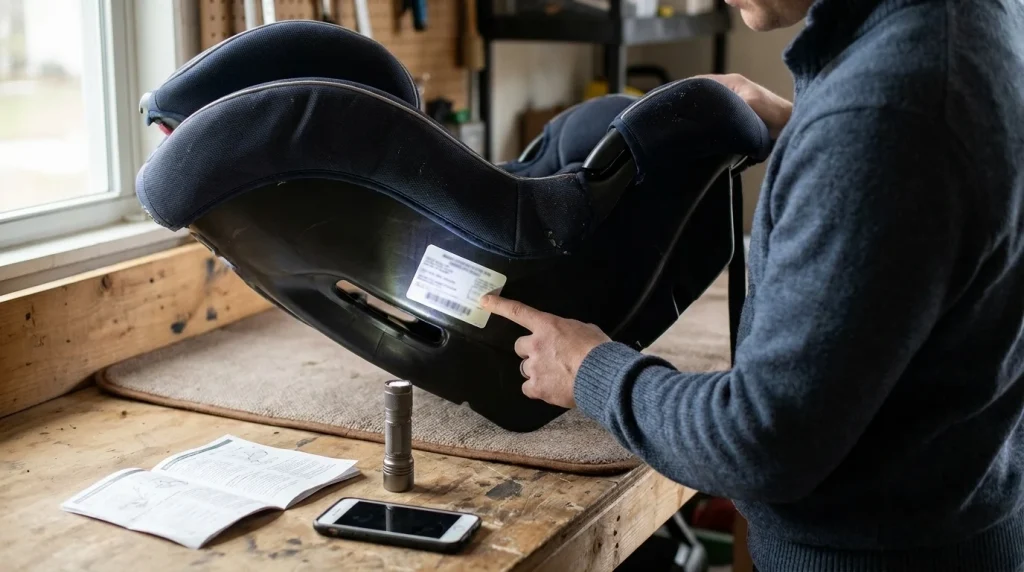
The expiration date is usually printed on a manufacturer label, molded into the plastic shell, or explained in the instruction manual. Its location depends on the brand and model.
Start with the places you can inspect without taking the restraint apart.
Check These Common Label Locations
- Underneath the seat: Inspect the bottom of infant carriers, convertible seats, and boosters.
- Behind the backrest: Look around the rear shell and tether storage area.
- Along the side: Check near the belt path or manufacturer identification sticker.
- Under removable padding: Lift only components the manual allows you to remove.
- On the infant seat base: Inspect the underside and storage compartments for separate date information.
- Inside the instruction manual: Find the useful-life or expiration section.
A bright work light makes the process easier. I also recommend taking a photo of the label before reinstalling the seat.
Never dismantle safety mechanisms just to locate a date. Ask the manufacturer if the identification label remains inaccessible.
Understand the Information Printed on the Label
Car seat identification labels often include several numbers. Not all of them describe expiration.
- Date of Manufacture (DOM): The date the factory produced the restraint.
- Expiration Date: The date after which the manufacturer says not to use it.
- Model Number: Identifies the particular product and configuration.
- Serial Number: Identifies the individual seat for manufacturer support.
- Manufacturing Batch: Helps identify production groups and affected recalls.
Some labels display only a manufacturing date. In that case, you must check the manual for the appropriate number of years.
Does the Infant Car Seat Base Have Its Own Expiration Date?
Yes, an infant seat base can have separate identification and expiration information. The carrier and base may also have different manufacturing dates.
For example, a family might purchase an additional base a year after buying the original carrier. That doesn’t extend the carrier’s useful life.
Check both components independently and follow their manuals. A newer base doesn’t make an expired infant carrier safe to reuse.
How Do You Calculate When a Car Seat Expires?
When the manufacturer provides a lifespan rather than an expiration date, add that lifespan to the date of manufacture. Use the exact period specified for your seat.
The basic calculation is straightforward:
Date of Manufacture + Manufacturer’s Useful Life = Expiration Date
Example: Calculating a Seven-Year Expiration
Imagine a car seat manufactured on April 15, 2020. Its instruction manual specifies a seven-year useful life.
- Manufacturing date: April 15, 2020
- Manufacturer’s lifespan: 7 years
- Calculated expiration date: April 15, 2027
Follow the manufacturer’s wording for the precise cutoff, especially if it specifies a month or year rather than an exact day.
How Long Do Different Car Seat Models Last?
Car seat expiration periods vary by product. Even seats from the same brand can have different lifespans.
The following manufacturer examples illustrate those differences as of 2026.
| Car Seat Model or Category | Useful Life | Expiration Basis |
|---|---|---|
| Britax Willow infant seat | 6 years | Date of manufacture |
| Graco Contender 65 convertible | 7 years | Date of manufacture |
| Britax Grow With You harness-to-booster | 9 years | Date of manufacture |
| Britax Poplar convertible | 10 years | Date of manufacture |
| Graco belt-positioning boosters | 10 years | Date of manufacture |
Important: These are manufacturer examples, not universal brand rules. Product generations, variants, and regional versions may have different limits.
For model-specific confirmation, consult the Graco expiration guidance or Britax expiration information, as appropriate.
Does Expiration Start When You Buy the Seat?
For most models, the useful-life clock starts on the manufacturing date, not your purchase date. However, some manufacturers specify different rules.
A seat manufactured in 2024 and purchased in 2026 may already be two years into its designated lifespan. Check the label before assuming you have the full number of years remaining.
If a manufacturer specifies a purchase-based period, retain the receipt and follow that product’s instructions.
What Signs Mean a Car Seat Needs Replacement Before Expiration?
A car seat doesn’t need to be expired to become unsuitable for use. Damage, missing components, crash involvement, and unresolved safety recalls can require attention earlier.
Inspect the Shell, Harness, and Buckles
Inspect the restraint under good lighting. Look beyond the fabric cover.
- Cracked shell: Look for fractures, splits, or damaged mounting points.
- Damaged harness: Check for cuts, fraying, or unusual wear.
- Faulty buckles: Confirm that the buckle operates according to the manual.
- Missing hardware: Inspect required connectors, adjustment pieces, and attachments.
- Damaged foam: Look for broken or missing energy-absorbing material.
- Illegible identification: Confirm that the model and manufacturing information remain readable.
If you notice damage, stop using the seat until its manufacturer confirms the appropriate remedy. Don’t attempt structural repairs with glue, tape, or replacement hardware from a general store.
Check for Car Seat Recalls
A recall can affect a seat that remains within its useful life. Checking the expiration date alone doesn’t establish that the seat is suitable for continued use.
Use the NHTSA recall search to look for safety notices involving your model.
- Find the manufacturer, model number, and manufacturing date.
- Search the relevant car seat recall records.
- Compare the affected models and production dates.
- Contact the manufacturer if your seat may be affected.
- Follow the official recall instructions before further use.
Not every recall requires disposal. Manufacturers may provide an approved repair, replacement component, or another remedy.
Does a Car Accident Make a Car Seat Unsafe?
A moderate or severe collision generally requires car seat replacement, even if visible damage is absent. A minor collision doesn’t always require replacement under NHTSA guidance.
The NHTSA post-crash guidance defines a minor crash only when every condition below is met.
- The vehicle remained drivable after the collision.
- The door nearest the child restraint was undamaged.
- No occupant sustained an injury.
- No airbag deployed.
- The child restraint has no visible damage.
Some manufacturers require replacement after any crash. Their specific instructions take priority when deciding whether to continue using the seat.
Pro tip: Always follow the car seat manufacturer’s crash-replacement policy. When the collision history is uncertain, don’t assume the restraint is safe.
What Should You Do With an Expired Car Seat?
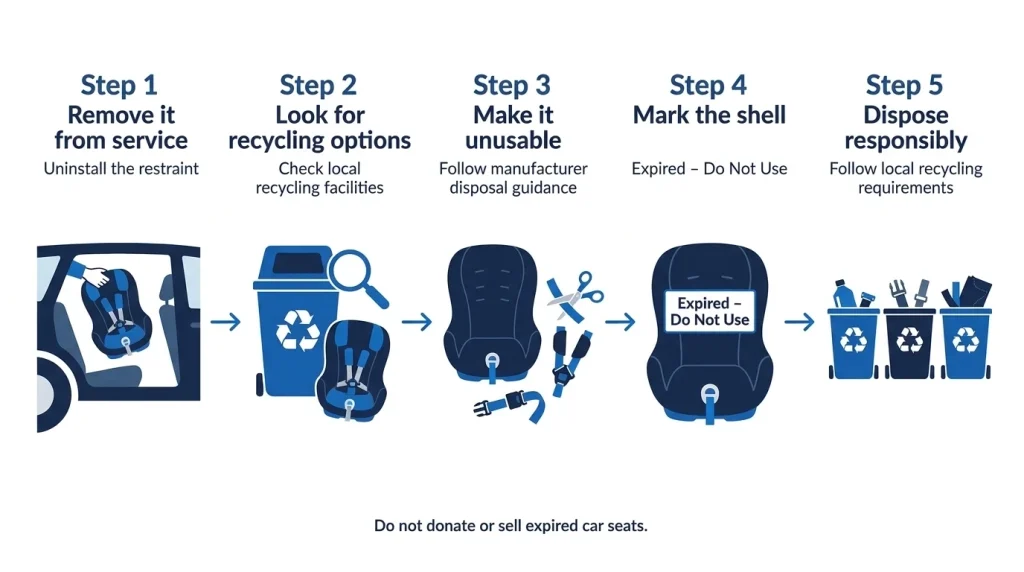
Stop using an expired car seat and replace it with a suitable restraint before your child’s next car trip. Don’t try to extend its service life through cleaning or cosmetic repairs.
How to Dispose of an Expired Car Seat Safely
Before disposal, make sure nobody can mistake the expired restraint for a usable seat. Check local recycling requirements first.
- Remove it from service: Uninstall the restraint and keep it away from vehicles used to transport children.
- Look for recycling options: Ask local recycling facilities whether they accept child restraints.
- Make it unusable: Once permanently retiring the seat, follow manufacturer disposal guidance, which may include cutting the harness.
- Mark the shell: Write “Expired – Do Not Use” in a visible location.
- Dispose responsibly: Separate materials only as permitted by the recycling program and manufacturer.
Don’t donate an expired seat to another family or sell it online. A buyer might not recognize that the seat has exceeded its useful life.
What If the Expiration Label Is Missing?
A missing label doesn’t mean the car seat has unlimited life. It makes the product harder to identify and its safety history harder to verify.
Take the following steps before deciding whether to use it:
- Look for a molded manufacturing date or another factory identification label.
- Check your instruction manual and original purchase records.
- Contact the manufacturer with any available model or serial information.
- Ask whether the exact restraint can be identified and its lifespan confirmed.
- Replace the seat if you cannot establish its age, model, and safe-use status.
Never create an estimated expiration date from the seat’s appearance. An old restraint can look remarkably new after its cover has been washed.
Choosing a Replacement Car Seat
The best replacement isn’t necessarily the most expensive model. It must fit your child, your vehicle, and your installation needs.
Before purchasing, check these essentials:
- Appropriate height and weight limits.
- Correct rear-facing, forward-facing, or booster configuration.
- Compatibility with your vehicle’s installation system.
- Clear instructions and accessible adjustment controls.
- Manufacturer support, registration, and replacement-part availability.
A properly selected and correctly installed restraint matters more than luxury padding or decorative features.
Can You Reuse an Older Car Seat or Replace Its Cover?
You can sometimes reuse a car seat for a younger sibling, provided it remains within its useful life and meets every safety requirement. Replacing its fabric cover doesn’t extend the expiration date.
Can You Pass a Car Seat Down to Another Child?
A hand-me-down seat can be a reasonable option when its complete history is known. It must still meet current manufacturer instructions for continued use.
Before reusing it, confirm all the following:
- The car seat has not expired.
- Its crash history is known and acceptable under manufacturer guidance.
- All required parts and labels remain intact.
- Any applicable recall has been properly remedied.
- The manufacturer-approved cover and padding are present.
- The seat fits the younger child’s current height and weight.
A seat’s condition matters more than its relationship to the previous owner. Even a restraint kept within the family needs inspection.
Will Replacing the Car Seat Cover Make It Safe Again?
No. A replacement cover can improve comfort and appearance, but it cannot restore an expired shell or extend the restraint’s useful life.
Be especially careful with aftermarket accessories. Extra padding or incorrectly fitted covers may interfere with harness positioning or manufacturer-tested performance.
Use replacement covers and padding supplied or specifically approved by the car seat manufacturer for that exact model. Avoid adding unapproved inserts between your child and the harness.
A vehicle’s decorative seat cover is also different from a child restraint cover. Neither should be used to conceal safety damage or compensate for an expired restraint.
Can Cleaning Help an Older Car Seat Last Longer?
Cleaning helps maintain an otherwise serviceable restraint, but it doesn’t reset expiration. Incorrect cleaning methods can also damage safety components.
Follow the manual’s instructions for each material:
- Fabric cover: Follow approved washing and drying instructions.
- Harness straps: Use only the cleaning methods explicitly permitted by the manufacturer.
- Plastic shell: Clean with approved products without damaging labels or components.
- Buckles: Follow the manufacturer’s instructions rather than using unapproved lubricants.
A freshly cleaned ten-year-old seat isn’t automatically suitable for another year of use. Confirm its actual service-life limit before reinstalling it.
Frequently Asked Questions About Car Seat Expiration
1. Can You Use a Car Seat After Its Expiration Date?
No. You should stop using a child car seat once it reaches the expiration cutoff specified by its manufacturer. Even if its fabric, buckles, and shell appear undamaged, the manufacturer no longer recommends relying on it for crash protection beyond that designated period.
2. Do All Car Seats Expire After Six Years?
No. Six years is a common useful-life period for certain models, but many seats last seven, nine, or ten years. Some products have shorter or longer limits. Always confirm the exact period using the product’s identification label and manufacturer instructions.
3. Do Booster Seats Have Expiration Dates?
Yes. Booster seats generally have manufacturer-defined useful lives, just like infant and convertible restraints. Their expiration periods vary by model. Check the plastic shell, identification label, or manual before reusing a booster for an older child.
4. Can a Brand-New Car Seat Already Be Close to Expiring?
Yes. A seat may spend time in storage or on a retailer’s shelf before purchase. If its useful life runs from the manufacturing date, that time counts toward expiration. Inspect the production date before buying older inventory.
5. What Happens If You Cannot Read the Manufacturing Date?
Contact the manufacturer using any remaining model information and purchase documentation. The manufacturer may help identify the restraint. If its age or safe-use status cannot be confirmed, replace it rather than guessing when its useful life ends.
6. Can an Expired Car Seat Still Protect a Child in a Crash?
An expired seat may appear functional, but its protection cannot be assumed beyond the manufacturer’s recommended lifespan. Materials, components, and design requirements change over time. Use a non-expired restraint that fits the child and vehicle and is installed correctly.
7. Should You Replace a Car Seat After a Minor Accident?
Not always. NHTSA allows for continued use after certain minor crashes, but every condition in its minor-crash definition must be met. Some manufacturers require replacement after any collision. Follow the applicable manufacturer’s instructions and replace the seat whenever required.
Final Takeaway: Check the Date Before the Next Ride
Knowing how to tell if a car seat has expired starts with one simple task: finding the manufacturer’s identification label. From there, verify the model’s useful life, inspect its condition, and check for recalls.
Make expiration checks part of your regular vehicle safety routine. If a restraint has expired or its history can’t be verified, choose an appropriate replacement before transporting your child.

Daniel Brooks is an automotive writer and product researcher focused on car accessories, car tech, maintenance, and practical driving guides. At Plug-in Car World, he helps drivers make smarter automotive decisions through honest reviews and research-driven content.
