
How to Read a Car Seat Warning Label: A Complete Guide
Quick Answer
To read a car seat warning label, first identify the child’s height and weight limits, approved seating direction, installation instructions, airbag warnings, and manufacturer information. Then check the manufacture date, expiration information, and model number. Compare every instruction with your specific car seat manual and the vehicle owner’s manual. The NHTSA car seat safety guidance provides additional help.
What to check on the label
- Child size limits: Check the minimum and maximum height and weight allowed.
- Seating direction: Identify whether the seat is approved for rear-facing, forward-facing, or booster use.
- Installation warnings: Look for seat belt, lower anchor, tether, and recline instructions.
- Airbag warnings: Pay close attention to warnings about rear-facing seats and active front airbags.
- Manufacturing details: Find the manufacturer, model number, serial number, and manufacture date.
- Expiration information: Check the printed expiration date or the manufacturer’s stated useful life.
Before using the seat
- Confirm that your child fits the seat’s limits and that the seat has not expired or been recalled.
- Never rely on the warning label alone when the complete installation instructions are available.
A car seat can look perfectly fine and still be unsuitable for your child. Sometimes, the most important safety information is printed on a small label attached to its side, back, or bottom.
These labels can look confusing at first. They contain numbers, technical terms, warning symbols, and instructions that are easy to overlook.
In this guide, I’ll explain how to read each important part, understand what the warnings mean, and recognize information that could affect your child’s safety. I’ll also explain which details you should verify before using an unfamiliar or second-hand seat.
What Is a Car Seat Warning Label?
A car seat warning label is a safety information label attached to a child restraint. It communicates important restrictions, potential hazards, and instructions for using the seat correctly.
These labels help caregivers understand how the seat should be installed, which children can use it, and what situations to avoid.
On car seats sold in the United States, manufacturers provide several types of required and supplemental labels. They don’t necessarily appear together on one sticker.
You’ll commonly find:
- Warning labels: Explain hazards such as improper installation or placing a rear-facing seat in front of an active airbag.
- Size and usage labels: Show the approved child height, weight, and seating configuration.
- Certification labels: Identify compliance with applicable motor vehicle safety standards.
- Manufacturing labels: Provide the model, serial number, manufacturer, and production date.
- Installation labels: Show important belt-routing, recline, and attachment instructions.
Each label serves a different purpose. Reading them together gives you a more complete picture of the seat’s requirements.
Where Can You Find the Warning Labels on a Car Seat?
Most car seat labels are attached directly to the plastic shell or fabric-covered areas. Their exact positions depend on the manufacturer and model.
Start by checking these locations:
- Side of the seat: Look for height and weight limits, airbag warnings, and seating direction information.
- Back of the shell: Check for the manufacturer label, model number, and manufacture date.
- Bottom of the seat: Look for serial information, production details, and expiration information.
- Near the belt path: Find instructions showing where the vehicle seat belt should pass.
- Near the lower anchors: Check for attachment instructions and weight restrictions.
- On the adjustable base: Look for recline indicators and instructions specific to that component.
Some labels are hidden beneath removable padding or covers. However, don’t remove components or upholstery unless the manufacturer’s instructions allow it.
If you cannot locate a particular label, check the owner’s manual or contact the manufacturer. Don’t assume that a missing safety label is unimportant.
How Do You Read a Car Seat Warning Label Step by Step?
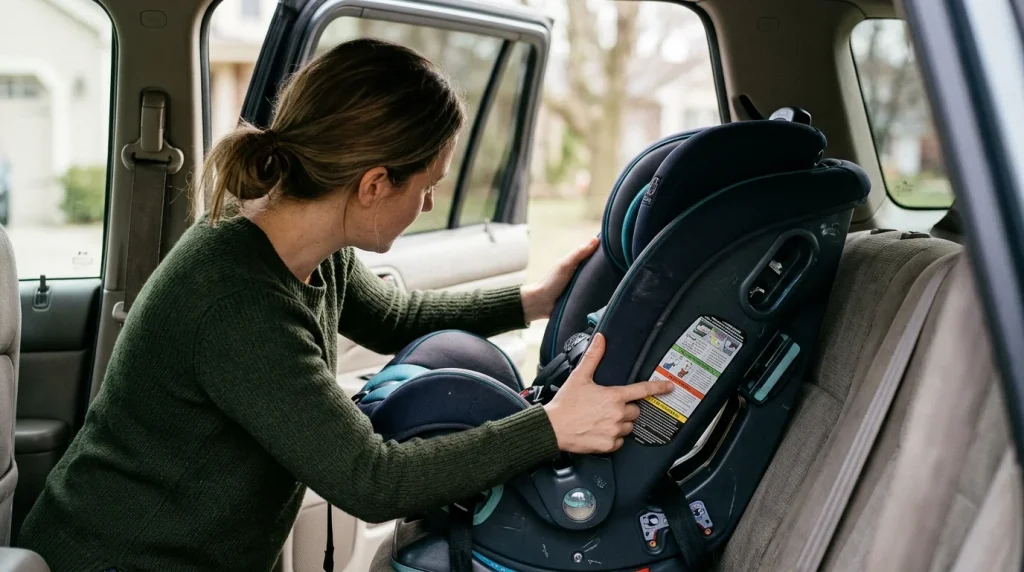
The easiest approach is to read the label systematically rather than trying to understand every number at once. Start with the child’s size restrictions and work through the installation and manufacturing information.
1. Check the Minimum and Maximum Weight Limits
The weight limit tells you how heavy a child can be while using a particular seating configuration. Some convertible seats have separate limits for rear-facing and forward-facing use.
You might see information such as:
- Minimum weight: 5 pounds.
- Maximum rear-facing weight: 40 pounds.
- Maximum forward-facing weight: 65 pounds.
These numbers are illustrative, not universal limits. Your particular seat may have different requirements.
Compare your child’s current weight with the correct limit. Don’t assume that reaching the maximum for one position means the child has outgrown every configuration.
2. Read the Height Restrictions
Height restrictions are just as important as weight limits. A child can exceed the permitted height before reaching the maximum weight.
Look for statements such as:
- Maximum standing height.
- Maximum seated shoulder height, if specified.
- Minimum height for a particular seating position.
- Instructions about head clearance above the seat shell.
Some manufacturers use additional fit requirements. For example, a rear-facing seat may specify how much space must remain between the child’s head and the top of the shell.
Follow the exact measurement method in your manual. Don’t substitute a general height measurement for a model-specific fit requirement.
3. Identify the Approved Seating Direction
A car seat may support one or several seating configurations. The label helps identify which directions are permitted.
Look for these terms:
- Rear-facing: The child faces the back of the vehicle.
- Forward-facing: The child faces the front of the vehicle.
- Booster mode: The seat positions the vehicle seat belt correctly across the child’s body.
Not every seat supports all three configurations. An infant-only seat, for example, is designed for rear-facing use.
Don’t change the seating direction simply because your child appears physically large enough. Follow the manufacturer’s limits and the applicable child passenger safety guidance.
4. Understand the Installation Warnings
Installation labels explain how the restraint attaches to the vehicle. They may include diagrams showing belt paths, lower anchors, tether connections, or locking mechanisms.
Common terms include:
- Vehicle seat belt: The belt used to secure the car seat to the vehicle.
- LATCH: Lower Anchors and Tethers for Children, an attachment system used in compatible vehicles and seats.
- Lower anchor connectors: Attachments that connect the car seat to the vehicle’s lower anchors.
- Top tether: A strap that connects a forward-facing seat to an approved vehicle tether anchor.
- Belt path: The designated opening through which the vehicle seat belt or installation strap passes.
Pay particular attention to weight restrictions for lower anchor use. The maximum child weight for lower-anchor installation can differ between car seat models.
Also remember that your vehicle has its own installation requirements. Check both manuals before deciding which attachment method to use.
5. Look for Airbag Warning Symbols
Airbag warnings are among the most important messages on a car seat. A rear-facing child restraint must never be placed in front of an active frontal airbag.
Look for a warning symbol showing:
- A rear-facing child seat.
- An airbag deploying in front of the seat.
- A red prohibition symbol or warning text.
The warning means that an inflating frontal airbag can strike the back of a rear-facing restraint with dangerous force.
Always install a rear-facing seat in an approved seating position without an active frontal airbag. Follow your vehicle owner’s manual for the correct airbag and seating-position instructions.
6. Find the Certification Statement
On car seats manufactured for the United States market, the certification label generally includes a statement that the restraint conforms to applicable Federal Motor Vehicle Safety Standards.
You’ll commonly see wording similar to:
“This child restraint system conforms to all applicable Federal motor vehicle safety standards.”
This statement indicates the manufacturer’s certification that the seat meets the applicable federal requirements.
It isn’t a guarantee that the seat is suitable for every child or vehicle. You still need to follow the seat’s size restrictions, installation instructions, and warnings.
7. Check the Manufacture Date and Expiration Information
The manufacture date identifies when the car seat was produced. It may appear as a month and year or in another date format.
For example, a label might show:
- Manufactured: March 2023.
- Model: ABC123.
- Do not use after: March 2031.
These are illustrative details, not a standard expiration period. Car seat useful life varies by manufacturer and model.
Some seats display an explicit expiration date. Others provide a useful-life period in the owner’s manual or a warning label.
Don’t automatically assume that every car seat expires six years after manufacture. Check the exact instructions for your model.
8. Identify the Model and Serial Number
The model and serial numbers help identify the exact car seat. They’re especially useful when checking recalls or contacting the manufacturer.
Look for labels containing:
- Manufacturer: The company responsible for the seat.
- Model number: Identifies the particular product version.
- Serial number: Helps identify an individual unit or production batch.
- Manufacturing location: Identifies where the seat was produced.
- Manufacture date: Shows when the seat was made.
Keep these details available when registering the seat or checking for safety recalls. Similar-looking seats can have different model numbers and manufacturing dates.
What Do the Different Car Seat Labels Mean?
Car seat labels can contain overlapping information, but each type has a distinct purpose. Understanding the differences makes it easier to find the right information quickly.
Here’s a comparison of the most common label types:
| Label type | Information provided | Why it matters |
|---|---|---|
| Warning label | Potential hazards and prohibited uses | Helps prevent dangerous mistakes. |
| Size label | Minimum and maximum child measurements | Determines whether the child fits the seat. |
| Installation label | Belt paths, anchors, tether, and positioning | Supports correct installation. |
| Certification label | Applicable safety-standard compliance statement | Identifies the manufacturer’s certification. |
| Manufacturing label | Model, serial number, and production date | Helps identify the seat and check recalls. |
| Expiration information | Expiration date or useful-life instructions | Shows when the seat should no longer be used. |
One label may contain several of these details. Other information may appear on separate stickers or in the instruction manual.
How Do You Read Car Seat Warning Symbols?
Warning symbols provide quick visual explanations of hazards. They are especially useful when printed text is small or difficult to understand.
Here are some common symbols and their meanings:
- Airbag prohibition symbol: Warns against placing a rear-facing restraint in front of an active frontal airbag.
- Read the manual symbol: Directs caregivers to consult the manufacturer’s instructions before using the seat.
- Incorrect belt-routing illustration: Shows a prohibited or incorrect installation path.
- Recline-angle indicator: Helps identify the permitted angle for a particular seating configuration.
- Prohibition symbol: Indicates that a particular action or configuration is not allowed.
Never interpret a symbol based on appearance alone when the accompanying explanation is available. Some symbols are specific to the manufacturer’s product design.
How Can You Check Whether a Car Seat Label Is Correct?
Reading a label is only the first step. You should also confirm that the information belongs to the actual seat and that the seat remains suitable for use.
Use this verification process:
- Match the model number: Compare the label with the model information in the owner’s manual.
- Verify the manufacture date: Make sure the date is readable and consistent with the seat’s documentation.
- Check the expiration information: Confirm the manufacturer’s stated useful life.
- Inspect the physical condition: Look for cracks, missing parts, damaged straps, or other visible problems.
- Check for recalls: Search the manufacturer’s model information through the appropriate government recall database.
- Confirm the instructions: Make sure you have the correct manual for the exact model.
For US-market seats, the NHTSA recall database allows caregivers to search car seat recalls by manufacturer and model.
A matching label doesn’t prove that a seat has never been damaged or recalled. Its history and physical condition matter too.
What Should You Do If a Car Seat Warning Label Is Missing or Damaged?
A missing or unreadable label can make it difficult to identify the seat and verify its safety requirements. Don’t ignore the problem or guess what the missing information said.
Take these steps:
- Stop and inspect: Identify which label is missing or damaged.
- Find the manual: Look for a matching model number and manufacturing information.
- Contact the manufacturer: Ask whether the label can be replaced and whether the seat can be identified.
- Check recall information: Use the available model and manufacturing details.
- Seek professional advice: Ask a qualified child passenger safety technician to help assess the seat.
The American Academy of Pediatrics advises against using a car seat without its required identification information, including the manufacture date and model number. Missing labels can also make recall verification difficult.
If you cannot establish the seat’s identity, history, or safe-use requirements, don’t use it until the manufacturer or an appropriate safety professional resolves the issue.
What Are the Most Common Mistakes When Reading Car Seat Labels?
Small misunderstandings can lead to incorrect installation or inappropriate seat use. These are some mistakes worth avoiding.
Confusing Weight Limits With Height Limits
Some caregivers check only the child’s weight. However, the child must meet every applicable size and fit requirement.
Always check both measurements and any additional headroom or harness-position requirements.
Assuming Every Car Seat Expires After Six Years
Expiration periods vary between manufacturers and models. A six-year rule should never replace the manufacturer’s specific instructions.
Find the printed expiration date or calculate the end of the useful life using the exact guidance for your seat.
Ignoring Airbag Warnings
An airbag warning is not decorative information. It identifies a serious hazard associated with certain seating positions.
Never place a rear-facing child restraint in front of an active frontal airbag.
Using the Wrong Installation Method
A label may show both a vehicle seat belt and lower anchor installation method. That doesn’t automatically mean you can use both together.
Check the car seat and vehicle manuals for instructions about permitted installation methods and any weight restrictions.
Assuming a Certification Label Means Every Installation Is Safe
A certification statement identifies compliance with applicable standards. It doesn’t mean the seat is correctly installed or appropriate for every child.
Proper use still depends on following the manufacturer’s instructions.
How Often Should You Check a Car Seat Warning Label?
Check the labels whenever you begin using a car seat, change its configuration, or adjust its installation. It’s also sensible to review the important information periodically.
Pay particular attention when:
- You purchase a new car seat.
- You receive a second-hand car seat.
- Your child approaches a height or weight limit.
- You switch from rear-facing to forward-facing mode.
- You reinstall the seat in another vehicle.
- You receive a safety recall notice.
- The seat approaches its expiration date.
For additional reassurance, register your car seat with its manufacturer. Registration helps the company contact you about recalls and important safety updates.
Are Car Seat Warning Labels the Same in Every Country?
No. Car seat labels and certification requirements can differ between countries. A label designed for the United States market may not use the same wording or certification marks as one designed for another country.
For example, US-market child restraints use applicable Federal Motor Vehicle Safety Standards, including FMVSS 213. Canadian seats use Canadian Motor Vehicle Safety Standards and the applicable National Safety Mark requirements.
Other markets have their own approval systems and labeling requirements. Therefore, don’t assume that a label from one country automatically establishes approval in another.
If you’re buying an imported car seat, verify that it meets the safety requirements applicable where you intend to use it. Check its documentation and consult the relevant local transport or road-safety authority.
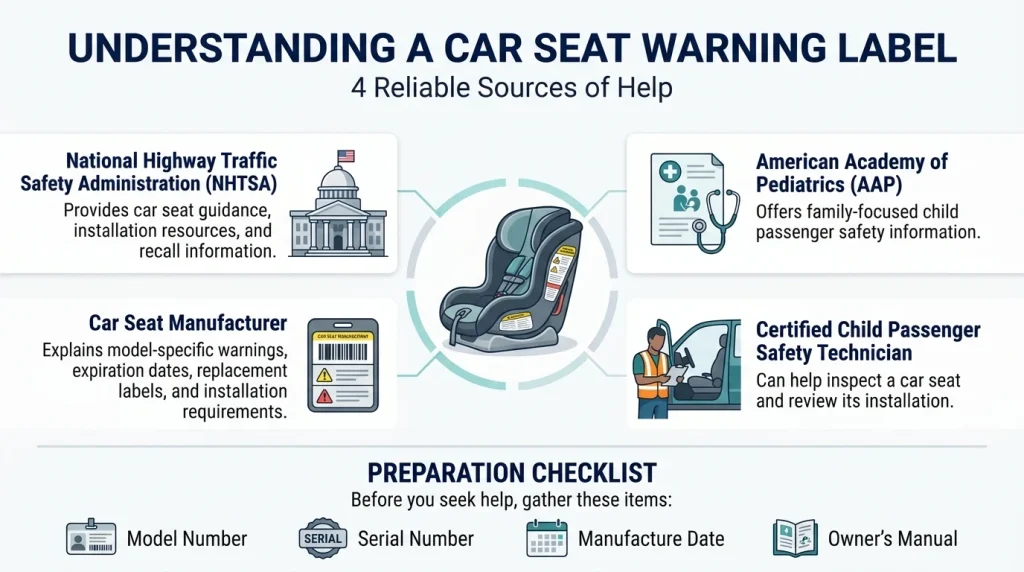
Where Can You Get Help Understanding a Car Seat Label?
You don’t have to interpret every technical instruction alone. Several reliable organizations provide guidance about child restraint labels, installation, and safety.
- National Highway Traffic Safety Administration (NHTSA): Provides US car seat guidance, installation resources, and recall information.
- American Academy of Pediatrics (AAP): Offers family-focused information about child passenger safety and choosing appropriate restraints.
- Car seat manufacturer: Can explain model-specific warnings, expiration dates, replacement labels, and installation requirements.
- Certified Child Passenger Safety Technician: Can help inspect your seat and review its installation.
You can find professional inspection assistance through the National Child Passenger Safety Certification program.
For the most accurate answer, have your model number, serial number, manufacture date, and owner’s manual available when asking questions.
Frequently Asked Questions
What information is required on a car seat warning label?
Requirements depend on the country and applicable safety standards. US-market car seats have required identification and certification information, along with applicable child-size limits and warnings. Manufacturers also provide installation instructions and other safety information through labels and the owner’s manual.
Where is the expiration date printed on a car seat?
The expiration date may appear on a label attached to the back, bottom, or side of the seat. Some manufacturers provide only the manufacture date and explain the useful life in the manual. Always follow the instructions for your exact model.
Can I use a car seat if its warning label is unreadable?
Don’t guess about missing safety information. Contact the manufacturer to identify the seat and determine whether replacement labeling is available. If you cannot verify the model, manufacturing information, or safe-use requirements, don’t use the seat until the issue is resolved.
Does a car seat certification label mean the seat is safe for every child?
No. Certification indicates that the manufacturer certifies compliance with applicable safety standards. The seat must still fit the child’s size, be compatible with the vehicle, remain within its useful life, and be installed and used according to its instructions.
How do I know whether my car seat has been recalled?
Find the manufacturer’s name and model number on the identification label. Then search the relevant government recall database or contact the manufacturer directly. You may also need the serial number and manufacture date to determine whether your specific seat is affected.
Final Takeaway: Read the Label Before Using the Car Seat
Learning how to read a car seat warning label doesn’t have to be complicated. Start with the child’s height and weight limits, then review the seating direction, installation instructions, airbag warnings, and manufacturing information.
Most importantly, treat the label and owner’s manual as complementary safety resources. Neither should replace the other.
Before every journey, make sure the seat remains appropriate for your child, is correctly installed, and hasn’t exceeded its manufacturer’s useful life. A few minutes spent checking the details can help you avoid preventable mistakes and use the restraint as intended.

Daniel Brooks is an automotive writer and product researcher focused on car accessories, car tech, maintenance, and practical driving guides. At Plug-in Car World, he helps drivers make smarter automotive decisions through honest reviews and research-driven content.
