
How to Choose a Car Seat for Your Toddler: A Parent’s Safety Guide
Quick Answer
To choose a car seat for your toddler, check your child’s age, height, and weight first. Select a seat that allows rear-facing use for as long as possible, fits your vehicle, and meets applicable safety standards. Follow the manufacturer’s height and weight limits, and consult the NHTSA car seat safety guidance for additional selection and installation advice.
Quick steps for choosing the right toddler car seat
- Check measurements: Record your toddler’s current height and weight.
- Prioritize rear-facing: Choose a seat that supports extended rear-facing use.
- Compare seat types: Consider convertible or all-in-one models.
- Check compatibility: Make sure the seat fits your vehicle and seating position.
- Review installation: Compare lower-anchor and vehicle seat-belt installation options.
- Verify safety details: Check certification, expiration date, recalls, and manufacturer instructions.
Before making your decision
- Never move your toddler forward-facing simply because they have reached their second birthday.
- A properly installed, correctly fitted seat matters more than extra convenience features.
Choosing a car seat for your toddler can feel confusing when every model promises something different. The good news is that a few important checks can make the decision much easier.
In this guide, I’ll explain how to compare seat types, understand height and weight limits, check vehicle compatibility, and avoid common purchasing mistakes. I’ll also share several models worth comparing in 2026.
What Is a Toddler Car Seat?
A toddler car seat is a child restraint designed to protect a growing child during vehicle travel. Depending on the model, it can accommodate rear-facing or forward-facing use with a built-in harness.
Unlike an infant-only seat, a convertible toddler car seat can usually change positions as your child grows. Some all-in-one models also provide a booster mode for a later stage.
The right seat depends on your child’s measurements and the manufacturer’s instructions. Age alone cannot determine which seat is appropriate.
How Do You Choose the Right Car Seat for Your Toddler?
Start by checking your toddler’s height and weight against the seat’s approved limits. Then compare rear-facing capacity, installation requirements, vehicle fit, and ease of everyday use.
I recommend following this selection process rather than choosing a seat based on appearance or brand popularity.
1. Measure Your Toddler’s Height and Weight
Before shopping, measure your child’s current height and weight. These measurements help narrow down suitable seats and prevent you from purchasing a model your toddler may quickly outgrow.
Check the manufacturer’s specifications for each seating position separately. A seat may have different limits for rear-facing and forward-facing use.
For example, a convertible seat might allow:
- Rear-facing use from 4 to 50 pounds.
- Forward-facing harness use from 26.5 to 65 pounds.
- Additional height restrictions that vary by position and model.
These are illustrative specifications from the Graco Extend2Fit 3-in-1, not universal limits. Always check the exact model and manual.
2. Prioritize Extended Rear-Facing Use
Rear-facing travel is an important safety consideration for toddlers. The American Academy of Pediatrics recommends keeping infants and toddlers rear-facing as long as possible, until they reach the highest height or weight allowed by their particular seat.
Rear-facing seats support a young child’s head, neck, and spine during a frontal crash. This position helps distribute crash forces across the child’s body.
Don’t rush the transition. A toddler with bent legs can still ride rear-facing when the seat manufacturer’s requirements allow it.
Look for a convertible seat with a generous rear-facing weight and height capacity. Many convertible models offer rear-facing limits of 40 to 50 pounds.
3. Choose Between Convertible and All-in-One Seats
Convertible and all-in-one seats are two common choices for toddlers who have outgrown an infant-only seat. Both can provide rear-facing use, but their long-term functions differ.
- Convertible seat: Changes from rear-facing to forward-facing harness use.
- All-in-one seat: Usually provides rear-facing, forward-facing harness, and booster modes.
A convertible seat may be simpler if you only need the next stage. An all-in-one model can offer more flexibility, although its larger size may create vehicle-fit challenges.
Which Type of Car Seat Is Best for a Toddler?
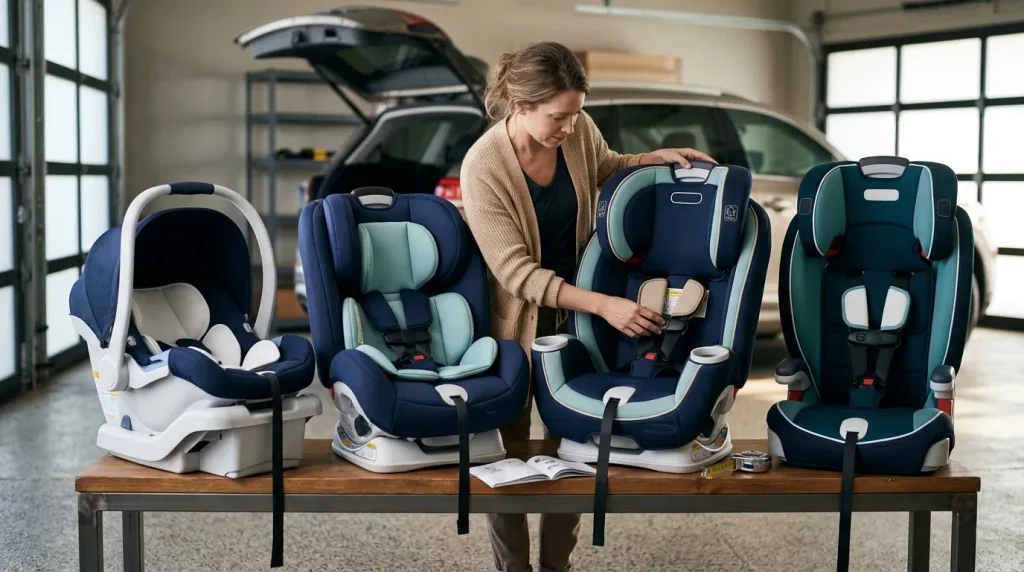
A convertible car seat is often a practical choice for a toddler who has outgrown an infant-only seat. An all-in-one model is another option when its dimensions and instructions suit your vehicle and child.
There isn’t one universally best type. The right choice depends on your child’s measurements, remaining rear-facing capacity, and installation compatibility.
| Seat type | Main use | Advantages | Limitations |
|---|---|---|---|
| Infant-only | Rear-facing only | Portable design and carrying handle | Usually outgrown earlier |
| Convertible | Rear-facing and forward-facing harness | Supports extended rear-facing use | Usually stays installed in the vehicle |
| All-in-one | Rear-facing, forward-facing, and booster | Multiple growth stages | Can be bulky and expensive |
| Combination | Forward-facing harness and booster | Useful after rear-facing is outgrown | Not suitable for rear-facing use |
For most toddlers, an infant-only seat is not the next purchase once they have reached its limits. A rear-facing convertible or all-in-one model is generally the more appropriate next step.
When Should a Toddler Switch to a Forward-Facing Car Seat?
A toddler should switch to forward-facing only after outgrowing the rear-facing height or weight limit of their current seat. The American Academy of Pediatrics recommends continuing rear-facing until that point.
Reaching age two does not automatically mean a child is ready to face forward. Some children can safely remain rear-facing well beyond that birthday.
Understand the Three Main Growth Stages
- Rear-facing: Keep your toddler in this position until reaching the seat’s maximum rear-facing height or weight limit.
- Forward-facing harness: After outgrowing rear-facing, use a forward-facing seat with a harness and top tether, within the manufacturer’s limits.
- Booster: Move to a suitable belt-positioning booster only after outgrowing the forward-facing harness limits and meeting the booster requirements.
Never move directly from a toddler seat to an adult seat belt just because your child looks bigger. Each stage has specific requirements.
The CDC child passenger safety guidance provides a useful overview of these stages.
What Safety Features Should You Look for in a Toddler Car Seat?
Focus on features that support correct installation and a secure harness fit. Decorative extras should come after these basic safety requirements.
Five-Point Harness
A five-point harness secures the child at both shoulders, both hips, and between the legs. It helps keep the child correctly positioned within the restraint during a crash.
Look for harness straps that adjust easily and remain flat without twisting. A no-rethread adjustment system can make changes easier as your toddler grows.
Side-Impact Protection
Some car seats include additional side-impact features, reinforced structures, or energy-management components. These designs vary between manufacturers and models.
Don’t assume that a large headrest or extra padding automatically means better crash protection. Review the manufacturer’s documentation and applicable safety compliance information.
Top Tether Compatibility
A top tether is an important part of forward-facing installation. It attaches to an approved anchor in your vehicle and helps reduce forward movement during a crash.
Check your vehicle owner’s manual to locate the correct tether anchor. Use it according to both the car seat and vehicle manufacturers’ instructions.
Easy-to-Adjust Harness
A practical harness should allow you to adjust its height and tightness as your toddler grows. Convenient adjustments can make consistent daily use easier.
Still, convenience cannot replace correct positioning. The harness must meet the manufacturer’s fit instructions every time you travel.
How Do You Make Sure a Toddler Car Seat Fits Your Vehicle?
A car seat must fit your vehicle correctly, not just your child. Before purchasing, check the seat’s width, depth, recline requirements, and installation options.
I would compare these measurements before getting attached to a particular model. A seat that looks compact online may take up more space once installed.
Check Your Available Space
Measure the vehicle’s rear seating area and compare it with the car seat’s dimensions. Pay particular attention to front-to-back space when installing rear-facing.
Check whether the front passenger or driver seat can remain in a safe, comfortable position. Never force a car seat into a position that conflicts with its installation instructions.
Understand LATCH and Seat-Belt Installation
Many U.S. vehicles provide lower anchors for compatible car seats. These attachments are commonly called LATCH, which stands for Lower Anchors and Tethers for Children.
Vehicle seat belts can also secure many car seats when installed correctly. The correct method depends on the car seat and vehicle instructions.
| Installation method | How it works | Important check |
|---|---|---|
| Lower anchors | Connects the seat’s lower attachments to vehicle anchors. | Follow the child and seat weight limits for anchor use. |
| Vehicle seat belt | Uses the approved belt path to secure the restraint. | Use the correct locking method described in the manuals. |
| Top tether | Connects the forward-facing seat to its tether anchor. | Use it as instructed for forward-facing installation. |
Never use lower anchors and a seat belt together unless the manufacturer specifically permits that combination. The two systems are not automatically interchangeable or interchangeable in every installation.
For more help, consult the NHTSA car seat installation and inspection resources.
How Can You Check Whether Your Toddler’s Harness Fits Correctly?
A correctly sized car seat still needs proper harness adjustment. Check the straps every time you buckle your toddler into the vehicle.
For a rear-facing child, the harness straps should come from at or below the shoulders. For a forward-facing child, follow the seat manufacturer’s specified shoulder-slot position, generally at or above the shoulders.
Use this quick checklist:
- Flat straps: Make sure the harness isn’t twisted.
- Snug fit: Tighten until you cannot pinch excess harness webbing at the shoulder.
- Correct clip position: If the seat has a chest clip, position it at armpit level.
- Proper clothing: Avoid bulky coats or thick padding underneath the harness.
- Correct inserts: Use only inserts and accessories approved for your specific seat.
Thick winter clothing can create hidden gaps between the harness and your toddler. Buckle your child in normal clothing, tighten the straps, and place a blanket over the harness if needed.
Should You Buy a New or Used Toddler Car Seat?
A new car seat offers a clearer history and makes it easier to confirm its manufacture date, condition, and recall status. A used seat may be acceptable only when its complete safety history can be verified.
Before considering a second-hand model, check these details:
- Crash history: Confirm that the seat has not been involved in a crash that requires replacement under its manufacturer’s instructions.
- Expiration: Verify that the seat remains within its approved service life.
- Recall status: Check for outstanding safety recalls.
- Complete parts: Confirm that the harness, buckles, labels, and required components are present.
- Instructions: Make sure the original manual is available or obtainable from the manufacturer.
If the previous owner cannot confirm the seat’s history, choose another option. A low purchase price isn’t worth uncertainty about a critical safety device.
What Mistakes Should You Avoid When Choosing a Toddler Car Seat?
Some purchasing mistakes happen because parents focus on convenience instead of fit. Others come from misunderstanding when children should change seating positions.
- Switching forward-facing too early: Don’t use age alone to determine readiness.
- Ignoring height limits: Weight isn’t the only measurement that matters.
- Buying without measuring: A seat may not fit your vehicle’s rear seating area.
- Choosing accessories without approval: Unapproved padding and aftermarket inserts can interfere with harness performance.
- Overlooking expiration: Every seat has a manufacturer-defined service life.
- Skipping the manual: Installation and adjustment rules differ between models.
One useful rule guides the entire process: choose a seat that fits your child, fits your vehicle, and can be installed correctly every time.
How Do You Install and Maintain a Toddler Car Seat?
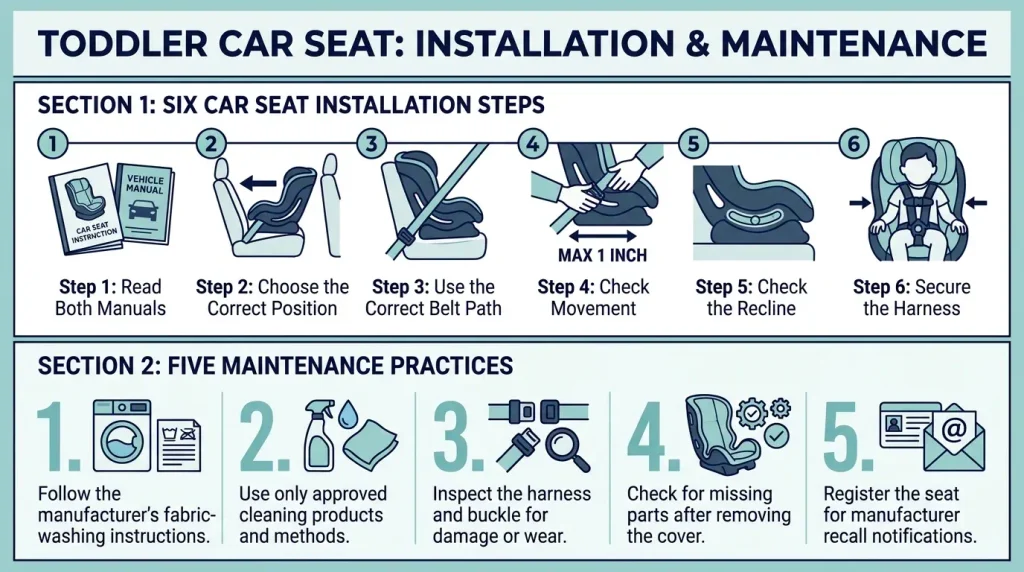
Correct installation is just as important as choosing the right model. Even a well-designed car seat cannot provide its intended protection when installed or used incorrectly.
Follow These Installation Steps
- Read both manuals: Review the car seat instructions and vehicle owner’s manual.
- Choose the correct position: Install the restraint in an approved rear seating position.
- Use the correct belt path: Follow the instructions for rear-facing or forward-facing installation.
- Check movement: At the belt path, the installed seat should move no more than one inch from side to side or front to back.
- Check the recline: Use the manufacturer’s approved angle indicator or adjustment system.
- Secure the harness: Check strap position and tightness before every trip.
For forward-facing use, connect the top tether whenever required or recommended by the applicable instructions. Never guess where an anchor is located.
Keep the Seat Clean and in Good Condition
Regular cleaning helps keep the seat comfortable and usable. However, cleaning methods must not damage the harness or other safety components.
- Follow the manufacturer’s fabric-washing instructions.
- Use only approved cleaning products and methods.
- Inspect the harness and buckle for damage or wear.
- Check for missing parts after removing the cover.
- Register the seat to receive manufacturer recall notifications.
Don’t add an aftermarket car seat cover, cushion, or head support unless the manufacturer approves that specific accessory for your model. A cover that changes how the harness fits can create a safety concern.
Which Toddler Car Seats Are Worth Comparing in 2026?
Once you understand the safety requirements, comparing a few established convertible models can help narrow your choices. These examples are starting points, not universal recommendations.
I’ve prioritized rear-facing capacity, installation features, and practical vehicle-fit considerations rather than treating extra features as proof of better safety.
🏆 Best for Extended Rear-Facing
Graco Extend2Fit 3-in-1
Editorial rating: Not independently scored
Offers rear-facing harness use up to 50 pounds, forward-facing harness use up to 65 pounds, and a highback booster mode. Its adjustable extension panel provides up to five additional inches of rear-facing legroom. I’d shortlist it for parents prioritizing extended rear-facing capacity.
📏 Best for a Slimmer Design
Britax Poplar Convertible
Editorial rating: Not independently scored
Provides rear-facing use from 5 to 50 pounds and forward-facing harness use from 30 to 65 pounds. Its 17-inch design and ClickTight installation system make it worth comparing when rear-seat space and installation convenience matter.
⭐ Highly Rated by Manufacturer Customers
Chicco NextFit Max ClearTex
★★★★☆ 4.6/5 (52 manufacturer-site reviews)
Supports rear-facing use up to 50 pounds and forward-facing harness use up to 65 pounds. Features include a SuperCinch LATCH tightener and nine recline positions. I’d compare it for parents who value installation adjustments and additional rear-facing legroom.
Important: Product specifications and availability can change. The Chicco rating above comes from the manufacturer’s website, not an independent safety test. Customer ratings are not crash-safety ratings.
Before purchasing any of these models, confirm the current manual, exact model number, height and weight limits, vehicle compatibility, and recall status.
Frequently Asked Questions
What Is the Best Age to Buy a Toddler Car Seat?
There is no single best purchasing age because children grow at different rates. Many parents buy a convertible car seat when their child approaches the limits of an infant-only seat. Check the current seat’s height and weight restrictions before making the change.
Should a Two-Year-Old Still Ride Rear-Facing?
Yes, a two-year-old can and generally should continue riding rear-facing if they remain within the seat’s height and weight limits. The American Academy of Pediatrics recommends rear-facing use for as long as the particular car seat allows, rather than switching automatically at age two.
Is a Convertible Car Seat Better Than an All-in-One Seat?
Neither type is automatically better. Convertible seats provide rear-facing and forward-facing harness modes, while all-in-one seats add a booster stage. Choose based on your child’s measurements, available vehicle space, installation compatibility, and the manufacturer’s instructions.
How Tight Should a Toddler Car Seat Be?
When installed correctly, the seat should move no more than one inch side to side or front to back when tested at the belt path. The child’s harness should also be snug enough that you cannot pinch excess webbing at the shoulder.
Can I Use a Car Seat Cover With a Toddler Car Seat?
Only use a cover or accessory that the car seat manufacturer approves for your specific model. An aftermarket cover can interfere with the harness, buckles, or seat fit. Never place additional padding beneath your child unless the manufacturer explicitly permits it.
Final Thoughts: Choose Safety and Fit Before Extra Features
Learning how to choose a car seat for your toddler starts with three essentials: your child’s measurements, the seat’s safety limits, and compatibility with your vehicle. These factors should guide your decision before convenience features or appearance.
Keep your toddler rear-facing as long as the seat allows, follow the installation manual, and check the harness before every trip. If you’re uncertain about installation, seek help from a qualified child passenger safety technician.
A suitable car seat isn’t necessarily the most expensive or feature-packed model. It’s the one that fits your child, fits your vehicle, and gets used correctly on every journey.
Safety note: This article uses U.S. guidance from the CDC, NHTSA, and AAP. Car seat laws and approval requirements vary by country. If you live outside the United States, check your local child-restraint regulations and approved safety standards before buying.

Daniel Brooks is an automotive writer and product researcher focused on car accessories, car tech, maintenance, and practical driving guides. At Plug-in Car World, he helps drivers make smarter automotive decisions through honest reviews and research-driven content.
