
How to Find Car Seat Laws in Your State: 2026 Guide
Quick Answer
To find car seat laws in your state, start with the Governors Highway Safety Association’s state law guide. Select your state, review the age, height, weight, and seating requirements, then confirm the current rules with your state’s official government website. State laws differ, and legal minimums don’t always match the safest restraint choice.
Five Steps to Check Your State’s Requirements
- Find your state: Open a state-by-state child passenger safety law directory.
- Verify official rules: Check your state transportation department, highway safety office, or legislature.
- Check your child’s size: Compare current age, weight, and height with legal requirements.
- Confirm seat placement: Review rear-facing, booster seat, and rear-seat requirements.
- Follow safety guidance: Keep using an appropriate restraint until your child genuinely outgrows it.
Important: Check the effective date of any law before relying on it. Requirements can change after a guide is published.
Finding the right car seat law shouldn’t require sorting through dozens of conflicting websites. Yet a quick search can produce different answers about booster seats, rear-facing limits, and front-seat ages.
I’ll show you where to find official rules, how to understand their wording, and how to avoid common mistakes. We’ll also cover interstate travel, installation safety, and what to check when your child outgrows a seat.
In This Guide
- Where Can You Find Official Car Seat Laws in Your State?
- What Do State Car Seat Laws Actually Require?
- How Do You Read Age, Weight, and Height Rules Correctly?
- How Do Car Seat Laws Differ Between States?
- What Should You Check Before Driving Across State Lines?
- How Can You Confirm Your Car Seat Is Legal and Safe?
- Frequently Asked Questions About State Car Seat Laws
Where Can You Find Official Car Seat Laws in Your State?
The most reliable place to find your state’s car seat law is an official state government source. National comparison websites are useful starting points, but the current state statute determines the legal requirements.
Start With a State-by-State Law Directory
All 50 states and Washington, D.C., have child restraint laws. Their requirements differ, particularly for younger children and booster seat transitions.
The Insurance Institute for Highway Safety’s seat belt and child seat law table lets you compare rules across states. It includes restraint requirements, enforcement information, and base fines.
Use a directory to identify the relevant law. Then verify its current wording through a government source.
Check Your State’s Official Government Website
Government transportation and highway safety agencies often translate legal language into practical guidance. They may also publish downloadable law cards, inspection resources, and recent legislative updates.
Try these searches using your state’s name:
- “[State] child passenger safety law official”
- “[State] car seat laws 2026 site:.gov”
- “[State] booster seat requirements department of transportation”
- “[State] rear-facing car seat law state statute”
- “[State] highway safety office child restraint”
Replace “[State]” with the actual state name. Prioritize official government pages over advertisements and outdated parenting articles.
Look for the Actual Statute
A statute is the written law adopted by a state legislature. Government summaries are easier to read, but the statute is especially important when a rule seems unclear.
For example, you might need to understand whether an age threshold applies together with a weight threshold. The exact wording can change the answer.
When researching, record these details:
- The official law or statute number
- The state agency publishing the guidance
- The date the law took effect
- The latest available update or review date
- Any exceptions related to vehicle type or seating position
If two websites disagree, don’t choose the easier requirement. Check the current statute or contact the state’s highway safety office.
Watch for Outdated Information
A page titled “2026 Car Seat Laws” isn’t automatically current. Some websites update their titles without updating the legal details.
Look for a stated effective date, legislative reference, or government update. Also check whether a future law has passed but hasn’t taken effect yet.
Section Takeaway: Use a national directory for discovery and an official state source for confirmation. Check the law’s effective date before acting.
What Do State Car Seat Laws Actually Require?
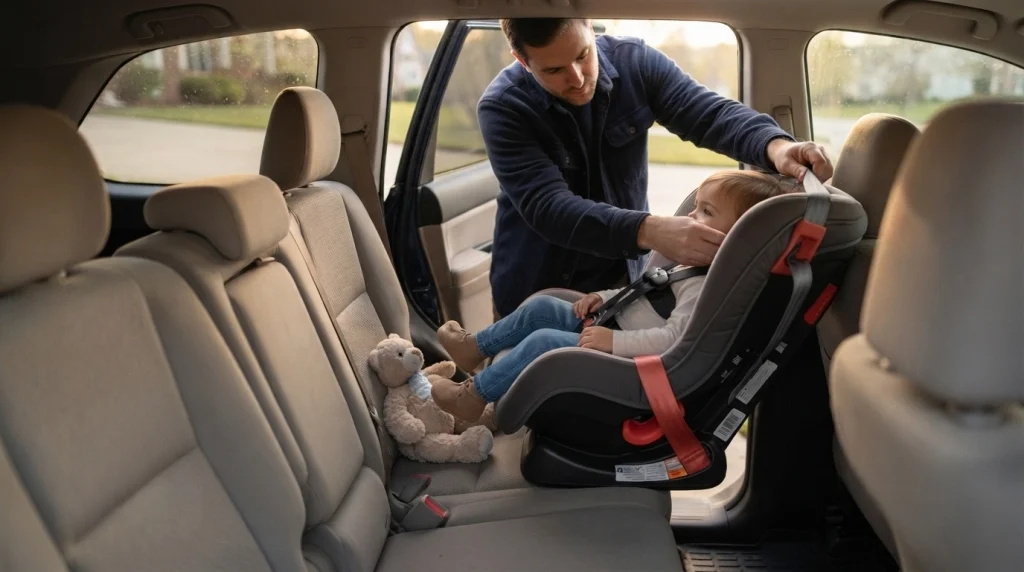
State car seat laws establish minimum requirements for restraining children in vehicles. They commonly consider age, height, weight, restraint type, and seating position.
A child passenger restraint is a safety device designed to secure a child during vehicle travel. It may be a rear-facing seat, forward-facing harnessed seat, or booster seat.
Rear-Facing Car Seats
Rear-facing seats support a young child’s head, neck, and spine during a crash. State laws differ on how long children must remain rear-facing.
The National Highway Traffic Safety Administration’s car seat recommendations advise keeping children rear-facing as long as their seat allows. Always follow the manufacturer’s height and weight limits.
When checking your state law, identify whether the requirement uses:
- A minimum age, such as the second birthday
- A weight threshold
- A height threshold
- A combination of age and size conditions
- A manufacturer-defined restraint limit
Don’t assume a birthday means a child must switch seats. Many rear-facing convertible seats accommodate children beyond the state’s minimum age.
Forward-Facing Car Seats With Harnesses
A forward-facing child restraint uses an internal harness to hold the child. Many models also use a top tether that limits forward head movement during a crash.
Children should remain in a suitable forward-facing harnessed seat until reaching its applicable size limits. State law may set additional requirements.
Check the restraint’s label and manual for its forward-facing minimums and maximums. A child’s readiness depends on more than age.
Booster Seat Requirements
A booster seat raises a child so the vehicle’s seat belt fits properly. It generally becomes appropriate after the child outgrows a forward-facing harnessed restraint.
Booster seat laws often use a combination of age, height, and weight. Some states require an appropriate booster or child restraint until a particular birthday.
Two common booster designs are:
- High-back boosters: Provide belt positioning and additional head and back support.
- Backless boosters: Position the vehicle belt and require suitable vehicle head support.
Both types require correct belt positioning. Follow the booster and vehicle manufacturers’ instructions, including lap-and-shoulder belt requirements.
Adult Seat Belts and Front-Seat Rules
Some laws allow children to transition to adult seat belts at a specified age or size. However, legal eligibility doesn’t guarantee a good seat belt fit.
Front-seat restrictions also vary by state. Separate safety recommendations advise keeping children in the rear seat through age 12.
Never place a rear-facing child seat in front of an active frontal airbag. Follow the vehicle manual when evaluating any permitted front-seat exception.
Enforcement and Penalties
State laws also identify who is responsible for securing the child and how violations are enforced. The driver or caregiver may face a citation when the restraint is missing or used improperly.
- Primary enforcement: An officer may stop a vehicle for an observed restraint violation alone.
- Secondary enforcement: Enforcement generally requires another qualifying reason for the traffic stop.
- Fines and penalties: Amounts and additional consequences vary by state and violation.
Don’t focus on avoiding a fine. Correct restraint use matters on every trip, including a short drive around the neighborhood.
Section Takeaway: State requirements establish the legal minimum. The right seat must also fit your child’s size and be used according to manufacturer instructions.
How Do You Read Age, Weight, and Height Rules Correctly?
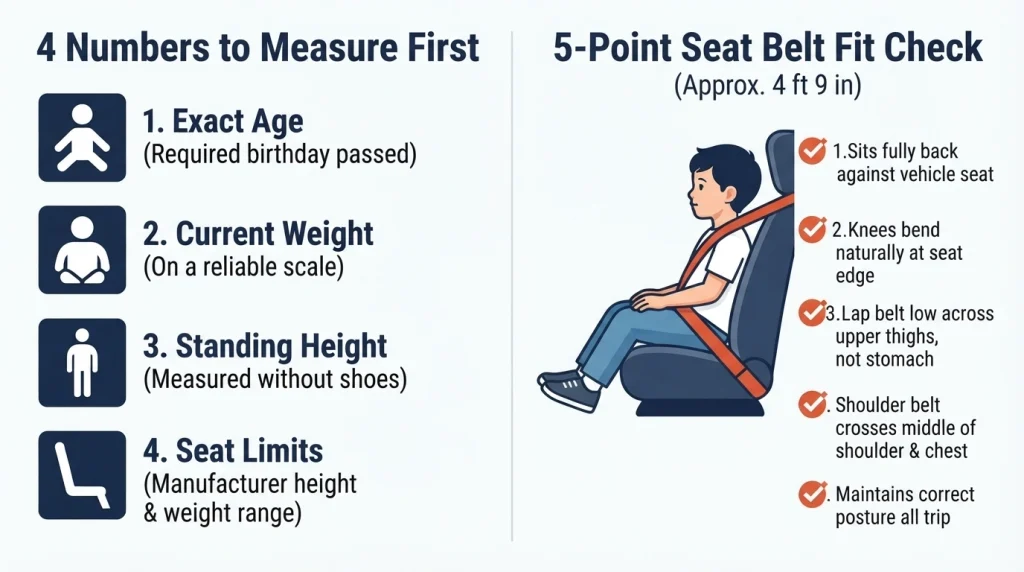
Read every age, weight, and height condition together before deciding which restraint is required. Words such as “and,” “or,” “under,” and “until” can materially change the rule.
Understand “And” Versus “Or”
This is one of the easiest legal details to overlook. Two similar-looking sentences can describe different requirements.
- “Under 8 and below 57 inches”: Both conditions must apply.
- “Under 8 or below 57 inches”: Either condition may be enough.
- “Until age 8”: The rule generally changes at the eighth birthday, subject to other conditions.
- “At least age 8”: The child must have reached that age.
- “Until outgrowing the seat”: Manufacturer limits become particularly important.
These are examples of how legal wording works, not a summary of one state’s statute. Always interpret the entire provision, including exceptions.
Measure Your Child Instead of Guessing
Children of the same age can have different heights and weights. Using age alone may lead you to select the wrong restraint.
I prefer checking three numbers before reviewing a law: age, weight, and height. That simple approach prevents many avoidable assumptions.
Use these measurements:
- Age: Your child’s exact age, including whether a required birthday has passed.
- Weight: Current weight measured on a reliable scale.
- Standing height: Current height measured without shoes.
- Seat limits: Manufacturer’s allowed height and weight range for the specific riding direction or mode.
Example: A Seven-Year-Old Child
Imagine a seven-year-old who weighs 55 pounds and stands 48 inches tall. A parent might assume the child is ready for an adult seat belt.
That conclusion could be wrong under the state’s law. The belt may also fit poorly without a booster.
Here’s how I would check the situation:
- Read the state’s child restraint requirements for seven-year-olds.
- Check whether height or weight changes those requirements.
- Confirm the child’s current seat remains within its limits.
- Test adult belt fit before considering a booster transition.
- Keep the child in an appropriate restraint whenever required or needed for safe fit.
Use a Seat Belt Fit Check
Most children need a booster until the vehicle belt fits their body correctly. This transition often occurs around 4 feet 9 inches, but height alone isn’t a guarantee.
Check these five conditions:
- The child sits fully back against the vehicle seat.
- The knees bend naturally at the seat edge without slouching.
- The lap belt lies low across the upper thighs, not the stomach.
- The shoulder belt crosses the middle of the shoulder and chest.
- The child can maintain the correct position throughout the trip.
If the belt fails this check, continue using an appropriate booster. Repeat the test in different vehicles because seat geometry varies.
Section Takeaway: A legal age threshold isn’t the same as a safe transition date. Check the precise law, your child’s measurements, and actual belt fit.
How Do Car Seat Laws Differ Between States?
Car seat laws vary because each state adopts its own child passenger safety requirements. The differences can affect rear-facing ages, booster eligibility, seating positions, and enforcement.
As of November 2026, it’s important to verify current rules instead of relying on older comparison charts. Recent legislative updates show why.
Selected State Law Examples
The following comparison highlights specific requirements from official state guidance. It isn’t a complete legal summary for any state.
| State | Selected Legal Requirements | What to Check |
|---|---|---|
| Colorado | Children under 2 and weighing less than 40 pounds must ride rear-facing. Children ages 4–8 must use an appropriate child restraint or booster under the law’s conditions. | Age, weight, rear-seat placement, and the rules updated in 2025. |
| California | Children under 2 who weigh less than 40 pounds and are shorter than 40 inches must ride rear-facing. Additional restraint and rear-seat rules apply. | All applicable conditions, rear-seat exceptions, and upcoming law changes. |
| Massachusetts | State guidance requires a federally approved child restraint until age 8 or until the child exceeds 57 inches in height. | The age-or-height threshold and proper restraint or belt fit. |
Note: These examples are abbreviated. Check each state’s official wording, manufacturer requirements, and effective dates before making a restraint decision.
Colorado’s Updated Child Passenger Safety Law
Colorado changed its child passenger safety requirements on January 1, 2025. Among the changes, the state raised the mandatory child restraint age threshold.
Under the updated law, children must use an appropriate car seat or booster through age eight. The law also includes specific rear-facing and rear-seat requirements.
The Colorado Department of Transportation’s official law guide explains the age categories and applicable weight conditions.
It’s a useful reminder that older articles can become inaccurate after legislation changes.
California’s Rules and Exceptions
California’s child restraint rules account for age, height, weight, and seating position. The state also specifies exceptions for certain rear-seat situations.
The California Driver’s Handbook explains the state’s child passenger restraint requirements. Review the current statute as well, especially when an exception may apply.
Never assume a rear-seat exception automatically makes a front-seat installation safe. Airbag placement and car seat instructions still matter.
Why State Comparisons Need Context
Two states may appear to share an age threshold while having different exceptions. One may specify weight, while another includes a particular height requirement.
Compare the entire rule rather than just the child’s age. Also distinguish minimum legal requirements from current child passenger safety recommendations.
Section Takeaway: State laws aren’t interchangeable. Verify the exact requirements where you’ll drive and check for recent changes.
What Should You Check Before Driving Across State Lines?
Before a road trip, review the child passenger restraint laws of every state on your route. Don’t assume your home state’s requirements will satisfy another state’s rules.
Make a Simple Travel Law Checklist
Interstate travel becomes easier when you check restraint rules before packing the car. I suggest recording the strictest applicable requirement along your route.
Use this checklist:
- Write down every state you’ll enter.
- Check each state’s official child restraint guidance.
- Compare rear-facing, harness, booster, and rear-seat requirements.
- Check whether any relevant exception applies to your vehicle.
- Confirm your child’s seat meets the applicable rules throughout the trip.
- Recheck the requirements before departure if you planned the trip far in advance.
For example, a child might legally use a seat belt in one state while needing a booster in another. Keeping an appropriate booster available can prevent problems.
What About Rental Cars and Rideshare Vehicles?
Rental cars, taxis, and rideshare vehicles can introduce additional questions. Some states have vehicle-specific rules or exceptions that aren’t obvious in simplified summaries.
Check the applicable state law before traveling with a child. Never assume a commercial vehicle is exempt from every restraint requirement.
For a rental vehicle, verify:
- The car seat is suitable for the vehicle.
- The vehicle has an approved installation position.
- The seat belt or lower-anchor system can secure the restraint correctly.
- The child’s restraint remains appropriate for their size.
- Any supplied rental car seat has its instructions and necessary components.
If you’re using a rideshare, plan how to transport and install your child’s restraint. A short ride still requires proper protection.
Do School Buses Have the Same Car Seat Rules?
School buses operate under different vehicle and occupant protection requirements. The rules depend on the bus type, applicable regulations, and transportation arrangements.
Don’t apply ordinary passenger-car requirements to every school bus. Contact the school district or transportation provider for the specific restraint policy.
What About Medical or Special-Needs Exceptions?
Some children require specialized transportation restraints because of medical or developmental needs. State laws may address these situations differently.
Ask the child’s healthcare team and a qualified child passenger safety specialist about suitable products. Also confirm whether the state requires medical documentation for a legal exception.
Keep a Record of the Rules
Before traveling, save the official government page or relevant statute reference. Record the effective date and any conditions affecting your child.
This is particularly helpful when crossing several state lines. It also makes future checks much easier.
Section Takeaway: Plan for every state’s requirements, not just your home state’s law. A correctly installed, age- and size-appropriate restraint is the best starting point.
How Can You Confirm Your Car Seat Is Legal and Safe?

Check three things: the state law, the car seat manufacturer’s instructions, and your vehicle’s installation guidance. Meeting only one of these doesn’t guarantee safe use.
Check the Car Seat Label and Manual
Every child restraint has specific operating limits and instructions. These determine how it can be installed and which children may use it.
Look for:
- Rear-facing minimum and maximum limits
- Forward-facing harness limits
- Booster mode requirements, if applicable
- Permitted installation methods
- Harness and headrest adjustment instructions
- Manufacture date and manufacturer-specified useful life
- Model information needed to check recalls
Some convertible seats allow multiple riding modes. Each mode can have different requirements.
Check the Installation Method
Most child restraints are installed using the vehicle seat belt or the lower-anchor system, when permitted. Lower Anchors and Tethers for Children (LATCH) is an installation system designed for compatible child restraints.
Follow both the restraint manual and vehicle manual when choosing a method. Do not use the seat belt and lower anchors together unless both manufacturers specifically allow it.
For an installed harnessed car seat, check movement at the belt path. Generally, it should move less than one inch side-to-side or front-to-back when tested correctly.
Also verify the correct recline angle and harness positioning. Use the top tether for a forward-facing installation when instructed.
Be Careful With Aftermarket Car Seat Covers
Decorative child car seat covers and accessories aren’t the same as the restraint itself. An aftermarket product can potentially interfere with harness fit or other safety features.
Before adding a replacement cover, seat protector, cushion, or harness accessory, check the car seat manufacturer’s instructions. Use only items specifically permitted for your restraint.
A product’s marketing claim doesn’t establish compatibility. Manufacturer approval for the exact model matters more than appearance.
Check Airbags and Rear-Seat Position
The rear seat is the recommended place for children through age 12. The correct seating position also depends on the restraint and vehicle design.
Never install a rear-facing restraint in front of an active frontal airbag. An inflating airbag can cause severe or fatal injury to a child in that position.
When circumstances require an unusual seating arrangement, consult the vehicle manual and a qualified professional. Don’t improvise around an airbag or restraint warning.
Pro tip: For airbag restrictions, installation details, and restraint compatibility, use the vehicle owner’s manual and car seat manufacturer’s instructions. Ask a certified Child Passenger Safety Technician when the correct setup isn’t clear.
Get a Professional Car Seat Inspection
A certified Child Passenger Safety Technician (CPST) can help you check installation and harness use. Many communities offer free inspection appointments or events.
A technician can review:
- Whether the car seat suits your child’s size
- Whether the restraint fits your vehicle
- Installation tightness and seating position
- Harness routing, adjustment, and buckle placement
- Booster and adult seat belt positioning
- Common misuse or compatibility concerns
Use NHTSA’s car seat resources or your state’s highway safety office to find local inspection services. Register your restraint with its manufacturer to receive recall notifications.
Repeat the Check as Your Child Grows
A correctly installed car seat can become unsuitable as a child grows. Recheck the fit regularly and whenever you change vehicles or restraint modes.
Pay special attention after growth spurts and before road trips. Also review the seat after a crash using manufacturer guidance and applicable replacement recommendations.
Section Takeaway: Legal compliance is only one part of child passenger safety. Correct fit, installation, maintenance, and manufacturer instructions are equally important.
Frequently Asked Questions About State Car Seat Laws
How do I find my state’s current car seat law?
Start with the GHSA or IIHS state law directory, then verify the requirement through your state’s government website. Check the transportation department, highway safety office, or legislature for current statutes, effective dates, and exceptions.
Are car seat laws the same in all 50 states?
No. Every state has child passenger restraint requirements, but their details differ. Age, weight, height, rear-facing requirements, booster seat rules, and front-seat restrictions may vary, so check the specific state where you’re driving.
At what age can a child stop using a booster seat?
The legal age varies by state and may also depend on height or weight. For safety, keep using a suitable booster until the vehicle seat belt fits correctly across the upper thighs, chest, and shoulder.
Do children legally have to sit in the back seat?
Some states specify rear-seat requirements for children of particular ages or sizes. Others have different rules or exceptions. Regardless of the legal minimum, safety guidance recommends that children remain in the rear seat through age 12.
What happens if I violate a car seat law?
Consequences depend on the state and the specific violation. Drivers may receive fines, citations, or other penalties. Consult the state’s current enforcement guidance rather than relying on an older national fine chart.
Can I use my car seat when traveling to another state?
Generally, you can use an appropriate restraint that meets applicable requirements and is installed correctly. However, your child’s age, weight, and seating arrangement must satisfy the rules where you’re driving. Review each state’s requirements before traveling.
Is a child car seat cover legally required?
No general state child passenger restraint requirement calls for a decorative seat cover. The important legal and safety issue is using an appropriate, properly installed restraint. Avoid aftermarket covers or accessories unless the car seat manufacturer permits them.
Final Takeaway: Knowing how to find car seat laws in your state starts with reliable sources, current measurements, and careful reading. Check your state’s official rules, follow your restraint manufacturer’s instructions, and prioritize safe fit over minimum legal thresholds.
Before your next drive, take a few minutes to review the law and inspect your child’s car seat. If anything seems unclear, schedule a check with a certified Child Passenger Safety Technician.

Daniel Brooks is an automotive writer and product researcher focused on car accessories, car tech, maintenance, and practical driving guides. At Plug-in Car World, he helps drivers make smarter automotive decisions through honest reviews and research-driven content.
