
How Much Does It Cost to Replace Car Seat Covers?
Quick Answer
Replacing car seat covers costs $30 to $1,200 or more for a full set in 2026. Most drivers pay $80 to $400 for a good set and fit them at home. Custom leather covers and professional fitting push the total past $600. Compare the best car seat covers before you buy, because fit and material drive the price more than brand name does.
What you will pay, in short
- Universal set: $30 to $80 for front seats, or $60 to $150 for a full set.
- Semi-custom set: $80 to $250 for a full set, with a closer fit.
- Custom set: $250 to $600 for fabric, or $400 to $1,200 for leather.
- Professional fitting: $75 to $250 in labor, on top of the covers.
- Cheapest fix: Replace only the worn front covers if the rear seats still look good.
Before you order
- Measure your seats and check for side airbags, heated seats, and seat controls first.
- Get a local quote if you want a shop to fit them, because labor rates vary by city.
I’ve replaced seat covers on a beat-up Honda Civic, a work-worn Ford F-150, and my own daily driver. The jobs looked simple on paper.
They taught me one clear lesson. The cover price is only half the story.
Fit, material, airbags, and labor can double the total fast. This guide breaks down every cost, so you can budget with confidence.
In This Guide
- How Much Does It Cost to Replace Car Seat Covers?
- What Affects the Cost of Replacing Car Seat Covers?
- How Much Do Car Seat Covers Cost by Material and Fit?
- DIY vs. Professional Replacement: What Will You Pay?
- Is It Cheaper to Replace Covers or Reupholster Your Seats?
- How Can You Save Money When You Replace Car Seat Covers?
- Frequently Asked Questions
- The Bottom Line
How Much Does It Cost to Replace Car Seat Covers?
A car seat cover is a removable layer that fits over your factory seat. It protects the original fabric or leather from wear, spills, sun, and pet damage.
Replacement means buying a new set and fitting it over the seats. It does not mean stripping the seat down to the foam and sewing new upholstery.
That distinction matters for cost. A cover swap is a quick accessory job. Reupholstery is a full trim-shop job.
As of 2026, here is the typical range for a full five-seat set in the United States.
| Cover type | Typical price, full set | Typical price, front pair only | Best for |
|---|---|---|---|
| Universal fabric | $60 to $150 | $30 to $80 | Budget protection, work trucks, pet owners |
| Semi-custom fabric | $120 to $250 | $60 to $140 | Daily drivers who want a neat fit |
| Neoprene or waterproof | $180 to $400 | $90 to $200 | Kids, dogs, gym gear, wet climates |
| Custom fabric | $250 to $600 | $150 to $350 | Exact fit, split rear seats, armrests |
| Custom leather or leatherette | $400 to $1,200 | $250 to $700 | Premium look, easy wipe-down, resale value |
Those prices cover the covers alone. Add $75 to $250 if a shop fits them for you.
Shipping can add $15 to $50 for a heavy full set. Custom orders may take 2 to 4 weeks to make.
My Civic job cost $110 for a semi-custom set. I fitted it in my driveway in about 90 minutes.
The F-150 job cost more. The owner wanted waterproof neoprene for two kids and a large dog.
That set was $320, plus $40 for a rear bench protector. It still beat a $1,500 reupholstery quote by a wide margin.
Section Takeaway: Most drivers will spend $80 to $400 total for a solid replacement set, and custom leather is the only option that regularly passes $600.
What Affects the Cost of Replacing Car Seat Covers?
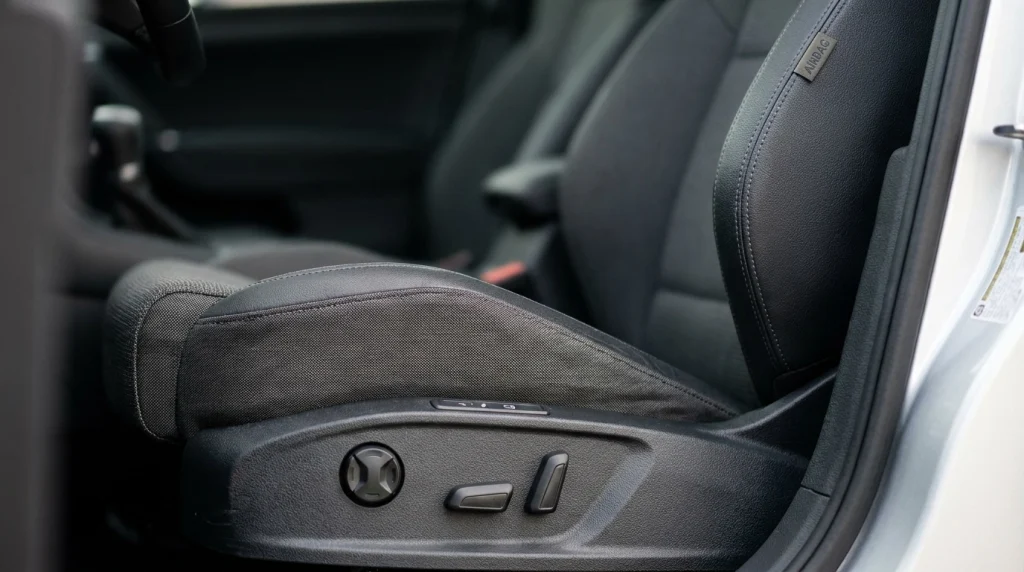
Two cars can need the same job and get very different quotes. The seats, features, and material explain most of the gap.
Start with the number of seats. A two-door coupe costs less to cover than a three-row SUV.
A front pair is the cheapest job. A full set with a split-folding rear bench costs the most.
Does your car have side airbags or heated seats?
Yes, and that changes what you can buy. Side airbags sit inside many front seatbacks.
A safe cover needs a breakaway seam or an airbag-compatible cutout. Cheap universal covers often lack it.
Do not cover an airbag seam with a thick, non-rated cover. Check your owner’s manual and the cover maker’s fit notes first.
Pro tip: Check your vehicle’s owner’s manual and NHTSA’s recall and safety information before you fit any cover over a seat with side airbags.
Heated seats add another wrinkle. A thick cover can slow heat transfer and trap warmth.
Look for covers rated for heated seats. Thin neoprene and perforated leatherette usually work better than thick padded fabric.
How does fit change the price?
Fit is the biggest price driver after material. Universal covers use elastic and straps to fit many cars.
They cost less, but they can bunch, slip, and leave gaps. Semi-custom covers are cut for common seat shapes.
Custom covers are patterned for your exact year, make, and model. They cost more because the maker cuts, sews, and tests for that seat.
- Universal fit: Lowest cost, loosest fit, fastest to buy.
- Semi-custom fit: Middle cost, cleaner look, still fits several models.
- Custom fit: Highest cost, best fit, made for your exact seats.
What else pushes the total up?
Seat shape matters. Sport seats with big bolsters, captain’s chairs, and integrated headrests need more fabric and more shaping.
Rear seat design matters too. A 60/40 split, a center armrest, and rear cupholders all add cutouts and cost.
Color and trim add cost as well. Two-tone stitching, piping, logos, and matching door panels are premium extras.
Labor rates vary by region. A trim shop in a large city may charge $100 per hour, while a smaller shop may charge $60.
Section Takeaway: Fit, material, airbags, heated seats, and seat count set the price. A simple front-pair swap and a custom leather full set are not the same job.
How Much Do Car Seat Covers Cost by Material and Fit?
Material decides how the cover feels, how long it lasts, and how easy it is to clean. Fit decides how good it looks once it is on.
Choose material for your real life, not for a photo. A dog owner and a commuter need different covers.
What does each material cost?
Polyester fabric is the budget pick. It resists stains fairly well and dries fast.
Expect $60 to $150 for a full universal set. It can last 2 to 3 years with daily use.
Neoprene feels like a wetsuit. It handles water, mud, and sweat better than most fabrics.
Expect $180 to $400 for a full set. It can last 3 to 5 years if you rinse it and let it dry fully.
Leatherette, also called PU leather or faux leather, looks close to real leather. It wipes clean in seconds.
Expect $200 to $600 for a custom set. It can crack in strong sun if you skip conditioner and shade.
Genuine leather is the premium pick. It feels soft, ages well, and suits a luxury interior.
Expect $600 to $1,200 for a full custom set. It needs regular cleaning and conditioning to stay supple.
Universal vs. custom: which is worth it?
Universal covers win on price and speed. You can order them today and fit them this weekend.
They lose on looks and safety fit. Loose fabric can shift under you and block seat controls.
Custom covers win on fit and resale appeal. They hug the bolsters, leave controls clear, and look factory-made.
They lose on price and wait time. You pay more and wait longer for the pattern to be cut.
If you want the lowest total cost, start with budget car seat covers and replace only the front pair first. That test tells you if the fit works before you cover the rear seats.
If you want a factory look, custom car seat covers are worth the extra cost. They fit split benches, armrests, and headrests without bunching.
Brand reputation also affects price. Well-known makers charge more for tested patterns and better stitching, as shown in our guide to the best car seat cover brands.
Section Takeaway: Fabric is cheapest, neoprene is toughest for wet use, and leather costs most but looks and cleans best. Custom fit costs more up front and saves you from a loose, shifting cover.
DIY vs. Professional Replacement: What Will You Pay?
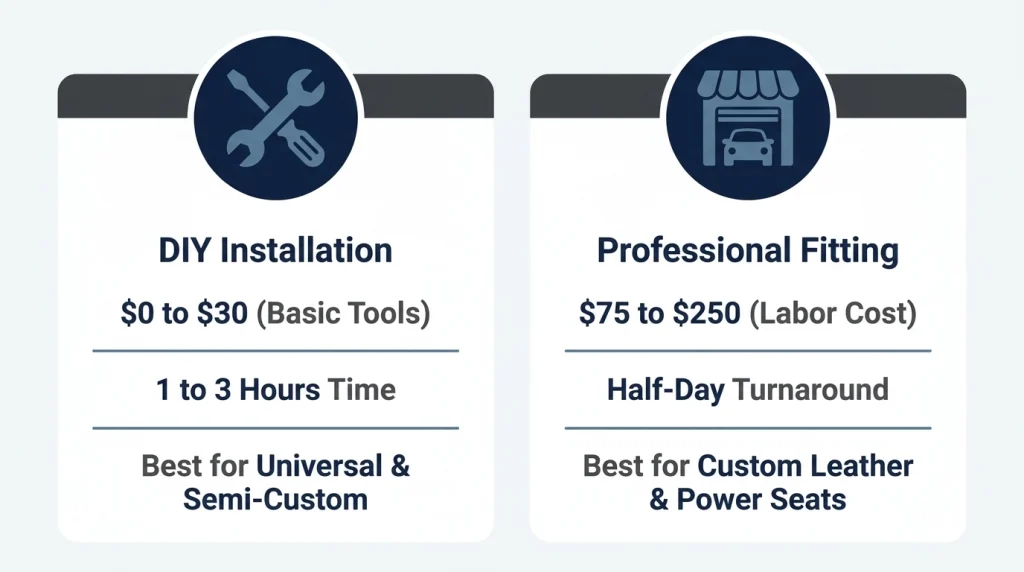
Can you replace car seat covers yourself? Yes, in most cases you can.
A universal or semi-custom set is a DIY job. A tight custom leather set may need a second pair of hands.
How much does DIY replacement cost?
DIY cost is the cover price plus a few basic tools. Most drivers already own what they need.
Budget $0 to $30 for extras. A trim removal tool, a flashlight, and a pair of gloves cover most jobs.
Time is the real cost. Plan 30 to 60 minutes for a front pair, or 90 minutes to 3 hours for a full set.
My first DIY fit took 2 hours. I rushed the headrest straps and had to redo one seat.
Take your time on the second seat. It always goes faster than the first.
How much does professional fitting cost?
A shop usually charges $75 to $250 to fit a full set. A front pair alone may cost $50 to $120.
That labor covers removal of old covers, fitting, tucking, strap routing, and a safety check. Some shops also clean the seats first.
Ask what the quote includes. Does it cover headrest removal, airbag checks, and seat control testing?
Get the quote in writing. Ask if the shop will refit a loose cover for free within 30 days.
For step-by-step fitting help, see how to install a car seat cover correctly before you book a shop. It helps you spot a rushed job.
When should you pay a pro?
Pay a pro for tight custom leather, for seats with side airbags, or for power seats with complex controls. A pro can route straps without pinching wires.
Pay a pro if your seats have built-in seatbelts or child-seat anchors that the cover must clear. A wrong cut can block a buckle.
DIY the job if you have a simple universal set, no airbag concerns, and a free afternoon. You will save $75 to $250.
Pro tip: Check your owner’s manual and NHTSA guidance before you disconnect a battery or touch any SRS airbag component. Most cover swaps do not need that step.
Section Takeaway: DIY costs $0 to $30 in extras and 1 to 3 hours of time. A pro costs $75 to $250, and it is worth it for custom leather, airbag seats, and complex power seats.
Is It Cheaper to Replace Covers or Reupholster Your Seats?
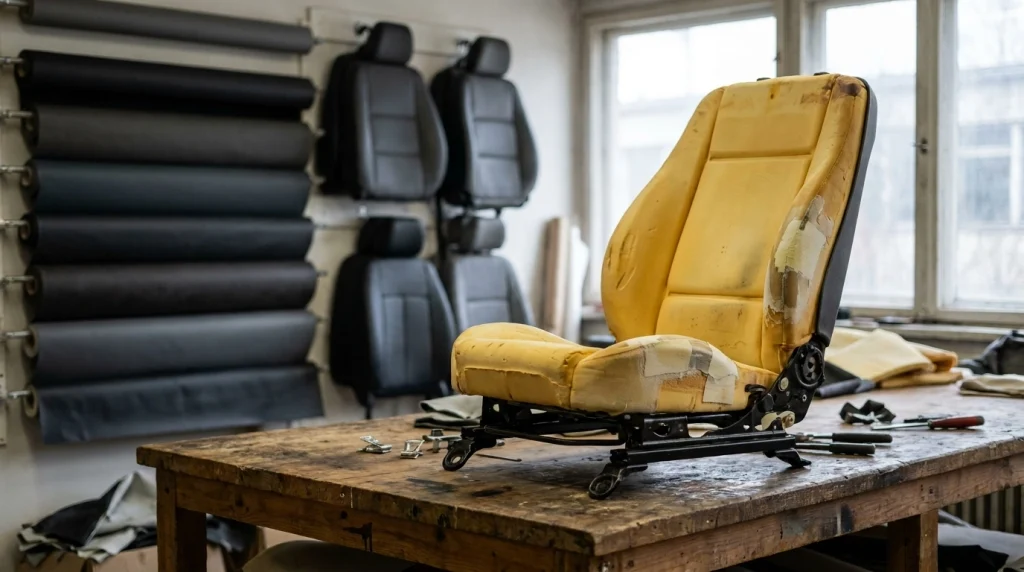
Replacing covers is almost always cheaper than reupholstery. The jobs solve different problems.
A cover hides worn fabric and protects good seats. Reupholstery replaces the worn fabric itself.
Use this comparison to pick the right fix.
| Option | Typical total cost | Time needed | Best when |
|---|---|---|---|
| Replace covers, DIY | $60 to $600 | 1 to 3 hours | Seats are sound, but stained or worn |
| Replace covers, pro fit | $150 to $1,400 | Half a day | You want a tight, factory look |
| Reupholster, fabric | $800 to $2,500 | 2 to 5 days | Foam or fabric is torn or failed |
| Reupholster, leather | $1,500 to $4,000 | 3 to 7 days | You want a full factory leather interior |
Reupholstery also includes foam repair, frame checks, and new padding. That work explains the higher price.
A cover cannot fix broken foam, a sagging seat, or a torn seam under the surface. It only hides the top layer.
Check the foam before you buy. Press the seat bolster and sit in it for a few minutes.
If the seat feels lumpy or sinks, get a trim-shop quote first. A $300 cover will not fix a $900 foam problem.
For resale, a clean custom cover can help. A buyer sees protected seats and a cared-for interior.
For a long-term keeper, reupholstery may pay off if you plan to keep the car for 5 more years. Do the math on cost per year.
Section Takeaway: Covers cost $60 to $1,400 fitted, while reupholstery costs $800 to $4,000. Replace covers for protection and looks, and reupholster only when foam or fabric has failed.
How Can You Save Money When You Replace Car Seat Covers?
You can cut the total by 30% or more without buying a poor cover. The trick is to spend where it matters and skip what does not.
Start with the seats you use most. Front seats take the most wear from drivers and passengers.
Rear seats often stay clean for years. Replace them later if they need it.
What saves the most money?
- Buy a front pair first: Test fit and comfort before you pay for a full set.
- Choose semi-custom over custom: You get a neat fit for $100 to $300 less.
- Pick leatherette over leather: You get the same wipe-clean look for half the price.
- Fit it yourself: You save $75 to $250 in labor on a full set.
- Buy in the off-season: Look for sales in late fall and early spring, when demand dips.
Check return terms before you order. A good seller allows a return if the pattern does not fit your exact model.
Keep the box and receipt until you have fitted both front seats. A wrong pattern is easier to return unwashed and unused.
Comfort matters as much as price. A cheap cover that slides around will annoy you every day.
If you drive long distances, read our guide to the best car seat covers for comfort before you choose. Padding, breathability, and grip affect long-drive fatigue.
Clean your seats before fitting. Vacuum crumbs, wipe the bolsters, and let the seats dry fully.
A clean base helps straps grip and stops smells from getting trapped under the new cover.
For price context, check Consumer Reports, Edmunds, and RepairPal for general car ownership and repair-cost guidance. Get a local labor quote before you commit to a pro fit.
Section Takeaway: Replace the front pair first, pick semi-custom or leatherette, and fit it yourself. Those three choices save the most money without hurting fit or comfort.
Frequently Asked Questions
How much does it cost to replace just the front car seat covers?
Front covers cost $30 to $80 for universal fabric, $60 to $140 for semi-custom, and $150 to $350 for custom fabric. Custom leather front covers cost $250 to $700. Add $50 to $120 if a shop fits them.
How much does it cost to replace car seat covers at a dealership?
A dealership usually costs more than an independent trim shop. Expect $200 to $500 for fitting and OEM-style covers, plus the cover price. Ask for an itemized quote and compare it with a local trim shop first.
Can I replace car seat covers myself?
Yes, most universal and semi-custom sets are DIY-friendly. Plan 30 to 60 minutes per front seat and use the maker’s fit guide. Get help for tight custom leather or for seats with side airbags and power controls.
Are custom car seat covers worth the extra cost?
Yes, if you want a factory look and a stable fit. Custom covers hug the bolsters, leave controls clear, and last longer than loose universal covers. They are less worth it for a work truck or a car you plan to sell soon.
How long do replacement car seat covers last?
Most covers last 2 to 5 years with daily use. Fabric lasts 2 to 3 years, neoprene lasts 3 to 5 years, and leatherette lasts 3 to 5 years with care. Sun, pets, kids, and heavy use shorten that life.
Do car seat covers affect side airbags or heated seats?
They can, if you pick the wrong cover. Use only airbag-compatible covers with a breakaway seam for seats with side airbags. Use thin, heated-seat-rated covers for heated seats, and check your owner’s manual and NHTSA guidance first.
What is the difference between replacing covers and replacing a child car seat cover?
Vehicle seat covers protect adult car seats from wear and spills. A child car seat cover is part of a child safety seat and must fit that exact model. Never use a universal child-seat cover that changes harness fit, and follow the child-seat maker’s instructions only.
The Bottom Line
Replacing car seat covers costs $30 to $1,200 or more, but most drivers land between $80 and $400. Fit and material set the price, and labor adds $75 to $250 if you hire a shop.
Start with the front pair, pick a fit that suits your seats and safety features, and fit it yourself if the job is simple. You will protect your seats, improve comfort, and keep the total under control.
Measure your seats, check for airbags and heated seats, and order a cover made for your exact model. That one check saves more money than any discount.

Daniel Brooks is an automotive writer and product researcher focused on car accessories, car tech, maintenance, and practical driving guides. At Plug-in Car World, he helps drivers make smarter automotive decisions through honest reviews and research-driven content.
