
How to Choose the Right Steering Wheel Cover for Your Car
Quick Answer
To choose the right steering wheel cover, measure your steering wheel, check the cover’s size range, and select a material that suits your climate, grip preference, and driving habits. Before buying, confirm that your vehicle permits a cover, especially if it has a heated steering wheel or hands-on driver-assistance sensors. For airbag-related safety guidance, consult the NHTSA airbag safety information.
What matters most when choosing a cover?
- Correct fit: Measure the wheel’s outside diameter and grip circumference, then match both to the manufacturer’s sizing instructions.
- Suitable material: Compare genuine leather, synthetic leather, microfiber, fabric, and rubberized options for grip, comfort, and upkeep.
- Secure construction: Reject covers that rotate, bunch up, or shift when you grip the wheel.
- Vehicle compatibility: Check restrictions for heated wheels, hand-detection sensors, and other steering-wheel features.
- Comfortable thickness: Make sure the added bulk doesn’t compromise your grip or access to controls.
- Easy maintenance: Choose a finish you can clean properly without damaging the original steering wheel.
Before your first drive
- Install the cover according to its instructions and test it while the car is parked.
- Keep the center airbag cover, horn pad, spokes, and controls unobstructed.
- Remove the cover if it slips, feels unstable, or conflicts with your owner’s manual.
Choosing the right steering wheel cover for your car involves more than matching the interior color or picking an attractive design. The correct cover should fit securely, feel comfortable in your hands, and work with your vehicle’s existing features.
When comparing steering wheel covers, I would put fit and safe operation ahead of appearance. This guide explains how to measure your wheel, compare materials, evaluate comfort, and avoid compatibility mistakes before spending your money.
In This Guide
- 1. How do you measure your steering wheel for a cover?
- 2. Which steering wheel cover material is best?
- 3. How should you choose a cover for comfort and climate?
- 4. Are steering wheel covers safe for every car?
- 5. How do you check installation and maintenance requirements?
- 6. How much should you spend on a steering wheel cover?
- 7. Frequently asked questions
1. How Do You Measure Your Steering Wheel for a Cover?

A steering wheel cover is a removable or fitted layer that wraps around the outer gripping rim of a steering wheel. Its purpose may be to improve comfort, protect the original finish, refresh the interior, or provide a different grip texture.
The first step is to measure your existing wheel rather than guessing its size from the vehicle’s make or model. A cover that fits one trim level might not fit another wheel design from the same manufacturer.
Measure the outside diameter
The outside diameter is the straight-line distance across the wheel through its center, measured from one outer edge to the opposite edge. Use a tape measure or ruler and keep the measurement across the circular rim rather than following its curve.
- Position the tape: Measure across the widest part of the wheel, passing through its center.
- Record the result: Note the measurement in inches and centimeters if convenient.
- Check irregular shapes: For a flattened-bottom or unusually shaped wheel, measure according to the cover manufacturer’s instructions and confirm compatibility with that design.
For example, a diameter of 14.5 inches is approximately 36.8 centimeters. This is an example measurement, not a universal size for every passenger car.
Measure the grip thickness or circumference
Diameter alone may not tell you whether a cover will sit correctly around a thick, contoured, or unusually shaped rim. Check the manufacturer’s instructions to determine whether you also need the grip’s circumference or thickness.
- For circumference: Wrap a flexible measuring tape around the outside of the rim at its thickest gripping section.
- For thickness: Measure across the rim’s cross-section as directed by the product instructions.
- For contoured wheels: Check several gripping positions if the rim changes shape significantly.
Don’t confuse the circumference of the entire steering wheel with the circumference of the gripping rim. They are different measurements used for different purposes.
Check the manufacturer’s size chart
Use your measurements to identify the cover’s stated fit range. If your wheel falls between sizes or has an unusual profile, ask the seller or manufacturer to confirm the fit before ordering.
Universal covers are designed for a range of compatible dimensions, but “universal” does not mean every wheel will fit securely. A vehicle-specific cover may offer a more tailored fit when its compatibility list explicitly includes your model, model year, and steering-wheel configuration.
Section takeaway: Measure before buying, and confirm the required dimensions against the product’s actual specifications. A secure fit matters more than choosing the cheapest or most attractive option.
2. Which Steering Wheel Cover Material Is Best?
The best steering wheel cover material depends on how you drive, how much grip you prefer, and how much maintenance you’re willing to do. Leather, synthetic leather, microfiber, fabric, and rubberized materials each offer different trade-offs.
Don’t rely on the material name alone. Surface texture, backing, stitching, thickness, and manufacturing quality can affect how a cover feels and performs.
| Material | Main advantages | Potential drawbacks | Best suited to |
|---|---|---|---|
| Genuine leather | Natural texture, refined appearance, potentially long service life with suitable care | Usually costs more and needs material-appropriate cleaning | Drivers who prefer a traditional leather finish |
| PU or synthetic leather | Wide range of colors and textures, often easy to wipe clean | Quality varies; some finishes may peel or crack with age | Budget-conscious buyers who want a leather-like appearance |
| Microfiber or suede-like fabric | Matte finish and a soft, textured feel | May collect oils, dust, and dirt; cleaning needs vary | Drivers who prefer a less glossy, tactile surface |
| Fabric or woven material | Many colors and patterns; can feel soft to the touch | May absorb sweat, retain moisture, or become dirty | Drivers who prioritize appearance and a softer surface |
| Rubberized or silicone-based material | Textured grip and straightforward surface cleaning | Can feel sticky, bulky, or unpleasant in some conditions | Drivers who prefer a more tactile, easy-care surface |
Is genuine leather better than synthetic leather?
Genuine leather is worth considering when natural texture and a traditional finish matter most. However, a well-made synthetic cover can be a sensible alternative when you want a lower-cost option with simpler everyday cleaning.
Check the product description carefully. Terms such as “leather-style,” “leather-look,” and “carbon-fiber design” may describe the appearance rather than the actual material.
Does suede provide better grip?
Microfiber and suede-like surfaces can feel more tactile than smooth finishes, but their performance depends on the exact fabric and construction. They may also need more frequent cleaning because skin oils and dirt can change the surface feel.
For everyday driving, choose a surface that stays comfortable during slow parking maneuvers and longer journeys. A sporty appearance is no substitute for a stable, predictable grip.
What about thick, padded, or decorative covers?
Padded covers can make a thin rim feel fuller, but too much bulk may make it harder to wrap your fingers comfortably around the wheel. Raised stitching, decorative bumps, and uneven padding can also create uncomfortable pressure points.
Choose decoration that remains confined to the gripping rim and doesn’t obstruct the wheel’s controls or safety features. Avoid rigid add-ons attached to the center airbag cover.
Section takeaway: Choose material by grip, climate, comfort, and maintenance needs rather than appearance alone. The best material is one that feels secure in your hands and suits your actual driving routine.
3. How Should You Choose a Cover for Comfort and Climate?
Your steering wheel cover should feel natural during everyday driving, including parking, tight turns, and longer trips. The best choice depends on your hand size, preferred grip thickness, local temperatures, and how much time you spend behind the wheel.
Choose the right grip thickness
A cover adds material to the original steering wheel, making the finished rim thicker. That change can improve comfort for some drivers but feel awkward for others.
Before purchasing, consider these points:
- Smaller hands: Look for a thinner cover that lets your fingers wrap comfortably around the rim.
- Larger hands: A moderately padded design may feel more comfortable if it doesn’t compromise control.
- Long commutes: Choose a consistent surface without bulky seams or pronounced ridges.
- Frequent parking maneuvers: Prioritize secure grip and predictable hand movement over decorative padding.
A thicker cover isn’t automatically more comfortable. If it makes the wheel difficult to hold securely, choose a slimmer option or use the original wheel without a cover.
What works best in hot or humid weather?
In hot conditions, a parked steering wheel can become uncomfortable to touch, while humidity and perspiration can affect grip. A breathable-looking surface may feel pleasant, but its actual performance depends on the material and construction.
- Perforated synthetic leather: Consider it if you prefer a leather-like finish with a textured surface.
- Microfiber: It can provide a matte feel, although oils and moisture may require more frequent cleaning.
- Rubberized textures: They may offer a tactile grip, but some finishes can feel sticky in high temperatures.
- Fabric: It offers plenty of design choices, but moisture retention and drying time deserve consideration.
Never assume a cover is suitable for a heated steering wheel simply because the material feels thin. Some vehicle manufacturers prohibit covers over heated wheels, so follow your exact owner’s manual.
Should you match the cover to your interior?
Color and design matter, especially if you want the cabin to look coordinated. Black, gray, and brown finishes are versatile, while contrasting stitching or brighter colors create a more customized appearance.
However, inspect the surface and seams before settling on a design. Decorative sections shouldn’t create slippery patches, sharp edges, or raised areas that interfere with your hands.
For an understated interior, a close-fitting cover that matches the existing trim usually looks more natural than an oversized, heavily padded design.
Section takeaway: Choose a cover that feels comfortable in your hands across normal driving conditions. Added thickness, surface texture, and climate suitability matter more than decorative details.
4. Are Steering Wheel Covers Safe for Every Car?
No, a steering wheel cover isn’t suitable for every vehicle or steering-wheel configuration. The cover must remain secure and must not interfere with airbags, controls, heated-wheel systems, or driver-assistance technology.
Before buying, check your owner’s manual and the cover manufacturer’s compatibility instructions. If either prohibits the accessory, don’t install it.
Keep the airbag and horn area clear
Most conventional slip-on steering wheel covers fit around the outer rim rather than the center of the wheel. The center section often contains the driver’s airbag and horn controls, so it must remain unobstructed.
Never stretch a rim cover over the center pad or attach rigid decorations to the airbag cover. The National Highway Traffic Safety Administration’s warning about aftermarket steering-wheel decals explains how unsecured decorative pieces can become dangerous projectiles during airbag deployment.
Pro tip: If an accessory requires altering the airbag cover, removing the airbag, or modifying steering-wheel wiring, consult the vehicle manufacturer’s service information and a qualified technician.
Can you use a cover on a heated steering wheel?
Only if the vehicle manufacturer permits it and the cover is compatible with the specific heated-wheel system. A cover can change how heat escapes from the wheel, and some manufacturers expressly prohibit covers.
Check the owner’s manual for warnings about insulation, temperature control, and approved accessories. Don’t rely solely on a seller’s claim that a product is suitable for heated steering wheels.
What about lane-assistance and hands-on sensors?
Some vehicles use sensors in the steering wheel to detect whether the driver is holding it. Depending on the system, an added cover may affect detection or conflict with the manufacturer’s operating instructions.
Check the documentation for lane-centering, hands-on detection, and other driver-assistance features before buying. If the manufacturer doesn’t confirm compatibility, choose the safer option and leave the wheel uncovered.
Does a cover affect steering performance?
A correctly fitted cover shouldn’t rotate independently of the steering wheel. If it slips, bunches, or shifts under your hands, it can interfere with controlled steering inputs.
Check for looseness while the vehicle is parked. Don’t attempt to fix an incorrectly sized cover with glue, tape, screws, or improvised fasteners.
Also remember that a steering wheel cover cannot fix steering-wheel vibration, excessive play, or heavy steering. Those symptoms can point to tire, suspension, steering, or power-assistance problems that need separate diagnosis.
Pro tip: Check the NHTSA vehicle recall lookup if you have concerns about a safety-related defect. For handling problems or warning lights, arrange a professional inspection rather than covering up the symptom.
Section takeaway: Treat compatibility as a requirement, not an optional extra. Keep safety systems unobstructed, follow the owner’s manual, and remove any cover that moves independently of the wheel.
5. How Do You Check Installation and Maintenance Requirements?
A good steering wheel cover should install according to the manufacturer’s instructions and remain firmly seated during normal use. Installation difficulty depends on whether you choose a slip-on cover or a stitched cover designed for a more tailored finish.
Which type of installation should you choose?
- Slip-on covers: These stretch over the wheel rim and are generally the simplest option for DIY installation.
- Stitched covers: These wrap around the rim and require careful stitching to achieve an even finish.
- Vehicle-specific covers: These may have particular alignment requirements or fit around a specific wheel shape.
For most first-time buyers, a conventional slip-on cover is the straightforward starting point. Choose a stitched design only if you’re comfortable following its instructions and taking extra time to achieve an even fit.
How can you tell if a cover fits properly?
After installation, inspect the entire circumference before driving. A properly fitted cover should sit evenly without exposed sections of the rim, folded material, loose edges, or uneven seams.
- Park the vehicle securely and switch off the engine.
- Check that the cover sits evenly around the rim.
- Grip it at several points and gently test whether it moves independently of the wheel.
- Check that the horn, buttons, paddles, and other controls remain accessible.
- Confirm that the center airbag cover and any sensor areas remain unobstructed.
If the cover rotates or slides, remove it before driving. Recheck the size and fit instructions instead of trying to force it into place.
How do you protect the original steering wheel?
A cover can protect the rim from some direct contact and everyday wear, but it can also trap dirt and moisture against the original finish. Movement between the two surfaces may cause abrasion, discoloration, or damage over time.
Before fitting a new cover, clean the original wheel using a method suitable for its material. Let the surface dry completely.
During routine cleaning, inspect underneath the cover when practical and permitted by the product instructions. Look for trapped grit, dampness, dye transfer, cracking, or wear on the original rim.
When should you replace a steering wheel cover?
Replace a cover when its material deteriorates or it no longer fits securely. There isn’t one reliable replacement interval for every material, driver, and climate.
- Cracks, peeling, or torn seams.
- Stretching that causes the cover to loosen.
- Persistent slipping or bunching.
- Surface deterioration that reduces comfortable grip.
- Damage that exposes rough edges or hard internal components.
Section takeaway: Inspect the cover after installation and periodically during routine vehicle care. If it becomes loose or damaged, stop using it rather than waiting for the problem to worsen.
6. How Much Should You Spend on a Steering Wheel Cover?
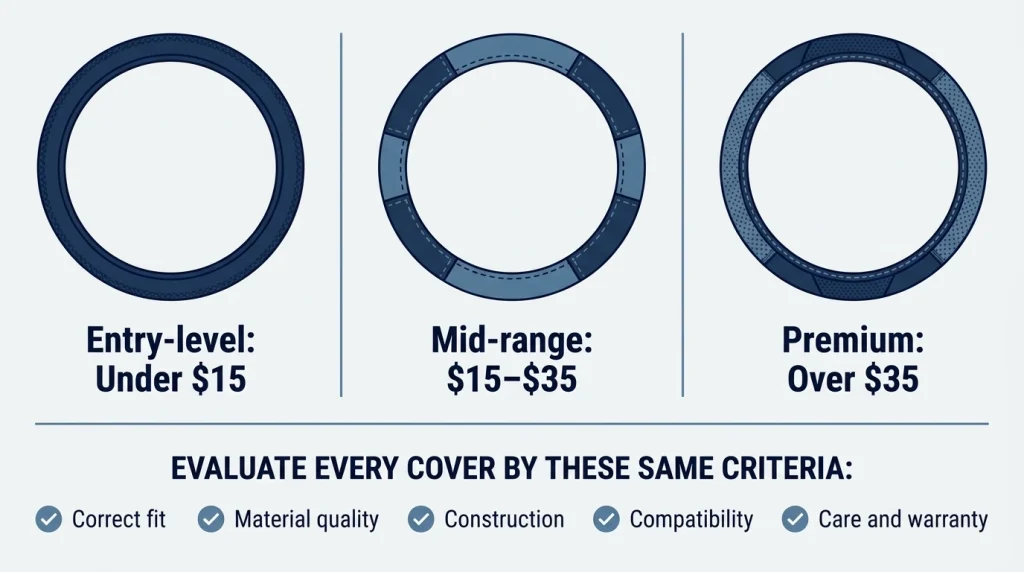
The right budget depends on the material, fit, construction, and features you need. A higher price may buy better finishing or more precise fitment, but it doesn’t guarantee that a cover will suit your vehicle.
As of 2026, compare current prices in your market and judge each option against its specifications. The following ranges are illustrative budgeting categories, not verified live prices or guaranteed market averages.
| Budget category | Illustrative price | What to evaluate |
|---|---|---|
| Entry-level | Under $15 | Sizing accuracy, grip texture, seams, and material quality |
| Mid-range | $15–$35 | Finish, construction, comfort, and cleaning requirements |
| Premium | Over $35 | Verified materials, vehicle-specific fit, warranty, and installation design |
Local availability, shipping, taxes, currency conversion, and product quality can change the final cost. Don’t pay extra for a premium label unless the product offers a meaningful benefit for your needs.
What should you check before ordering?
Read the complete listing rather than relying on product photos or a short title. Confirm the following details before committing to a purchase.
- Dimensions: The cover’s stated size range matches your measured steering wheel.
- Material: The description identifies the actual material rather than only its appearance.
- Compatibility: Any heated-wheel or sensor restrictions are addressed.
- Construction: Seams and edges appear even, with no obvious loose components.
- Installation: Instructions are clear, and you won’t need to disassemble safety components.
- Care instructions: You can maintain the material with products and methods suitable for your routine.
- Returns and warranty: You understand the return conditions if the fit proves unsuitable.
Which cover should you choose for your situation?
- For everyday commuting: Choose a snug, understated cover with a comfortable texture and easy cleaning.
- For a leather-look interior: Consider a well-made synthetic leather cover or a compatible genuine leather option.
- For a tactile grip: Compare textured rubberized materials and microfiber finishes in person when possible.
- For a worn original wheel: Consider whether a cover can address cosmetic wear without concealing structural damage or sharp edges.
- For a heated or sensor-equipped wheel: Buy only when the vehicle manufacturer’s instructions permit the accessory.
One useful final check is to compare the cost of a cover with the alternative of professionally restoring the original steering wheel. If the factory finish is badly damaged, a cover may conceal the appearance without addressing the underlying problem.
Section takeaway: Spend according to fit, construction, and verified compatibility rather than price alone. A simple cover that fits correctly is a better purchase than an expensive one that doesn’t suit your wheel.
7. Frequently Asked Questions
How do I know what size steering wheel cover my car needs?
Measure the steering wheel’s outside diameter and check any additional dimensions required by the cover manufacturer, such as rim circumference or thickness. Compare those measurements with the product’s sizing chart and confirm that it accommodates your wheel’s shape.
Are universal steering wheel covers suitable for every car?
No. Universal covers fit a range of wheel sizes, but they may not suit every diameter, rim thickness, or unusual wheel shape. Measure your wheel and verify the manufacturer’s fit range. Never use a cover that rotates, bunches up, or feels loose after installation.
Is leather or synthetic leather better for a steering wheel cover?
Genuine leather suits drivers who prefer natural texture and a traditional finish, while synthetic leather often offers more colors at a lower cost. Durability depends on material quality, construction, exposure, and care. Compare the actual specifications rather than relying on appearance alone.
Can a steering wheel cover damage my original steering wheel?
Yes, it can if dirt or moisture becomes trapped underneath, the inner surface abrades the rim, or the cover moves repeatedly. Clean and dry the original wheel before installation, follow care instructions, and inspect the covered surface periodically for wear or discoloration.
Can I put a steering wheel cover on a heated steering wheel?
Only when the vehicle manufacturer permits it and the cover is compatible with that specific system. Some manufacturers prohibit covers because they can affect heat management. Check your owner’s manual instead of relying exclusively on a seller’s compatibility claims.
Are thick or padded steering wheel covers safe?
Thickness alone doesn’t determine safety, but excessive bulk can make the wheel harder to grip comfortably. Choose a cover that stays firmly in place and preserves access to controls. Avoid designs that interfere with the airbag cover, sensors, or other steering-wheel features.
How often should I clean or replace my steering wheel cover?
Clean it according to the material manufacturer’s instructions and inspect it regularly for grime, wear, and movement. Replace it when the surface deteriorates, the seams fail, or the fit becomes loose. There is no universal cleaning schedule or replacement interval for every cover.
Final Takeaway: Choose Fit Before Appearance
The right steering wheel cover should fit your wheel securely, feel comfortable in your hands, and suit your vehicle’s equipment. Start with accurate measurements, compare materials carefully, and check compatibility before making a purchase.
My main recommendation is simple: don’t compromise on fit or safe operation to save money or achieve a particular look. If the cover feels unstable, adds too much bulk, or conflicts with your owner’s manual, leave it off.
Take a few minutes to measure your wheel and review the product specifications before ordering. That small step can help you avoid an uncomfortable purchase and choose a cover you’ll be happy to use every day.
For additional safety information, consult the NHTSA airbag safety resource and your vehicle’s owner’s manual.

Daniel Brooks is an automotive writer and product researcher focused on car accessories, car tech, maintenance, and practical driving guides. At Plug-in Car World, he helps drivers make smarter automotive decisions through honest reviews and research-driven content.
