
Can You Use a Steering Wheel Cover on a Racing Wheel?
Quick Answer
Yes, you can use a steering wheel cover on some racing wheels, but compatibility and grip matter more than appearance. A properly fitted, purpose-designed cover may work on a compatible round aftermarket steering wheel, while loose universal covers are generally unsuitable for performance driving. For a road car, you must also consider the original steering wheel’s airbag and safety systems.
What you need to check
- Wheel shape: Round racing wheels are easier to cover than flat-bottom, D-shaped, or heavily contoured designs.
- Exact fit: Match the cover to the rim diameter, circumference, thickness, and shape.
- Grip: Avoid materials that become slippery with sweat or shift under hard steering inputs.
- Driving conditions: A road-going aftermarket wheel, a track wheel, and a sim-racing wheel have different requirements.
- Airbag safety: Never cover an airbag deployment seam or interfere with the horn, controls, or other safety features.
The safest approach
- Choose a manufacturer-approved cover that fits the specific wheel, and test for movement while parked before driving.
- For track use, prioritize a secure, purpose-built grip surface rather than adding a generic cover.
A steering wheel cover can make a worn racing-style steering wheel more comfortable, but it can also change how securely you control the car. The difference comes down to the wheel’s shape, the cover’s construction, and how you drive.
In this guide, I’ll explain how covers fit aftermarket racing wheels, what changes on track, when a cover makes sense, and which safety issues deserve extra attention.
In This Guide
- What is a steering wheel cover for a racing wheel?
- Which racing wheels can use a steering wheel cover?
- Does a steering wheel cover affect grip and performance?
- Which cover materials work best for racing wheels?
- How do you fit a cover safely?
- Should you use a cover or replace the wheel?
- Frequently asked questions
What Is a Steering Wheel Cover for a Racing Wheel?
A steering wheel cover is a removable or fitted layer placed over a wheel’s rim to change its feel, protect its surface, or improve comfort. On a racing-style wheel, it must fit securely without interfering with precise steering inputs.
How does a cover differ from a racing wheel wrap?
A traditional cover slips over the existing rim, often using elastic tension or a close-fitting molded shape. A steering wheel wrap, by contrast, typically uses material stitched or bonded around the rim for a closer, more integrated finish.
These options serve different purposes:
- Slip-on cover: Convenient for some round wheels, but its security depends on fit and construction.
- Stitched wrap: Can follow the rim’s contours more closely when installed correctly.
- Factory grip material: Often the best choice when the original racing wheel already has a suitable surface.
- Replacement wheel: Makes sense when the existing rim is damaged, structurally compromised, or incompatible with the intended use.
What counts as a racing wheel?
The term can describe a road car’s aftermarket sports steering wheel, a dedicated competition wheel, or a steering wheel attached to a sim-racing controller. These aren’t interchangeable applications.
A road car’s aftermarket wheel may have a hub adapter, horn wiring, and no airbag, depending on its design. A dedicated competition wheel may have molded grips, thumb controls, and a flat-bottom profile that makes ordinary covers unsuitable.
A sim-racing wheel doesn’t carry the same road-crash airbag considerations, but its grip, dimensions, and ability to withstand force-feedback torque still matter.
Which Racing Wheels Can Use a Steering Wheel Cover?
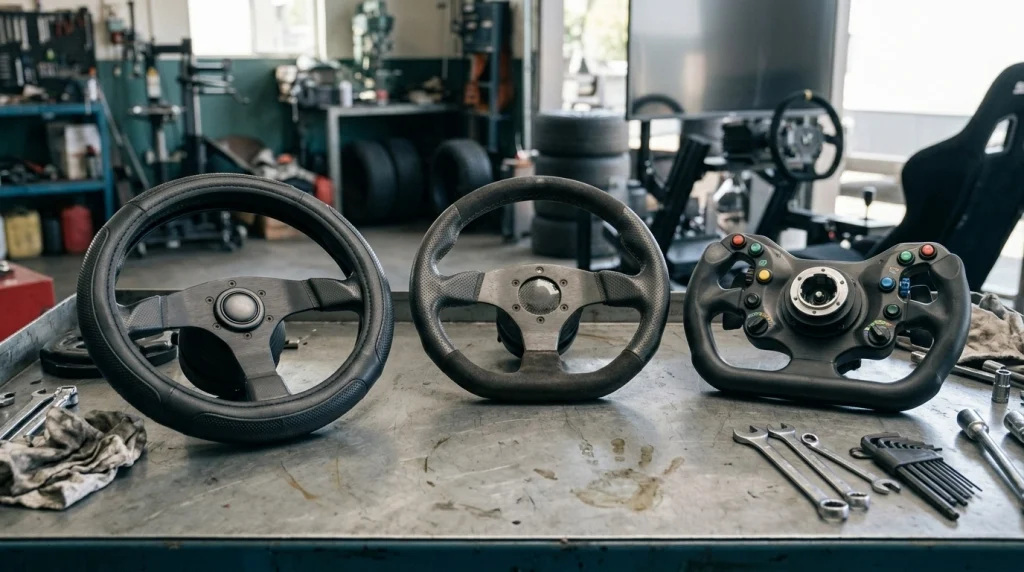
Some round racing-style wheels can accept a compatible cover, but many purpose-built racing wheels aren’t designed for one. The wheel’s exact shape and dimensions determine whether a cover will fit without shifting or bunching.
Round aftermarket steering wheels
A conventional round aftermarket wheel is the most practical candidate because its rim has a relatively consistent shape. Even then, check the manufacturer’s fitment guidance rather than assuming a standard cover will work.
Measure the wheel’s outside diameter and rim thickness, and check the cover’s specified range. A cover made for a thick, padded factory wheel may sit poorly on a thinner racing rim.
Flat-bottom and D-shaped wheels
Flat-bottom wheels have a flattened lower section, while D-shaped designs use a similar profile to create additional legroom or a sportier feel. A circular cover can stretch unevenly over these shapes, leaving excess material or creating tight spots.
That uneven fit can affect hand placement during quick steering movements. Choose a cover explicitly designed for the wheel’s shape, or leave the rim uncovered.
Wheels with molded grips or integrated controls
Many competition wheels use sculpted finger grooves, thumb rests, buttons, rotary controls, or paddle-shifter arrangements. A cover can hide those contours or interfere with access to controls mounted near the rim.
Don’t force a universal cover over these features. If the manufacturer doesn’t approve a compatible cover, preserve the wheel’s original grip surface.
Sim-racing wheels versus real-car wheels
Sim-racing equipment may tolerate a wider range of aftermarket grip accessories, provided they remain secure under force feedback. A loose cover can still twist in your hands or bunch during a fast virtual corner.
For a real car, the decision requires another layer of scrutiny: the steering wheel may contain an airbag, horn contacts, wiring, or other safety-related components. Never assume that a cover suitable for a simulator is appropriate for a road car.
| Wheel type | Cover suitability | Main concern |
|---|---|---|
| Round aftermarket wheel | Potentially suitable | Diameter, thickness, and slippage |
| Flat-bottom or D-shaped wheel | Only with shape-specific fitment | Uneven stretching and loose sections |
| Molded competition wheel | Usually best left uncovered unless approved | Blocked controls and lost grip contours |
| Road wheel with an airbag | Only if compatible and safe for that design | Airbag deployment and control interference |
| Sim-racing wheel | Potentially suitable | Movement under force feedback |
Section takeaway: A cover is only a good fit when its shape, dimensions, and retention match the specific wheel. A generic cover isn’t automatically suitable just because you can stretch it over the rim.
Does a Steering Wheel Cover Affect Grip and Performance?
Yes, a steering wheel cover can change grip, steering feel, and the precision of your hand movements. On a racing wheel, even a small amount of unwanted movement can become distracting when you make quick corrections.
Why can a loose cover be dangerous?
A cover that rotates independently of the rim can interrupt your normal hand movement. During a sudden steering correction, your hands may move the cover before the wheel responds as expected.
Watch for these warning signs:
- Rotational movement: The cover twists around the rim when you apply firm pressure.
- Wrinkles or bunching: Material gathers beneath your palms or fingers.
- Uneven thickness: One section feels noticeably thicker than another.
- Slippery contact: The surface loses traction when your hands become sweaty.
- Shifting seams: A seam moves into a position where your fingers repeatedly catch it.
Any of these problems is a reason to remove the cover before driving. Tightening your grip to compensate doesn’t solve the underlying fit problem.
Can a cover make steering feel heavier?
A cover doesn’t directly change the power steering system, which uses hydraulic assistance or electric power steering (EPS) to reduce steering effort. However, a thicker rim can change how your fingers wrap around the wheel and how comfortably you apply force.
For example, a driver accustomed to a slim racing rim may find a padded cover awkward during tight turns. That change in hand position can make steering feel less natural, even though the steering mechanism itself hasn’t changed.
Does a cover improve lap times?
There’s no universal reason to expect a cover to improve lap times. Better comfort may help some drivers, but extra thickness, reduced feedback, or a shifting surface can work against precise inputs.
For track use, start with the wheel manufacturer’s recommended grip surface. If the existing material is worn, choose an approved restoration or replacement solution instead of assuming a generic cover will improve performance.
Pro tip: Before a track day, inspect the wheel and all its mounting hardware according to the vehicle or wheel manufacturer’s instructions. A cover cannot compensate for a loose hub, damaged rim, or faulty steering component.
Which Cover Materials Work Best for Racing Wheels?
The best material depends on the wheel’s intended use, your preferred grip, and the conditions in which you drive. Leather, microfiber, suede-style materials, and silicone each feel different, and no material guarantees secure grip without correct fitment.
Material comparison
| Material | Potential benefits | Limitations |
|---|---|---|
| Genuine leather | Familiar feel, durable surface when maintained | Can become slick with oils or wear |
| PU leather | Often affordable and easy to wipe clean | Quality and long-term durability vary |
| Suede or microfiber | Can provide a tactile, performance-oriented feel | May collect oils, dust, and dirt |
| Silicone or rubber-like material | Can offer a textured, washable surface | May feel bulky or shift if poorly fitted |
Leather versus suede-style grip
Leather is a practical choice for road cars when the finish is designed for steering use and stays clean. It can provide a familiar balance of comfort and control without requiring the maintenance routine associated with some performance materials.
Suede-style and microfiber surfaces can offer a different tactile feel, particularly for drivers who wear suitable driving gloves. However, these surfaces can lose their intended texture when contaminated with hand oils or accumulated grime.
Choose according to the wheel manufacturer’s recommendations rather than selecting a material based on appearance alone. A premium fabric fitted poorly is still a poor choice.
How thick should a racing wheel cover be?
There isn’t one ideal thickness for every driver or racing wheel. Your hands should wrap around the rim comfortably without excessive stretching, awkward finger placement, or reduced access to controls.
A thick padded cover may suit a worn, round road-car wheel used for everyday commuting. The same cover can make a small-diameter competition wheel feel oversized and reduce the precise hand placement you expect.
Section takeaway: Prioritize secure fit, consistent thickness, and reliable grip over material labels. The wheel’s original design should guide your choice.
How Do You Fit a Cover Safely?
Fitting a cover should start with compatibility checks, not force. If the cover requires extreme stretching, leaves loose sections, or interferes with wheel controls, stop and choose a suitable alternative.
Step-by-step fitting checklist
- Identify the wheel. Confirm its manufacturer, model, shape, and intended use.
- Measure the rim. Check the diameter, rim thickness, and shape against the cover’s published fit range.
- Inspect the original surface. Look for cracks, loose trim, exposed structural material, or other damage that a cover could hide.
- Clean the rim. Remove dirt and oily residue using a cleaning method approved for the wheel’s material.
- Install according to instructions. Follow the cover manufacturer’s fitting method and don’t use adhesives or fasteners unless explicitly approved.
- Check the entire circumference. Look for folds, gaps, twisted seams, and uneven tension.
- Test while parked. Apply moderate hand pressure in different directions and confirm the cover doesn’t rotate, slide, or bunch.
- Check every control. Make sure the horn, buttons, paddles, and other functions remain accessible and unobstructed.
What if the wheel has an airbag?
An SRS airbag is a supplemental restraint system designed to help protect occupants during certain crashes. If your original wheel contains a driver airbag, any cover must remain compatible with the wheel’s design and must not obstruct the deployment area.
Never stretch material over the airbag cover or its deployment seams, and don’t attach hard decorative pieces that could become projectiles during deployment. The NHTSA airbag safety guidance explains why correct airbag operation matters.
Pro tip: Check the vehicle owner’s manual and the steering wheel or cover manufacturer’s instructions. If they don’t explicitly confirm compatibility, ask a qualified automotive technician before installing anything near an airbag module.
Should you disconnect the battery to install a cover?
A normal slip-on cover usually doesn’t require steering wheel removal or electrical work, so battery disconnection isn’t normally part of that simple installation. Never remove the wheel, airbag module, or related wiring just to make a cover fit.
If your chosen solution requires wheel removal or modification, stop and obtain the vehicle-specific service procedure. Airbag systems can retain hazards even after power is disconnected, and incorrect handling can cause serious injury or disable safety equipment.
For additional guidance, consult the NHTSA recall lookup if you suspect a safety-related defect, and have warning lights or airbag faults diagnosed promptly.
What should you check before driving?
After installation, make sure the wheel turns freely and the cover remains stable throughout its circumference. Never conduct a high-speed road test or track session to find out whether a questionable cover will hold.
- Confirm that no material catches on fingers, gloves, or clothing.
- Check that controls and shift paddles move without interference.
- Verify that the wheel’s original surface and mounting hardware are sound.
- Remove the cover if it moves, slips, or changes your ability to hold the wheel securely.
Section takeaway: A safe installation requires correct fit and unobstructed controls. If the cover compromises either, don’t use it.
Should You Use a Cover or Replace the Wheel?
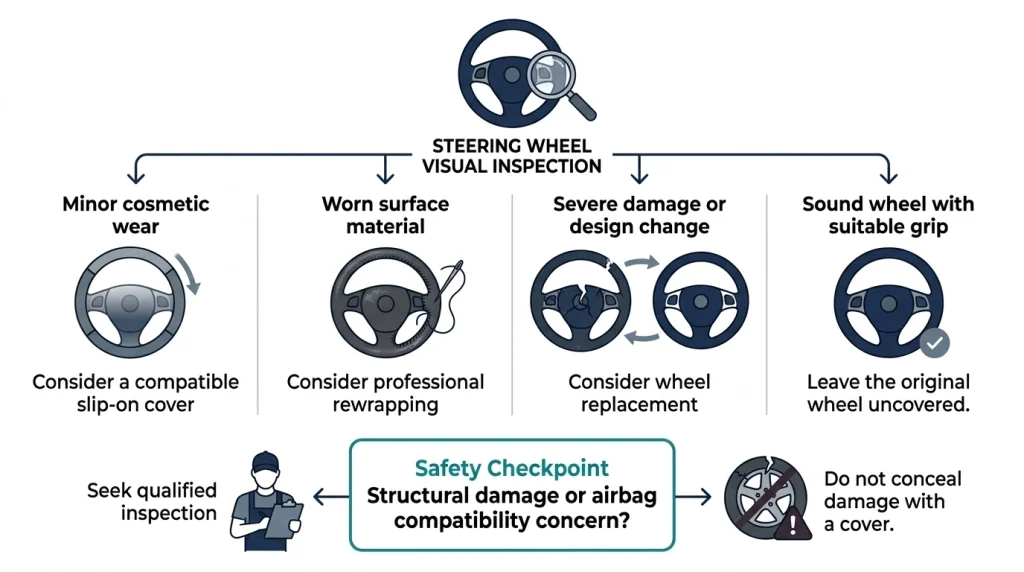
A steering wheel cover is worth considering when a compatible wheel has cosmetic wear but remains structurally sound. If the rim is damaged, its grip material is deteriorating, or its shape doesn’t accept a cover securely, restoration or replacement is the better route.
When does a cover make sense?
- Minor surface wear: The original rim remains intact, but its finish looks tired.
- Comfort preference: You want a slightly different texture for ordinary road driving.
- Surface protection: A compatible cover can help reduce direct contact with sweat, oils, and everyday dirt.
- Reversible change: You prefer an accessory that can be removed without permanently modifying the wheel.
When should you restore or replace the wheel instead?
- Structural damage: The rim is cracked, bent, or otherwise compromised.
- Severe material failure: The original covering is peeling or separating and prevents a secure grip.
- Specialized geometry: The wheel’s molded grips or controls make a conventional cover unsuitable.
- Safety-system concerns: The wheel, airbag, horn, or mounting assembly needs professional inspection.
A cover can conceal worn material, but it can’t repair damage underneath. Inspect the original wheel carefully before deciding that a cosmetic solution is enough.
How do the options compare?
| Option | Best use | Main trade-off |
|---|---|---|
| Compatible slip-on cover | Minor cosmetic wear and comfort | Can add bulk or move if poorly fitted |
| Professional rewrap | Worn leather or deteriorated surface material | Requires appropriate materials and skilled work |
| Replacement wheel | Severe wear or a desired design change | Fitment, controls, airbag compatibility, and installation costs |
| Leave the original wheel uncovered | A sound wheel with a suitable factory grip | Doesn’t change the existing finish or comfort |
What about legality and track regulations?
Requirements depend on your location, vehicle, and the rules of the event you’re entering. An aftermarket racing wheel or cover isn’t automatically legal or suitable for every road vehicle or sanctioned competition.
In the United States, federal vehicle safety requirements and rules concerning modifications can depend on the specific circumstances. Review the relevant regulations and local laws before changing safety equipment.
Pro tip: For road cars, review the vehicle manufacturer’s instructions and applicable local requirements. For competition vehicles, check the event organizer’s technical regulations before changing the steering wheel or its covering.
Section takeaway: Use a cover for compatible cosmetic or comfort needs, not to disguise a damaged wheel. When safety, structural integrity, or airbag compatibility is uncertain, seek professional advice.
Frequently Asked Questions
Can you put a steering wheel cover on an aftermarket racing wheel?
Yes, if the wheel’s manufacturer permits it and the cover matches its shape and dimensions. Round aftermarket wheels are generally easier to accommodate than flat-bottom or molded-grip designs. Confirm that the cover cannot rotate or interfere with controls before use.
Will a steering wheel cover fit a flat-bottom racing wheel?
Some covers may fit, but a standard circular cover can stretch unevenly over a flat-bottom or D-shaped rim. Choose a product specifically designed for that profile. If no suitable cover exists, keep the wheel uncovered or consider a compatible rewrap.
Are steering wheel covers safe for track driving?
Only when the cover is explicitly suitable for the wheel and intended driving conditions, and it remains completely secure under steering loads. Generic slip-on covers can compromise grip or shift during rapid inputs. Follow the wheel manufacturer’s guidance and any applicable track regulations.
Does a steering wheel cover affect steering response?
A cover doesn’t directly change the steering rack or power steering system, but it can change grip, rim thickness, and hand placement. If the material slips or bunches, it can make precise steering inputs more difficult. Remove any cover that compromises control.
Can you use a cover on a steering wheel with an airbag?
Compatibility depends on the specific wheel and cover. Never obstruct the airbag deployment area, cover deployment seams, or attach hard decorations that could become projectiles. Check the manufacturer’s instructions and consult a qualified technician if compatibility isn’t clear.
Is leather or suede better for a racing wheel?
Neither material is universally better. Leather can be practical for everyday use, while suede-style and microfiber surfaces offer a different tactile feel but may require more careful cleaning. Prioritize secure fit, consistent grip, and the wheel manufacturer’s recommendations.
What should you do if a steering wheel cover starts slipping?
Stop using the cover and remove it when the vehicle is safely parked. Inspect the cover and rim for incorrect sizing, wear, contamination, or damage. Replace it only with a compatible product that fits securely; never rely on a loose cover during driving.
Final Takeaway: Choose Fit and Control Over Appearance
You can use a steering wheel cover on some racing wheels, but it isn’t the right choice for every setup. The wheel’s geometry, the cover’s retention, and your intended driving conditions should determine your decision.
For a compatible round wheel used on the road, a well-fitted cover may improve comfort and protect the finish. For a dedicated competition wheel, preserving its designed grip surface is often the more sensible choice.
Before buying, verify the dimensions, material, and manufacturer guidance. If the cover compromises grip, controls, or airbag safety, leave it off and choose a safer solution.

Daniel Brooks is an automotive writer and product researcher focused on car accessories, car tech, maintenance, and practical driving guides. At Plug-in Car World, he helps drivers make smarter automotive decisions through honest reviews and research-driven content.
